Thursday Thoughts Ubi sunt …

IMG_0576 (2).JPG

Thursday Thoughts
Ubi sunt …

Ubi sunt qui ante nos fuerunt? Where are they who went before us? As St. Augustine is said to have written: O homo, dic mihi, ubi sunt reges, ubi sunt principes, ubi imperatores, qui fuerunt ante nos… “O man, tell me, where are the kings, where are the princes, where the emperors, who had been before us” {Wikipedia]. Many philosophers have written on this theme, and many poets, including Villon in his famous ballade “Mais où sont les neiges d’antan?” Where is last year’s snow? Cervantes also echoes the theme with this slight variation “No hay pájaros en los nidos de antaño.” There are no birds in last year’s nests.
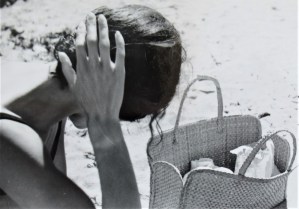
IMG_0573 (3).JPG

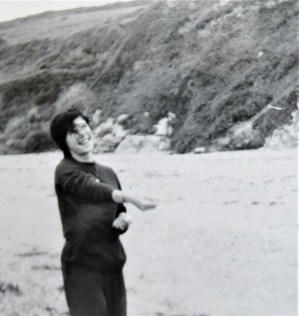
Goran Haven, Cornwall, July, 1966. I was waiting to receive the results of my final exams from Bristol University. Clare and I decided to spend a week in Cornwall and ended up in Goran Haven. When we came back, I made her a book of photos from the trip with hand-written poems beneath them. I discovered that book the other day and was taken back to a time when I wasn’t even thinking of coming to Canada. Fifty-three years later, looking at these photos, I ask myself ubi sunt … where did those days go? All those days, the old country, and everything that went with our youth … ubi sunt?

IMG_0574 (2).JPG

Same thing happened when I visited McAdam Railway Station: wonderful memories of all the steam trains of my youth. And those railway names: Great Western Railway [GWR], London Midlands Scotland [LMS] , London North Eastern Railway [LNER]. So many things that I can never forget: the smell of the old steam engines, the sound of their wheels going clackety-clack, the taste of smoke and ash when I thrust my head out of the window, in spite of the sign that said, Do not lean out of the window, the feel of those worn cloth seats beneath the fingers, and the sense of excitement and joy when an empty corner seat begged to be sat in. Something else I’ll never forget: the cold taste of a Cadbury’s Milk Flake stuck in an ice-cream on a warm summer’s day.
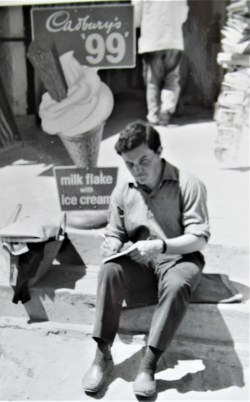
IMG_0570 (3).JPG


Volunteers


IMG_0765 (2).JPG

Volunteers
McAdam Railway Station 6

Only the old in body
and young at heart know
how to cook like this.

The soda fountain stools,
the horseshoe bar
from the old Royal York,

they merit only the best.
Simplicity rules. Stews
like grandma made them,

lining the ribs,
defying damp and cold.
Railway Pie, recipes

a hundred years old, or more.
bread rolls that melt
into the butter knife,

coffee to kill for. No wonder
the old ghosts walk around
feeding off cooking smells,

sad, gentle eyes, watching us
as we eat, refusing to leave.

Comment: That’s the end of the Railway Pie, I’m afraid. The soup has already vanished. Three lucky people, arriving on cooking day, and receiving a free lunch. What joy, what delight. The volunteers were cooking for another event, outside the station, which was not yet open. Old ghosts watched from quiet corners as we ate. I am sure those spirits survive on the wonderful cooking smells that emerge. I should add how impressed I am at the knowledge displayed by the volunteers at McAdam Railway Station. They now only have their facts at their fingertips, but hey are able to express those facts in a way that draws the audience in and makes every visit a genuine pleasure. Volunteers: thank you for being there. You do a great job.

IMG_0765 (2).JPG

Master Clock

IMG_0687 (3).JPG

Master Clock
McAdam Railway Station 4

“It came from the Empress,
in Victoria. It won’t work here,
I’m afraid. It’s the clock
that runs all the clocks
and keeps them on time.

It needs a network.
ten, twenty, thirty clocks
that it can control
from its central circuit,
keeping them all on time.

Just like the railway.
The trains were always on time.
Except, just like this clock,
they don’t run anymore.”

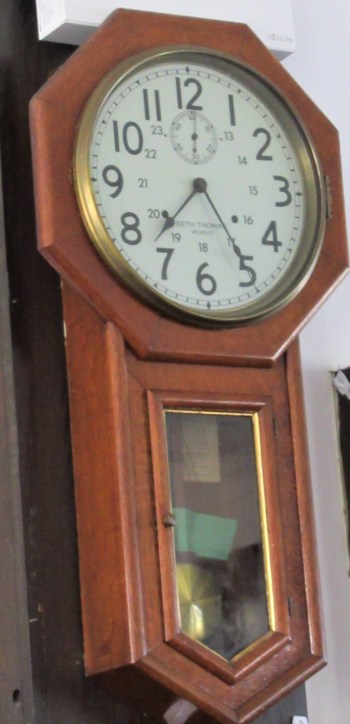
Comment: I don’t have a picture of the Master Clock at McAdam Railway Station. I guess I’ll have to take one next time I visit McAdam. This clock can be found in the dining room. Like the Master Clock, it too has stopped. Known in Wales as Grandmother Clocks, these pendulum clocks are designed to hang on the wall rather than to stand on the floor like Grandfather Clocks. Can a Grandmother Clock be a Master Clock? I’ll leave that semantic conundrum to the experts in linguistics. While they are all arguing about it, I will just say that Elsie, who else, told the story of the Master Clock to a group of tourists from Nova Scotia while I was listening.

Fourteen

IMG_0774.JPG
Fourteen
McAdam Railway Station 2

“Fourteen years old, he was.
Left school to work at the station.
Pushed brooms, did the cleaning.

Walked into the men’s washroom
early one morning to give it a clean.
Found a man hanging there, dead.

Took out his pocket knife,
cut him down, called for help.

I met him at the station
when he was ninety-three.

He told me all about it,
shrunk in size he did
as he told his story, shrunk

until he was the same size
he was at fourteen.”

Comment:
Another story from Elsie, one of the guides at the McAdam Railway Station and the President of the Macadam Historical Association. A true historian, she is gifted with an uncanny ability to condense a remembered incident into a minimum of poetic words. Thank you, Elsie, for allowing me to access your memory and repeat what you told me. It is an honor and a pleasure to do so.

Ogmore-by-Sea

IMG_0055

Ogmore-by-Sea
(1960 AD)

white stone its castle
tumbled into ruin
stones in the river bed
mirrored its image
wind-broken ripples
picture fragmented

mud flats and rocks
stretch out horizontal
distant the sea
Severn mud an obstacle
no swimmers out there
where tides twist and pull

rock bathing instead
wind-whipped bare bodies
blasted with sand
skimpy the clothing
bikinis and pants
intrepid the wearers
breathless young girls
Welsh voices on the wind
always the wind
across rock across mud

dinosaurs walked here
left tracks in that mud
metamorphosed now
into fossil and rock

breeze tickles the nostrils
gulls batter the ears
salt stings the tongue
life on the margin
a bargain a gift
sweet in my memory
her kiss on my lips

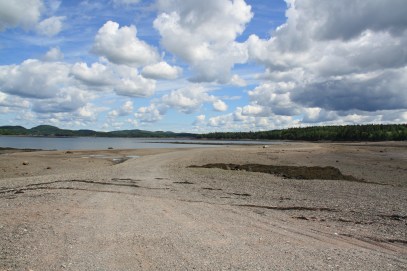
Comment: I have no pictures of Ogmore (except in my mind). You’ll have to make do with St. Andrews, also by the sea. My thanks go out to David Watts for reminding me of my childhood in Wales. So many memories came twitching back. I went regularly to Ogmore with one of my school friends and his family. This was while I was still in the sixth form in school … a long time ago … but I remember it well.

Tara Pine


IMG_0003

Tara Pine
(1770 / 1977 AD)

maritime jack pine
arm-waving
declamation
sonnet to wild growth
a wilderness now

lop-sided
forest church
spired with birds
crows’s nest
crowning savage
extravagance

radical disorder
flustered
clicking needles
clustered
knitting the wind

salted the air
old man’s beard
sprouting fresh bristles
old salt sea salt

“ill fares the land
to hastening ills a prey”
without a helping hand
to point the way

each broken limb
an olive branch extended
scorched earth policy
salt-sown earth

Dark Night


img_0265

Dark Night
(1577-1579 AD)

candlelight
stole the moon’s halo
moth sputtering to its death
this owl high-flying

a cat tears out
mouthfuls of hair
swallows
spits out a hairball
swallows
steal it for a nest

dish and spoon
dance
cats and dogs
rain golden
milky the way
earth’s
thirst is quenched

blind hands
deaf fingers
no longer deft
voices breaking
waves
an unstrung
guitar of sound

fire will one day
come to claim us all

Eight Deer

img_0436

Eight Deer
(1113 AD)

eight deer visit
my garden each night
they raid my feeders
capture my birdseed
lusting for gold
anything to keep out
this winter cold

raccoons
leave claw-marks
grubbing for grubs
dug up like donuts
circled on my lawn

who captures whom
when the full moon
descends from the sky
walks among men
making them mad

death by snow plow
snow-melt and crows
Eight Deer emerges
his sacrificed body
preserved on this page
and in salt snow

My Favorite Pen

IMG_0395.JPG

My Favorite Pen

This is my oldest Mont Blanc fountain pen. I must have bought it in 1986 when I traveled to London to attend a Spanish Golden Age seminar at one of the university colleges. I can’t remember which, though I do remember the seminar was on someone called Francisco de Quevedo. We met like spies, my pen friend and I, on the steps of the British Museum. I had never met him before, so he carried a specific book under his arm, one of Quevedo’s I think, by which I would recognize him. We lunched together at an Italian Trattoria, whose name also escapes me, and we discussed the ways of that ancient Hispanic world and our own research upon it. I paid for our lunch from my travel funds. I had a sabbatical that year and had arranged a short tour of four or five British universities in my search for knowledge. After lunch, he took me back to his London college and I sat and absorbed wisdom from 2:00 until 5:00 pm.

After the seminar, walking back to the nearest tube station, I passed a shop that had this Mont Blanc in the window. I went in and bought it. On the spot. No second thoughts. Then I caught the tube to Paddington station. While waiting for the train back to Cardiff, I sat in the station bar and ordered a pint of beer. A well-dressed man, slightly older than me, asked if he could join me. I said yes. He sat down and began to talk. He told me how to commit suicide by slashing my wrist with a knife.  There were many incorrect ways to do it, he explained. But only one right way, if you wanted to be successful. He rolled up his sleeve and showed me his collection of scars that ran crisscross and welted over his left wrist. Failed attempts, he said. But I’ll get it right next time. I wouldn’t want you to make the same mistakes as me, if you decided to try it.

Must go, I told him. My train’s about to leave. I left the remains of my pint on the table, looked back, and watched him finishing my beer. Good job I didn’t spit in it, I thought. Then I realized that I probably had, one way or another. I boarded my train and 90 minutes later I was back in Cardiff. No more post-war, coal and steam engines, a diesel this, powerful, fast, and smelly. It reduced the former four hour journey to much, much less than two. Cafeteria style, the train carriage offered a table top for every four seats. I opened my new pen and wrote in the pocket journal I had bought for the trip.

So many memories. But I don’t remember the names of either of these two men. I do recall those scars, though, deep and ridged, crisscrossing like railway tracks. Every time we clicked over a junction or a cross track I shivered and my writing wiggled on the page.

IMG_0396

Squirrel

IMG_0266.JPG

Squirrel

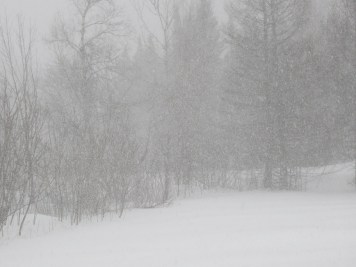
He’s here for the food on the picnic table, of course. He’s been here before, even in bad weather, and he knows where the treasure is: buried beneath the snow. I can’t believe he’s out in this. He should be in some little squirrel cave, tucked in, nice and warm. One of my best friends told me he was going to drive to Halifax today. What drives people out on a day like today when the snow is deep and still accumulating, when visibility is such that I can hardly see beyond the trees at the edge of the garden, when more snow, higher winds, drifting snow, and blizzard conditions are all around us. There is also the possibility of ice pellets and freezing rain when the snow finishes. “Stay home, little squirrel, stay home,” I told him. “It’s not a good day for travelling. I can hardly see the road through the falling snow.”

IMG_0251.JPG


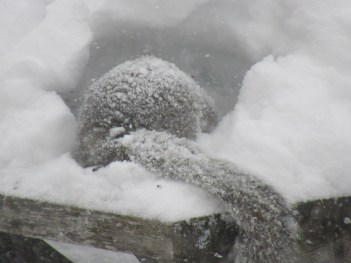
Squirrels are tough, though. They must have Welsh blood in them the way they tunnel and dig. Unsnubbable on the trail of some winter seed and totally defiant against wind and weather. “Did you see him?” my beloved called out. “See who?” I asked, clicking away busily with my Christmas camera. “The squirrel,” she said. “You should take a picture.” So I did. And another and another. I caught him first head down, back towards me, guzzling, deep within his snow cave.


IMG_0273.JPG

He reminded me of Lorca’s roosters: “Los picos de los gallos cavan en busca de la aurora / the roosters’ beaks dig in search of the dawn.” I wanted him to come out and look at me, to show me what he had found. I didn’t have to wait for long. Then it was in (click) and out (click). What a cheeky chappy.

IMG_0275.JPG

I wonder why I always call this squirrel ‘him’. Maybe I never learned enough about the birds and the bees when I was a child. I find it hard to tell the difference between the genders of animals unless they have antlers (male) or, like the birds, they have distinctive plumage. Then it is much easier for me to tell them apart. I had a tortoise once, back home in Wales. I called him Henry, don’t ask me why. It took me two years to find out that Henry was actually Henrietta.  I guess I was slow on the uptake. Dai Bungalow: not much in the top storey. Or should that be story? There, I’ve looked it up:  storey in the Oxford Dictionary’s English English, but story in Webster’s American English. Oh dear, there are some things I still have to look up.

IMG_0282.JPG

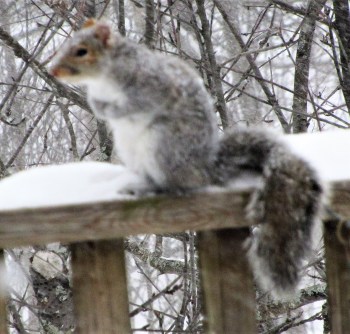
So there he is, Mr. Squirrel, perched on the balustrade, about to make his final farewell. Fare well, Mr. Squirrel. Come back soon. I am so glad you didn’t decide to drive to Halifax.