Bottle House, PEI

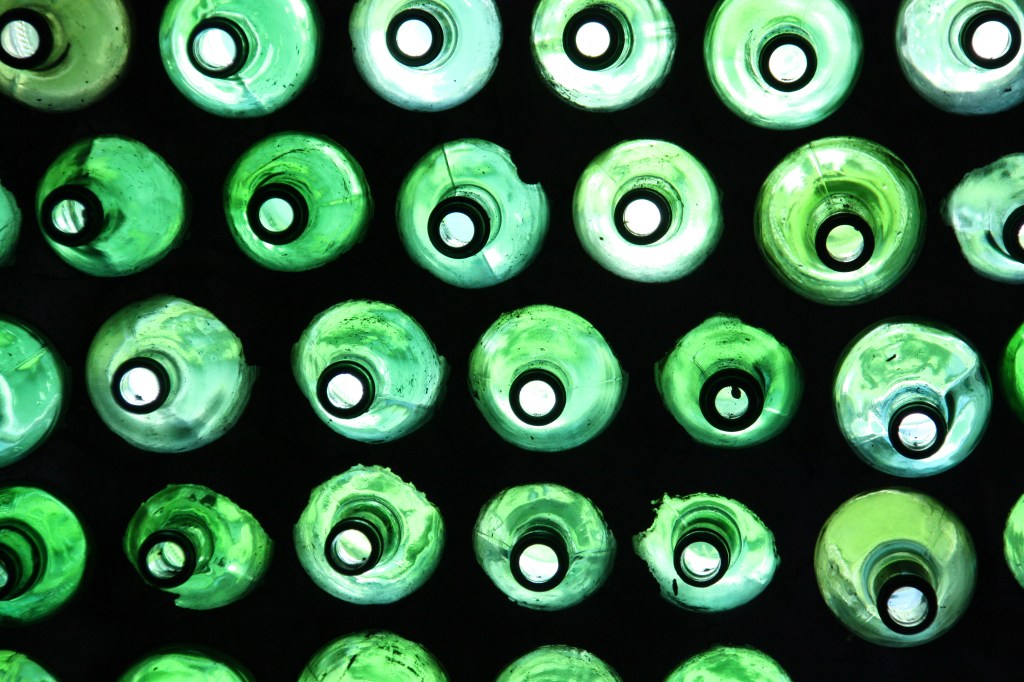
Light through glass, darkly: bottles set in one of the bottle house walls in PEI. The gardens are wonderful and well-worth a visit.

Bottle House, PEI
            The day begins with flowers: at the entrance, beneath the windows, flowers everywhere, a delicacy of scent. Beyond these flowers, even more flowers, then playthings in the garden: a child’s paradise, these sculptured faces, this glass among the trees, sun and shade, the fountain’s water, this dream of an old man, kept alive now by his children, a dream of health and sanity and peace out by the bay, where the mud red waters roll and the tide’s hand grasps at the land and pulls it down with watery fingers.
            Everywhere: faces and elements of faces: a nose, eyes, a mouth, open in surprise. Carved wooden faces, glass faces, pottery faces, flesh and blood faces, grandma’s face, grandpa’s face, then the grandchildren.
            Tourists travelling, old islanders returning to see family and friends, young islanders returning to visit the almost forgotten farms which their families worked a generation or three ago, before their exodus from the land.
            “This was grampy’s house!” they say or “that was my grandmother’s farm!” as if a life could be reborn in that pointed finger, those casual words. How many memories are snapped in each picture? How many lives are caught in this snapping of the fingers as the past is instantly summoned and perfection is bottled for a second or two in the magic of this house, this garden where the builder’s spirit roams. Sit still awhile. Be silent: you may hear him breathe, glimpse him, for a second, staking out the flowers, extracting a weed, checking the set of the concrete foundations, polishing a bottle, resting on a wooden seat, avoiding the slow snail on the path bejewelled by rain-drops from the trees or spray from the fountain. For where there are flowers, there must be water and rain and peace and happiness and all good things, glimpsed darkly through smoked glass yet grasped so smoothly in the sun’s bright light.
            This is the house of bottles, the glass house, where rough winds are shunned and the bottles are set in concrete. It is a museum of light and dark, the creation of sun and shadow as sunshine fails and the lighthouse’s flashlight beam reverberates from glass to stone and back again. Shapes, shadows, memories curved and carved in glass, set in glass, this shimmering beacon this glass house, this light house built as a heaven-haven for harboured ships and the soul’s refreshment, here, in these gardens, among these bottles, and at the chapel door, an angel-in-waiting.

Angel or fairy? It doesn’t matter. She was a gift one morning, when we visited. In this photo you can see how the bottles are set in the wall.

Three links to the Bottle House, PEI.

https://moore.lib.unb.ca/poet/Bottle_House.html
https://moore.lib.unb.ca/poet/Bottle_House_2.html

https://moore.lib.unb.ca/poet/BH3_Gardens.html

R.I.P.

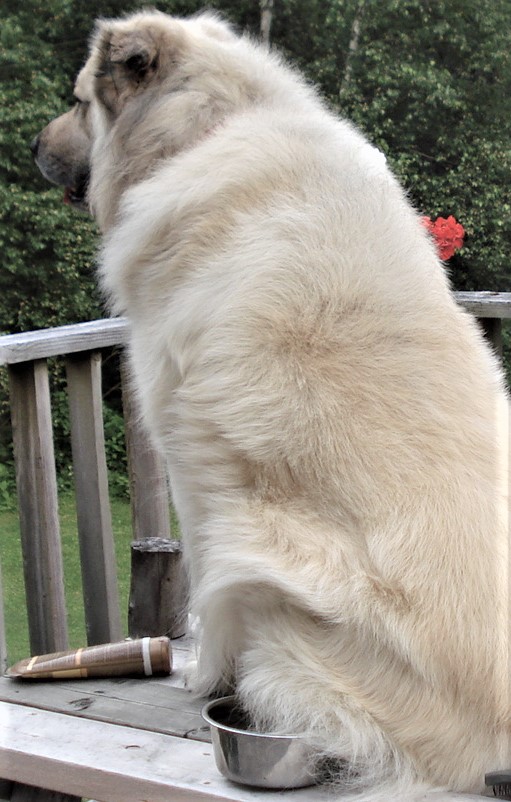
Tigger blowing his coat in Spring and waiting on the picnic table for his daily grooming. Some days I am convinced he is still out there, waiting for me.

What’s in a name?
            At the Farmer’s Market there are fourteen puppies in a cardboard box. One of the puppies, still blind, clambers whimpering over the side of the box and totters toward me. An elderly lady picks him up, thrusts him towards me and says:
            “Here: he’s your dog. He wants to be with you!”
            “No way, Lady!” I say and turn away.
            When I exit the market, I walk past the dog box. There are five dogs left but the one that wandered in my direction has gone. The salesman calls out to me: “Hey you!” He walks towards me. “That woman said you’d be back for your dog. Here: take him!” He unzips his coat, and there’s the dog, snuggled against his chest.
            “When was he born?” I ask.
            “January 16!” comes the reply.
            January 16 is my birthday. Today is March 8, the anniversary of my mother’s death. The dog is 53 days old, much too young to leave his mother.
            When I get home, my wife tells me to take the dog straight back to the market.
            “I can’t do that!” I say. “The man will be gone by now.”
            “But we don’t know anything about the dog!”
            “I’ll clean up after it.” I say. “I’ll feed it and train it.”
            “You’ll have to put it in a cage.” She tells me. “I’m not having it peeing and pooping all over the floor. You know why they’re called poopies.”
            Later that evening, I force the little puppy into the old dog’s crate, and I retire to bed. No sooner have I gone upstairs than there’s an unholy noise from the kitchen.
            “Help me!” I say to my wife.
            She laughs. “Not a chance! You know the rules!”
            Down in the kitchen the puppy is in distress. I take him out of his cage and he waddles and wags and promptly pees. I clean up after him and wonder what to do. The cage isn’t a solution. There’s no box in which to put him and any form of captivity, like a board across the door or a baby’s gate, sets him howling again. I gather my sleeping bag and a couple of cushions and I lie down on the kitchen floor. He immediately snuggles up to me, finds my finger, and sucks on it.
            I get up off the floor, make my way to the fridge, open the door, and pour a glass of milk; for the rest of the night, every time the dog gets restless, I stick my finger into the milk and the dog sucks my finger. I spend the next week doing this.
            While I’m lying on the floor, I study the dog.
            “What is your name?” I ask him constantly.
            Then, one night, as I watch him bounce across the room towards my milky finger, I know what to call him.
            “Tigger!”
            If I had waited another week, I might have called him Pooh!
            Tigger never leaves me. He is like an orphaned duck who follows the first human being who feeds it. Tigger follows me around the house with his nose behind my knee and if I stop suddenly, he bumps into me. My wife has started to call me Dada Duck. I now call her Mother Duck and our daughter has been renamed Baby Duck. Tigger has a second name: Dada Duck Dog.
            We have a little corner piece on our lot where the roads join and all the dogs stop, including mine. I went out there one day and put up a large sign with “Pooh Corner!” written on it. Beside it I placed an arrow which points “To the house!”
            All the children on the block love Tigger. When he came home, he weighed 6 pound and covered six tiles. Full grown, he weighs 110 pound and covers 108 tiles! He is gentle and well-behaved and everyone adores him. Some of the children want to buy a little saddle and ride on him, he is certainly big enough, but I won’t let them do that. The children on the block now call me Christopher Robin. At Christmas, they bring me pots of honey.
            As eleven years went by, Tigger grew old and slow. He developed cancer and had arthritis. On fine days he was fine, but on damp days he could hardly place one foot in front of the other. He had difficulty climbing the stairs and would sleep for hours rising only for his morning and evening walks and his food.
            Yesterday, el cinco de mayo, at 12 noon, Tigger passed away.
            Today, there is a little white cross at the corner of our lot. The children have laid a circle of flowers around the cross. On it somebody has painted: R.I.P. Tigger.

The Red Room

I looked for a picture of music, but could find nothing. No Carlos, no flute, no nothing. So, I invite you to use your imagination: just pretend these are the notes of an Andean flute, floating in the early morning air. Now close your eyes and listen carefully. Can you hear the music?

The Red Room

Carlos makes music on his flute.
He lives in the Green Room,
with its door just opposite mine

He creates the highest note of all
and it floats before me in the air,
a trapeze artist caught in a sunbeam
and suspended between the hands
that fling and those that catch.

His musical rhythms are different.
I try to follow his fingering.

In the space between notes,
tropical birds flash jungle colors
as they flit between flowers.

With a whirring of wings,
all music stops,
save for the robin’s trill
refreshing the early summer
with his eternal song.

Comment:

I finally found a photo of Carlos.
Here he is, in Kingsbrae Gardens,
playing Beethoven’s Ode to Joy
on ‘half-filled’ water bottles
tuned to play a perfect scale.
Like an Andean bird, the man
could pluck notes from the air
and fill the world with music.

Dreamcatcher

Dreamcatcher

In my dreams, I track the sails of drifting ships,
white moths fluttering before the wind.

I think I have caught them in overnight traps,
but they fly each morning in dawn’s forgiving light.

I give chase with pen and paper, fine butterfly nets
seeking wild thoughts waiting to be caught, then tamed.

I grasp at something just beyond my fingertips,
but I can’t quite remember what it is.

I wake up each morning unaware of where
I have been the night before.

“¡Qué será, será!”

“¡Qué será, será!”

In one room in my head
my mother’s mother
sits with me on her knee
at the kitchen table
playing patience.

Elsewhere, I stand on a stool
beside my father’s mother
helping her to mix the cake
she will later bake
in the coal-fired oven
of the black, cast iron stove.

My mother’s father
sits before the television.
He leans back in the chair,
raises his foot so he can’t see
the adverts on the screen,
and puts his fingers in his ears.

My father’s father lies in bed,
downstairs, in the middle room.
His dog lies beside him,
licking his hand.
We all wait for the death
that has haunted him
since he was gassed
in World War One.

Clare sits at the computer,
following the figures
that track the pandemic.
I sit here watching her,
humming softly to myself:
“¡Qué será, será!”


Summer is Ice-Cream

I can’t put a real ice-cream up here,
it might melt and spoil the computers,
yours and mine,
so here’s a cardboard one instead!

… after my grandfather died I slept with my grandmother in her large double bed when I was there on my own … but when all the cousins were there we shared a double bed and three or four of us slept at the top and three or four of us slept at the bottom and we were so small and short in those days that our feet never touched in the middle and the bed was like an earth worm … an octopus earth worm with several heads and no feet … or all the feet in the middle … like a centipede … and sometimes my parents would have to snuggle in with us too … though we scarcely woke up when they arrived or departed … and with tears we would go tired to bed … and the grown-ups would promise that it was only for an hour or two … for a little rest … and we were so far north that the summer sun was in the sky until late at night … but sleep we did and they never woke us up … and we didn’t wake up until the dawn chorus of birdsong … bird after bird chirping and singing in the hedge with its bluebells and primroses … the hedge that divided one bungalow field from the other …

… and we were in the first bungalow field, which was the best one, obviously, because we lived in it … and there was another bungalow field behind us and we could look through the gaps in the hedge and occasionally there were gaps we could crawl through … but they were well guarded because there was an all out war between the two fields and we didn’t like the boys in that second field and they didn’t like us … and we fought our skirmishes through the hedge and at the gaps in the hedge and the people in the field behind us would rent out their bungalows to boys with strange accents who would be instant enemies the moment they opened their mouths or heard us talk and vice versa, the other way round … and it was the silent arrow or spear shot or thrown through the hedge … and the long trailing root set out to trip the unwary, and once we tied a rope across the field, a trip wire to trip those foreign warriors, and we meant to take the rope down before it got dark, but we forgot and we missed the enemy but we caught my father and all the uncles walking back home in the dark from the local pub … and didn’t they trip and all fall down in a great big squealing piglet pile … and the aunties thought it very funny because once they were down, they couldn’t get up again … and the aunties said it had nothing to do with the rope … that they were all falling down anyway, falling down all the way home from the pub they were, and stumbling … but we had hoisted our allies with our own petard and next day we were brought to justice and the justice was severe … and what, they said, if we had caught one of the farmer’s cows … and if it had broken a leg … then who would be responsible then, to the farmer, for payment, and we all hung our heads in shame for those days everyone was big on responsibility and being responsible was a big thing … and even the dog, our scout and protector, our war horse and chariot, for we were Ancient Britons that summer, sat there silent and serious and hung his head in shame at the hot bitter words and he wasn’t even wagging his tail … and the adult jury, twelve sober uncles, tried men and true, all pronounced us guilty and sentenced us to a day without cricket, a day with no jam on the bread, a day in which we must eat up all the greens, a day with no puddings, a day with no sweets, no treats, no ice cream …

… but summer was ice-cream! Who wants ice cream in winter when the hands are cold and the ice wind blows straight down from the Arctic? But in summer, to rob a child of ice-cream is to commit a capital crime against childhood … and the ice cream was miles away, and to run to get it and to bring it back before it melted was a rare adventure that had to be carefully planned … go to the end of the field, run through two sets of lanes, stop at the first ice cream shop and if there was no ice cream there because it had all been eaten by that awful foreign army, run another mile to the next shop … and if you were lucky there would be some ice cream there … and no we didn’t want cones … cones were for the babies … the tiny children who couldn’t control their ice creams … we wanted wafers, like the big boys we were, although we were all still in short trousers … and there were three penny wafers and six penny wafers, and even chocolate bars with thin chocolate on the outside and the ice cream inside … and there were lollipops and other marvels … like Cadbury’s ’99’ … but that day all this was forbidden … forbidden because we had set a trip wire for the enemy and caught, by accident, our very own men … oh the injustice, the burning injustice of it all …

Summer in Wales

Summer in Wales
aka
Cricket, lovely cricket!              

Summer in Wales is always as I remember it: glorious days of sun and sand and blue skies and warm winds … and especially the sun on the beaches with the water sparkling and little boys and little girls playing cricket on the dry wrinkled sand packed hard when the tide goes out and leaves the land stranded … and uncles and aunties bowl under arm, not over arm, so the little ones could manage to score lots and lots of runs … and I remember us, standing breathless between the wickets, or at the wicket, if there was only one set of stumps, or a picnic basket stood on its side, or three pieces of driftwood, with sea-weed for bails, and what are bails, you ask?

              Well, bails are the sea-weed that is draped over the driftwood that stands as stumps. And we guard our stumps with the cricket bat that somebody has brought and we bowl with wet tennis balls, because nobody will risk a red, leather ball on the sands, with the wet tide standing there, waiting for the ball to be hit at it, or into it, and it’s cold, but not that cold, and when uncle hits the ball, right out so sea, someone has to run after it, then dive, and then swim after it, and if it’s real runs you want, then uncle runs two or three quite quickly; then the aunties tell him to stop running so fast or he’ll have a heart  … so he slows down and trots four or five; then he walks six and seven; and when you throw the ball back, he’s walking eight or nine; and then the dog intercepts the ball, catches it in his teeth, and starts running around with it in his mouth and everyone is trying to catch the dog except my uncle who is now limping very, very slowly between the wickets, but he’s already up to eleven or twelve; and then the little ones start crying because “It’s not fair!” Loud sniff! Then uncle stops in the middle of the wicket and sits there, waiting for somebody to run him out; except everyone is tired, except the dog, who is tireless and completely energized, and now the centre of attention; and nobody is going to catch him;  and finally uncle walks to the wicket and he lifts the piece of seaweed with his bat and everybody appeals, then he’s finally “OUT!” because officially he’s hit his own wicket and that’s illegal and now the game can go on once more, with everyone happy and God’s in his heaven and all’s right with the world …

And the dog has dropped the ball right at the edge of the waves and is barking furiously at the incoming waves as time and tide march up the beach and sweep us and our memories all away.

Hot Water Duck

Canada Geese at Mactaquac

Hot Water Duck

The worst punishment of all was to be sent to bed early.  You climbed upstairs by candlelight, if you were lucky, or groped your way upwards in the dark, if you had been really bad. You entered the cold, dark, damp of the bedroom and punishment was not to have supper, and not to have a warm hot water bottle or a warm baked brick to keep you warm in bed. I loved that hot brick, baked in the oven or by the fireside, then wrapped up in a towel. Bricks and bottles: they banished damp from the bed and kept you warm for a while, or burned if the wrapping fell off. The hot water bottles: they were made of tin not rubber, and once, I remember a cast iron duck, that my grandmother baked in the oven, then wrapped in swaddling clothes, like a little baby. But if the grown-ups said you had been naughty, or nasty, or cheeky, or just plain wicked, then you were given nothing to keep you warm, and you lay in bed and shivered until you cried yourself to sleep.

Canada Geese and Fall Foliage at Mactaquac

Rain Again

The rain in Spain
does not stay on the plain

Rain
              When it rained in South Wales, it rained everywhere soaking rich and poor alike. There was no escaping the eternal wetness of Welsh Rain. Whenever we traveled, especially by bus, to another part of Swansea Town, it would be raining there too, but, as my auntie used to tell us when we came back home: “Smile now. Look happy. And remember: we had lovely weather all day. The sun was shining over there where we were. Raining here, at home, all day, was it? What a pity. You should have come on the bus with us!” I remember her smiling, all wrinkles round the eyes, her false teeth shining white, as she flashed a horse’s collar coal-scuttle of a grin, absolutely shameless. But we’d back her up. We’d all smile happily and laugh, and dance, and jump up and down, basking in the joy of the falsified sunshine of her wonderful smile, her shining false teeth. And she was right: where we had been together, the sun had shone all day, in spite of the umbrellas, our wet, cold feet, and all the undoubted evidence of a day of rain.