Commentary:
Another game.
Once more you must click on the link.
For me, this is fun … for you … the visitor …
well, I am not sure how this affects you.
Click on Sandspit and you’ll find out.
And please let me know what you think.

Time-Spirits
Zeitgeist
Zeitgeist is a concept from 18th- to 19th-century German philosophy, translated as “spirit of the age” or “spirit of the times”. It refers to an invisible agent or force dominating the characteristics of a given epoch.
Wikipedia
Those who cannot learn from history are doomed to repeat it.
“Plus ça change, plus c’est la même chose.”
Poems for troubled times.
Introduction
Our world finds itself in an incredible mess right now. Somehow, we have to sort it out. Images and metaphors tie past, present, and future together. We must pick our ways through the difficulties of these troubled times, as you must pick your way through the intricacies of these poems. Many of you will give up. Some of you, the chosen few, will make your way to the heart of each poem.
These poems are deliberately cryptic. Each one is a mind game I am playing with you. I do not underestimate you. I have placed clues throughout each poem and if you follow the clues you will arrive at many of the poem’s hidden meanings. Some poems are more difficult than others, their meaning more recondite. Others seem very straightforward, yet still contain secrets.
This style of poetry has a long history going back to Anglo-Saxon riddles and way beyond, back into the mists of time. Luis de Góngora (1561-1627) and Francisco de Quevedo (1580-1645) specialized in similar forms of recondite poetry, often based on metaphor and the juego alusivo-elusivo, the game of alluding to something while eluding the act of saying what it is. Jorge Guillén (1893-1984) and Federico García Lorca (1898-1936) also played this game, as did Octavio Paz (1914-1998). In the works of all of these poets, the clues may rest in the poem or they may be found in a generic knowledge of the mythology of the poem’s exterior world.
Always remember that “those who cannot learn from history are doomed to repeat it” (George Santayana). Otherwise expressed, in the words of T. S. Eliot: “Time present and time past / are both perhaps present in time future / and time future contained in time past” (Burnt Norton). The seeming anachronisms in these poems suggest that all time is ever-present and that each new day presents us with events that have already occurred on many occasions.
Commentary: The idea for Time-Spirits aka Zeitgeist was born around the kitchen table in Island View on Saturday, 22 December 2018, during a literary conversation between Gwen, Victor, and Roger. A poem at a time, one after another, grew from that table top chat. The result: 70 poems, not easy to read, deliberately difficult, that reflect our troubled times. My thanks to Geoff Slater, line-painter, who drew the cover picture: Robin Red in Claw and Breast, a symbol of nature ‘red in tooth and claw’. So are we in the words of Albert Camus who writes ‘nous sommes ou les meurtriers ou les victimes’ . Is it the early bird that catches the worm? Or is it the late worm that gets caught by the bird? Whichever: it’s the worm that gets eaten, until the robin bites the dust, when he is eaten in his turn. Just think of it as nature doing its regular recycling …


Tracks
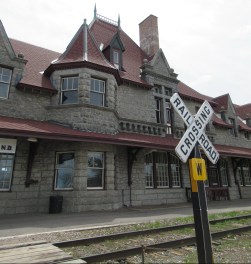
McAdam Railway Station #12
“Put your fingertips on the rail,
see if you can feel its pulsing beat.
No heart rail rhythm now. No tremble.
Put your ear on cold metal:
nothing but silence. No murmur,
however distant. Black fly whine.
No-see-ums flit. The train track’s
buzz of harmony is lost and gone,
replaced by careless nature. Listen
to the wind whistling in the woods,
hark to spring sounds, so subtle,
grass growing, rust accumulating,
sleepers turning over in their graves,
silent, rotting beneath forgotten rails.”
Comment: Nothing so lonely as an abandoned railway track, rusting beneath snow and rain, the wooden sleepers rotting into oblivion. That said, the Southern New Brunswick Railway still carries freight trains through McAdam, and it is the railway station that suffered, with the loss of passenger traffic, rather than the rails themselves. What a pleasure, incidentally, to hear the hoot of the approaching diesel, to count the wagons as the train came to a halt outside the station. Then came the joy of watching the engine separate wagons from the main train, shunt them into sidings, return, and take the freight train, slow at first, but rapidly gathering speed, out of the station and away into the distance. Such memories. So many ghost trains riding those rails. So many ghosts bewitching the windmills of the child’s mind that still inhabits the ageing brain.


Murals
McAdam Railway Station #11
Painting a mural,
inside, interior
wall, knowing it will
stand time’s test.
Viaduct broken,
a tumbled engine,
Canadian workers,
railwaymen all,
some from Macadam,
pebbled the floor,
handrail, radiator
camouflaged for war,
part of the painting.
Depart from the station.
Turn right. Straight ahead,
flaked peeling paint.
So sad, this outside
mural, exposed to winter’s
snow, frost, winds, and ice.
So vulnerable
and so ephemeral.
Such a short-lived
summer, over in a day.
Butterfly on a rock.

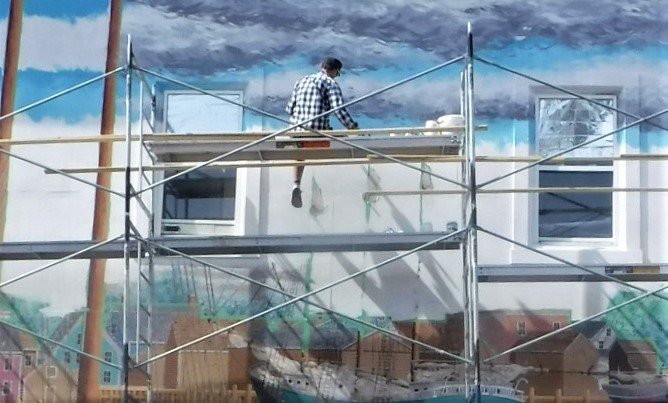
Comment: This sequence comes from the indoor and outdoor work (murals) of my friend Geoff Slater. Geoff told me how ephemeral were the outdoor murals with a life-span of about ten years before they needed redoing. After that, the paint starts to fade, then crack, then dry and peel away. Our Canadian winters with their icy cold and the ensuing springs with their frost and thaw do not help. The protection, no ice, no snow, no sun, no rain, afforded to the interior murals means that they will last so much longer. Our outdoor art, unless cast in the firmest stone, is ephemeral. Like a butterfly, it will not last much longer than a brief summer day. Hence the final metaphor.

After the Floods
(2004 BC)
as the crow flies
so the pigeon
holding straws
within its beak
time to rebuild
not so easy
mud walls fallen flat
rubble and rubbish
litter river banks
warped wooden planks
water-swollen
so much stolen
by wind and wave
who now knows
the unknown
perceives the abyss
beneath egg-frail
cockle-shell hulls
waters recede
islands re-emerge
bald skulls of hillocks
stripped of grass and trees
water-logged fields
old bones dug up
displayed in the ditch

Crows
one day
whirled off my feet
next day
toes set
in concrete
a single black feather
floats down from the sky
meaning?
a bone to a dog
sun-flower seeds
strewn before squirrels
red and grey
the occasional chipmunk
only crows
black-winged marauders
monarchs destined to wear
a weighty crown,
cry out their anguish
mobbing the hawk
longing for the day
when they’ll rule again
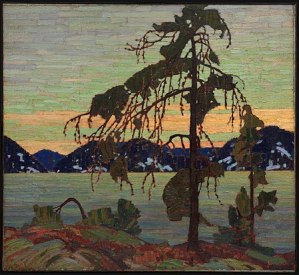
Jack Pine at Tara Manor
(1770 & 1834 & 1917 & 1977 & 2018 AD)
Tara Manor jack pine
arm-waving Maritimer
long-past sea-faring
cult-haired declamation
poem to a wilderness
cultured
cultivated now
you radiate disorder
flustered
clicking needles
clustered
knitting the wind
lop-sided
radical forest church
spired with birds
crows’ nest crowned
growing out extravagant
salted the air
old man’s beard
sprouting fresh bristles
old salt sea salt
always a helping branch
to point the time of day
each rough-barked limb
a friendly hand extended
every night
your black bristling branches
haul down the sun
Purple
I pen poems
in emerald ink
but I prefer
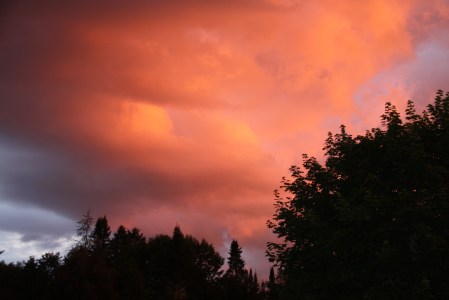
the violence of evening’s
bruised violets
wind-beaten clouds
add dark depths
to a rainbow
a glow of satisfaction
flutters northern lights
the setting sun
hums low notes
to cello
and double bass
Comment: I like this, but I prefer the re-write. If you wish to express your preference, I would be glad to receive it. This is the third revision. Click here to read the first posted version of Purple. Any comments on the evolution of the poem would also be welcomed.
Purple
violent
evening’s
bruised violets
wind-beaten clouds
move through dark depths
a rainbow arcs
an iris curve
northern lights
flicker organ music
fugues of color
sound into light
low notes hum
bring tears to the eye
cello and double bass
serenade a setting sun
Butterflies
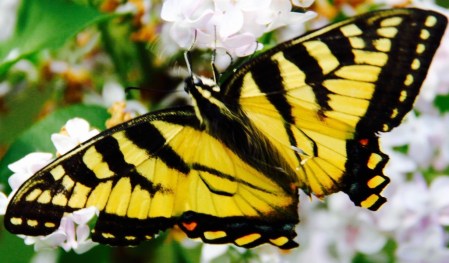
butterflies
their ephemeral forms
flutter by
flickering
brief their sweet sway
they spread
paint-daubed
fanciful wings
fan flowers
flourish
eternity
perched briefly
on flowering bees’ balm
robin puffs out
his red breast
hauls down
tomorrow’s sun
white-throat sings
an evening elegy
Comment:
“Poetry gives permanence to the temporal forms of the self.”
Miguel de Unamuno.

Eden 1
(1956 AD)
wet rags of dirty washing
hang on the Siegfried
line’s barbed wire
flesh rent ripped
broken-glass anger bottled
blood-mottled concrete
bones mixer-crushed
blood sacrifice a keep-safe
ash-cross camouflage
stretched sketched
over grime and crime
heavy the spike-toll
rooted the rock
chips off old blocks
these flint flakes flying
faceless this sphinx
inscrutable smile
where now
sands of the Nile
ample ammunition
beneath this apple tree
flat-footed lame-duck walk
goose-stepped after expulsion
walled this garden
to lock what in
to keep who out


