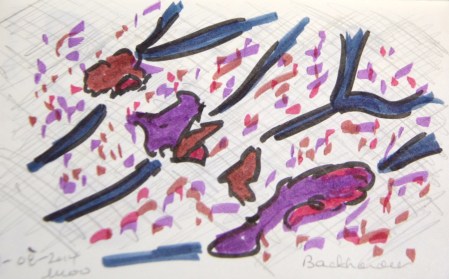
Love Spoon

039

Kingsbrae 9.1
9 June 2017

Love Spoon

Celtic the Knot
binding heart and soul
the love spoon
carved
by caring hands

Sharp moon blade
honed by the wind
white
wooden clouds
flowing against
dark sky grain

Sweet surge
time and tide
tied together
knotted
our heart strings
twisted our love
forever in this
Celtic Knot

Comment: Celtic Knot is the name of one of the more formal gardens at Kingsbrae. It is also one of the symbols carved into Welsh Love Spoons and signifies eternal love. Carving the love spoon was one of the traditional tasks given to the young man when he asked for the hand of his beloved in marriage. In addition to showing craftsmanship and woodcarving skill, the task of carving the wood spoon kept the young man’s hands occupied while he was courting. Parents would then be able to check on the progress of the love spoon and ensure that their daughter’s virtues were in safe and trustworthy hands.

Le Pont Mirabeau

Kingsbrae 8.4
8 June 2017

Le Pont Mirabeau
(click for French original)

The Seine flows down beneath Mirabeau Bridge
and so does our love
must I be reminded yet again
that happiness always follows pain

Let night descend let the hours sound
the days go by but I’m still around

Hand in hand let us stay here face to face
while beneath the bridge of our arms
our gazes interlock
like river waves flowing

Let night descend let the hours sound
the days go by but I’m still around

Love flows away like these flowing waves
love flows away
how slowly life passes
and hope is so brutal

Let night descend let the hours sound
the days go by but I’m still around

Days flow by and weeks flow by
nor times past nor former loves
come back again
under Mirabeau Bridge flows the Seine

Let night descend let the hours sound
the days go by but I’m still around

Comment: I spent the school year in Paris in 1962-1963 and I have always wanted to translate Le Pont Mirabeau from French into English. Today, I found both the time and energy to do so. It’s not a great translation, but it is mine. Click on one of the links above to get the French original.

Words

IMG_0167.JPG


Kingsbrae 8, 2
8 June 2017

Words

Here, on the seashore,
the whisper of waves,
splashed with a flash of sun,
wind fingering the hair,
the light a delight,
and wordless this world
though its beauty be
configured in words.

The scything of the sea,
the land seized in snippets,
grey stones, red rocks,
gelatinous mudflats
blue on white striations.

Seagull wings
snipping celestial ribbons,
salt caked keen on lips,
sea weed scents sensed
yet never seen.

Captivated we stand here,
unattached our single wings,
save to this singular beauty:
peregrine the falcon soul,
so solitary as it soars.

Comment: So many of these new poems are just that, “new” and “raw”. Words, for example, is just a couple of hours old. That is the gift of time that I have been given. The writing process is so rapid that there is little time to digest the last thought and image sequence, before the next comes tumbling along. I guess it’s just a question of rolling merrily along and we’ll see later what we still think is fit for survival. The selecting of these poems will be an interesting task … and who will select the selectors …

Flute

IMG_0134 (2)

Carlos Carty Making Magic

Kingsbrae 8.1

Flute
(for Carlos Carty)

Songs without words:
a black alpaca rolling on green grass,
two deer dashing across the lawn,
three Indian Runner Ducks actually running,
four tents, canopies billowing beneath the sun,
Passamaquoddy stretched out before me,
a dark island stark in the bay,
sunlight descending a ladder of cloud.

Song without words without end:
music of wind through rock,
waves lapping against stones,
a breeze tapping rhythm from river reeds,
plucked and pierced, the reeds:
the world’s first flute.

Life and breath are one.
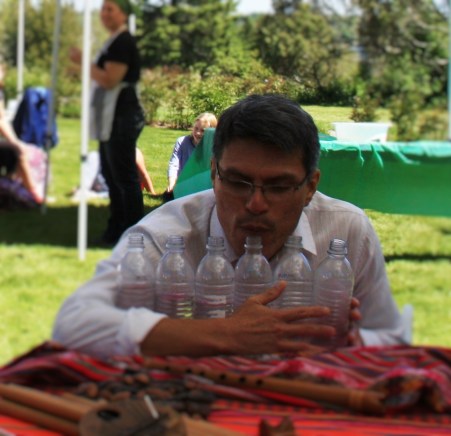
The young man opening the water bottles,
sipping the right amount, pursing his lips,
blowing into the bottle neck,
making sweet music:
a song of joy.

Absences

Avila 2008 006

Kingsbrae 7.3
7 June 2017

Absences

Pigeons flapping
across abandoned squares.

Clothes peg dripping
raindrops from a deserted line.

Ile Ste. Croix,
lonely in the bay,
longing for Champlain’s
return.

Endless rock and roll
tide after tide
water without end.

A whole day goes by
without putting
pen to paper.

The blank page
waits for the pencil’s
resurrection.

Small Corner

IMG_0160.jpg

Kingsbrae 6.1
6 June 2017

Small Corner

 And this is the good thing,
to find your one small corner
and to have your one small candle,
then to light it, and leave it burning
its sharp bright hole in the night.

 Around you, the walls you constructed;
inside, the reduced space, the secret garden,
the Holy of Holies where roses grow
and no cold wind disturbs you.

 “Is it over here?” you ask: “Or over here?”

If you do not know, I cannot tell you.

But I will say this: turning a corner one day
you will suddenly know
that you have found a perfection
that you will seek again, in vain,
for the rest of your life.

Journal: I had the pleasure of reading this poem to the artists and committee of the KIRA program after the evening barbeque on Saturday, 3 June, 2017. It is indeed a Golden Oldie, but it summarizes with remarkable accuracy my own feelings about Kingsbrae and the surrounding area. There are places of peace within the world and, as our world becomes more crowded and our cities overflow with urgency, these peaceful places take on more and more importance. It is essential for us to escape the concrete and tarmac of the so-called civilization and to take refuge in nature. The cultivated garden has a long tradition going back to Medieval times, le jardin enclos and its sacred space, for example, and the monastery cloisters and their enclosed serenity,

Following in this tradition, Kingsbrae Gardens has established an oasis of cultivated peace within the larger peaceful space that is New Brunswick. We are indeed lucky to be permitted to enter these places, to renew our contact with nature in all its beauty and bounty, and to be able to refresh our spirits and drink deep of the peace that flows, and fills us, and blesses our endeavors.

The photo that accompanies this poem is of the crab apple trees in full blossom on the front lawn of the house in Island View where Clare and I have lived and worked together for a quarter of  century or more. This is the view from my writing room window. It is no wonder that poetry flows from this subtle spring beauty.

Hymn of Praise

IMG_0021.JPG

Kingsbrae 4.2
4 June 2017

Hymn of Praise

Woodhenge, Stonehenge,
bay and shore henge,
the sun rising out of the sea henge,
this forest older by far
than the Christian God,
and those Druids, my ancestors,
late-comers, five thousand years ago,
bound to this earth by the same
rays of sunshine that bind me now.

No man kills
in praise of the life-giving Sun,
that Celestial Father
who raised with Earth Mother
the beauty of our flowers,
the bounty of our fields.

Here, at Kingsbrae,
sitting at my window,
I raise my Sunday hymn of praise
to the Sun who gifted me my life
and who’ll still be there
when I end my days.

Blackfly

15-may-2002-pre-rimouski-224

Blackfly

Open car door or window:
they whisk in with the wind.
Silent they head for light,
crawling steadily up the inside
surface of the windshield.

If you are quick, you can
catch them now. Kill them
cleanly before they gorge
on your blood, spreading it
thin, your own raspberry jam
blocking your line of sight.

When you exit the car,
you see the killing fields,
blackberry jelly spread
thick on number plates,
dimming your headlights
with dark clots of death.

Comment: We drove down to St. Andrews on Monday and visited Kira and the Kingsbrae Gardens. Such beauty, such a wonderful reception, and the food in the garden café was marvelous. On the way home, the pinging of blackfly against the windshield made us think it was raining. When we got out of the car, headlights, hood, and license plate were covered with thick films of dead flies. We kept doors and windows closed, except for a brief moment at the service station, where we filled up with much more than gas.

Metaphor: Wednesday Workshop

img_0177

Metaphor
Wednesday Workshop
26 October 2016
Revised
31 May 2017

Metaphors: What are they? I must be honest: I don’t really know. I don’t understand them. I never have. I probably never will. This morning, I determined to find out what a metaphor really is. So I Googled metaphor and came up with the following definitions.

  1. A metaphor is “a figure of speech in which a term or phrase is applied to something to which it is not literally applicable in order to suggest a resemblance.”
    Well, that is pretty clear, isn’t it?
  2. A metaphor is “something used, or regarded as being used, to represent something else; emblem; symbol.”
    No doubts there.
  3. “Metaphor is a figure of speech which makes an implicit, implied or hidden comparison between two things that are unrelated but share some common characteristics. In other words, a resemblance of two contradictory or different objects is made based on a single or some common characteristics.”
    I know exactly what they mean. Or do I?
  4. “In simple English, when you portray a person, place, thing, or an action as being something else, even though it is not actually that “something else,” you are speaking metaphorically.”
    No misunderstanding here.
  5. “A metaphor is a figure of speech that refers, for rhetorical effect, to one thing by mentioning another thing. It may provide clarity or identify hidden similarities between two ideas. Where a simile compares two items, a metaphor directly equates them, and does not use “like” or “as” as does a simile.”
    Slightly clearer, but not as clear as daylight.

I turn to my blog in search of metaphors that I have created in my poetry and read that “The egg of my skull / shows hairline cracks: / tiny beaks pecking / fine-tuned sparks of song”. “This piece,” Tanya Cliff writes, “offers a unique and beautiful perspective on the theme (of birds).” I think I can do without the dull, dry definitions set out in the definitions above and understand metaphor as “a unique and beautiful perspective”. This functions for me. Thank you, Tanya.

Two more sequences, this time from October Angel: (1) she gathers her evening gown / and walks among ruined flowers (Meg Sorick’s choice) and (2) a snapdragon opens / the frosted forge of its mouth / and sprinkles the sky / with ice-hard shards of fire (Tanya Cliff’s choice). I can understand the first in terms of “a unique and beautiful perspective” since the picture of the October Angel is clear in my mind. In addition, evening / evening gown / ruined flowers are particularly evocative. The second sequence is much stronger as anyone who has seen the snapdragon flowers braving the ice and frost will testify.

After thinking about these three examples, I think I can now understand metaphor a little bit better. I would now define a metaphor as “a brief verbal sequence that creates a new reality that offers a unique and sometimes beautiful perspective on something that we have long known and accepted but now, thanks to the writer / poet, see in a different light.”

This personal definition allows us to distinguish more easily between dead metaphors and clichés like dead as a door nail or avoid it like the plague while allowing us to enjoy the permutations that spring from the innovation of the true metaphoric sequence. The metaphoric sequence also allows us to distinguish between a two word metaphor and a series of metaphors that are thematically linked.

From my own poetry, ruined flowers would be an example of the first while the longer sequence a snapdragon opens / the frosted forge of its mouth / and sprinkles the sky / with ice-hard shards of fire would be an example of the second. Iterative thematic imagery, a form of sequenced metaphor chains, then links the whole work, be it poem or longer piece, within an associative semantic field of parallel meanings. This also illustrates the idea of differentiating between the inorganic and organic conceit, where the inorganic conceit is the example of a single, independent instance while the organic conceit is woven into the fabric of the oeuvre.

In the WFNB Workshop on Metaphor, held in Saint John on Saturday, 27 May, 2017, we had a two hour, in-depth discussion on this topic. We began the workshop with a meet and greet and ice-breaker. Then we offered a pictorial definition of a metaphor. We generated a series of dead metaphors, to be avoided like the plague, except where we use them to define a character, or make fun of them, or use them in a new fresh light that resurrects them and brings them back to life. This was a great deal of fun. We then indulged in a series of creative writing exercises that focused on the creation of new metaphors. We finished the workshop with a “song of craze” in praise of the joys of metaphors. What a day!

The structure of the workshop was very simple. We had 120 minute (two hours) and broke them into 3 sessions of 20 minutes, a 5 minute break, 2 sessions of 20 minutes, and  a grand finale composed of 3 sessions at 5 minutes each. The twenty minute sessions broke down into 5 minutes writing, 7 minutes small group discussion (4 participants per group), and 8 minutes full room participation. The five minutes writing centered on each person writing to a topic. Each member of the group then shared what they had written with the other group members. This helped develop individual voices (the theme of the conference) and showed how each individual approached a single topic in a multitude of different ways. A representative piece from each group was then chosen and the writer read the creation to those gathered in the full room participation.

As a result, everybody was actively engaged in the thinking, writing, creating, reading, and critiquing process. A considerable number of what I call “writing starts” were made. Hopefully participants will continue to develop these writing starts and develop something from them, long term.
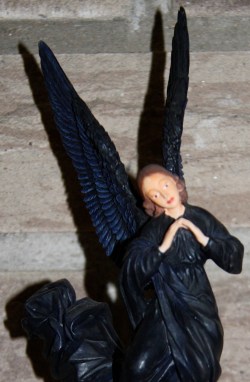
Phoenix

IMG_0158

Phoenix

The wool shop has gone.
It survived the winter storms
that whipped the bay ice
into waves of mashed potatoes
that hardened and crashed
against the quay, splintering
its timbers, tearing it down.

It survived the spring time
freeze and thaw that cracked
the sea wall, split foundations,
and wobbled the shop
as if it were yellow jelly.

It survived the carpenters,
the stonemasons, the police,
the insurers that came
with their cameras and their
oh-so awkward observations.

It survived everything
except the lightning bolt
that lit the fire that reduced
the old shop to dust and ashes
from which, unlike the phoenix,
it would never be born again.