Swansea

IMG_0898 (2).JPG

Swansea

To be Welsh in Swansea is to know each stop
on the Mumbles Railway: the Slip, the Rec,
Singleton Park, Blackpill, West Cross, Oystermouth,
the Mumbles Pier. It’s to remember where single
lines turn double by Green’s ice‑cream stall.

It’s to know where the trams fall silent, like dinosaurs,
and wait without grunting for one to pass the other.
As you wait you can hear the winter roar of the rugby
crowd or St. Helen’s summer “click” of ball on bat.

Today the tide is out and the nets are golden with starfish
as if a night sky stretched across day’s horizon.
Mudflats rule the bay beyond the sand, and banana boats
ride the distant waves, waiting for the tide to turn.

When it does, the Mumbles Railway has been sold
to a Texas millionaire and the brown and yellow busses
no longer run to Bishopston, Langland, Caswell,
Pyle Corner, Pennard, Three Cliffs, Ilston, Rhossili:
sweet names of sea and sand where my father fished
for salmon bass, his thin line cast defiantly at a rising sea
that would smash the walls of the sandcastles I built to last
forever, unaware that time’s rising tide would breach
their defenses, leaving them in ruins on the summer
beaches where I dreamed my buoyant boyhood away.

Commentary: The Mumbles Pier from Limeslade. This is the first water color painted by my father’s brother, my godfather after whom I received my second name. He took up painting after he retired and became a quite accomplished amateur water colorist. He gave me four of his water colors, I particularly wanted this, his first, and the later ones are excellent, especially the award-winning paintings, of which I have one.


Rhondda Fawr

IMG_0689


Rhondda Fawr

To be Welsh on the coalfield
is to speak the language of steel and coal,
with an accent that grates like anthracite ‑‑
no plum in the mouth for us; no polish,
just spit and phlegm that cut through dust and grit,
pit‑head elocution lessons hacked from the coal‑face.

We sing arias and deep, rolling hymns
that surge from suffering and the eternal longing
for a light that never shines underground
where we live our lives and no owners roam.

Here “gas” and “fall” mean violent death
and the creaking of the pine pit‑prop is a song‑bird
suddenly silent in its cage warning of danger
soon to be upon us…

… words and music stop in our throats
as up above us the sad crowds gather.

Featured Image -- 7454

Village Bully

IMG_0114 (2).JPG

Village Bully
Pyle Corner,
Bishopston

“Shall I thump you one?” he asked.
And the fist that removed five teeth
from an opposition player hovered near my face.

He was always like that with smaller men:
a punch, an elbow, a kick, a threat so loud…
yet people his own size frightened him.

Many times I saw him back down from larger boys
and when someone was bigger,
well, that was always another story!

I’ll never forget him though: superb
against Cubs, Brownies, and Girl Guides,
but when the real Boys came to play,
why, he had one of his off days.

We called him “the million-pound body
with the one-shilling brain.”

Hate drove him. He lived off it, thrived on it,
until one day he discovered that the face
he really hated was staring back at him
every morning when he shaved.

He went downstairs, put his head in the oven,
and turned on the gas.

Sheep

IMG_0126 (2).JPG

Sheep                               

Wales is whales to my daughter
who has only been there once on holiday,
very young, to see her grandparents,
a grim old man and a wrinkled woman
who wrapped her in a red shawl
and squeezed her and hugged her
till she cried herself to sleep
lunging for lack of space and air,
suffocating in a straitjacket
of warm Welsh wool so tightly bound.

So how do I explain the sheep?
They are everywhere, I say.
On lawns, in gardens. I once knew
a man, a friend of my father’s,
whose every prize tulip was devoured
by a sheep, one single sheep
who sneaked into the garden
on market day when they left the gate ajar.

Sheep are everywhere, I say, everywhere.
I remember riding on a passenger train
and seeing sheep leering like tourists
peering from dark coal wagons travelling
God knows where and bleating
fiercely as we passed them by.

In Wales, I say, sheep are magic.
When you travel to Paddington
on the train, just before you leave Wales
at Severn Tunnel Junction,
you must lean from the carriage window
and loudly call “Good morning, Mister Sheep!”
and if the one you greet looks up,
why, provided you’re good and quiet
for the rest of the journey,
your mum and dad will buy you
something nice in London.

My daughter shows disbelief. And “Look
at that poster there:” I say, “a hillside
of white on green, and every sheep
as still as a stone,
and each white stone a roche moutonnée.”

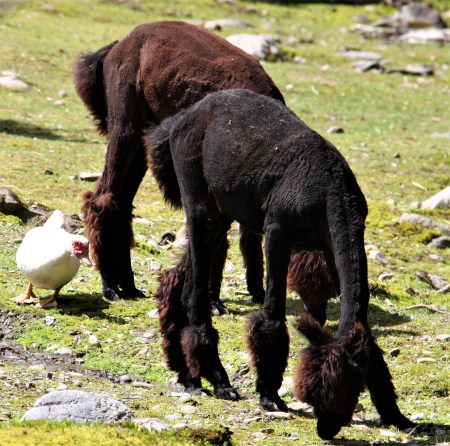
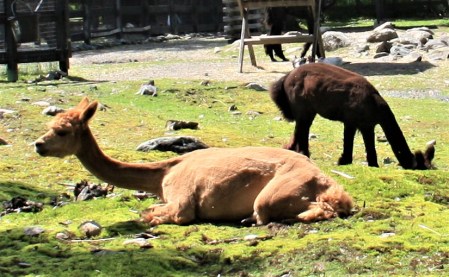
Commentary: I couldn’t find a Welsh sheep in my photo collection, so I used this photo of Pre-Columbian Incan sheep substitutes instead. Llamas is probably a Freudian slip or a typo for lambs. See: there’s reason for everything and a link between all things, even llamas, vicuñas, and alpacas, like this pair from Kingsbrae Garden Barber Shop Shorn Quartet. The other two from the Barber Shop Alpaca Quartet are around somewhere. I’ll go and look. Ah yes, here they are. Listen carefully, and you may hear them sing.

IMG_0119 (2).JPG

Sunday in Wales

IMG_0795.JPG

Sunday in Wales

To be Welsh on Sunday in a dry area of Wales
is to wish, for the only time in your life,
that you were English and civilized,
and that you had a car or a bike and could drive or pedal
to your heart’s desire, the county next door, wet on Sundays,
where the pubs never shut and the bar is a paradise
of elbows in your face and ribs and the dark liquids flow,
not warm, not cold, just right, and family and friends
are there beside you elbow to elbow, shoulder to shoulder,
and the old ones sitting indoors by the fire in winter
or outdoors in summer, at a picnic table under the trees
or beneath an umbrella that says Seven Up and Pepsi
(though nobody drinks them) and it serves as a sunshade
on this Sunday evening when the sun is still high
in the summer sky and the little kids tumble on the grass
playing soccer and cricket and it’s “Watch your beer, Da!”
and the gymnasts tumble over and over the family dog
who hides beneath the table and snores and twitches until
“Time, Gentlemen, please!” and the nightmare is upon us
as the old school bell, ship’s bell, rings out its brass warning
and people leave the Travellers’ Rest, the Ffynnon Wen,
the Woodville, the Antelope, the Butcher’s, the Deri,
the White Rose, the Con Club, the Plough and Harrow,
the Flora, the Pant Mawr, The Cow and Snuffers,
the Villiers Arms, the Cricketers, the Mexico Fountain,
the Church (the one with handles on the prayer books),
God Bless them all, I knew them in my prime.

Comment: In the old days, when there were twelve counties in Wales, each county voted whether or not to permit the consumption of alcohol in public houses (pubs) on Sunday. Those counties who forbade Sunday drinking were called ‘dry’ and the others, who permitted it, were called ‘wet’. I remember hearing about the rush from Sunday Chapel Services in dry counties as the church-goers headed over the border into the wet counties where they could fill up in the proper fashion. The pubs listed at the end of the poem are all in the Swansea or Cardiff area, and yes, I have visited them all. The poem was designed to be read in a single breath … at quite high speed and in a Welsh accent. Alas, it takes me more than one breath now and I, like the ageing church-goers, must stop a couple of times as I wend my way down Memory Lane, from the dry to the wet.

Mannequins


IMG_0836

Mannequins
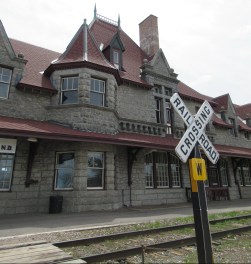
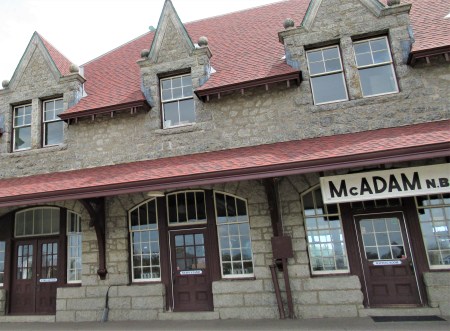
McAdam Railway Station #12

“He startles the unaware, that man by
the door, in uniform, with his youthful
looks and old-fashioned peaked cap,

fingers poised by his silver watch chain
ready to pull out his Waltham pocket watch
and check the time against the master-clock.

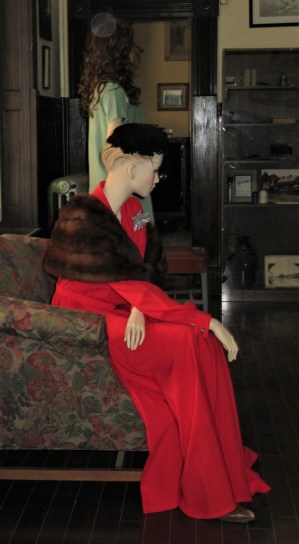
Two ladies wait in the waiting room.
One wears winter robes of red and black
while the other wears velvety green. Both

are motionless, one seated, one standing. Yet
if you watch them from a corner of one eye,
you will see shadowy gestures as their lips move.

Overnight they have changed into summer
clothes, gauzy, almost see-through, flowery
patterns, light-weight wedding boots, laced,

restful, cool, thin-soled. ‘Are you for real?’
I ask the standing one, for a joke. When she
nods and winks, a chill settles over the room.”

IMG_0676 (2).JPG


Tracks

IMG_0777

Tracks
McAdam Railway Station #12

“Put your fingertips on the rail,
see if you can feel its pulsing beat.

No heart rail rhythm now. No tremble.
Put your ear on cold metal:

nothing but silence. No murmur,
however distant. Black fly whine.

No-see-ums flit. The train track’s
buzz of harmony is lost and gone,

replaced by careless nature. Listen
to the wind whistling in the woods,

hark to spring sounds, so subtle,
grass growing, rust accumulating,

sleepers turning over in their graves,
silent, rotting beneath forgotten rails.”

Comment: Nothing so lonely as an abandoned railway track, rusting beneath snow and rain, the wooden sleepers rotting into oblivion. That said, the Southern New Brunswick Railway still carries freight trains through McAdam, and it is the railway station that suffered, with the loss of passenger traffic, rather than the rails themselves. What a pleasure, incidentally, to hear the hoot of the approaching diesel, to count the wagons as the train came to a halt outside the station. Then came the joy of watching the engine separate wagons from the main train, shunt them into sidings, return, and take the freight train, slow at first, but rapidly gathering speed, out of the station and away into the distance. Such memories. So many ghost trains riding those rails. So many ghosts bewitching the windmills of the child’s mind that still inhabits the ageing brain.

IMG_0780


Elevator Pitch

IMG_0627 (2)


Elevator Pitch
Jean Chrétien

His enormous presence filled that tiny
space. His corkscrew smile, well-known tic,
semi-frozen face, that trick of wild speech

butchering language, misunderstood in
both English and French. “Bonjour,” he said. “Good
day.” I nodded, didn’t know what to say,

just shuffled my feet. I remember he
talked on the radio about our land,
how, in winter, with car stuck in snow,

we spin our wheels, forward and back, a bit
at a time until we emerge, content,
victorious. Time and the floors slipped by.

I thought of the elevator pitches
I had written for my films. Should I pitch
him about my latest film or should I

just keep quiet. The elevator stopped.
Jean Chrétien got out. “You’ll be back,” I
said. “Damn right,” he grinned, lop-sided.

Renaissance Hotel. Toronto. Nine-teen
eighty-five. Tongue-tied I had stood there.
Later I thought of all I might have said.

Murals

IMG_0692.JPG

IMG_0659 (2).JPG

Murals
McAdam Railway Station #11

Painting a mural,
inside, interior
wall, knowing it will
stand time’s test.

Viaduct broken,
a tumbled engine,
Canadian workers,
railwaymen all,

some from Macadam,
pebbled the floor,
handrail, radiator
camouflaged for war,

part of the painting.
Depart from the station.
Turn right. Straight ahead,
flaked peeling paint.

So sad, this outside
mural, exposed to winter’s
snow, frost, winds, and ice.
So vulnerable

and so ephemeral.
Such a short-lived
summer, over in a day.
Butterfly on a rock.

IMG_0691 (2).JPG

image1 (2) - Copy.JPG

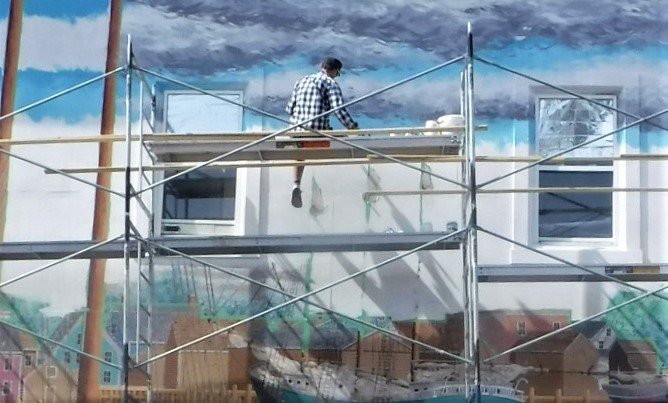
Comment: This sequence comes from the indoor and outdoor work (murals) of my friend Geoff Slater. Geoff told me how ephemeral were the outdoor murals with a life-span of about ten years before they needed redoing. After that, the paint starts to fade, then crack, then dry and peel away. Our Canadian winters with their icy cold and the ensuing springs with their frost and thaw do not help. The protection, no ice, no snow, no sun, no rain, afforded to the interior murals means that they will last so much longer. Our outdoor art, unless cast in the firmest stone, is ephemeral. Like a butterfly, it will not last much longer than a brief summer day. Hence the final metaphor.

Faces

IMG_0258.JPG

Faces
McAdam Railway Station #10

“White at windows
when trains pass through
in June on their way
to summer and sand.

Wind-tousled, tanned
at summer’s end
returning home to
Boston and Montreal.

I remember them
waving their hands,
flickering white hankies
as they went by.

This station is a ghost train
that travels through time
instead of space. Stand
still as silent stone. Wait.

Look: there’s someone,
waving at us now
from that window
on the second floor.”


IMG_0782 (2).JPG