The Exact Word

Le mot juste

Searching for le mot juste
the exact word that sums it all up, 
catches the essence of the thing 
and holds it in the mind forever.

Think flowers. Think scent. 
Think of the limited ways 
we describe how daffodils
lift and clematis clings.

I look across the breakfast table 
and see my wife of fifty years, 
a teenager reborn, walking into 
that café where we had our first date.

I search my memory and my mind 
for the words to describe that beauty, 
that surge of excitement, 
I still feel when she enters the room:

but find I cannot find le mot juste.

Comment: I shortened this poem from its earlier version. You can click on this link to compare the two versions. I am always puzzled by the dilemma of lengthening or shortening. My thoughts center on the longer and shorter versions of some Raymond Carver stories. Follow the editor’s advice and cut all material down to its essential bones or fill out the skeleton with flesh and blood and expand the creative process further. I also think of the exhortation to ‘stay in the moment’. Anything that takes the reader away from the central experience is superfluous. Experienced writers are aware of that moment and its importance. Writers at my stage are often baffled by it and need to be told yes, this is the moment or no, that is not the moment. I guess the more we write, the more we understand the process. Understand: do we work this out consciously or does it develop in unconscious fashion? Are some people just born with those skills or we must work hard to develop them? Sunt rerum lachrimae: tears are in all things and I guess hard work is all part of the process. As I was told a long time ago: genius is 99% perspiration and 1% inspiration. You have to put in the hard work for that little light bulb to go ‘pop’!
Jack Pine and Stars

Jack Pine and Stars

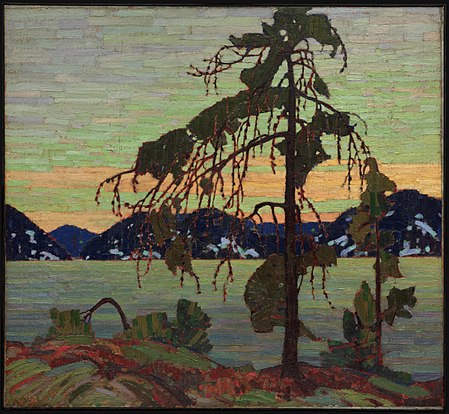
            Sitting on the porch at Tara Manor, measuring the evening shadows as they lengthen and thicken, I study the jack pine’s wild, extravagant growth, the way it reaches out to reject the commonplace of ‘tree’, as Milton Acorn rejected the commonplace of ‘poet’.
            The jack pine grows in radical disorder, sprouting here, there, anywhere the sea wind blows and its capricious nature dictates. Each limb of the jack pine bears a thin layer of salt, borne in from Passamaquoddy Bay by thin fingers of air that sow salt on branches and needles. Broken branches, untidy crows’ nests limb-tangled like grim, bedraggled hair sprout out from on high. Lower down the tree extends a branch, held out towards me like a helping hand.
            Charcoal shadows fill in the gaps between darkening trees. Shy deer emerge, step by cautious step, drifting their sylvan ghosts, delicate, across footpath and lawn. Wrapped in a scarf of peace, I forget the city’s hustle and bustle. Stars poke peepholes in the dark. I try to name each constellation, as it traces its new-to-me path across the indifferent evening sky.
            I look around: more jack pines, no two the same. How could they be? There’ll never be another poet like Milton, another book like his Jack Pine Sonnets, no tale like his own tale told in his own inimitable way.

Yours

Yours

Yours are the hands that raise me up,
that rescue me from dark depression,
that haul me from life’s whirlpool,
that clench around the jaws that bite,
that save me from the claws that snatch.

Yours are the hands that move the pieces
on the chess board of my days and nights,
that break my breakfast eggs and bread,
that bake my birthday cake and count
the candles that you place and light.

You are the icing on that cake, and yours
is the beauty that strips the scales
from my eyes, then blinds me with light.

Some People

Some people leave indelible impressions
memorable moments impressed
on memory’s eye or clasped closely
to the butterfly heart caged in its chest
wings wildly beating as it strives for flight

some people cast shadows on snow
leave footprints light as flakes
as they walk across our waking dreams
or call on us in those midnight hours
when their image sears the drowsing mind

Some people set a fire in our hearts
allow us to see things out of sight
to write what we never thought to write
to reach out to the unreachable
to teach what we thought was unteachable

Stars in night’s silence they point the way
lead us on paths we never thought to tread
present us with a thread to lead us
through life’s labyrinths and out
from the darkness into bright light

Sometimes they cross the rainbow bridge
before we do and when they go we know
deep down in our hearts that they are there
just out of sight waiting for us ready
to welcome us when it’s our time to go

WFNB

Moo

WFNB

I have been a member of the Writers’ Foundation of New Brunswick for a long, long time. I am not a ‘founding member’, but I think I have been a member since around 1985, and I am sure I was a member in 1986, when Goose Lane Editions, Fredericton, published my second poetry collection, Broken Ghosts. I was most certainly a member in 1989 when my still-unpublished poetry manuscript Still Lives placed first in the Alfred G. Bailey poetry competition.

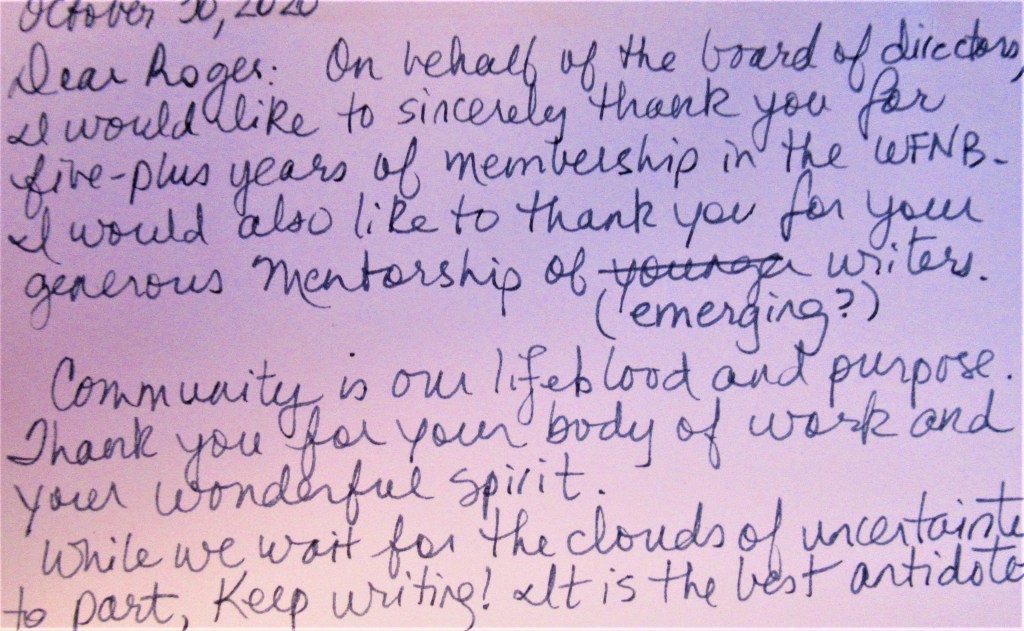
In the years between 1985-1986-1989 and 2020, I have never received a hand-written communication from any member of the WFNB Board, other than an official communication of one kind or another. Imagine, then, my surprise, when the above postcard, inserted in a hand-addressed envelope, arrived in my mail box yesterday. I was truly amazed and very grateful to the president who wrote these kind words to me. Amidst the panic and the pandemic, it is so nice to be remembered and in such a thoughtful way. Madam President: thank you so much for reaching out to me with this verbal gesture. And yes, you can count on my support for yourself and our Writers’ Federation, I hope for a long, long time to come.

I was in two minds whether to post this or not. However, I wish to emphasize several things: the importance of reaching out, the importance of continuing to believe in ourselves and our creative talents during these difficult times, the necessity of creating alternate communities and of supporting each other as much as possible, the need to avoid total isolation and to maintain human contact in different ways when the physical things — meeting, touching, holding, direct dialog — and the normal activities and relationships of healthy human beings are denied to us, and last, but by no means least, the need to encourage each other and to offer comfort and recognition whenever and wherever possible.

Waiting for inspiration
and
hoping to fly!

Downsizing

Books abandoned on the sea shore of life.

Downsizing
Francisco de Quevedo

I chose each book, held it in my hands for
one last time, then placed it peacefully in
its new resting place. Old friends, they were …
I broke that friendship and set my friends free
to fulfill their promised afterlife on
another reader’s shelves.

Mind to mind, though they had
lived five hundred years ago,
I strove to engage them in lively
conversation, Bakhtinian dialogs
within our time and space, and
that space my basement library.

I loved to hear their lilting speech,
to listen to their wisdom with open eyes
and mind. I answered them with words
I quickly pencilled on each page.

One day, a man arrived from the university.
He carried them away in a delivery truck
and they were borne to a wider world.

If you see on, bless it, read it, cherish it.
Blind now my eyes that devoured their words.
Deaf now my ears that heard the dead,
for I can listen no more.

Note: “Escucho con mis ojos a los Muertos /
I listen with my eyes to the words of the dead.”
Francisco de Quevedo (1580-1645)

With thanks to Nicholas Wermuth, who was kind enough to comment and help me revise and restructure this poem.

Survivor

Survivor

Every day, now he’s learning to speak Welsh,
he finds out something new about his childhood.
It’s not the need to talk so much as the necessity
of diving into himself and mining his memories.

Brynhyfryd / Mount Pleasant.
Pen-y-Bont / the End of the Bridge.
Ty Coch / the Red House.

This latter the house in which he was born,
way out of town, by Fairwood Common,
away from the strafing and bombing.
The war generation of his family all born
in the same in-the-country Gower bed.
No room in war-time hospitals
not even for the birth of war babies.

Three of his brothers did not survive
those rough, household births.
He still bears the forceps’ scars
from the moment the doctor
plucked him out, head first,
and hung him up by the heels,
shaking him, bringing him back to life.

He bears other scars as well
from the survivor’s burden of carrying
three dead brothers for seventy long years,
alive and kicking in the womb-warm
crevices of his still beating heart.

Autumn

Autumn
and all that jazz

1

Slow last drag of summer’s sad trombone
sliding its airs between stark, naked trees.

Golden memories float face down in tranquil
waters, life and the summer drained away.

A voice, her voice, ripples across the pond,
echoes over drowned and mirrored leaves.

2

Grey the sky, white the birch trees:
Narcissus kneeling, dark waters flooding.

Tumble-dried by this autumn sky,
leaf words falling, still her voice echoes.

3

Tintinnabulation: a tin-pan alley of leaves
blown against windscreen and car windows.

I, who a grief ago sat here watching her walk,
now sit here alone, waiting for her return.

4

I who am nothing know nothing, save that I
am a burnt-out ember, cold, in a grey-ash grate.

A grating of old bones, these hips and knees,
and if I fall, sweet heart, please love me more.

5

Here endeth today’s lesson: that of the fall,
the fall of all things finally into deep water.

Fall, fall asleep to the rhythmic leaf beat
that summons us all to our appointed end.

Striations

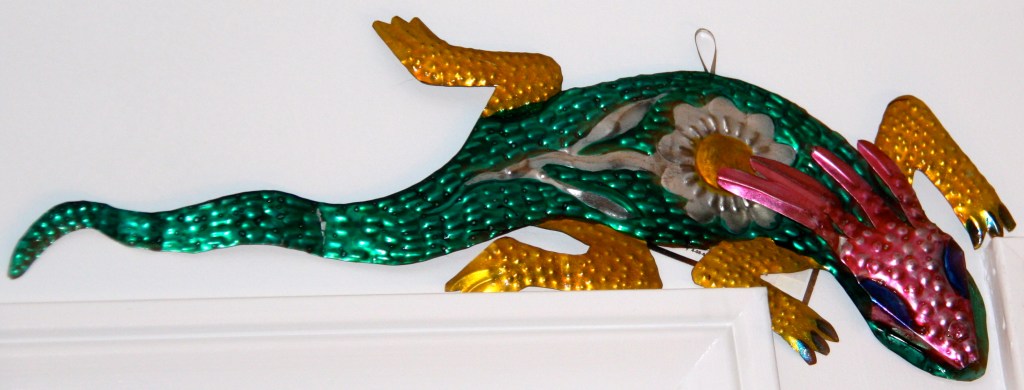
There are striations in my heart, so deep, a lizard could lie there, unseen, and wait for tomorrow’s sun. Timeless, the worm at the apple’s core waiting for its world to end. Seculae seculorum: the centuries rushing headlong. Matins: wide-eyed this owl hooting in the face of day. Somewhere, I remember a table spread for two. Breakfast. An open door. “Where are you going, dear?” Something bright has fled the world. The sun unfurls shadows. The blood whirls stars around the body. “It has gone.” she said. “The magic. I no longer tremble at your touch.” The silver birch wades at dawn’s bright edge. Somewhere, tight lips, a blaze of anger, a challenge spat in the wind’s taut face. High-pitched the rabbit’s grief in its silver snare. The midnight moon deep in a trance. If only I could kick away this death’s head, this sow’s bladder, this full moon drifting high in a cloudless sky.

Comment: This is the prose version, from Fundy Lines (2002). The prose version was based on an extract from a longer poem that first appeared in Though Lovers Be Lost (2000). Though Lovers Be Lost is also available on Amazon and Kindle.

Pilgrim

Pilgrim
Oaxaca, Mexico

Outside the church,
a boy pierces his lips
with a cactus thorn.

The witch doctor
catches the warm blood
in a shining bowl.

He blesses the  girl
who kneels before him.

On her head she carries
a basket filled with flowers
and heavy stones.
He sprinkles it
with her brother’s blood.

All day she will walk with
this basket on her head
until evening’s shadows
finally weigh her down.

Cobbles clatter beneath her clogs.

When the stones grow tongues,
will they speak the languages
in which she dreams?

Comment: Revisiting and revising some earlier poems. The early version can be found here. The original poem comes from the collection Obsidian’s Edge, which can be found on Amazon.