Carlos Carty

IMG_0134 (2)


Journal: Carlos Carty addressed the group of resident artists tonight. Carlos is from Lima, Peru, but he has lived for the past few years in Brazil. He told us how, at the age of 15, he had discovered music while still in school. It was, he said, love at first sight. However, musical instruments were expensive and not easy to obtain, so he learned to play rhythms and music on throwaway things, empty boxes, plastic and glass bottles, material that could be re-cycled. He was self-taught and has had few lessons. However, his explorations have led him to the Pan Flute, the Andean flute, the Chinese (or sideways) flute, and to many of the myriad flute-like instruments that are played in the Andes in general and in Peru in particular.

Carlos is interested in all types of music and would love to be a full-time musician, dedicated exclusively to his music. However, he has a family to look after and music alone will not keep food on the table. This was a problem shared by all the artists in residence. He then told us of some of his difficulties. He also told of his preference for his own people’s traditional music. This music existed before the Incan Empire and long before the arrival of the Spanish conquistadores who laid his land and his people to waste. Part of Carlos’s musical experiments have centered on restoring a melodic happiness to a Peruvian traditional music that is, by nature, sad. Add to this his ability to create music from all types of recyclable material, and you will see Carlos as an innovator. His own compositions demonstrate this innovative spirit and he happily blends any and all types of music to the traditional music as he searches for new ways in which to express himself, his moods, and his emotions.

With regards to KIRA and the Kingsbrae experience, Carlos stated that six months ago, while thinking about his application to KIRA, he realized how important it was to write down his ideas and focus on the elements that made him the musician that he is. From these cogitations arose his ideas on the eclectic nature of music and the necessity to recycle not just music, but the means by which music is made. Music, for Carlos, comes as an imitation of nature. It is the sound of water, of rocks knocking against each other. It is the sound of the wind through grass and reeds, the beating of wood on stone. He also spoke of the various waves of immigrants who came into Peru. The African slaves, in their moments of leisure, expressed themselves in sound, sounds made from the very materials with which they were laboring. This too became a part of Peruvian music.

One of the reasons why Carlos loves the flute is that it is one of the world’s most ancient instruments coming after the percussion of wood on rock and taut animal skin or shells. Flutes go back many thousands of years, to ancient Greece, among other places, and they are the world’s original instruments and bind all cultures together via the international language of music.

Many questions followed Carlos’s presentation. Most of them centered on a clarification of one thing or another. However, thanks to Anne Wright, a very productive theme was introduced: the relationship between North American aboriginal music (especially the first nations peoples of Canada) and the traditional music of other aboriginal American people. This theme merged into the question of identity, loss of identity, and the attempt to recover that lost identity, especially in the current age when so many differences are so easily erased. Language, culture, identity, music … they are all tied closely together. Carlos is an excellent ambassador and has the personality to explore and develop such links as these. Perhaps there will be further room to develop these contacts at a later date.


Scent and Touch

img0137_1

Kingsbrae 9.4
9 June 2017

Scent and Touch

A feather upon the cheek,
this fern frond held
fragile, hesitant
between fine fingers.

Touch and smell:
two senses engaged.
A paint brush sounds,
brush-brushing lightly
the expectant skin.

Faint the taste tested
suggestive
on tongue tip.
No sight, just insight.

I have a sense of senses lacking.
My words reach out like fingers,
but they can neither retain
nor explain the meaning of it all.

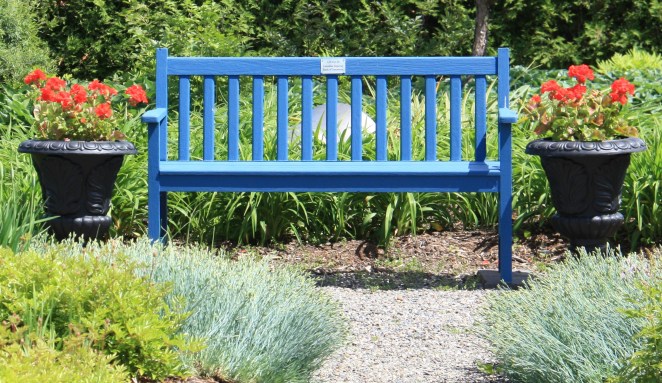
Comment: “Built in cooperation with the Canadian National Institute for the Blind, the Scents and Sensitivity Garden is dedicated to the memory of St. Andrews’ resident Albert McQuoid. The garden features raised beds that allow handicapped, sight impaired, and wheelchair bound visitors the opportunity to enjoy the feel, and scent, of the plants and flowers right within arms’ reach.”

Stone Carving

Elise

Elise in her Studio

Kingsbrae 6.2
6 June 2017

Stone Carving
Elise Muller

Last night, Elise Muller led the second of our after supper artistic discussions. She told  how her grandmother had been a sculptor, but had never talked to her directly about stone sculpting. Later, when at art school, Elise took a course on stone carving and knew immediately that it was what she wanted to do. Something appealed to her and she was hooked.

Elise then showed us a series of photographs that displayed her sculptures in chronological order. She talked about each one individually, the stone from which it was carved, the manner in which she carved, and the effects she was trying to achieve. Movement interested her and she was trying to sculpt a series of movements into her stonework. Her early sculptures featured different forms of movement, fathers and mothers carrying their children, a woman wading,  and so on. At this early stage movement was present, but it was not conceived as an intentional thematic link between sculptures. Her later sculptures, some commissioned, some made for friends and family, were conscious attempts at carving movement into stone.

A statue called Ballerina was sculpted by Elise for her grandfather and shows her own daughter dancing. The slender figure moves elegantly, poised and posed in stone. A companion piece, Ballerino, shows a male figure dancing. Even a perched bird, a Whisky Jack or Grey Jay, carved in stone and perched on a stone pedestal, leans forward in a moment caught by the camera that photographed the stone. Movement, caught in still stone and photos, is everywhere in the later sculptures. Looking at them, time stands still and the stone flows.

Open discussion followed and we chatted about the healing qualities of crystals and how stones too held their magnetism and personalities. Elise talked about the different types of stone, the various marbles, soapstone, granite, and we discussed the fundamental cost of the actual stone, before it was even turned into the work of art. Elise told us how she was attracted to different types of stone and how the raw material would “call” her and attract her attention. Sometimes, she said, she drew her ideas from the stone, however, on other occasions, she would sketch what she wanted to carve and then find a stone that would be suitable. This latter method she associated more with her commissioned work. Elise also told us about the effect of weather upon stone and how some stones could be left outside in sun, rain, and snow,  while others needed more protection.

Art lag, something similar to jet lag, but far more pleasant, was setting in and, a weary group, we adjourned early, leaving behind, with regret, some wonderful ideas and memories, but taking with us images Elise’s creative techniques and mind pictures of the creations that Elise had plucked from her stones.

Encaustic


Anne Mist

Mist Lifting Over The Bay
Anne Wright

Kingsbrae 4.3
4 June 2017

Encaustic
Anne Wright

Anne Wright led the first after supper discussion for KIRA June 2017. She talked about her voyage of discovery into the world of art and explained how she envisioned herself as an abstract expressionist who attempted to place mood, emotion, and feeling into her art work. She showed us examples of her latest works, greeting cards with a combination of pressed flowers and  artwork. She also presented three ‘works in progress’ from her encaustic collection. These have a wonderful tactile quality and seeing them and then touching them gave two very different impressions of her art.

Anne also talked about art as a communion with the unconscious. This may be understood as that which is not yet known or revealed, but is waiting to be given expression.  Art and poetry are the language of the soul, and so can capture something instinctively, before it gains open expression. Words and the meaning into which they distill often come much later and that, according to Anne, is the process of crystallizing the narrative of our lives. Sometimes, as artists, we enter art in order to probe more deeply into ourselves and to discover that which is within us. Anne then led our group into a deeper discussion of this residency and what each one of us, starting with herself, wished to achieve while at Kingsbrae.

Carlos intervened at this point and suggested that we should distinguish between ‘process’ and ‘result’.  With our nightly conversations we are working on the process of how we act and think as artists. Our creativity is in a process of change and this residency gives us time to think and re-think ourselves and thus to concentrate on the how and why we create. In addition, we have time in the individual creative periods to experiment with our creative process. The ‘results’ may be seen as a short term product, i.e. what we produce today, this week, this month, or as a long-term process, i.e. how we grow and develop in a future of which we may not not yet be aware.

Elise responded to this with the story of how she had pushed herself in her sculpting and had, as a result, accidentally broken her own stonework. This was the result of trying to carve a thin, delicate figure from stone. Her effort to create movement in static stonework led to a further discussion into how we attempt to place movement into two dimensional paint. This in turn led to a discussion of classical art with its formality and its entry points versus a more modern art that has no entry point and less formal construction. This responds in part to the twin aspects of reproducing the visual, external world versus creating a new, internal world that represents the inner workings of the artist’s and, by extension, the viewer’s, mind. In this way, what the viewer / reader / listener sees / reads / hears is as important (almost!) as what the creative artist creates.

Ruby spoke of her own art as a narrative line that led into a painting and told, through her painting, a story of her subjects. She spoke of her adventures on the quay where she had spoken with various people and asked permission to photograph and paint them. The contrasts between our different views on our distinct creative methods and how we create / imitate / reproduce / react with our various versions of the world were most interesting. This is an aspect of our residency that will grow and strengthen. It will play a large part in what we are now calling, thanks to Carlos’s intervention, the ‘artistic process’. Needless to say, we are all growing and developing and our creative worlds are growing with us.

Apologia

IMG_0447


Kingsbrae 5.2
5 June 2017

Apologia

Late last night, I opened Alistair Macleod’s book The Lost Salt Taste of Blood and I re-read the first story. I was soon dabbing my eyes with a tissue and blowing my nose.

This morning, I want to destroy everything I have written. I know I don’t possess the verbal and emotional genius of the great writers and I sense that I cannot write like them. Graduate school taught me to be passive, not active, and to write impersonally, choking every emotion when I write. Academia also taught me how to kiss and how to run away with my thirty silver pence. “Never challenge the status quo,” my professors told me. “Learn the rules and disobey them at your peril.”

But here, in this private space where I create and re-create, there are no rules. The enemy is not clear any more and the fight is not one of black against white. It is rather a choice between diminishing shades of grey, and all cats are grey in the gathering dark that storms against my closing mind. Should I destroy all my writing? I wouldn’t be the first to do so; nor would I be the last. And I won’t be the first or the last to destroy myself either. Intellectual, academic, and creative suicide: as total as the suicide of the flesh.

I carry on my back the names of those who have gone on before me as if they were a pile of heavy stones packed into a rucksack that I carry up a steep hill, day after day, only to find myself, next morning, starting at the bottom once again. But this is not the point: the point is that if I cannot write like the great writers, how can I write?

I think of Mikhail Bakhtin and his cronotopos, man’s dialog with his time and his place. I have no roots, no memories, and that is where my stories must start: in the loss of self, the loss of place, the loss of everything. I was uprooted at an early age, soon lost my foundations, and only survival mattered.

I look at the first page of one of my manuscripts. My writing manifesto is clear before me: “And this is how I remember my childhood,” I read. “Flashes of fragmented memory frozen like those black and white publicity photos I saw as a child in the local cinema. If I hold the scene long enough in my mind, it flourishes and the figures speak and come back to life.”

I am aware of the words of T. S. Eliot that “every attempt / is a wholly new start, and a different kind of failure / because one has only learnt to get the better of words / for the thing one no longer has to say, or the way in which / one is no longer disposed to say it” (East Coker).

Are these stories an exercise in creativity or are they a remembrance of things past? How accurate is memory? Do we recall things just as they happened? Or do we weave new fancies? In other words, are my inner photographs real photographs or have they already been tinted and tainted by the heavy hand of creativity and falseness?

The truth is that I can no longer tell fact from fiction. Perhaps it was all a dream, a nightmare, rather, something that I just imagined. And perhaps every word of it is true.

I no longer know.

Yellow Bird

IMG_0176

Kingsbrae 5.1.1
5 June 2017

Yellow Bird

Broken-winged, a bird I found,
panicking upon the ground.

I stooped to lift it from the land:
it nestled in my open hand.

A matchstick splint with cotton tied,
a canary cage to rest inside.

With healing done, an open door:
my yellow bird will fly no more.

I take a pencil, draw a tree,
my bird begins to sing for me.

I erase the cage bars, one by one,
paint a lion’s mane of sun.

Now yellow bird sits in his tree,
and sings all day, to inspire me.

Comment: I split the original post into two segments. The first, 5.1.1 is the poem Yellow Bird and the voice recording. The second, numbered Kingsbrae 4.3 Encaustic, contains the summary of the first evening’s artistic discussion.

Triumphs


Avila 2008 006.jpg

Triumphs

Now is the time of minor triumphs:
waking to birdsong in the morning,
making it safely to the bathroom,
shaving without cutting my face,
getting in and out of the shower
with neither a slip nor a fall,
drying those parts of the body
that are now so difficult to reach,
especially between my far-off toes,
pulling my shirt over sticky patches
still damp from the shower,
negotiating each leg of my pants,
tugging the pulleys that permit
my socks to glide onto my feet,
forcing my feet into my shoes,
hobbling to the top of the stairs
and lurching down them, left
then right, one step at a time …

Battle Axe

img_0199

Battle Axe

Grim-faced, ageing,
wrinkles bone-deep
sculpting her skin
into unsightly waves,
a grimaced frown,
much practiced,
worn as a mask
to keep the world at bay.

Over her shoulder,
the mail-pouch slung,
brimful of letters,
bills, in all probability,
their content unknown
until the recipient’s
thumb or pocket knife
slits open the envelope
and reveals the secrets.

She carries more secrets.
They bob along in the streams
that flow beneath her skin
where joy and sorrow mingle.

Tomorrow, the surgeons
will perform their biopsy
and search out those secrets.
For now, she walks
with her eyes cast down,
unwilling  to meet
my all-seeing gaze.

Double Trouble

IMG_0473.jpg
Double Trouble
“I’ll need some ID,” the guy selling Fred a new cell phone said. “Something with a photo on. May I see your driving license?”
“Of course,” Fred pulled out his driver’s license.
The salesman took it, glanced at the picture, walked over to the computer, and started to type in numbers. Fred watched him as he nonchalantly punched the keys. Then Fred saw him stiffen and straighten up as he held the license up to the light, double-checked it, and frowned.
“I’m sorry, sir,” the salesman said, looking very sad. “This license has expired. It’s more than two years out of date.”
“You’re joking,” Fred said
“No sir,” the salesman replied. “This license expired two and a half years ago.”
He handed it back to Fred who also checked it with care. At first, the figures seemed blurred. Fred took out his glasses and put them on.
“You’re right,” Fred said. “It is out of date. I must have the new one in here somewhere.”
He started to rummage through all the plastic cards in his wallet. But there was no new driving license.
“I must have left it at home,” Fred muttered.
“They usually shred the old licenses,” the salesman smiled. “They never let you keep them. You must have forgotten to renew.”
Fred placed his hands on the cell-phone counter, looked down, and saw his face mirrored in the shiny plastic. He gazed into his own eyes and they looked back at him. Then his mind flashed back two and a half years.
He had just been through the biopsy, a messy, painful, and unnerving affair, and the results had come back positive.
The urologist demanded a new battery of tests: X-rays, bone scans, blood tests, MRI’s, examinations, more examinations, questionnaires, discussions about possible forms of treatment …
The different treatments were set out like food in a self-serve restaurant and, like the strange foreign foods that Fred liked to try without knowing exactly what they were, their names meant nothing to him.
Then there was the travel: out on the road between his little place in the country and the major cancer hospitals in the province with an examination here, and a consultation over there. All the medical staff he encountered were kind and helpful and the suggestions they offered were sound. The winter road conditions complicated matters, though, and twice he was forced to cancel appointments because of road conditions.
Then, a week or so after the MRI, the allergic reactions set in and, over a three week period he lost all the skin, first off his hands, and then off his feet. He watched the skin bubble, then he saw it go very dry, and then it just flaked off. He remembered getting out of the shower one morning, drying his feet, and staring down at the little pile of flaked-off skin that had come away with the towel.
A little later on, came the injections, the tablets, and that was before the start of radiation treatment …
Now, two and a half years later, Fred’s driving license, the one that should have been renewed on his birthday, had expired. He remembered that birthday well. He lay on his side in the hospital and the specialist drove that first needle into his buttock … what a birthday present. And now, two and a half years later, he had another special gift from that birthday, an expired driving license.
He thanked the cell-phone salesman, put his expired driving license back in his wallet, and said how sorry he was that e would be unable to purchase the cell-phone at this time.
Early the next morning, Fred went down to the Driving License Renewal Center to discover his fate.
The lady on the counter was most sympathetic. She listened to his story and told him not to worry.
“Don’t worry,” she said. “It happens all the time. But I’m afraid you’ll need to take all the tests again, including the road test. That’s the law. I’ll need to see some documentation. A photo ID is preferable. Do you have your birth certificate or your passport with you?”
Fred nodded. He had checked online to see what he needed and had brought all the right documents. He handed the passport over.
The lady behind the counter took the passport, opened it, and looked up at Fred with a sad little smile.
“I’m sorry, sir,” she said. “You are in trouble. Your passport’s expired as well.”