Summer in Swansea

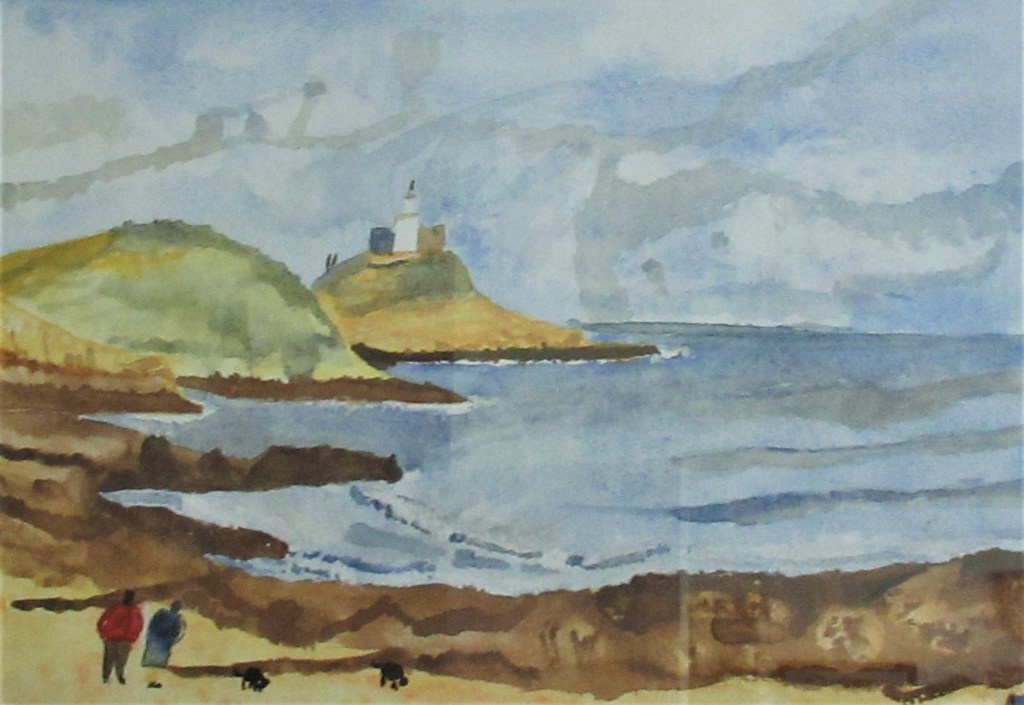
My Uncle Frank’s first water color:
the Mumbles Lighthouse from Limeslade

              … but it’s watch out for the dog, for the dog gets everywhere because he’s on holiday too and everybody’s on holiday in this little sea side town and the cousins have come down from London with their cockney accents, born within the sound of Bow Bells, though they’re half Welsh by blood, though you wouldn’t believe it with those incredible accents which nobody can understand … and they’ve never seen the sea, though their mother was born here, beside my mother, beside this self-same sea which has never left and which still flows in and out, even now, and it still flows through my bones and “Look at all the water!” my youngest cousin cries and then he really cries because London, the capital of England, is concrete and tarmac and all petrol smell and smog and fumes and busses and he’s never ever seen the sea, the sea’s open spaces, the wide open arms of the bay held out to embrace you with Swansea Docks on the left, a working area of ships and shipyards where my grandfather labours and takes me on workdays, even in summer, and shows me the ships and his friends and everyone is happy and laughing because it’s summer and it’s hot and there’s lots of employment and the banana boats are lining up in the bay, at low tide, waiting for high tide, when they can enter harbour and be unloaded and this happens all year round, but it’s really in summer, when the sun is as yellow as the bananas, that the banana boats become significant and we show them to my cousin who has never seen the sea nor the banana boats, though he knows what a banana is and where to buy them and what they cost, but he never knew they came in on these boats, these great white summer boats, from Africa and the Caribbean,  with their funnels all yellow and their bright stripe of blue, Elder and Fyffe, and the boats all lined up in the bay and look: to the right there’s the Mumbles and the Mumbles has a pier and a playground and you can go out and walk on the pier and at the end there’s the life boat and the life boat has a slipway for the life-boat to run down into the sea to rescue people who are shipwrecked, but only in winter because in summer the sea is calm and shiny and it runs in and out twice a day, like an obedient dog, and why is the beach wet? Because the sea weed … and the pier is a world full of wonders, with its peep shows and its games and the old men fishing off the end, chatting and gossiping, and not ever worrying about whether or not they catch the fish which many of them throw back anyway, so they can catch them again tomorrow  …

After the Lecture

After the Lecture

After I delivered the lecture at London University, as it was back then, I caught the tube and descended at Paddington station. While waiting for the train back to Cardiff, I sat in the station bar and ordered a pint of beer and a Cornish pasty. An older man wearing a sweater and jeans asked if he could join me. I didn’t say ‘yes’ but he sat down anyway and straight away began to talk.
            I paid no attention to him until he rolled up his sleeve and showed me the collection of scars that ran crisscross, hard and welted, over his left wrist.
            “Failed attempts,” he said. “But I’ll get it right next time. “I wouldn’t want you to make the same mistakes I did. If you want to kill yourself, you must do it this way,” he reached across the table and picked up the knife I had used to cut my pasty. He pulled out a dirty hanky and wiped the knife in it. Then he laid the blade not cross-wise but parallel to the artery in his wrist. “And you must dig deep, first time, and at a slight angle.”
            “I’ve got to go,” I told him as a tinny voice came over the Tannoy. “That’s my train.” I stood up, leaving the remains of my pint and my pasty on the table.
            I got to the door of the station bar and looked back. Then I watched as my table companion finished my pasty and reached across the table to claim the remains of my beer.
            “Quite the lecture,” I thought. “Good job I didn’t spit in the glass.” Then I realized that both my day’s lectures had been effective, in one way or another.

To be Welsh on Sunday

To be Welsh on Sunday
in a dry area of Wales

              To be Welsh on Sunday in a dry area of Wales is to wish, for the only time in your life,  that you were English and civilized,  and that you had a car or a bike and could drive or pedal to your heart’s desire, the county next door, wet on Sundays, where the pubs never shut  and the bar is a paradise of elbows in your ribs and the dark liquids flow, not warm, not cold, just right, and family and friends are there beside you  shoulder to shoulder, with the old ones sitting  indoors by the fire in winter or outdoors in summer,  at a picnic table under the trees or beneath an umbrella that says Seven Up and Pepsi (though nobody drinks them) and the umbrella is a sunshade on an evening like this when the sun is still high  and the children tumble on the grass playing  soccer and cricket and it’s “Watch your beer, Da!” as the gymnasts vault over the family dog till it hides beneath the table and snores and twitches until “Time,  Gentlemen, please!” and the nightmare is upon us as the old school bell, ship’s bell, rings out its brass warning and people leave the Travellers’ Rest, the Ffynnon Wen,  The Ty Coch, The Antelope, The Butcher’s, The Deri, The White Rose, The Con Club, the Plough and Harrow,  The Flora, The Woodville, The Pant Mawr, The Cow and Snuffers — God bless them all, I knew them in my prime.

Comment: When I lived in Wales, a long time ago, there were twelve counties and each one of them voted whether or not to allow open pubs and hence drinking on Sundays. The ‘dry’ areas did not permit drinking, but the wet areas did. Hence there was mass migration from dry to wet every Sunday, especially after Sunday morning chapel. I dedicate this piece to every dedicated Welsh boy who fled his dry county to quench his thirst in a wet one! NB This piece should be read out loud, fast, in a Welsh accent and also in a single breath! Mind you, I find that hard to do nowadays.

Don’t Look Out

Don’t Look Out the Window

Don’t look out the window, you don’t want to
know what’s lying out there. Don’t look out.

Play ostrich. Place your head in the sand,
pretend there’s nothing there to worry you.
Pretend you can see the missing PPE,
the vanished masks, the surgical gloves,
the sanitized hand-wash that everybody needs.
Just don’t look out the window. Don’t look out.

Pretend there’s nothing out there. Deny that
nearly two million people are ill.
Deny that a hundred thousand have died,
not in vain, but from ignorance and vanity
 and a total denial of scientific truth.
Just don’t look out the window. Don’t look out.

Just look at these walls that surround you.
Smile back at the smiling faces, the nodding heads,
the puppet-string politicians who agree with
every piece of nonsense that issues, meaningless,
from empty mouths. Surround yourself with people
who believe what you believe, who think and do like you,
fellow narcissists and bullies, cheats and liars,
who have deceived and stolen, lied like you, to build
enormous fortunes while they have cheated on
their wives, gone bankrupt, and borrowed shady money
in questionable deals with shabby, foreign banks.
Don’t look out the window. Don’t look out.

All those employees know a bum deal
when they are on the sharp end of one.

But nobody speaks out and nobody,
but nobody, dares open those curtains
for fear of seeing that reborn beast,
its hour come at last,
slouching down the streets.
Close your eyes. Don’t look out the window.
Don’t look out.

Comment: I rarely comment on political events, let alone write poems about them. That said, I do not consider this poem to be a political statement. For me, the key to the poem can be found in the final five lines beginning with ‘for fear of seeing …’. I have explored inter-textuality before in these pages. I hope the reference to W. B. Yeats’ poem The Second Coming, is clear.

Kite

Kite Flying

So light, the kite,
a butterfly in flight.

Breeze battered,
sky-blue shattered.

Children stare
seeing the wing-shape
fluttering there
rising on flimsy air.

Diving, dipping,
nylon cord slipping,
finger-flesh ripping.

Here come others,
children and mothers.

Butterflies, bright,
ready for flight,
fighting wind-might:
a child’s delight.

I didn’t have photos of a kite.
I offer some humming birds instead.
Listen closely:
you can hear them hum.

Blue and Green

“Blue and green
should not be seen
without a color
in between,”
thus spoke my mother.

What did she know
of the Peace Park grass
sweeping spring-clean
to head pond waters?

Didn’t she sense the frail
brown fringe of rock
scarfing between green
grass and head pond blue
or the white caps lacing
cow parsley on the stones?

I know she knew nothing
of yellow and red leaves,
brown spotted like an old
man’s hands, freckling waters,
fretting at the fragility
of nature’s delicate balance.

My Grandfather’s Chair

18581930_1306791786107970_4016640231053970709_n

My Grandfather’s Chair
For Margie Goldsmith

“Write about that chair,” Margie said,
and I wondered what was in her head.
How can I write about that chair
when those who sat in it are not there.

Before the coal fire my grandfather sat,
snoring away, on his lap slept the cat.
At three years old, I climbed that chair,
and blew on the bald spot in his hair.

So many things we no longer know:
my grandpa did the same thing, years ago,
and years before that, his own grandad
did just the same to make his old man mad.

Now I, in my turn, when I drink deep,
like to sit in that chair for a little sleep,
and my grand daughter, there’s no grandson,
climbs up that chair, as others have done,

and sees the bald spot in my hair
and blows and blows as I snooze there.
The years roll back and I see the smiles
of generations woken by a young child’s wiles.

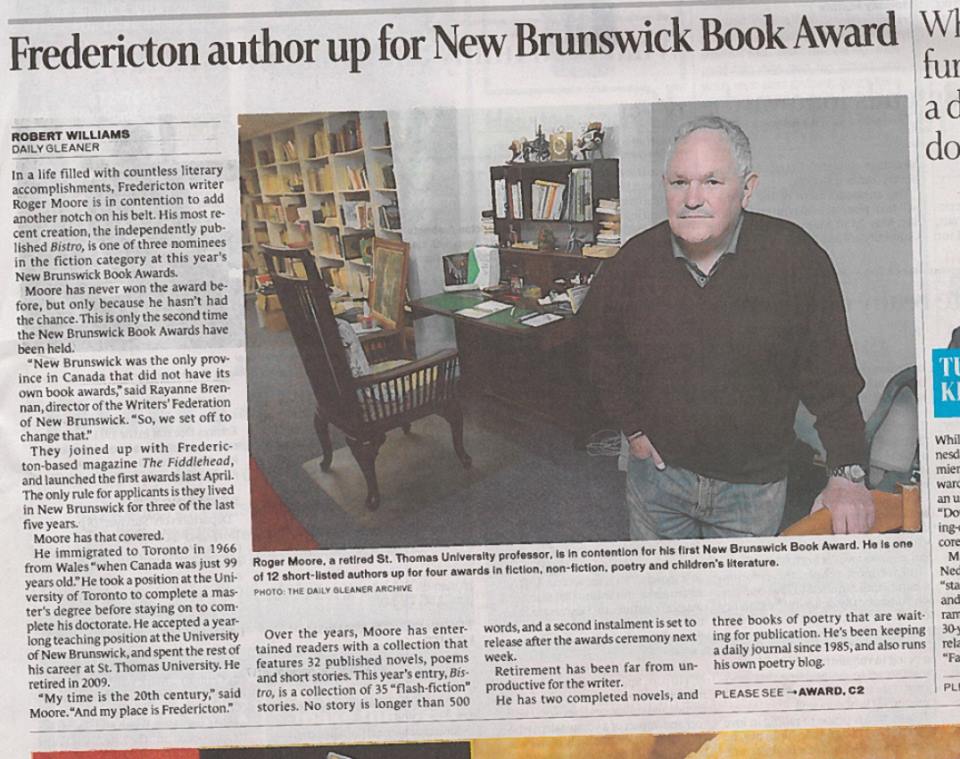
Comment: Talking the other day, I mentioned my grandfather’s chair, the only piece of furniture rescued from my parents’ house, and Margie said I had to write a poem about it. So, last night I did. The result is something very different from what I normally write. This is what in Spanish is called an occasional poem and it celebrates a specific occasion, a specific set of circumstances. Thus, it is written under different rules, rhyme, rhythm, stanzas. It is always an adventure to write something suggested by someone else. Poems like this cross the boundary between poetry of play (which this is) and occasionally enter the realm of poetry that expresses the authenticity of being which, to a certain extent is present in this poem too. The above photo, from our local newspaper, The Daily Gleaner, is the only one I have of the chair which resides in the basement where I keep my books. The article is an old one (2017), but the photo is nice!

Rain Again

The rain in Spain
does not stay on the plain

Rain
              When it rained in South Wales, it rained everywhere soaking rich and poor alike. There was no escaping the eternal wetness of Welsh Rain. Whenever we traveled, especially by bus, to another part of Swansea Town, it would be raining there too, but, as my auntie used to tell us when we came back home: “Smile now. Look happy. And remember: we had lovely weather all day. The sun was shining over there where we were. Raining here, at home, all day, was it? What a pity. You should have come on the bus with us!” I remember her smiling, all wrinkles round the eyes, her false teeth shining white, as she flashed a horse’s collar coal-scuttle of a grin, absolutely shameless. But we’d back her up. We’d all smile happily and laugh, and dance, and jump up and down, basking in the joy of the falsified sunshine of her wonderful smile, her shining false teeth. And she was right: where we had been together, the sun had shone all day, in spite of the umbrellas, our wet, cold feet, and all the undoubted evidence of a day of rain.


Empty Nest

fundy 05 mist+wolfepipers 153

Emptiness
is an
Empty Nest

The wind at the window
scratches tiny notes.
I can no longer hear the tune
nor read the words.

Who walks beside me
as I pace my lonely path,
abandoned
in this empty house.

My self-portrait
stares back at me:
a splintered selfie,
framed in a sliver
of silvery glass.

Above me,
the monkey-faced moon,
that itinerant tinker,
walks a fractured way
over broken glass.

The knapsack on his back
is cobbled together
from a finery of cobwebs
and clumsy clouds.

IMG_0039

Bath Time

62074164_10157302392400522_2936552509885382656_n

Bath Time

              My grandfather took a bath once a year, On New Year’s Eve, so he could be ready, so he said, washed and clean, for the New Year. His bath day / birthday was a family event. If we wanted a bath, well the bath water didn’t stay hot for long in the bath-tub at the top of the house, under the rafters, so an old tin bath was dragged into the kitchen and a black, iron kettle was placed on the hob, and water was boiled. One by one, we were immersed, and scrubbed, to emerge pink and glossy. All this happened in the kitchen in front of the fireplace, where we sat up wrapped in bath-robes and blankets, drinking hot cocoa so we wouldn’t catch cold. But my grandfather took his bath at the top of the house, under the rafters, in the old chipped enamel tub with its lion-claw feet, water-stained sides, and its old brass taps. He walked up there fully clothed, walked into the bathroom, and shut the door behind him, drawing the bolt with a finality that shut us all out. He sang the great choruses from Aida, and Nabucco, and we imagined him, wallowing there, in the warm water, with all his clothes on, for it was hard to imagine my grandfather naked. Then, half an hour later, he would emerge, looking just like he did when he walked into the bathroom. We never heard the water running, nor did we hear it draining away. All we heard was the The Hebrew Slaves’ Chorus and my grandfather swinging his Blacksmith’s hammer as he battered at the New Year’s Anvil.

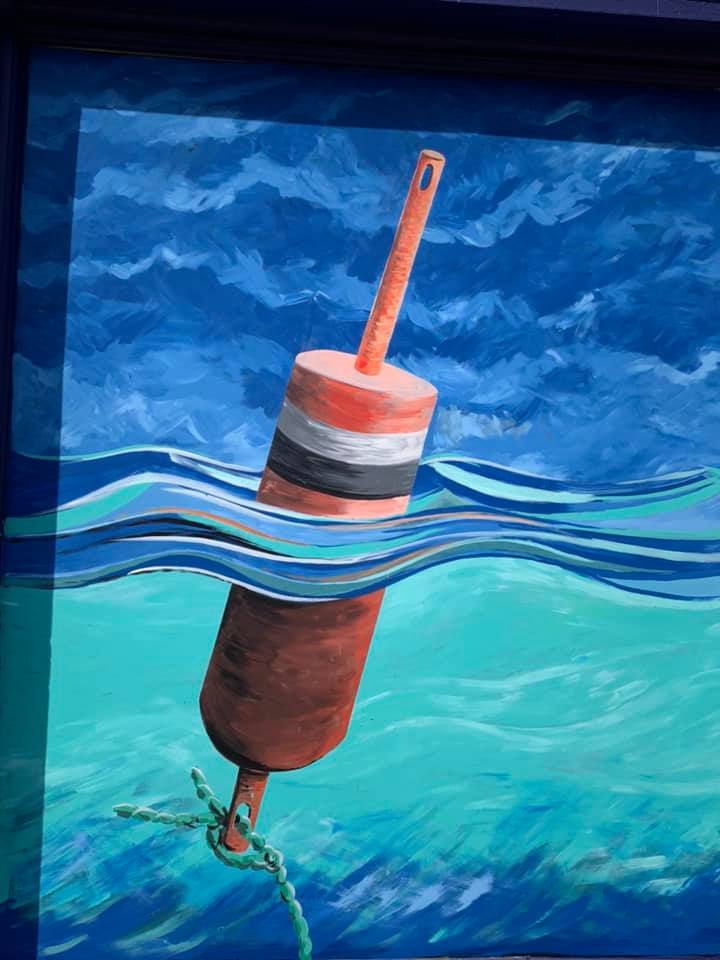
Comment: I didn’t have a photo of an old bath tub in my collection, so the lead picture is one of Geoff Slater’s murals: a buoy (pronounced ‘boy’ in Wales), taking a bath in the sea.  Let me know if you like these Welsh childhood memories, and I will keep adding to them. They are certainly fun to write and I find incredible the many ways in which memories surge as I am learning to speak Welsh. Each new chapter in my journey seems to start a new wave of thought.