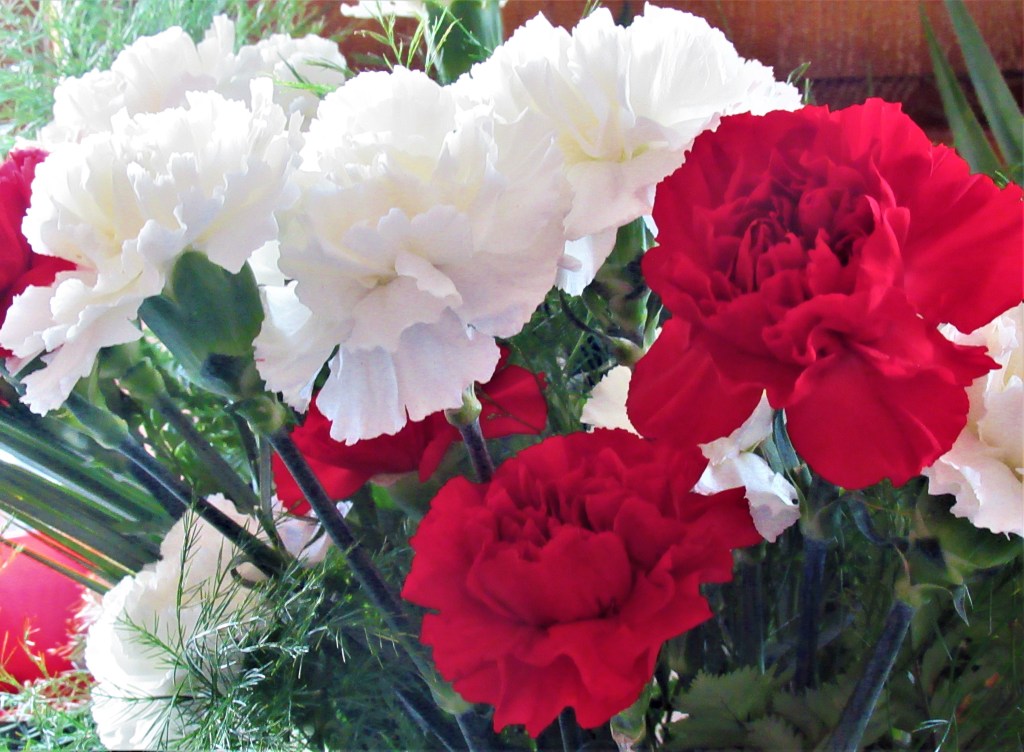
Where e’er she treads, the glossy flowers shall rise and light, like the light of flowers, will pierce any gloom and brighten the room.
Silence
When I wait for words to come and they refuse, I know that silence is golden and spreads its early morning sunlight across the breakfast table where yellow butter melts on hot toast.
Light from the rose window in Chartres once spread its spectrum over my hands and I bathed in its speckled glow.
My fingers stretched out before me and I was speechless, for in such glory, mortal things like words cease to flow.
So much can never be said even if it is sensed: fresh coffee, poutine à pain, bread baking, flowers bursting into bloom, the sense of immanent beauty that fills me each time my beloved enters the room.
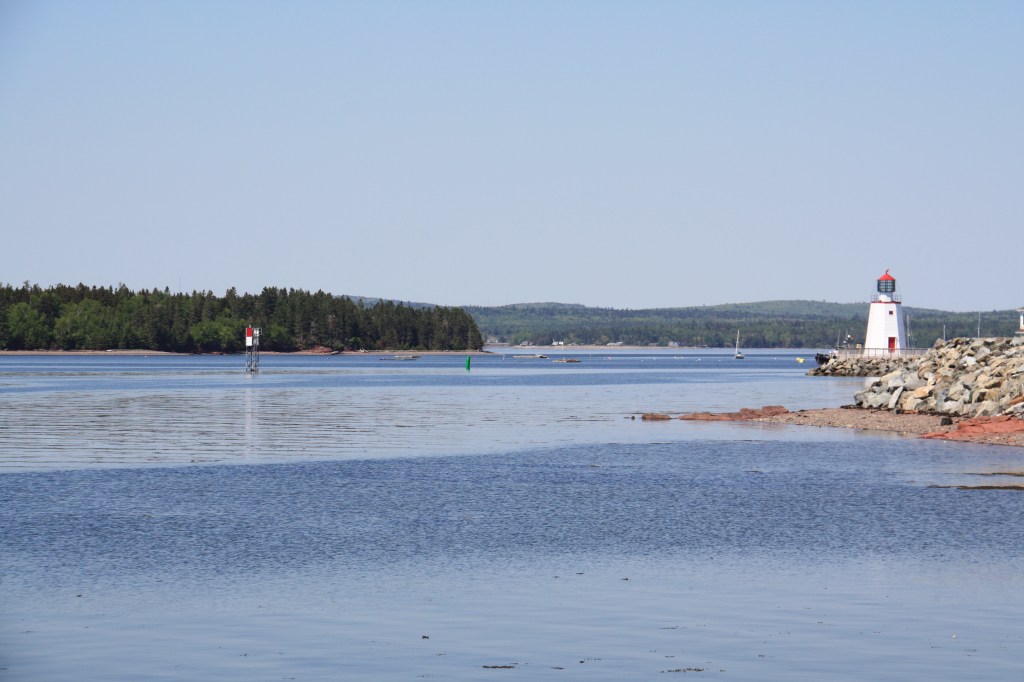
A lighthouse to light your way, shining to make the night as clear as day and to highlight any obstacles that might stand in your way.
Lighthouse
Once upon a time that lighthouse on the quay was a young boy who sat within the shadow of his father’s tale. He sensed he would never feel the power of his own words because he didn’t seem to have any on account of the black hole inside him that swallowed everything up. He thought he would never know the joys of creating his own myths, telling his own story. He thought he would never come to grips with storm music, wind and rain, a lost path sought and found. He longed for someone to gift him a rainbow, with or without its pot of gold. He also thought that the fatal shadow, cast upon a child by a father, would always be there. One day, the early morning sun knocked on his bedroom window. He drew back the curtains and let in the light. That day, he emerged from the shadow and saw that the world was bright and filled with sunshine. Each morning, he breathed in the sunlight, felt it flow through his body. His heart pumped new blood and he was refreshed by the joy of living, of being himself, of being nobody but himself, unique and wonderful, subject to nobody’s wishes and whims. Gradually he grew into the person he was always destined to be. The sun’s rays lit up his face and eyes. Sunshine flourished within him and renewed not only him but all that he touched. Light flooded out like the beam from that other lighthouse, over there, on those rocks, that was put there to help and guide wayfarers and seafarers lest they become lost at sea. Lost, he found himself. Found, he centred himself. Joy and hope, belief and knowledge took root under the sun that each day nourished his body, soul, and spirit. Renewed, light flooded from him. He burned like a bonfire or a beacon and became one of those special lights that enlighten the world. He became that lighthouse.
Comment: One of the prose poems from Tales from Tara that slipped in here by accident. I have included it for, and dedicate it to, my good friend and fellow writer, Judy Wearing, to wish her well with health and strength in this new year that is now turning into something special.
Photo by my good friend, Geoff Slater. Books by yours truly, who stayed on the bus and believed.
To be a writer ….
He who would true valor see, let him come hither. One here will constant be, come bad or fair weather. No line length can him fright, he’ll with a paragraph fight, and he will have a right, to be a writer.
Those who beset him round with dismal stories, do but themselves confound: his strength the more is. There’s no discouragement will make him once relent his first avowed intent, to be a writer.
Rejections nor bad critics can daunt his spirit. He knows he at the end will a book inherit. So critics fly away, he’ll fear not what they say, he’ll labor night and day to be a writer.
Comment: John Bunyan tempted me and I fell into temptation. In fact, as my good friend Oscar Wilde once said: “I can resist anything except temptation.” So, ladies and gentlemen, change the he to a she or the pronoun of your choice, turn the writer to a sculptor, stoneist, poet, playwright, painter, novelist, dramatist, comedian, song-writer, singer. Breathe deep. Believe in your own artistic talent and remember: “Genius is 99% perspiration and 1% inspiration.” Remember this too: “You’ll never get to Vancouver by bus, if you get off the bus at Montreal or Toronto.”
Married 54 years ago today. What a way to celebrate with 3 poems to Clare on QBF. My thanks to Brian Henry and Quick Brown Fox.
Yours
Yours are the hands that raise me up, that rescue me from dark depression, that haul me from life’s whirlpool, that clench around the jaws that bite, that save me from the claws that snatch.
Yours are the hands that move the pieces on the chess board of my days and nights, that break my breakfast eggs and bread, that bake my birthday cake and count the candles that you place and light.
You are the icing on that cake, and yours is the beauty that strips the scales from my eyes, then blinds me with light.
Comment: what excellent timing: thank you for publishing three of my poems to Clare and on our 54th wedding anniversary too (24 December 2020). An incredible gift and Clare and I both thank you for it, Brian. How to make a memorable day even more memorable. Tonight, when we open the champagne, we will have a glass for you on the table. Much as we would appreciate your presence, the two week quarantine on entering New Brunswick places a blanket over so many invitations and celebrations. That’s why every little helps, and this is so much more than a ‘little’, it is a lot, a very thoughtful lot. So, for Brian, his family, and all my family and friends: tonight we will be alone in our home. But we will raise a glass to absent friends, and we will be together in our hearts. “To absent friends”!!! Here’s the link to Brian’s page.
Silence in the garden. A hawk perched nearby. There are so many ways to die.
Death by Devilry
Silence in the garden. A hawk perched nearby. There are so many ways to die.
A cerebral bleed, minor, but enough to send him to hospital and keep him there.
Cured, ready for release, he would need extra care and added attention.
The devil lived in the small print. Too much attention needed now: his care home wouldn’t care for him.
Back to the old folks ward he went. There he lay, waiting for a vacancy in a home that would really care.
One day, Covid came a-visiting, stalked the ward that night, choosing its victims: you, you, and her, and him.
What killed him? A cerebral bleed, a minor stroke? Or a major stroke from the devil’s pen?
Bold words, bare words, a barren ward, another vacant place around a Christmas table.
Comment: Sitting at the breakfast table, with an empty space before me, I penned these words. So tragic, so avoidable. Yet how many families have gone through something similar in the past twelve months? How many empty spaces are there, vacancies that will never again be filled? I look at today’s figures from the USA: 18,466,231 infected and 326,232 already perished, an increase of 227,998 and 3,338 since yesterday. I am reminded of the words of Pink Floyd: “Is there anybody out there?” Blas de Otero also echoes through my mind: “levanto las manos: tu me las cercenas” / I hold up my hands: you cut them off. And yet it is Christmas Eve and there is still the Christmas promise of joy, and hope, and a new year entering. Let us raise our hands in prayer: and let us pray they are not hacked off.
Searching for le mot juste, the exact word that sums it all up, catches the essence of the thing and holds it in the mind forever.
Think flowers. Think scent. Think of the limited ways we describe how daffodils lift and clematis clings.
I look across the breakfast table and see my wife of fifty years, a teenager reborn, walking into that café where we had our first date.
I search my memory and my mind for the words to describe that beauty, that surge of excitement, I still feel when she enters the room:
but find I cannot find le mot juste.
Comment: I shortened this poem from its earlier version. You can click on this link to compare the two versions. I am always puzzled by the dilemma of lengthening or shortening. My thoughts center on the longer and shorter versions of some Raymond Carver stories. Follow the editor’s advice and cut all material down to its essential bones or fill out the skeleton with flesh and blood and expand the creative process further. I also think of the exhortation to ‘stay in the moment’. Anything that takes the reader away from the central experience is superfluous. Experienced writers are aware of that moment and its importance. Writers at my stage are often baffled by it and need to be told yes, this is the moment or no, that is not the moment. I guess the more we write, the more we understand the process. Understand: do we work this out consciously or does it develop in unconscious fashion? Are some people just born with those skills or we must work hard to develop them? Sunt rerum lachrimae: tears are in all things and I guess hard work is all part of the process. As I was told a long time ago: genius is 99% perspiration and 1% inspiration. You have to put in the hard work for that little light bulb to go ‘pop’!
Warm in Bed. Cozy. I roll over and the flashlight clipped to my Teddy Bear’s ear drives its hard, metal lump into my face. “Are you awake?” Teddy’s soft voice lilts across the pillow. “I am now.” “Look!” Teddy points with his little leather paw. “The moon: it’s climbing the fir tree.” Sure enough, a thin fingernail of gold is perched on a branch. It hides its face among the fir’s darkness and vanishes for a moment. “The maple tree has a garland of tiny Christmas lights,” says Teddy, pointing again. “Those aren’t Christmas lights, they’re stars.” “Spoilsport. Look, that one’s moving. I think it’s an angel.” “What time is it, Teddy?” “I don’t know.” “Here, lend me your flashlight.” I pull him towards me, switch on the torch, and focus its light on my wristwatch. “4:55 AM. That’s the early morning flight from Toronto. It’s a plane.” “I’d much rather it was an angel.” “Me too.” “Can we pretend it’s an angel, a Christmas angel?” “Of course we can. But it’s gone now.” “Perhaps angels don’t live long when they come to earth.” “I think they live for ever. Especially if we believe in them.” “Do you believe in angels?” “I was taught to believe in my guardian angel.” “What’s a guardian angel?” “He’s the one who looks after you when you sleep at night.” “But you don’t need a guardian angel. You’ve got me.” “But you’re a teddy bear, not a guardian bear.” “That’s true, but you’ve got Blueberry. He’s your guardian bear. Look at him standing there, on guard, all night long to protect you from the Night-Bumps.” “Ah yes, good old Blueberry. I’ve got a busy day today. I need some more sleep.” “Okay. Blueberry and I will watch over you. I’ll watch over you. I’ll let you know if any more angels climb the tree.” “That would be nice. Now I’m going back to sleep.” “Good night. Or should that be ‘good morning’.” Some days, when I wake up, I think I have dreamed all of this. Other days, I believe in talking teddy bears and angels. Today, I’m not so sure.
Los toros de Guisando, pre-Christian Celtic stone bulls, Avila, Spain.
Invisible Scars
Our minds absorb words as blotting-paper soaks up ink. Phrases carve beehives deep in our inner circuits. No te preocupes / don’t worry. Yet tone and carry are different in each language and the comfort-blanket serenity of note preocupes does not translate easily from Spanish to English. The verbal vibes are just not the same. Nor do the catcalls from the soccer, aimed equally at opponent and referee, and tumbling raucous from the stands where people sit. Shrill whistles sound in the bull ring: a matador who seems afraid to approach this particular bull for reasons only known to him, yet his shakiness visible to all who watch and understand what they are seeing. The Cordobés answers the telephone he places on the bull’s nose, yet fails to approach between the horns and his sword rebounds off bull bone: pincha hueso. Each one wounds, the last one kills. El Viti, stately, graceful, an elderly churchman proud of his vocation and always willing to perform to perfection the weekly ceremony of the sacrifice. The boos when the bull enters the ring, stumbles, and comes up lame and limping. The cheers that accompany the arrival of the seventh bull. The refusal to eat meat that has been slaughtered in the bullring, even though it is advertised outside the butcher’s: tenemos solomillo de toro de lidia / we have tenderloin steaks from fighting bulls. Bulls who have led the best of lives, fed on the tenderest pastures, watered by flowing streams. Bulls grown for slaughter and public sacrifice.
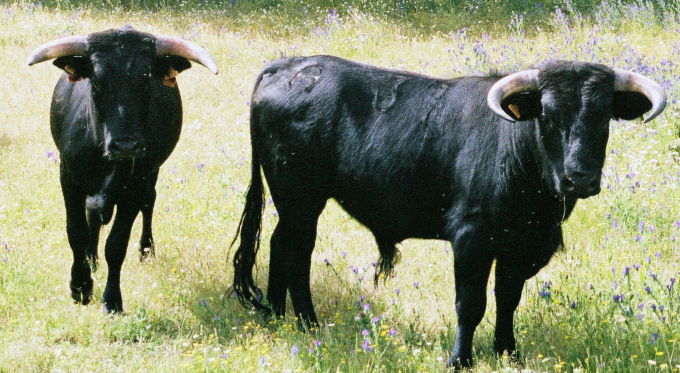
The real thing: young fighting bulls (novillos) on a bull farm in Salamanca, Spain.
Guernica. The bull fight in the sand-filled square. Except it wasn’t a fight, it was more a circus. The slippery pig. The hens and chickens. The rabbits and hares. All the animals running scared. The animals released, one by one, and the spectators jumping into the ring, really a sand-filled square, one by one, and chasing down the animals, taking them home for dinner, if they could catch them. Then the bigger beasts. The mule, ferocious, jumping into the air, kicking four tormentors, one with each leg, and biting a fifth with his teeth. No fearful, clucking chicken this, nor the cow who came after with her padded horns. Participants moved more carefully now. She watched them from her querencia, the where she chose to fight, not die. She knelt, scraped off the rubber balls that covered her horns. Re-armed, she charged and the crowd scattered, all but one young kid, caught, falling to the ground, the cow standing over him, ready to gore again. Sixteen years old, an outsider, I jumped with others over the barrier, twisted this away and that, thumped the cow’s side, smelled her fury, her fear, the whole soured being that emanated from her. Together, we hustled her, bustled her, dragged her kicking, butting, from the ring, backwards, pulled by the tail. Visible scars of damaged animals. Scars of the participants. That young man who broke his leg. That old man, inebriated, stuffed with food and drink, who loosened his belt to move more freely. We watched as his pants slipped from his waist to fall around his knees and trap him, just as the cow charged. He survived but will bear the scars forever, some visible, many not. Long summer days, on the Sardinero, the Segunda Playa, playing soccer. Different rules, different skills, different swear words: I carry a dictionary tucked into my bathing trunks and refuse to play while I look up the words spat at me by my opponent. Good heavens, I think, is that anatomically possible? The ball bounces away on the hard, sand ridges. I chase it and steadily dehydrate under the hot sun. A sea-salt wind desiccates my body. My mouth fills with salt water when I swim out to retrieve the ball from the sparkling sea. My tongue sticks to the inside of my mouth. When I spit, I spit dry and everyone laughs. Now I am totally dry, shiver, and no longer sweat. On the way home, we get off the trolleybus early, at Jesús del Monasterio and enter the long string of bars that lead past Numancia towards Perines. Red wine in glasses, in porrones, with tapas and raciones to soak up the alcohol, morcilla, mariscos, callos, patatas bravas, wine consumed until our blotting-paper bodies are ready once more to sweat. Bread soaks up the wine that relieves the oil that now filters through our skins and who needs suntan lotion when the oil is inside us and bodies are oiled, well-oiled, from the inside out? These excursions are all male, just like the soccer teams. I have four friends and I know them by their nicknames and the way they play soccer. I also know them from the way they try to trick me and laugh at my mistakes, or the way they treat me as a human being and help me to understand this new world into which, sink or swim, I have been thrust. Total immersion in another culture does not come with a set of instructions and the rules of soccer change from grass field to beach sand. Pedro plays centre-half, loves heading the ball, even when it’s laden with sand. I watch him playing field hockey one day, out at La Albericia, and when a low shot heads for the corner of the goal, he dives and heads it away. They carry him off on a stretcher, blood everywhere, and you wonder if his scars will ever heal. Tennis on the clay courts, also at La Albericia. I play so slow but they play so fast. I learn top spin, side spin, back spin, cutting the racket beneath the ball and learning to bend it sideways off the clay that is not clay really, but a fine-packed Italian sand on which I can slide and glide, and commit to a shot running one way then turn and commit to another in the opposite direction. I try it on a hard court, after the immersion period ends, when I get home, and my foot sticks on the tarmac (or whatever that hard, non-slip surface is) and over I go, skinning my knees, creating more scars.
Comment: Another Golden Oldie reclaimed from the reject file. I remember the scenes so well, even though I have moved deliberately in the piece from Elanchove and Guernica (Basque Country) to Santander (now Cantabria). I got lucky and was able to attend a series of workshops on memoirs run by Brian Henry of Quick Brown Fox. Taking his workshops, I realized that most of what I write is more akin to Creative Non-Fiction (CNF), rather then memoir, though much of what I write is rooted in memory. What thrills me in this style of writing is the rhythm that emerges, the word patterns I knit with my pen and a skein of ink, the remembered brightness of the Spanish sun, the sparkle of the waves, the warmth of a people, still grieving after their losses in a bitter civil war, their willingness to accept me, a foreigner, and take me to their hearts. The Other: we talk so much about The Other. But when we ourselves have been That Other, have been dependent on Other Others for food, drink, warmth, care, and love it is so much easier to understand what The Other is lacking and what we can give. Warmth, not scars; a hug, not a punch; open arms, not a fist… so easy to say. I have been there. I know. But can we, deep in our hearts, find it in ourselves to make the sacrifices for The Other that other others have made for us? Only time will tell.
Some of the worst educators I have been unfortunate enough to work with over my undergraduate and graduate years have come up with cliché after cliché in an effort to the sway students into believing that they really are getting an excellent education. One such phrase is the infamous: “We are teaching you to think outside the box.” So, what is their definition of ‘the box‘? Alas, I do not know. They deal in clichés and, by definition, a cliché is a phrase that both parties (teachers and taught) accept as being meaningful, even though it is often without meaning. It is also a conversation closer, as in ‘it is what it is’. It’s hard to argue with that or to reason your way around it. ‘But it doesn’t have to be!’ rarely cuts the mustard aka mouse-turd.
So, if these teachers are teaching their students how to think outside the box, how are they managing to do so? Why by building bigger boxes inside which each student can be safely taught to think, without asking questions, and without looking for independent answers.
Today’s cartoon has two titles: (1) Brave hearts escaping, finding meaning outside the bigger boxes and (2) can the true heart escape its coffin in a bigger box? I love the boxes within boxes and the drawers within each boxed segment into which the young, developing mind can be stuffed and crammed. How do we release those hearts? How do we develop those minds? Certainly not by confining them in bigger boxes. In the battle for hearts and minds, how do we set our students free?
It must be done on the student’s terms, each student, one by one, in co-operation with intelligent, meaningful teachers who step away from cliché and commonplace to enter the learner’s world and to themselves learn how to contact each learner at a mental, spiritual, and intellectual level. Only then will teacher and taught be able to speak of true intellectual freedom. Until that happens, be very careful when your child comes home and announces that today, of all days, that child has been taught to think outside the box. “Verily, I say unto you, open the cage door. Let in the sunshine and the light. Set those children free.” But remember, it must be on a case by case basis, with each individual weighed, assessed, understood, and released to find their own individual way of earning the things they specifically need to know. In true education, one size really doesn’t fit all.
Comment:Another Golden Oldie that suddenly surfaced and, on emerging from the depths, reminded me of another of my callings: that of a teacher of philosophy and a teacher with a philosophy. Retired now, I can no longer help young minds to create and shape themselves. This is doubly true with Covid-19 haunting us, waving at us from the shop-windows, supermarket aisles, and street corners, flapping its wings and trying to fly into our bodies. And remember to distinguish between clichés and things that are not clichés, like ‘Wear a mask’, ‘wash your hands’ (twenty seconds, with soap), and ‘keep a safe social distance’. Do this all the time and hopefully you will avoid thinking inside the bigger box of a six foot pine Covid-19 coffin.