Rats

Rats

Black clouds build over the Bristol Channel, threatening to cross the Severn from Ilfracombe to Brandy Cove and climb inland to rattle our windows and bounce rain off our corrugated roof.
            We run out to the lane, looking for the dog, calling his name. Hoping to get him in before he gets soaked. The rubbish dump outside the gate sits on a concrete stand and dominates the lane. Tall and stinky, the red-brick structure rustles with scavenging, skirmishing rats. Pinned to the dump, a hand-written notice: “Please do not light this dump.” We smile as we read it. Our neighbours will put a match to this dump, one dry night, on the way back from the pub.
            Kim, Nana’s Wire-haired Fox Terrier, spends his days at the dump in an effort to achieve his life’s desire: the elimination of every worrying, scurrying rat that ever inhabited the planet. When he tires of killing rats, he will bring their bodies home to the bungalow. Sometimes he lays them in rows outside the backdoor: rats, mice, field mice, voles. Sometimes he brings them inside and places them on the concrete base beneath the old cast-iron stove. Every day Kim sacrifices to my grandmother, his Gower Goddess, and lays the victims out on her altar.
            The rain is close. We run back down the lane to avoid the storm that is now upon us. Violent and short-lived, like so many summer storms in Wales, raindrops will thump against windows and roof. Lightning will flash, thunder roll its celestial drums, and the wind will whip its lash round the chimney. We sit at the table and sip hot cocoa. No sign of the dog.
            Later, when the storm has passed, we wander up to the lane, avoiding the deeper runnels of muddy water, and stepping from high point to stony high point. We scurry hurriedly past the dump and listen to the rats. They will survive for another night. Nobody will be able to light the dump after rain like that. Back in the field, we fill up the water can, take a handle each, and carry the precious liquid back to Gran.
            We walk to the back door. Our neighbor is standing there, crying.
            “I didn’t see him,” she stammers. “He ran out from the dump as I drove round the corner,” she points to Kim, laid out on the back step, his broken body wet and bloody, the last rat he would ever catch still clasped tightly in his jaws.
Forget-me-not

Forget-me-not

sitting in the kitchen
crouching by the coal fire
hands quite warm
back quite cold
checking the windows
peeling back the curtains
blackout curtains
frayed and old
looking at raindrops
sliding down the windows
chill greasy raindrops
grey and cold

wondering who wants me
wondering who loves me
wanting my teddy bear
longing for my pussy cat
wanting my little dog
longing for his tail wag
so much missing
my nose so cold

now I am seventy
everything has changed
changed town and country
changed clime and weather
everything is different
nothing is the same
longing for my childhood
longing for my home land
watching the ocean
that comes rolling in

ocean of waters
ocean of memories
ocean of people
now long departed

Comment: Rhythm is everything here. I have just re-read The Sing-song of Old Man Kangaroo from Just So Stories (Rudyard Kipling). My mum and dad gave me copy when I was seven years old. Did they really think I could read it and understand it at that age? Whatever! The rhythms have stayed with me all my life and today I tried to reproduce them. My soul and my fingers danced as I thought of old man kangaroo and how he lost so much to gain so much. And what of the Elephant’s Child with his insatiable curiosity? I lost so much when I came here to Canada but I gained so much from this wonderful country. I tore my world apart then put it back together. How to explain it? It may not be explicable.

Hot Water Duck

Canada Geese at Mactaquac

Hot Water Duck

The worst punishment of all was to be sent to bed early.  You climbed upstairs by candlelight, if you were lucky, or groped your way upwards in the dark, if you had been really bad. You entered the cold, dark, damp of the bedroom and punishment was not to have supper, and not to have a warm hot water bottle or a warm baked brick to keep you warm in bed. I loved that hot brick, baked in the oven or by the fireside, then wrapped up in a towel. Bricks and bottles: they banished damp from the bed and kept you warm for a while, or burned if the wrapping fell off. The hot water bottles: they were made of tin not rubber, and once, I remember a cast iron duck, that my grandmother baked in the oven, then wrapped in swaddling clothes, like a little baby. But if the grown-ups said you had been naughty, or nasty, or cheeky, or just plain wicked, then you were given nothing to keep you warm, and you lay in bed and shivered until you cried yourself to sleep.

Canada Geese and Fall Foliage at Mactaquac

Dream

Fall Foliage

Dream

I dreamed last night
that angels lofted me
skywards and wrapped me
in cotton-wool clouds.

The nearest rainbow
was a helter-skelter
that returned me to earth
where I landed in
a pot of golden sunlight.

Red and yellow
were
my hands and face.
I stood rooted like
an autumn tree covered
in fall foliage with
no trace of winter’s woe.

“May this moment last
forever,” I murmured,
as the rainbow sparkled
and I rejoiced in
my many-colored coat.

Comment: I have noticed on several occasions that when I am reading a text, I change the wording on the page to a new wording that seems more in keeping with the rhythm of the moment. I see that I have done this here, more by accident than by plan. I have noticed this too when listening to Dylan Thomas’s recordings of his own verse. Each reading then becomes a new variant on the poem. In this case, I rather prefer the second variation, but I am not sure that I approve of the first one, nor nor do I approve of leaving words out. Naughty! I am afraid that I still haven’t developed the skill of reciting instead of reading my poems. I guess it will happen soon enough. In the meantime, I’ll just have to put up with these little flaws.

Dream … A poetry reading from One Small Corner
Fall Foliage in Island View

Ffynon Wen

McAdam Railway Station drawn by Geoff Slater

Ffynon Wen

Stuffy, you said. I can’t breathe. Early morning mist scratched pale finger nails down your bedroom window. Grey foggy faces glanced in, grimaced and scowled. Damp and slippery, the window frame, when I opened the sash. What time is it?  Before I could answer, you demanded more milk for your tea. I left you there, in bed, went downstairs to the kitchen and brought back milk. Then you wanted more sugar. Shut the window, you said. It’s cold. I’m shivering.
Puppet on a string, I raised my cord-bound feet and danced at your command. Then I went downstairs, fetched more sugar, came back, and left the morning paper on your bed. On the front page, a picture of the last passenger engine, green and rusty, from the GWR (Great Western Railway). It used to carry passengers from Swansea to Cardiff to Paddington in London. Now it pulls a line of filthy coal trucks. Covered in dirt, rain, steam and dust, I couldn’t make out the name or the number.
Passengers on trains speeding to different destinations, we never had time, time for talking, time for understanding, time to think, time to be heard. Laden with baggage, our minds followed different tracks. Platform lights blazed in the night, a Van Gogh blaze of starry fires. We flashed past towns, stations where we’d never stop. Windows glowed in deserted waiting rooms, shattering the darkness, their full moons reflected in the double glass of a locked carriage door.
We rattled over cross-tracks, never knowing why, yet I have never forgotten the rhythm of the wheels, slowing, accelerating, running at full speed, the telephone wires looping, cattle in fields grazing peacefully, wondering why …
We rarely talk. I guess we have little to say. We leave big questions to float in the wind. We don’t tell our nightmares, our stories or our dreams. Trivia is too trivial. Serious issues cut too deep, unspoken, unanswered to this day. We bury our noses in the daily paper. We gloss our lives away. We flash past so many signals with their pointed mechanical signs.
When your train finally stopped, I disposed of your body in Thornhill Crematorium, opposite the Ffynnon Wen, the White Well Restaurant and Bar where we celebrated our last supper together.

Comment: An old story, resurfacing from the Archives in which I found my old, dusty Cambrian Chronicles. It’s also a story I have reworked many times, as poem, flash fiction, philosophical statement, personal memoir … I guess such moments, such memories, are very hard to come to terms with. They lie just out of sight and gnaw at us at night, surfacing when least expected and packing a powerful punch of helpless hopelessness. And no, there is nothing we can do about such things except stare blank-faced into our moon-faced morning coffee and blink back the tears we were unable to shed at the time.

I guess, deep down, it’s all about grieving and how we grieve. In some cultures, it is all about manhood and stiff, upper lip. In others, it is letting the tears flow and the emotions run riot. It differs with each and all of us for we and our circumstances are all unique. I look at the current state of the world and I keep thinking that, no, it’s not a case of one size fits all. Not everybody is the same, and each one of is special, and needs something special, especially in these difficult times. Keep safe, keep well, and do not provide, if you can avoid doing so, any reason for your loved ones to mourn for you.

My Grandfather’s Chair

18581930_1306791786107970_4016640231053970709_n

My Grandfather’s Chair
For Margie Goldsmith

“Write about that chair,” Margie said,
and I wondered what was in her head.
How can I write about that chair
when those who sat in it are not there.

Before the coal fire my grandfather sat,
snoring away, on his lap slept the cat.
At three years old, I climbed that chair,
and blew on the bald spot in his hair.

So many things we no longer know:
my grandpa did the same thing, years ago,
and years before that, his own grandad
did just the same to make his old man mad.

Now I, in my turn, when I drink deep,
like to sit in that chair for a little sleep,
and my grand daughter, there’s no grandson,
climbs up that chair, as others have done,

and sees the bald spot in my hair
and blows and blows as I snooze there.
The years roll back and I see the smiles
of generations woken by a young child’s wiles.

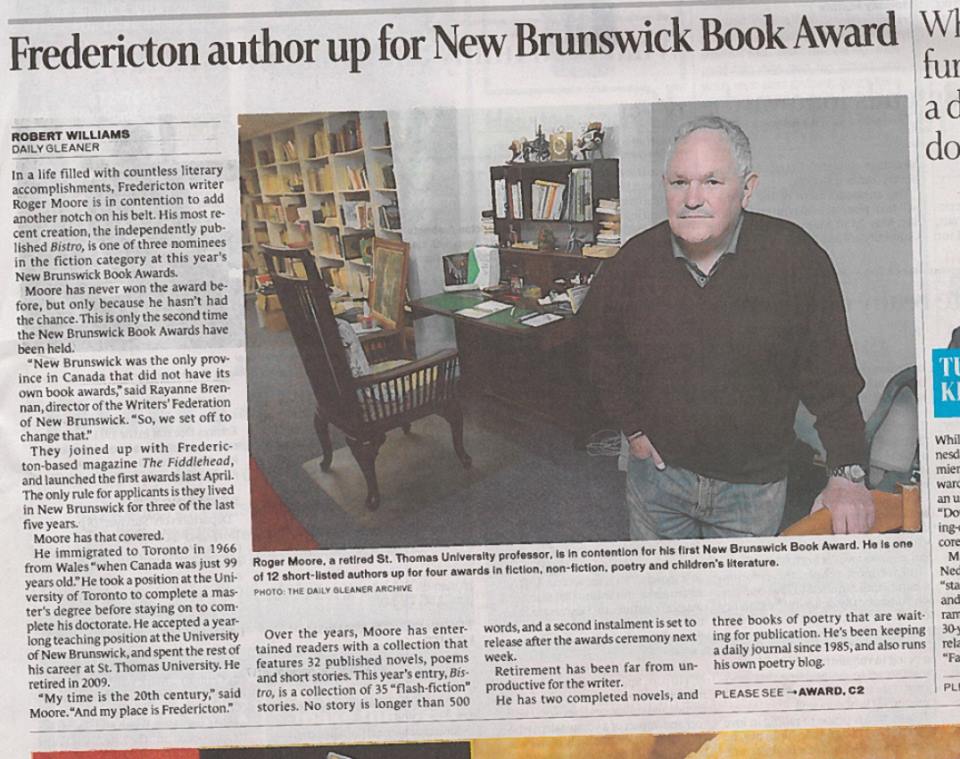
Comment: Talking the other day, I mentioned my grandfather’s chair, the only piece of furniture rescued from my parents’ house, and Margie said I had to write a poem about it. So, last night I did. The result is something very different from what I normally write. This is what in Spanish is called an occasional poem and it celebrates a specific occasion, a specific set of circumstances. Thus, it is written under different rules, rhyme, rhythm, stanzas. It is always an adventure to write something suggested by someone else. Poems like this cross the boundary between poetry of play (which this is) and occasionally enter the realm of poetry that expresses the authenticity of being which, to a certain extent is present in this poem too. The above photo, from our local newspaper, The Daily Gleaner, is the only one I have of the chair which resides in the basement where I keep my books. The article is an old one (2017), but the photo is nice!

On Learning Welsh


IMG_0094

On learning Welsh

Welsh
is a key to my childhood.

Every day I learn something
about myself and my upbringing.

It’s not the need to talk
so much as the necessity
of diving into myself
and mining my memories.

Brynhyfryd / Mount Pleasant.
Ty Coch / the Red House.
Pen-y-Bryn / the Top of the Hill.

This latter the house
in which I was born.
No room in hospitals
for war time babies.

All of my wartime family
born in the same in-the-country
Gower bed.

Three of my brothers
did not survive
those rough, household births.

I still bear the forceps’ scars.

And I still bear the scars
of carrying my brothers
with me all my life.

A long and difficult
and very private history.

But it’s mine
and I embrace it
and I love it,
with all its warts.

Comment: The photo is of the dragon in Kingsbrae Garden. I think of it as a Welsh dragon … Y ddraig Coch … the Red Dragon of Wales, but of course, it isn’t. Anyone can write easy poems: Twinkle, twinkle, little star … it’s the hard, gut-wrenching stuff that’s hard to put down on the page. My close friend, Margie Goldsmith, encouraged me to write this. Thank you, Margie. Thank you for caring. This is indeed my life ‘… with all its warts …’ It’s easy to wear rose-tinted glasses and see everything as ‘for the best in the best of all worlds’. However, it’s more difficult to grovel on your knees, in the trenches, and to come face to face with the stark realities of who we are and where we come from. Thank you, Margie, for helping me and encouraging me to do just that.

An Angel at Jarea

IMG_0258

An Angel at Jarea

An angel moves through the room
in the silences between our chatter.
He fills the interstices of speech
with the wonder of feathers
enlightened by rainbows.

Tranquil his footsteps
as we sense his presence.
He places his hand on an arm,
his arm around our shoulders,
and now, commanding silence,
a finger on his lips.

We sit here
scared by our intimate inadequacies,
scarred by the fierceness of our thoughts
as we sense the vacuum
of his soon-to-be absence.

Comment: The video reading of my poem follows. Ruby Allan, one of the five artists invited to participate in the first cohort at KIRA (2017) would always say, when a silence fell on the group, that ‘an angel is moving through the room’. This poem is dedicated to her, and to my friend, Geoff Slater, whose house and gallery we were visiting when the happenings depicted in this poem took place in June, 2017. Several years ago now, but I remember it like yesterday: a magic moment that I have tried to preserve in words. I could never have captured these moments in my verbal snapshots without the assistance of my friends. Thank you all so much.


Mist at Jarea

fundy-05-mistwolfepipers-081

Mist at Jarea

Moving in with the tide,
drawing gauze curtains
over the islands,
climbing, so silent,
pebbles and rocks
to arrive at our windows
and block out the sun.

The mist’s grey face
presses against the panes.
Long lost friends,
come back to haunt us,
loom out of our past.

They bear memories
born beyond the mist,
living now in, and for, this mist.

They come stalking us and tap
with long, cold wisps of fingers
at locked windows and doors,
bolted so they can’t get in.


Rain Again

The rain in Spain
does not stay on the plain

Rain
              When it rained in South Wales, it rained everywhere soaking rich and poor alike. There was no escaping the eternal wetness of Welsh Rain. Whenever we traveled, especially by bus, to another part of Swansea Town, it would be raining there too, but, as my auntie used to tell us when we came back home: “Smile now. Look happy. And remember: we had lovely weather all day. The sun was shining over there where we were. Raining here, at home, all day, was it? What a pity. You should have come on the bus with us!” I remember her smiling, all wrinkles round the eyes, her false teeth shining white, as she flashed a horse’s collar coal-scuttle of a grin, absolutely shameless. But we’d back her up. We’d all smile happily and laugh, and dance, and jump up and down, basking in the joy of the falsified sunshine of her wonderful smile, her shining false teeth. And she was right: where we had been together, the sun had shone all day, in spite of the umbrellas, our wet, cold feet, and all the undoubted evidence of a day of rain.