Between Two Places Dianne Fitzpatrick Where’s Home?
Where’s Home (3) Part III of an open letter to Jan Hull
The Little Things
In 1898, Spain fought and lost a war with America over possession of Cuba. Cuba was the last of Spain’s overseas Empire and when it went, the all conquering fatherland, upon whose empire the sun never set, was reduced to its original territory in the Spanish Peninsula. That same year, the literary Generation of 1898 started a new movement, one that made Spain itself central to its imagery and thought. Theirs was not the Spain of Imperial History, with its wars and treaties, battles and conquests. Theirs was the eternal countryside of Spain, the Spain of Old Castille that was rooted to the soil, and that had remained virtually unchanged in the small towns, fishing ports, and villages, for hundreds of years. This was the Spain of Miguel de Unamuno’s Intra-historia: the history of small things.
St. David, Dewi Sant, the patron saint of Wales, a historical figure flourishing circa 600 CE, is famous within Wales for his many sayings. But for me, one stands out. “Byddwch lawen a chadwch eich ffyd a’ch credd, a gwnewch y petheu bychainmewn bwywd” / Be joyful and keep your faith and creed and do the little things in life. In these times of stress and strain, faced by enormous changes brought about by the pandemic, to these prophetic words I turn.
Poets, creators, artists, stoneists, craft-workers of all kinds … we are the antennae of the people. We sense the directions in which life flows and will flow and we are ahead of our times, not behind them. We are the ones who ‘do the little things’, often abandoning larger, more financially rewarding projects in favor of smaller ones that spiritually enrich both us and the people around us. And that is what I am now reading in Jan Hull’s Where’s Home? People, real, live, flesh-and-blood people, many of them artists at heart, abandoning the big city’s rush and rock and roll to enjoy the quietude of small communities which they help to build with their own hands.
Troglodytes, cavemen, people living in the past, I have heard ‘so-called saner citizens’ mutter about some of our contemporary artists. They live off hand-outs and charity and welfare, and they live in the past. Grey-suited, working in concrete boxes, these well-heeled critics are all made out of ticky-tacky, as the old song says, and they work in little boxes, and they come out all the same. Fine fr some, but you certainly cannot say that of the characters who inhabit the small towns, villages, and ports, as Where’s Home? demonstrates so clearly, with quote after quote from contented people, all resident in Nova Scotia, some CFA (Come From Away), others CBC (Come By Choice), and yet others native to the province.
Living in the past … when Hurricane Arthur struck, we went without power for twelve days. No water, no warm food, no cooking, no refrigeration, no flush toilets, no showers, no air conditioning, no television, no Wifi, no internet … In 1928, my grandfather and my father built a summer home, a bungalow, in Gower. I remember, even in the late fifties, living there during the summer with my grandparents: wood stove, rain water barrels, no running water, outhouse, no electricity, no refrigeration, oil lamps … Hurricane Arthur … and Clare and I went back to bungalow living. Several of our neighbors did not know how to cope with the ‘problems’. A couple moved into hotels or stayed with family elsewhere until the crisis was over. As for us, this was the life I was used to as a child. We went into bungalow mode and had more fun than anyone could imagine… living in the past? … or preparing for the future? … Think about it, and don’t jump too quickly to the wrong conclusion.
Above all, Jan Hull’s book, Where’s Home?, has made me think. It has made me think deeply about my own life, my own memories, my own restless, rootless existence, my own attempts to settle and resettle. More, in light of the pandemic with so many working from home, so much home schooling, and so much online back and forth, maybe we, the artists, the returnees, the WAH (Work At Homers), maybe we are not stranded, forgotten, on the back-burners of modern life. Maybe, just maybe, we are the fore-tellers, the front-runners, the pioneers of how a better, more meaningful existence may be created and kept. Thank you, Jan, and please thank all your contributors on my behalf.
Yours are the hands that raise me up, that rescue me from dark depression, that haul me from life’s whirlpool, that clench around the jaws that bite, that save me from the claws that snatch.
Yours are the hands that move the pieces on the chess board of my days and nights, that break my breakfast eggs and bread, that bake my birthday cake and count the candles that you place and light.
You are the icing on that cake, and yours is the beauty that strips the scales from my eyes, then blinds me with light.
“Eric, Phillip, Peter: why did you leave me? Why did you, where did you go?
Eric, Phillip, Peter: you went out through the door, so silent, didn’t even slam it, why did you go?
Eric, Phillip, Peter: I hardly even knew you, the house, my life, so empty without you, shadows so scary, why did you leave me, where did you go?
Eric, Phillip, Peter: vacant and silent, lonely the house, such a big world without you, so full of menace, so full of woe, why did you leave me, why did you go?”
In one room in my head my mother’s mother sits with me on her knee at the kitchen table playing patience.
Elsewhere, I stand on a stool beside my father’s mother helping her to mix the cake she will later bake in the coal-fired oven of the black, cast iron stove.
My mother’s father sits before the television. He leans back in the chair, raises his foot so he can’t see the adverts on the screen, and puts his fingers in his ears.
My father’s father lies in bed, downstairs, in the middle room. His dog lies beside him, licking his hand. We all wait for the death that has haunted him since he was gassed in World War One.
Clare sits at the computer, following the figures that track the pandemic. I sit here watching her, humming softly to myself: “¡Qué será, será!”
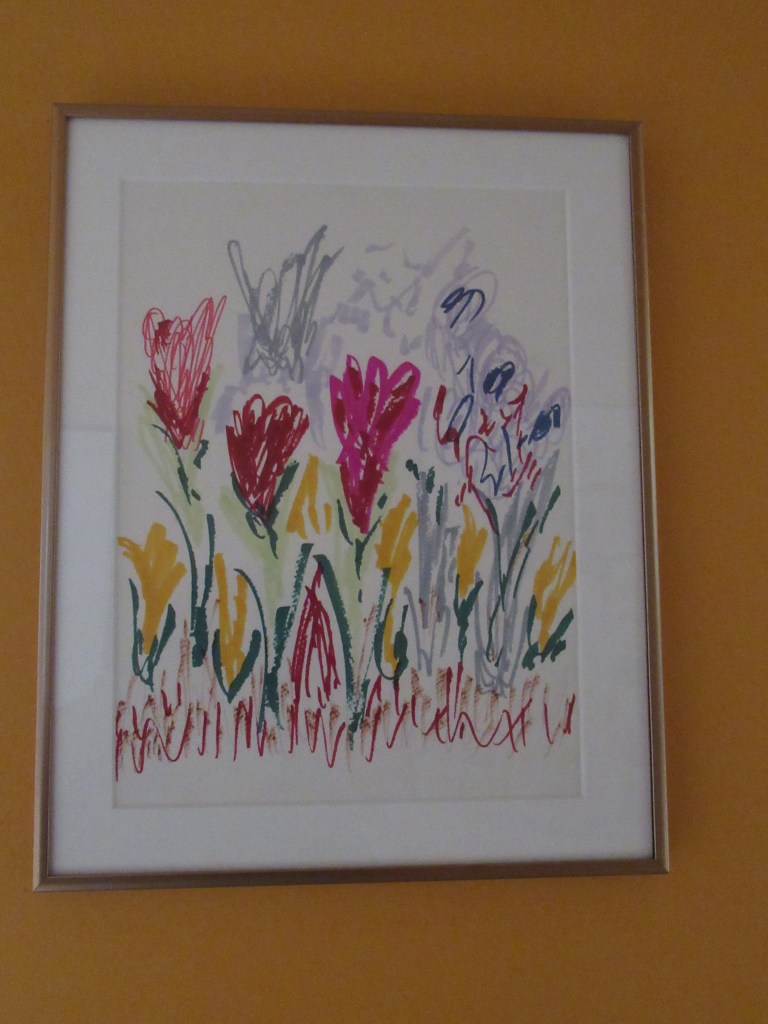
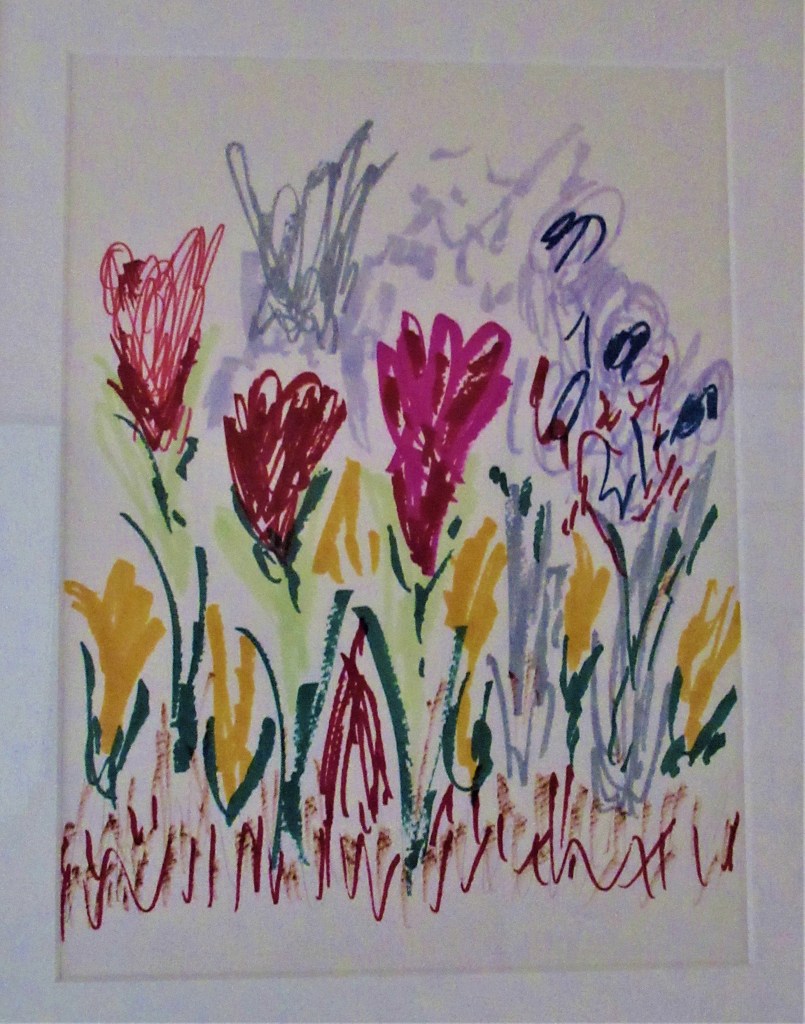
“The flowers that bloom in the spring, tra-la, bring promise of merry sunshine …” Gilbert and Sullivan, from The Mikado, if I remember correctly, and not at all anonymous like the Anonymous Bosch artist who painted this painting. Still, I like it, and it certainly lends a little bit of color to the pale cheeks of these walls.
“And we merrily dance and we sing, tr-la, as we welcome the promise they bring, tra-la, of a summer with roses and wine …” I can remember my grandfather singing that in the kitchen in Swansea. He would conduct with one hand, and encourage me to join in with the other. And I did. Merry days, they were, before the fire in winter and out in the greenhouse in early spring.
So, where have all the flowers gone? Gone with the grosbeaks, everyone. Which reminds me, I saw an Evening Grosbeak at the feeder this morning. The first one in years. There used to be several nesting nearby and they were regular visitors, as were the Gray Jays, aka Whisky Jacks, aka Gorbies, aka Ghosts of the Woods and all of them long, long gone.
Will they naw come back again? Who knows? The world is changing even as I sit at my window and watch it go by. February, March, April, May, June, and now July. The lock down has been lifted, but the fear of going unmasked in the great outdoors is still with us, as are the anonymous givers of the virus, a donation I do not want, and nor does anyone else, in their right minds, compus mentis, and not yet willing to on the anonymous ranks of the Gorbies, the Grosbeaks, the Swallows, and the other birds that have fled elsewhere, leaving our yard to the crows, the blue jays, the squirrels, the chipmunks, and the occasional more colorful visitors.




 rogermoorepoet