Why?

IMG_0446

Why?

“Where are you going?” I ask again. “To see a man about a dog,” my father replies.  “Why?” I ask. “Hair of the dog,” his voice ghosts through the rapidly closing crack as the front door shuts behind him. “Why?” I cry out.

I recall the mud nest jammed tight against our garage roof. Tiny yellow beaks flap ceaselessly open. Parent birds sit on a vantage point of electric cable, their beaks moving in silent encouragement. A sudden rush, a clamour of wing and claw, a small body thudding down a ladder of air to crash beak first on the concrete.

“Why?” I ask.

The age-old answer comes back to me. “Wye is a river. It flows through Ross-on-Wye and marks the boundary between England and Wales.” The swallows perch on the rafters watching their fledgling as it struggles on the floor, the weakening wing flaps, the last slow kicks of the twitching legs.

“Why?” I ask.”

Y is a crooked letter invented by the Green Man of Wye,” my grandfather says.

“Why?” I repeat. “I want to know why.” Silence hangs a question mark over the unsatisfied spaces of my questing mind.

Comment: A golden oldie. We would all like to know why. But there are no answers. Just riddles cast, like two trunk-less legs of stone, on the sands of time. Nothing beside remains. Yet still we ask the age old question? Why? And still we get the age old answer from the ageing masters who rule our childhood lives and teach us everything they know: “Because.”

Self-Isolation Day 18

IMG_1773 (2).JPG

Self-Isolation Day 18

So we are in the eighteenth day of our Self-Isolation. Yesterday I added a fifth book to my group around the table: The Art of the Middle Game by Paul Keres and Alexander Kotov, translated by Harry Golombek. I have had this book since 1964 when it was first published in Penguin Books. Once upon a time, I played serious chess, was president of a chess club, and read widely about the game. But I have not played any serious, face to face chess since I came to Canada and the last games I played were in 1994, when I visited the Dominican Republic, although I did pay a couple of games in Oaxaca on my first visits there.

I dipped in and out of this book yesterday, playing sample games here and there. It was a joy to rediscover the movement of the pieces and to see how great minds viewed the chess board. Sharpe’s Riflemen are wonderful to watch on YouTube, but they cannot rival the two sixteen piece armies that wage battle on the sixty-four squares of the chess-board!

The Art of the Middle Game uses descriptional notation. This means that when the King Pawn takes two steps forwards, it moves from King two to King four. In descriptional notation, this becomes P-K4. If it is the first move of the game, by white, then it becomes 1. P-K4. If the opposition follows suit, then his move is also transcribed as P-K4. This gives us 1. P-K4   P-K4. And this is where the confusion arises: each side has a K-4, and a Q-4 and every other square is doubled up as well in a mirror image of army facing army. After such a long time away from the game, I found my concentration wavering in places and thus I had pieces on the wrong squares and had to start all over again. Very frustrating.

When I played chess in Spain, also back in the sixties, I was faced with algebraic notation, long in use on the continent of Europe. The eight ranks are lettered a-h, from left to right, and the eight files are numbered 1-8 from bottom to top, with ‘white on the right’ i.e. h-1 always white. This means that each square has a single, plotted designation and it is much easier to follow the game as there is no mirror imaging. In this fashion, 1. P-K4 would become e2 – e4 followed by e7 – e5. None of this changes the nature of the game, but it does change the speed and ease with which it is transcribed and followed.

I remember buying my first pocket chess set, in Boots the Chemist (!) when I was 9 or 10 years old. It is an old cardboard set with red and white squares and pieces. I still have it and I am using it now. The scrawl that I call my handwriting is still unmistakable, after all these years. That same day I bought Harry Golombek’s The Game of Chess, and I taught myself how to play, based on that book. I remember looking at the descriptional notation and not understanding how the system worked, even after days of memorization. Then, one morning, as Dylan Thomas, another Swansea Boy once wrote, ‘light broke where no light shone’ and as all the squares fell miraculously into place, the system of descriptional notation suddenly made sense to me. “Threshold knowledge is a term in the study of higher education used to describe core concepts — or threshold concepts — which, once understood, transform perception of a given subject, phenomenon, or experience” (Wikipedia). The discovery of the key to descriptional notation was indeed a threshold experience, as was the transition to algebraic notation. What a wonderful world we live in.

CV-19 Week 3 Day 1

IMG_1058 (2)

CV-19 Week 3 Day 1

So, yes, I am starting the third week of my self-imposed isolation. I am also in the first week of an imposed provincial State of Emergency. What I was doing willingly before, self-isolation, has now become law, self-isolation by edict.

It seems a minor change, but it isn’t. Whereas before I was happy not to go out, now the very prohibition makes me want to go out. Yes: I now want to be out there, wandering the now-empty streets, shopping in the now-closed stores, and visiting the newly locked and barred bars and restaurants.

This situation reminds me of the word-games we used to play as children in which you were given a word which you mustn’t use and then you discovered that you really, really wanted to use it, simply because you had been told not to. One such banned word, in my childhood, was bloody. All the grown-ups used it, but it was forbidden to the little children. Bloody hell, we thought. Or bloody nice weather, we said to friends of our own age. Then, if our parents caught us using the forbidden word, out came the carbolic soap and it was mouth wash time again. Yuck: I have never forgotten the taste and smell of that carbolic soap.

We devised schemes for getting round the prohibition. I guess children of all ages devise schemes for breaking down prohibitions. That’s why so many soldiers in WWI used to ‘break out of barracks’ as they resisted the imposition of nightly curfews with their locks and keys. “Oh we’re breaking out of barracks,” they would sing, “as we have done before.” Then came the other verses. “Take his name and take his number.” “Up before the CO.” “Forty days in prison.” Back to bread and water, as we have done before.”

So, when my mother took us to the butcher’s shop one day, we were all primed. “Look at all that bloody meat” we cried out , shrieking with laughter and rolling all over the saw-dusted floor. My mother was furious, but we were spared her wrath as the butcher, and his other customers, found it so amusing.

But CV-19 (Corona Virus \ Covidis 19) is not so funny and the punishments are much more drastic than a simple carbolic soap mouth wash session. That said, the itch to break the prohibition is so much stronger now that the law is provincially enforced and not self-imposed. That said, these are rules well worth following. Nobody wants to catch this and, much more important, nobody wants to be responsible for passing it on to somebody else, especially if that somebody else is in the target range for a serious, perhaps fatal, bout with the virus.

Funny old world, eh? And some funny old people living in it.

Le Pont Mirabeau

IMG_1318 (3)

Le Pont Mirabeau

Beneath Mirabeau Bridge flows the Seine
and so does our love
must I be reminded yet again
that happiness always follows pain

Let night descend let the hours sound
the days go by … I’m still around

Hand in hand let us stay here face to face
while beneath the bridge of our arms
like flowing waves our gazes interlace

Let night descend let the hours sound
the days go by … I’m still around

Love flows away like waves that flow
love flows away
hope fills us with dismay
and life passes slow

Let night descend let the hours sound
the days go by … I’m still around

Days and weeks flow by bye bye
along with former loves
and past times that did fly fly fly
they will never come back again
Beneath Mirabeau Bridge flows the Seine

Let night descend let the hours sound
the days go by … I’m still around

Comment: It’s hard to give up on this. The poem has stayed with me since 1962 (58 years). A slight variant on an earlier version. Sorry, Guillaume.

Le Pont Mirabeau

Le Pont Mirabeau

Beneath Mirabeau Bridge flows the Seine
and so does our love
must I be reminded yet again
that happiness always follows pain

Let night descend let the hours sound
the days go by … I’m still around

Hand in hand let us stay here face to face
while beneath the bridge of our arms
like flowing waves our gazes interlace

Let night descend let the hours sound
the days go by … I’m still around

Love flows away like waves that flow
love flows away
hope fills us with dismay
and life passes slow

Let night descend let the hours sound
the days go by … I’m still around

Days and weeks flow by bye bye
along with former loves
and past times that did fly fly fly
they will never come back again
Beneath Mirabeau Bridge flows the Seine

Let night descend let the hours sound
the days go by … I’m still around

Comment: I spent the school year in Paris in 1962-1963 and I have always wanted to translate Le Pont Mirabeau from French into English. Today, I found both the time and energy to do so. It’s not a great translation, but it is mine. It also contains new revisions from an earlier post but note that the links in the earlier post no longer function. Click on the link above to get the French original.

Losing It

IMG_1478 (2)


Losing It

When you lose it
whatever it is
your fingers pick at seams
hankies skirts shirts jeans
or strip a label from a bottle
or crumble bread or

there are so many things
you can do
personal things

on the table
a vacant cereal bowl
a silver teaspoon in a saucer
an empty teacup
returning your round moon stare

your hands
twist and pull
your nails
click together

blunt needles knit
then unpick stitches
trying to unravel
then to repair
this ball of empty air

Crows

UNADJUSTEDNONRAW_thumb_2788.jpg

Crows

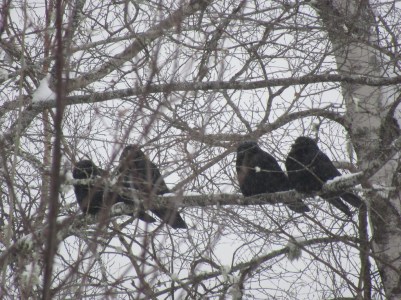
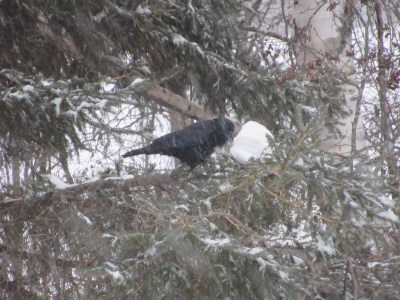
A family of crows lives  and nests close to our garden. Here are four of them together on the same branch. Two years ago, there were five of them. Last year there were seven and this year ten flew in the other day. They are such beautiful flyers. All weather conditions, too, summer and winter, all year round visitors.  I wish I could photograph the sound the air makes through their pinions as they swoop low over the roof on a warm summer’s afternoon.

UNADJUSTEDNONRAW_thumb_2741.jpg

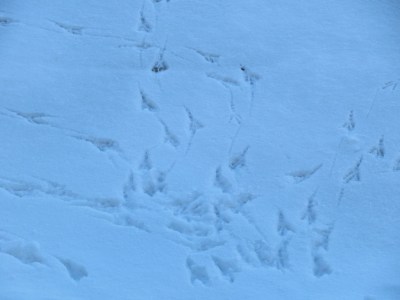
And they leave such gorgeous tracks in the snow. It is always fun to have them around and totally raucous when they find something worth eating.

UNADJUSTEDNONRAW_thumb_2731

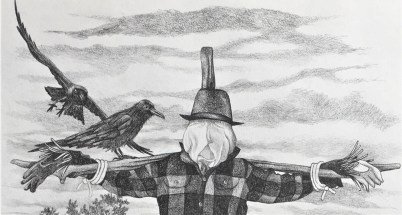
Geoff Slater has captured them to perfection. He’s better with his pencil than I am with my camera.

image3 (10)


Creating vs Revising

IMG_1095 (2)

Creating vs Revising

The introductory picture (above) shows revisions made to my painting by my three year old grandchild!

1. As I read my early morning messages, I realize that there are two very different processes involved in creative writing: creation and revision.

In terms of creation, I follow Graham Green and Steven King: write 500 words a day, regularly, about two pages. Then, next day, re-read them and revise them. Then continue with the next two pages. This allows a steady accumulation that is usually somewhat under the writer’s control. It also allows the writer to go back and revise while creating: an important step for both King and Green.

In terms of revision, once the book or story or manuscript is complete, different processes emerge. One is to leave some time for the manuscript to settle: this also works chapter by chapter during the writing process. The other is to start again and apply the revision process as outlined in the First Five Pages.

Each one of us will be on a different stage of what is, I hope, an enjoyable creative experience. Part of the fun is also finding out what works for us; and by us, I mean each one of us. And yes, we all need those words of encouragement … so hang in there… have confidence … and be creative …

As for revision, I started by reading The First Five pages and found that this made the revision of my own manuscript much easier. The First 5 Pages deals with items one by one and in order of priority; it also allows you, as a writer / reader / adviser to have a clear idea of where you are going with the revisions, what you are doing, and why you are doing it. I also perused other online links and found them quite useful, especially those that referred to the revision process. I recommend searching for such links, in particular, the one that tells us never to give up.

Burroway for me is an adventure. I find that when I am reading the theory, I have a tendency to get confused and lost. In addition, I do not always agree with her analyses of the chosen snippets of text. I understand what she is saying, but I do not always agree with what she has said.

Selected stories themselves are something different. Reading them allows me to gain a perspective on what I am doing and how I am doing it. Thus I can say: I can do that; or I’ve done that; or I wouldn’t want to do that. The stories then come over as a reflecting mirror in which I can see aspects of my own writing, however beautified or distorted. The theory, on its own, leaves me cold and often confused. Other people’s creativity is inspiring.

The secret, in my opinion, is to relax, to be yourself, and to continue writing as you want to write while paying attention to the small details of which I am becoming more and more aware of every day. We are all creative — or we wouldn’t be here, reading this, doing this course. The secret is to develop and polish our own creativity. We must also learn to develop our own voices and to have confidence in those creative sparks that dwell within us.

2. Writing the introduction last is a standard procedure in academia. This is partly because it isn’t until the end of the research / study that the writer really understands the substance and the intent of what s/he has been studying. Also, it is only when the work is finalized that the appropriate conclusions can be drawn and the route that one has taken can be established.

As for the order in which revisions are made, there are many rules and circumstances can change. Even when there doesn’t appear to be a plot, as such, there is a chronology and chronology can be used as a substitute for plot. There is probably some form of evolution throughout the chronology, and that should be kept in mind, too. In addition, I would assume that as the learning process “bites” so we will be better able to make our own judgement calls. The art of good teaching is to eliminate the need for a teacher.

3. Changing the perspective: letters work: they can be found, sent, received, or discovered. The identity of the writer / receiver is also interesting.

In the 13th Story, the novel which I am currently reading, the principal narrator investigates / researches her subject in local libraries, the Who’s Who, a graveyard (reading the tombstones), and many different places. She also visits the local newspaper archives and interviews other characters in the novel, much as a newspaper reporter might.

Just read, think, learn, absorb, and, above all, remember to reject that which doesn’t suit you!

Self-Publishing

img_0196


Self-Publishing

Why do we write?

Before we talk about publishing, in any form, we must pose the question: why do we write? As a former academic, my writing was intimately tied to academia. At first, I wrote to pass my exams; then I wrote to pass my courses by handing in essays and potential papers; then, when I was a full-time academic, I wrote for the “publish or perish” world of academia, churning out articles (90) and reviews (70) on topics that were tied to my research projects. My writing, in other words, had a purpose and a direction. I knew why I was writing and I was conscious of the areas and places in which my publications would be acceptable and accepted.

At the same time as I wrote for the academic world, I indulged in creative writing. I have always written poetry. I have always been aware of my vocation as a poet. However, I was also aware that it was very difficult to earn a living as a poet. We’ll talk more about that later. The academy, research, and teaching gave me enough free time to indulge my dream of being a creative writer. It also permitted me to put food on the table and to keep my family warm and comfortable during our cold, Canadian winters.

So, the first question you must ask yourself is: why am I writing? What do I hope to achieve as a writer? Who do I want to read my works? Why do I want to be published? How do I want to be published? Your answer to these questions, and others like them, will determine your relationship to the publishing process.

Traditional Publishing

It isn’t easy to become published in the traditional fashion. In the first place, there are fewer major presses out there, and those that do exist are very large and powerful indeed. They want only the very best work. Not only that, they want the best work that will make them the most money. Good writing isn’t always guaranteed to sell well and thus to make the most money, remember that. In the second place, there are some excellent smaller presses, but they tend to be niche presses tied to a specialized corner of the market. Academia is a niche market. My own area of academia, Spanish Seventeenth Century Literature, is a very small niche market indeed. In order to get published in the traditional manner, a great deal of research into the niche area and the presses that publish therein is needed.

Most major presses will not look at up and coming writers unless they are represented by an agent. Few agents will take on an up and coming writer. This is a chicken and egg conundrum: how do we get the experience to be represented when we need the representation to help get the experience? All writers must solve this problem in their own fashion. There is no easy answer. Novels that have the potential to be turned into films: these will attract an agent and a big press, because that’s where the money is. How many of us are capable of writing them? Short story collections used to be a reasonably safe bet, but it appears that fewer presses and literary magazines are publishing them. Poetry generates little or no money, hence it also belongs to a highly specialized niche market with very small circulation figures. Once these realities are understood, then we can consider the alternatives.

Self-Publishing

 Self-publishing is no longer associated with the so-called Vanity Press, a term used to denigrate it. Not so long ago writers who paid for their writing to be published were considered by many to be ‘poor’ writers, ‘vanity’ writers. This is no longer true and The Writers’ Union of Canada (TWUC) now accepts self-published works as genuine works of literary merit, always provided that they are well-written. The advent of the computer revolution made all forms of writing, printing, and publishing so much easier. The ensuing advances in desk-top publishing allowed anyone to be a published writer and a writer’s life was suddenly that much simpler.

I published two poetry books with traditional presses in 1978 (Last Year in Paradise) and 1986 (Broken Ghosts). In 1990, following the death of my parents, I felt a deep desire to write and to be published once more. I had poems published in small literary reviews and magazines and I had a track record of wins and honorable mentions in writing competitions, but nobody wanted to publish another book of my poetry. I papered my walls with rejections … and I got nowhere. Therefore, in 1990, I started to self-publish.

My first six books were simple: I typed out the poems, ordered them the way I wanted, and took them to the local print shop where, for a small sum of money, the books were printed and saddle-stitched. This was a cheap means of production, so cheap, that I didn’t need to sell the copies so I just gave them away to my friends. Between 1990 and 1996 I published six of these little paperback chapbooks: Idlewood, In the Art Gallery, Daffodils, Secret Gardens, Iberian Interludes, and On Being Welsh. The runs were small, ranging between 100 and 200 copies, and very cheap per copy, often less than a toonie / twony (two dollar coins, after ‘loonies’ one dollar pieces with a loon on the coin).

All the initial work for these books was done by me: writing, selection, typing, and editing. The printers did the rest: copying and binding. In the case of these first self-published books, the covers contained typed titles and the author’s name and nothing more. In 2000, I was very fortunate. I met a genuine editor who agreed to work with me to publish my poetry via a small university print-shop. I wrote the poems and typed the text. My editor, a wonderful lady, then edited the text and prepared it for printing. My beloved (aka my wife) designed the covers for these books. Between 2000 and 2012 we (self-) published six of them: Sun and Moon, Though Lovers Be Lost, Fundy Lines, At the Edge of Obsidian, Obsidian 22, and Monkey Temple. These were genuine paperback books, with an ISBN. They were all limited editions and again I gave them away to my friends.

2008 saw Nashwaak Editions, the book division of the Nashwaak Review, publish Land of Rocks and Saints, a book of poetry that I wrote while in Avila (Spain). Again I funded this printing myself and again I gave it away to my friends and colleagues. I was devastated on several occasions to find signed copies of these books in second hand bookstores, that which I had given away for free had been sold for money. The receivers of free gifts had gained more cash than the books’ writer.

I continued writing and now had several manuscripts that I thought well worth publishing. Armed with a genuine list of publications and prizes and with excellent letters of recommendation from established writers, I again tried the traditional approach. Alas, I got the traditional results. Two small trade presses who agreed to publish my work both went out of business before they could do so. Agents, if they bothered to reply (and most of them didn’t), turned me down. I got to final judging with a famous niche press, but their marketing department said the book wouldn’t sell and they refused to market it … I didn’t know where to turn.

I had for some time been getting e-mails from houses that, for a large sum of money, would publish my new works for me. However, I was by now retired, and didn’t have those ‘large sums of money’. Publishing costs varied from $1500 US to $3500 US to £3000 (sterling). Well, I wasn’t that desperate, especially when I was suddenly subjected to regular e-mails, constant phone calls, and targeted advertising. I got tired of sales reps ringing me up and asking “are you read to go to press now?” There had to be easier and cheaper ways to get published.

2016 saw a major change in my self-publishing. A new friend, now a very close friend, suggested I try CreateSpace on Amazon. He came over one afternoon to give me a demonstration and we had a manuscript up and running that same day. It cost me nothing. I still haven’t sold a copy of that particular book. But it is up and available on Amazon. I buy copies at a relatively cheap rate and, you guessed it, I still give them to my friends. I now have nine titles on Amazon, two new titles* and seven rewrites and expansions. These include Monkey Temple, Bistro*, Though Lovers Be Lost, Sun and Moon, Obsidian’s Edge, Empress of Ireland, All About Angels, Iberian Interludes, and Avila* (my first book of poetry in Spanish).

Marketing is still a problem partly because I just don’t have (nor do I want to have) what it takes to be a salesman. I still give copies of my books to my friends. I guess I’ll never make any money worth speaking about from my creative writing. But that has never worried me: I have never written for money, only for love. I write because I love writing. I publish so I can give copies of my books to those friends who ask for them. I am a poet, whether I want to be or not. I am also condemned to my fate: I am an academic, a writer of poetry and books, and a book self-publisher. I guess I’ll never be a businessman.

Is it all worth the effort? Yes, I think it is. Can (other) people make money from self-publishing? Yes, they can, especially if they are willing to advertise, market, and sell their books at every opportunity. This is something that I just cannot bring myself to do although I know several writers who have been very successful with this aspect of the trade.

Quality Control

Are self-published books capable of being genuine works of art? Indeed they can. Bistro, although being self-published, has just been confirmed as one of three finalists in the New Brunswick Book of the Year Competition (2016-2017). Several of the stories in Bistro were either published separately in literary magazines or were part of larger manuscripts that received recognition in one way or another for the quality of their writing. Parts of several of my other books on Amazon have been published or awarded prizes or honorable mentions in competitions and this gives my creative work a track record of respectability.

I am an academic, trained to assess written work and to maintain quality control on my own written work as well as that of other people. Not everyone is born to be an editor, let alone a self-editor. How do we get to the level of self-editing necessary to be confident in our own quality control? Enter your work in competitions. Submit your work to literary magazines. Take writing workshops online and in person. Consult with other writers and join a good writing group or form one yourself. Be careful of submitting your work to the opinions of your best friends and your family: they will only tell you how good you are. Remember that your granny may be your favorite person, but she is not necessarily your best critic. Seek always the objectivity that allows you to stand back and criticize your own writing from a distance. Seek the opinions of others who are objective and will do the same.

Summary

  1. Think about why you are writing and what you want to achieve with your writing.
  2. Consider the different ways in which you can publish or self-publish and decide which is better for you.
  3. Research your market / niche market as carefully as you can and target the area in which you wish to work.
  4. Writing is a long-term commitment: you must make that commitment and stick with it.
  5. Remember that there is no substitute for high quality writing.
  6. Remember the words of Dewi Sant, St. David, the Patron Saint of Wales: “Keep the faith.”
  7. Don’t give up. Keep moving forward. If you stop writing, you will never achieve your goals or finish that book.

Writing: Task or Multi-Task?

IMG_0262

Writing: Task or Multi-Task?

“To task or multi-task? That is the question.”

In the lonely world of creative writing, be it in poetry or in prose, is it better to continue with one text until the task of writing it is thoroughly finished? Or should we flit from text to text, developing several at once and thus multi-tasking in the best sense of the word? This is a key question in the revision process and relates directly to the concepts of write, re-write, revision, revisionism, and the creative process, all of which have been mentioned both in this blog and in the comments to this blog. However, there is no single answer to this seemingly either / or question as many factors must be considered.

  1. Deadlines:

Anyone who has worked with strict deadlines knows that they matter more than anything else. “I want this work on my desk by 4:00 pm today,” says the manager rubbing the magic bottle in which the genie is kept. “Yes, ma’am,” says the genie bowing before vanishing back into his bottle. Only one thing matters, the task in hand, and there can be no multi-tasking.

  1. Novellas and Novels:

With longer texts, while there might be room for manoeuver, provided no deadline is in sight, it is better by far to focus on the task in hand — the extended narrative — and to dedicate all tasking and multi-tasking to that prime task. The majority of writers who have written on the art of writing, including Stephen King, Graham Green, and E. M. Forster, emphasize the necessity of sticking at it, maintaining focus, and getting on with the task. Graham Green’s recommended approach is to write four to five pages a day, re-reading them and revising them the next day, before writing another four pages. That way the events, the action, the characters, are kept well in mind. In addition, Joan Clark and Norman Levine, in their workshops, advise writers to get to know their characters intimately, to think about them, and to write and rewrite until they come living from the page. Anyone who has taken a longish break and then returned to the writing of a novel knows just how difficult it is to get back into the mind of those characters. With an extended narrative, a dialog abandoned is a dialog lost. And one must learn to listen to one’s characters and to never forget what they have said, mustn’t one?

  1. Poems, Prose Poems, and Flash Fiction:

This is where multi-tasking can truly take place. The brevity of these pieces, and I classify epic and extended poetry with narrative rather than with poetry, allows the writer time to pick the pieces up and put them down again, to play around, to abandon the text and to return to it later. Being shorter pieces by definition, one can re-read them with ease, correct them at leisure, and research around them with impunity. In an extended narrative, or when writing to a deadline, focus is necessary. With shorter pieces, easily recalled, procrastination is a pleasure, not a crime. With poetry, focus is sharper but for shorter periods.

  1. From Poem to Poetry Book:

As the poems accumulate and the writing, or rather the putting together, of the collection becomes more important, so the need to concentrate and single-task, rather than to procrastinate and multi-task becomes paramount.

These are my initial thoughts on Task or Multi-Task. What happens when we apply them in real life to real questions?

  1. On Revision (Chuck):

Will this exercise (revision of older texts) provide you more gratification than starting new ones that may or may not be so important to you?

The question of revision is key. While I would like to avoid revisionism (Al: There is value in showing poetry as a snapshot in time (if only to avoid endless revisionism), the question of how to revise a text is of maximum importance. The text to be revised may be old or it may be recent, but the act of revision — how and why and what to revise — is one that must concern us as writers if we are to eschew automatic writing in a search for le mot et la phrase justes. If I can learn from the revision of older texts what I need to look for in order to revise newer texts, then my search for a way in which to recognize and achieve better form of writing can be justified, for the techniques discovered can surely be applied to future texts as well as to past ones.

  1. The young Roger who was once you is no more (Kevin):

This is a beautiful thought: thank you, Kevin. Much of that earlier writing must stand as it is (and was) as a monument to what and who I was back then. However, some thoughts and phrasings may well be weak and need revision. The recognition of weakness and the realization of how to strengthen and how to renew is surely a part of our ongoing growing writing process. That is what I would argue, anyway. I would argue further that revision is NOT multi-tasking, but is single-tasking in the sense that I, as reviser, am teaching myself how to revise: an ongoing process in the act of creativity.

  1. Conclusion:

In my current situation, I have five creative works (Echoes …, Waiting, Bistro, Stars … , People … ) lying fallow and waiting for their final touches. As I look back on what I have previously written and how I have written it, I am, in my opinion, multi-tasking. That is to say, I am working with many texts rather than concentrating on a single text. However, at the same time, I am working hard on a single task: that of teaching myself, once again, how to revise and how to rewrite. Hopefully I will put a little, objective distance between my current self and my recent texts. Then, when I return to them, I will be able to take them, one at a time, and revise them properly. That is my hope and my intention.

To task or to multi-task … writing or re-writing … each has its place in the creative process. To conclude: I thank all of you who contributed to this conversation (mentioned or not!), and I wish you joy in your (re-)creativity.

Comment: These questions are as relevant to my writing now as they were when I first posted them several years ago. The text names change, but the multi-tasking continues. There are about five manuscripts / typescripts on my desk right now, each one clamoring for attention. In a couple of cases, there are deadlines that I must meet. In others, overnight thought means an early morning return with new ideas. Most important of all, is to write, and to continue writing. And yes: unless there is an imminent deadline, I multi-task!