Clepsydra 28 & 29

28

… diagnosed
     with a terminal illness
          called life
               I know it will end
                    in death

I have seen many
     pass that way
          two-legged humans
               four-legged friends
                    and none have come back

I recall
     holding the dog’s shaved paw
          while the vet slipped
               that last redeeming needle
                    into the exposed vein

the dog’s eyes
     pleaded for release
          her tongue licked my hand
               oh so trusting
                    even at that
                         for me
                              so bitter end

and did the poor dog know
     what was coming
          did she live her life
               as I have led mine
                    waiting for that last word
                         to be spoken
                              the last order given …

29

… two of us
     me and my death
          walking side by side
               everywhere
                    sharing the same bed
                         sleeping between
                              the same sheets

I wonder if
     we dream
          the same dreams

my death
     how would I greet him
          when he came
               as executioner
                    not friend

I re-create him as a man
     or as a dark angel
          with all-comforting wings

is he open-eyed,
          while I am blindfolded
               not knowing the way
                    afraid of falling

this death
     is it cruelty
          or merely love               

the path is ahead is new
     and totally unknown …

Commentary:

Many of the images in these two pieces are exercises in intertextual examples, Stanza 29 in particular, drawn from the Neo-Stoicism of Francisco de Quevedo (1580-1645). His advice, set out in poem after poem, is to embrace death before it comes. Prepare for it, mentally, and be aware that it is the natural end of life. As Dylan Thomas also writes, “Every morning when I wake, oh Lord this little prayer I make, that thou wilt keep thy watchful eye on all poor creatures born to die.” The Dunvant Male Voice Choir gives us this version of it. Remember to turn your sound on! I like this version, not just for the music, but also for the views over one of my favorite childhood beaches, Rhossili and the Worm’s Head, not far from my home in Gower.

As I grow older and creakier, as my ailments accumulate, one by one, so I realize that indeed I have been “diagnosed with a terminal illness called life.” It’s funny to think of life as a terminal ailment. “Take two Tylenol and when you wake up tomorrow morning you’ll be feeling much better.” And yes, like every sane person “I know it [this terminal ailment] will end in death.” So, don’t be sad. Carpe Diem – seize each day and enjoy every one of them to the best of your ability. Remember the inscription on the Roman Sundial – horas non numero nisi serenas – I count only the happy hours. Whatever you do, have no regrets. If you do have some, make your peace with them now – or as soon as you possibly can. And, when the call comes, go willingly. Step with pride and joy onto that new and unknown path that will lead you to an eternity of joy, acceptance, and love.
                   

Slipping Away

Slipping Away

Some days I feel you are slipping away, sliding
slowly into yourself, losing all thoughts and feelings
in your mind’s twisting maze of secret ways.

It gets harder and harder for me to drag you away
from the color tv and back into the black and white
realities of the daily life we used to share.

I do my best. I drive you out for a daily walk
in the local park. I do the shopping on my own,
selecting the groceries I think will please you.

I pick up your prescriptions from the pharmacy.
I prepare a croissant sandwich for your lunch.
Every night, I cook you the supper of your choice.

The possibility of losing you starts to affect me.
Already I am feeling alone and desperate and I grieve
for that which I might lose, your active presence.

What is happening to us? Is it just old age?
The longer it goes on, the more it seems that you are
like a sailing ship at sea, diminishing in the distance,
or like early November snow, slowly fading away.

Commentary:

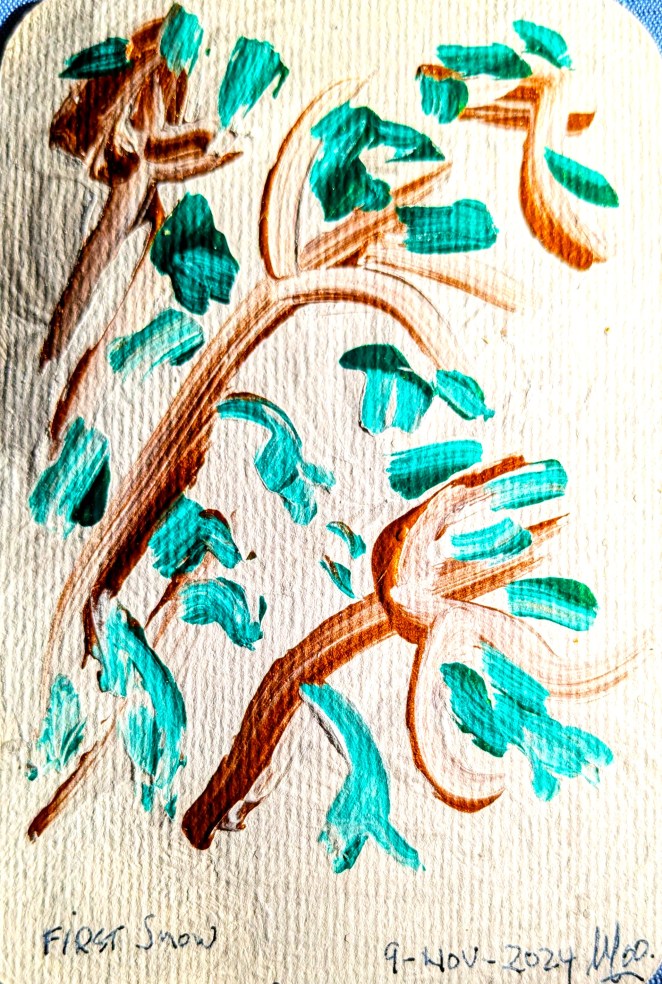
Moo liked this poem. He thought that First Snow was an excellent choice for the painting. This is Canada. We all know how that first, early snow storm can suddenly drift away into nothingness. The original poem ended with the line ‘like a sailing ship at sea, diminishing in the distance’ but Moo begged me to add another line – and so I did ‘or like early November snow, slowly fading away’. Good old Moo, he mothers me like a mother duck with only one duckling. He has some good ideas, though, and I love some of his paintings. It’s Thanksgiving Monday in Canada today and yes, we can all give thanks for Moo and his paintings! Well, I can anyway. So, here goes – thank you Moo.

Not that there’s any early snow here. Not yet, anyway. Frost yes, but last year I only used the snowblower on three occasions. That is a crazy winter. We used to get nine feet of winter snow here in Island View, and when the spring melt came, our black Labrador retriever could swim around the block in the flooded ditches. Now we scarcely get enough water to fill the aquifer and we live in fear of a water shortage that may, next year or the year after, dry up our wells. “De Nile ain’t just a river in Egypt.” No water shortage yet this year – but we are being very, very careful with our water usage. The St. John River is lower than anyone can remember – four feet down at least as it descends towards the sea. And that is not good news for anyone. “Those who have eyes, but will not see until the river fails to reach the sea.”

Many of us care. And we all do our little bit. No watering the lawns. No washing the car. No watering the flowers. Use the dish-washer once every few days, one weekly load, not multiple daily loads. Don’t leave the tap running while you brush your teeth. When they stayed with us, our friends from Oaxaca looked on in astonishment at the amount f water we wasted. We learned a great deal about water conservation from them. I must include them in my Thanksgiving Thanks as well.

My First Thanksgiving

My First Thanksgiving

For the first twenty-two years of my life,
Thanksgiving had no meaning, no substance,
no shape, nor form, nothing to hold me.

When I emigrated to Canada,
my Canadian cousins changed all that.
when they invited me to come to
Kincardine for Thanksgiving.

They served a traditional Thanksgiving Dinner
with vegetables in colored jellies
and all sorts of things I had never seen.

We were all surprised
at how alike we looked.
Like Cousin George in Vancouver,
or Cousin Elsie in Revelstoke.

They told me how WWII
had brought the family back together
on these special holidays –
Christmas in Wales for the Canadian troops
or Thanksgiving in Winnipeg
for the Welsh boys learning to fly.

That thanksgiving, the old family names
turned into photographs before me.
Snaps of my mother’s wedding,
my grandmother holding me on her knee.

And finally, as a special Thanksgiving gift
a long-distance phone call to Britain
and Clare on the phone saying
yes she would come to Canada
and yes she would marry me.

And I remember crying
all the way back from Kincardine
to Toronto and that was my first
Thanksgiving in Canada.

Clepsydra 23 & 24

23

… gulls on the wharf-side roof
     fishing boats
          returning to port
               white wakes trailing,
                    pointing to where they’ve been

where have I been
     all my life         

where is the wake
     that tracked me to and from
          so many unimportant places

so often have I waited
     for that moment of reunion
          port station airport

birds leaving nest
     only to return
          then leave again
               are not more faithful

sweet brevity of life
     a stone memorial
          on the harbour wall
               raised to all
                    who went to sea
                         and never returned
                              dying in the waves’ embrace …

24

… a watery grave
     no church no candles
          just cold waters sliding shut
               as down to the depths they go
                    

sinking from level to level
     never to rise again
          not till seas run dry
               burnt up by the sun’s candle

even then they’ll walk no more
          with their beloveds
               hand in hand
                    on diminishing land
                         or sea-licked sand …

Commentary:

“Birds leaving nest, only to return, then leave again, are not more faithful.” A lovely photo, from Avila, of storks, bouncing on their nests, waiting for the wind to lift them up aloft. I thought of using sea side photo from PEI, but this image caught my eye, and my words. A verbal – visual link. Not easy to spot, but there, in the sky above them, a parent waits. As soon as one chick takes flight, the watching parent will drop, fly under the fledgling’s wings, and tutor the young bird in the art of soaring and flying. I have spent many a happy hour, just sitting there, watching them.

And here’s the photo from PEI. An osprey, returning to the nest, after a fishing expedition. One hopes for such moments. Then, suddenly, one day, the magic happens, and verbal and visual joining hands in a single moment of magic. And listen to that baby bird, beak open, shrieking, waiting for the parent to arrive. I can still hear the screeching, although we are in the age of silent, but colorful, pictures.

In the picture below, the Grande Réunion – you can see the White Geese gathered at Bic. They return every year, so beautiful. The first time I saw them, I thought they were a drift of late snow. Then they rose from the field, and flew up, into the air. I have often seen snow falling but that was the first time I saw snow actually rising, after it had settled. A memorable moment.

Moments of magic, as I said, and each of them linked – verbal to visual. Silent dialogs with my time and my place, now shared with whoever has ears to hear and eyes to see and an imagination to reconstruct the alternate realities.

St. Mary Redcliffe

St. Mary Redcliffe

Time and Temple Meads
have begrimed your wand-thin spire,
the tallest in England.

You waved goodbye
to the Cabot boys,
Nova Scotia bound,
as they set sail.

Starling lime your belfry,
gift and inspiration
of Merchant Adventurers,
that gentlemen’s company.

Worms wriggle and gnaw
at your ship’s figure-head,
harbored now, bare-breasted,
sturdy in your oak-beam nave.

Rust rustles and creaks
at the Edney Gates,
wrought to last centuries
by Bristol ironmasters,
themselves apprenticed
to learn time’s laws.

Commentary:

Yesterday, via Zoom, I met with the Canadian Alumni of Bristol University. Sarah Price (Bristol Alumni Association) and Heather Proctor (Alumna) set the meeting up for us. Golden Oldies, all of us, we sat there and reminisced about our days, so long ago for most of us, at Bristol. I graduated in 1966, the same year I came to Canada. Most of the other alumni graduated long before I did. My last visit was in 1986 when I met with the Spanish Department, much changed, and talked abut my most recent research. One alumnus had visited just last year and talked of his returning to his old hall, his old room, his olde department, and all the changes that he had seen.

Most of those gathered had been in halls of one sort or another. Their experiences and friendships seemed very different to mine. Digs out in Knowle, Bristol, my first year. Then rooms in a rooming house, up by the Clifton Suspension Bridge, with other members of the Cross-Country team, for my next two years. Summers in Spain and France distanced me enormously from both England and the university. I remember coming back from Spain one summer and standing at the bus stop in Clifton, waiting for a bus to take me to Temple Meads Railway Station, a Number 18, if I remember correctly. Well, the bus arrived and drove towards me at enormous speed. It didn’t look as if the driver had any attention of stopping. So, I ran out into the road, waving my arms. He braked, gave me a very strange look, and asked me what I wanted. I said I wanted to go to Temple Meads. He said well get on the ****ing bus then. I looked at a great expanse of green metal, with windows, but no door, and asked him “Where’s the door?” Of course, after three months in Spain, like an idiot, I was standing on the wrong side of the road, and the wrong side of the bus. Such bitter-sweet memories.

I suppose I wasn’t a very good student. My only talent was speaking Spanish fluently. I worked hard at that, completely immersed in Santander, playing soccer on the sand, wandering through bars at night, learning to drink from a porrón and a bota without disgracing myself, and fishing on the weekends for panchos and julias in the Bay of Santander. I also learned how to row an old battered row boat, un bote. And it was all marvelous fun.

I also wrote a great deal of poetry and even managed to publish regularly in the Nonesuch Magazine. St. Mary Redcliffe, the poem above, dates from those days. I loved that church and visited it regularly. I wonder how many other Bristol students went in there and walked around inside. I also wonder how many stood with Jorge Luis Borges by the polished, black slate of the city hall, with its coal mine on the green, and gazed at their reflections in those shiny azabache mirrors. As I wrote yesterday on my blog – “How much can we know, your life of mine, my life of yours? At what point do those twin railway lines meet at the edge of time? Or are they doomed to a parallel universe where mind and mind, rail and rail, neither meet nor understand?” Sometimes, we can take a great joy in working out the answers to such questions. 

Clepsydra 18-20

18

… as free as the birds
     a sky full at North Cape
          where shores retreat
               year after year
 
the big red mud diminishes
     under advancing waters
          sea-threatened cliffs
               undermined roads
                    houses
                         the lighthouse

gulls follow the fishing boats
     herring gulls
          blotting out
               sun and sky
                    above the reef

with its seals
     basking in sunshine
          knowing themselves
               being themselves
                    thinking themselves safe

kings and queens
     of their sealdom
          never questioning …

19

… an osprey
     sudden the swoop
          turned into a stoop

water shattered
     total immersion
          then emerging
               with lusty thrusts of wings

claws clasping
     imprisoned prey
          prised from the sea
               raised to the skies
                    up and away
                         murderer and victim

oblivious below
     the black horse
          with cart and farmer
               gathering seaweed

all of them
     having no doubts
          safe in the security
               of their roles …

20

… while lost in the labyrinth
      I searched for a thread
               on life’s loom

a thread woven
     by an unknown
          unseen hand
               a hand and thread
                    I could never control

yet one day
     that thread
          will lead me out
               from the dark

then shall I see
     the sun’s great candle
          beneath which red rocks
               wave and water battered
                    crumble

here at North Cape
     in a way that nobody
          can understand …

Commentary:

The osprey “emerging with lusty thrusts of wings, claws clasping, imprisoned prey prised from the sea, raised to the skies, up and away, murderer and victim.” The words are based on the photograph. A quiet day, somebody shouted, and pointed, and clickety-click, I was lucky enough to capture the whole thing on my digital camera. This one shot summarizes it all.

The stanzas (16 & 17) that precede this moment are available here. Clepsydra, the book, is one single poem, one single sentence, that rambles on and on. Each stanza stands alone, each poem (numbered) stands alone, and the whole book stands alone as a single sentence summarizing what I have seen and where I have been. Bakhtinian Chronotopos – my dialog with my time and my place. In this case, my many dialogs with my multiple times and multitudinous places.

Albert Camus lent me the phrase ‘murderer and victim’. ‘Nous sommes, ou meurtrier ou victime‘. Quoted from memory. I hope I am not too far wrong. My memory fades as I age. Louis Aragon suggested I borrow his line “rois tombés de leurs chariots” – that I found in his collection Il ne m’est Paris sans Elsa. Here, I have applied it to the seals at North Cape, PEI – “seals – basking in sunshine – kings and queens of their sealdom.” Intertextuality – texts talking to texts and recalling segments of texts within other texts.” Wonderful. Alas, I fear the coming days when the memory may no longer be so clear. ‘What will be, will be’ said the Osprey as he pulled the flounder from the sea and carried him too his nest in a nearby tree.

Absence

Absence …

… makes the heart grow
callouses scabs you can
pick at with your finger
nails bleeding fresh blood

they remind you that you have
a heart feelings something
buried so deep you need
a pick and a shovel to dig
a shaft with wooden slats
placed carefully at the sides
so your mine won’t collapse

you dig deeper and deeper
until in the gloom you see
the feathered fluttering —

a broken-winged canary
sacrificed in its cage
so part of you can escape
flee the mine
and come out alive

Commentary:

A golden oldie. Moo thought Poppy Day (11/11/2024) would be a suitable painting. Those who survive rarely forget those they were forced to leave behind. Kindred spirits, they travel though life together, the live one carrying the other on his shoulders as he would have done earlier, had he been able to.

Moo still has a teddy bear. He tells me he has always slept with one. His first teddy was an Australian Koala, a real stuffed koala given him by his Australian family, back when he was born. Moo was reading a book on the Battle of Britain (15 September 1940). It had a picture of the gunner from a Bolton Paul Defiant, sitting in the gun turret. Behind him, he had his little teddy bear. Moo couldn’t stop crying. He thinks he might have been an air gunner in another life, and when he saw that teddy, it brought back so many memories – flak, night fighters, search lights, tracer bullets, pain, flames, and then the unending darkness. So many did not come back, especially the tail-gunners. Their absence is still a presence to someone in their families. And so it should be.

Monkey Visitsthe Chimpanzees’ Tea Party

Monkey Visits
the Chimpanzees’ Tea Party

Dressed to the nines in their gala outfits,
they have come here for the tea party.
Hairy penguins, they waddle back
and forth across the temple,
then lunge for a table with its jumbo shrimp,
smoked salmon, scallops, baked oysters.

Faces slashed from ear to ear
by enormous grins,
“Food’s free!” they say
and stuff themselves
regardless of the consequences.

Serviettes tucked into collars,
they scoff lobster and crab.
Birds of Paradise, subtle delicacies
flown in from half a world away,
decorate the tables.

There is something about them, though,
these chimpanzees,
gripping cup handles
between finger and thumb,
enormously pleased to be the centre of attention,
however clumsily they walk,
in their hired-for-the-occasion,
ill-fitting, black and white penguin suits.

Commentary:

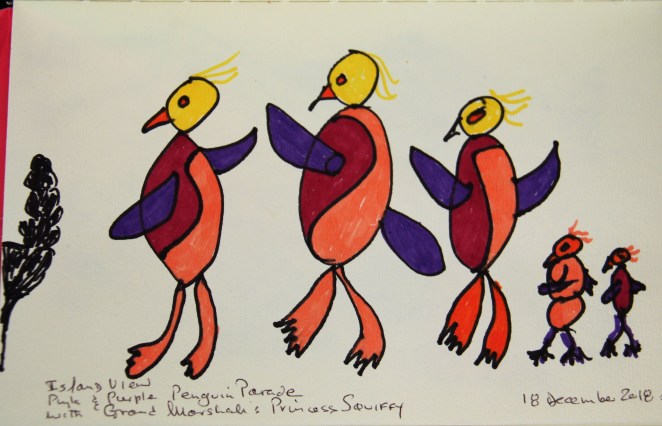
Moo apologizes. He hasn’t painted any chimpanzees, but a long time ago (2018) he drew and colored this cartoon. Pink and Purple Penguin Parade with Grand Marshall, Princess Squiffy. You can just see the end of Princess Squiffy’s tail as she vanishes out of the cartoon, encouraging the Pink and Purple Penguins to follow behind her behind. Oh the joys of leading the parade. Not everybody wants to do it though, many are content not to lead, but just to follow. Perhaps we should have called our cat MacNamara. After all, he was the leader of the band. But I don’t think Princess Squiffy would rather be anything other than what she is – a princess.

This poem, from Monkey Temple (of course / wrth gwrs) reminds me of Parents’ Day at my Boarding School. After several weeks of scarcely edible food, the tide would suddenly turn. Thursday, prime rib roast beef for supper. Friday, roast chicken with all the trimmings. When our parents arrived on the Saturday, all we could talk about was the wonderful food we had been eating for the last two days. Cunning, eh? We all had to dress up for Parents’ Day. Sunday starched collars, collar studs and all, and nice clean Sunday School ties.

Tea on the lawns in summer – unforgettable. A marquee, in case it rained, but otherwise tables laden down with a variety of skillfully cut sandwiches, little triangles, with no crusts, followed by endless helpings of strawberries and cream. The boys served their parents, fleeting back and forth to full the rapidly emptying plates. One boys father, I won’t say whose, devoured 12 bowls of strawberries and cream before the headmaster call the son over and begged him to beg his father not to eat all the strawberries and cream as some other parents’ would like some also.

Griffin Hunting – not a typical public school sport but one in which my school most certainly indulged. Our school symbol – a griffin – woven with gold thread on a dark blue background symbolized for the younger boys the perfection of the Prefects. To Hunt a Griffin was to behave in such a way as to attract the attention of older boys (already Perfect Prefects) and the school masters so that one became a candidate to climb the ladder and become a candidate for Griffin-hood. Some of us, myself included, preferred the anonymity of Robin Hood and were happy in our chosen roles of outlaws in Sherwood Forest and agents provocateurs and anarchists. Not for us the gentle counting of innumerable sheep. We chose rather the perils of after-dark transistor radios and the joys of Radio Luxemburg.

I remember being caught out of bed one night, on my knees, in a corner of the dormitory. All the dorm occupants were squealing and making a terrible noise. This attracted the attention of Perfect Prefect Plod – and in he came, threw the door open, and switched on the light. “You!” he pointed at me. “What do you think you are doing, out of bed?” “I am catching a mouse, Prefect Plod,” I replied. “You are a nasty little liar,” said Prefect Plod. “There are no mice in our nice clean house.” “Oh yes there are,” I replied, and I showed him the little mouse that I had cradled in my hands. “Give that to me,” ordered Prefect Plod. So I did. And the mouse took an instant dislike to him and immediately sunk its sharp little teeth into his thumb. I remember Prefect Plod running out of the dorm screaming “Matron! Matron!” and the little rodent swinging back and forth and hanging grimly on.

Those boarding school days ended 63 years ago. Hard to believe, really, but I still have such vivid memories of them. And of the Perfect Prefects, gripping cup handles between finger and thumb, enormously pleased to be the centre of attention on Parents’ Day, however clumsily they walked, in their spruced up for the occasion, Sunday Suits and Shirts, with their Golden Griffin ties. I always think of the Chimpanzees’ Tea Party when I think of the special performances of that little lot ‘for a Prefect’s lot is not a nappy one, nappy one.’

Monkey Turns Down Promotion

Monkey Turns Down Promotion

“I hereby appoint you head of the asylum.”

The young office monkey with the plastic stethoscope
was dressed neatly in a white sheet.

“Dr. Freud, I presume?”
Monkey held out his hand
but his witticism was lost in a flood of water
flowing from the flush and over the floor.

Monkey stood there, paddling in piddle.
Inmates with crowded heads and vacant faces,
fools grinning at a universe of folly,
paddled beside him. He wiped
a sick one’s drool from his sleeve.

The office boy spat on his hands,
slicked down his hair, and placed
his stethoscope on monkey’s heaving chest.

“You have no pulse.”
“How do you know I have no pulse?
Surely, you cannot hear my heart
for you have a banana stuck in your ear.”

“Speak up!” said the doctor,
“I cannot hear you:
I have a banana stuck in my ear.”

Then monkey felt fear.

Daylight diminished
and waters closed over his head.
He spurned the proffered paw,
the life belt thrown
by the offer of a new position.

Exit monkey left,
pursued by a chorus:
“Run, monkey, run!”

Commentary:

A Golden Oldie from Monkey Temple (2010). I came across it by accident as I thumbed through some older books – wow, fifteen years ago that came out. A Golden Oldie indeed. I had forgotten all about Monkey Temple. However, the last couple of days I have watched New Zealand vs Canada and England vs France (Women’s Rugby World Cup). Both semi-finals took place at Ashton gate, Bristol. That’s when I started thinking about Bristol and Bristol Zoo.

We had family in Bristol (Westbury-on-Trym) and from an early age we visited Bristol Zoo. One of my favorite places was the old ruined Monkey Temple, full of monkeys that impressed me with their antics. A small, walled zoo, it was full of innovations and I remember well Alfred the Gorilla and Rosie the Elephant. I loved the rides on Rosie’s back. The camels too offered lifts to young children and the elephants took apples from my hand with their long trunks. I also remember the bear pit, and loved watching the brown bear climb to the top of his pole and catch food thrown to him by the visitors.

I think everybody’s greatest thrill came with feeding time for the seals. What a racket when the attendant appeared with his / her pail of fish and he/she threw them to the waiting seals. Almost as thrilling was the penguin house with its aquarium and glass windows. Animals that seemed so clumsy, waddling on land, turn into sea-angels when they dived and we could meet them, face to face, so to speak, almost in their own environment.

My love of zoos reached out and I recall the zoo in Madrid, established when Columbus returned from his voyages with species of animals hitherto unknown. And who could forget Copo de Nieve, the albino gorilla in Barcelona zoo.

Alas, my zoo day’s are over. But the world is wonderful. Today, two deer entered our front yard, lunched on the fallen crab apples, and went to sleep underneath the trees outside our window. Joy to the world and the world brings me joy -sunrise and sunset, colored clouds, the deer in my yard, a fox passing through. However, I must admit I am not impressed by the little red squirrel that nests under the hood of my car and gnaws my cables. Nor by the porcupine who loves the salt in my garage doors and nibbles at the door frame every chance it gets. The love of nature – red in tooth and claw – I guess we have to enjoy the good and put up with the bad. Life’s like that. “Ask the animals, they will teach you.” Bristol Zoo motto.

Love in Old Age

Love in Old Age

How do I love you? Let me count the ways.
I love you when together we start to write
for although you’re sometimes out of sight,
you’re never out of mind. So many days

we’ve spent sitting together at keyboards, tapping
at computer keys. Is this the way to please
each other, a choosing of words, a squeeze
of meaning into a smaller space, with overlapping

metaphors and images improved in ways
we never would have dreamed of? Each
to his or her own, we say. Yet we reach
out to each other over time and space,

not joined at hip or lip, but with energy and zest,
sailing similar seas, and trying our very best.

Commentary:

A Golden Oldie, the poem more than the painting. Moo is more up to date than me. He also thinks my beloved and I sit side by side, or at opposite sides of the table, gazing at each other, but not saying much. Hence his choice of cartoon – The Sound of Silence.

“Each to his or her own, we say. Yet we reach out to each other over time and space.” Sometimes silently, often with words. Silence is best – because as my hearing goes, what I hear is a mumble – like the rumble of the old Mumbles Railway – does anybody else remember that? The result of the overheard mumble is an inelegant ‘Eh?’ Too many ‘ehs’ spoil the silence. Don’t they, eh? What’s that you say, eh?

So, I am now having great fun reading a new word a day in Welsh. What a joy to pursue the language that was forbidden when I was a boy. I don’t have anyone to talk to, but that is beside the point. Reading, remembering, the old place names still there at the tip of the tongue – Brynhyfryd, Rhosili, Pwll Ddu. Each name brings with it a visual memory, usually silent, but sometimes filled with the cries of sea-gulls and the growling of corgis defending their territories. Whatever – what joy!