Where’s Home (2)

My home for 31 years

Where’s Home (2)
Part II of an open letter to Jan Hull

I ended yesterday’s letter with the words “There is a brighter side too, and I will get to that another day.” This is the day, and the brighter side is the sacredness of place. The Celtic Nations believe strongly in the sacredness of place. In the old religions we believed that places held spirits who dwelt in the rivers and streams, who lived in the trees and the orchards, who were a large part of the spirit of place and sacred space. You can still read some of this innate pantheism in The Chronicles of Narnia. Irish, Scottish, Welsh, French … we all have Celtic roots and, like the First Nations of Canada, we still believe in the sanctity of the land. This is an old tradition and a worthy one. Not all great ideas were born in Western Culture post the Industrial Revolution. Many pre-date our so called modern culture. Some should replace it.

I believe very strongly in the power of place. Sometimes, turning a corner one day, we know we are home. This is the feeling that comes so strongly through the second chapter of your book, Jan. Yes, the Maritimes (NB, NS, and PEI) are home for many people. It is indeed their One Small Corner. their querencia. What is a querencia, you ask? Well, it is the place that calls you, the place in which you want to live, the place in which you want to die. And yes, in this time of pandemic, death is on all our minds: those twin realities, sickness and death. Neither is easy. These times are not easy. But they become easier for those of us rooted in our time and our place and, like it or not, the human being, male, female, or other, must live in a dialog with their own time and place. This is the chrono- (time) -topos (place) of the Russian Philosopher, Mikhail Bakhtin.

Life is so much easier when we are in our own beloved space. When we are out of it, away from home, down the road, that is when we suffer most, Sometimes we are still able to flourish. Oftentimes, we wither and perish, like leaves on the tree. You, in your book, Where’s Home?, have offered us a glimpse of what that one small corner, the province of Nova Scotia, means to your correspondents and the ones with whom you have held dialog. We are all of us richer for that experience. Thank you, Jan, and on all our behalves, mine particularly, please thank your contributors.

One Small Corner

 And this is the good thing,
to find your one small corner
and to have your one small candle,
then to light it, and leave it burning
its sharp bright hole in the night.

 Around you, the walls you constructed;
inside, the reduced space, the secret garden,
the Holy of Holies where roses grow
and no cold wind disturbs you.

 “Is it over here?” you ask: “Or over here?”

If you do not know, I cannot tell you.

But I will say this: turning a corner one day
you will suddenly know
that you have found a perfection
that you will seek again, in vain,
for the rest of your life.

Flowers

Clare’s Birthday

I won’t allow her to sit here
with her head in her hands
fearing the future
or brooding on the past.

Every day we survive
is a bonus now, each sunrise
a celestial celebration.

We welcome daylight
with open arms and now,
on her birthday, we will
accept all gifts with joy.

Sunshine floods through us.
It fills us with joy and beams
like a beacon. A full tide
of love overflows in our hearts

filling our souls with sunlight
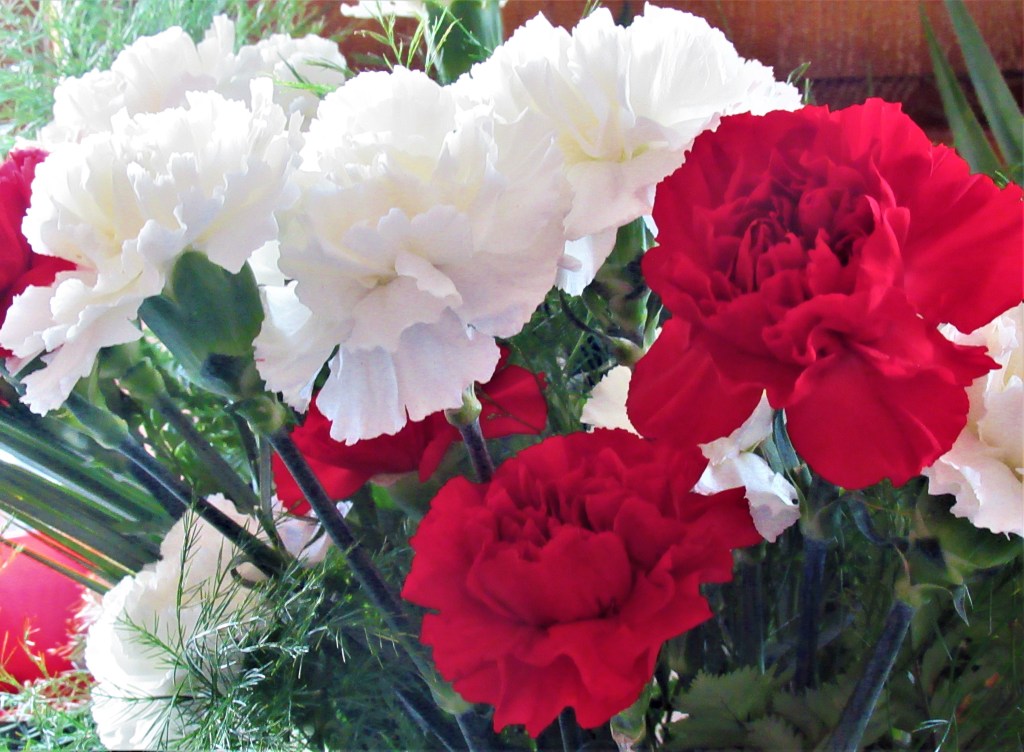
and red and white carnations.

Yours

Some flowers don’t fade
even after 55 years

Yours

Yours are the hands that raise me up,
that rescue me from dark depression,
that haul me from life’s whirlpool,
that clench around the jaws that bite,
that save me from the claws that snatch.

Yours are the hands that move the pieces
on the chess board of my days and nights,
that break my breakfast eggs and bread,
that bake my birthday cake and count
the candles that you place and light.

You are the icing on that cake, and yours
is the beauty that strips the scales
from my eyes, then blinds me with light.

Merry Sunshine

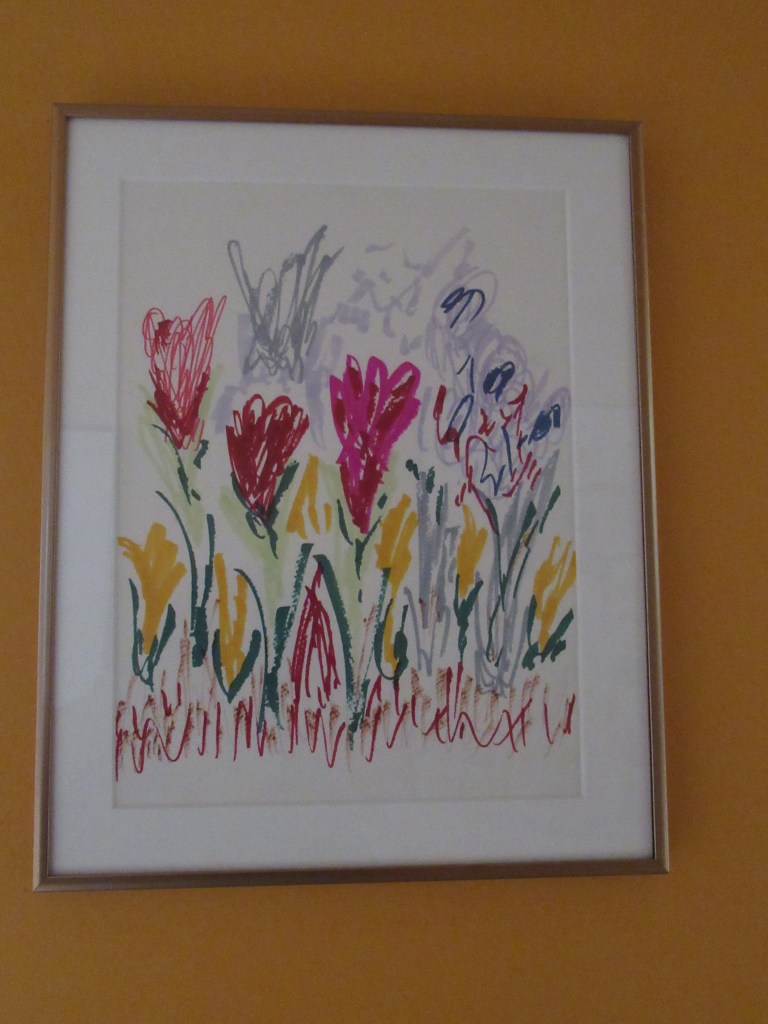
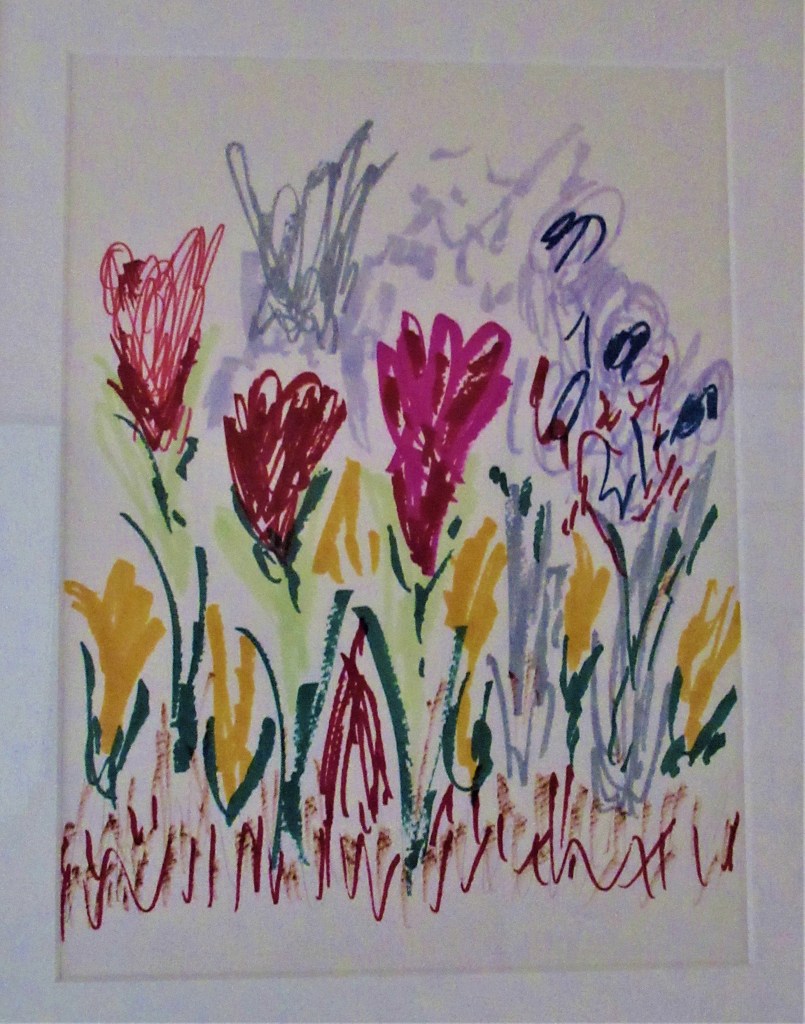
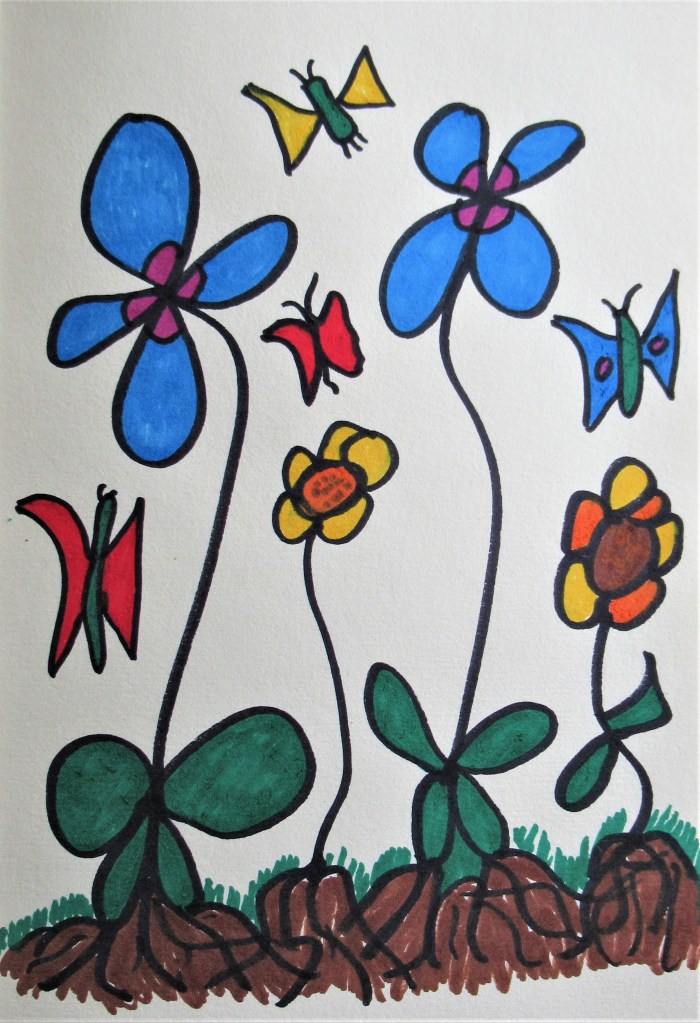
“The flowers that bloom in the spring, tra-la, bring promise of merry sunshine …” Gilbert and Sullivan, from The Mikado, if I remember correctly, and not at all anonymous like the Anonymous Bosch artist who painted this painting. Still, I like it, and it certainly lends a little bit of color to the pale cheeks of these walls.

“And we merrily dance and we sing, tr-la, as we welcome the promise they bring, tra-la, of a summer with roses and wine …” I can remember my grandfather singing that in the kitchen in Swansea. He would conduct with one hand, and encourage me to join in with the other. And I did. Merry days, they were, before the fire in winter and out in the greenhouse in early spring.

So, where have all the flowers gone? Gone with the grosbeaks, everyone. Which reminds me, I saw an Evening Grosbeak at the feeder this morning. The first one in years. There used to be several nesting nearby and they were regular visitors, as were the Gray Jays, aka Whisky Jacks, aka Gorbies, aka Ghosts of the Woods and all of them long, long gone.

Will they naw come back again? Who knows? The world is changing even as I sit at my window and watch it go by. February, March, April, May, June, and now July. The lock down has been lifted, but the fear of going unmasked in the great outdoors is still with us, as are the anonymous givers of the virus, a donation I do not want, and nor does anyone else, in their right minds, compus mentis, and not yet willing to on the anonymous ranks of the Gorbies, the Grosbeaks, the Swallows, and the other birds that have fled elsewhere, leaving our yard to the crows, the blue jays, the squirrels, the chipmunks, and the occasional more colorful visitors.

Spring Flowers
by
Anonymous Bosch

After the Lecture

After the Lecture

After I delivered the lecture at London University, as it was back then, I caught the tube and descended at Paddington station. While waiting for the train back to Cardiff, I sat in the station bar and ordered a pint of beer and a Cornish pasty. An older man wearing a sweater and jeans asked if he could join me. I didn’t say ‘yes’ but he sat down anyway and straight away began to talk.
            I paid no attention to him until he rolled up his sleeve and showed me the collection of scars that ran crisscross, hard and welted, over his left wrist.
            “Failed attempts,” he said. “But I’ll get it right next time. “I wouldn’t want you to make the same mistakes I did. If you want to kill yourself, you must do it this way,” he reached across the table and picked up the knife I had used to cut my pasty. He pulled out a dirty hanky and wiped the knife in it. Then he laid the blade not cross-wise but parallel to the artery in his wrist. “And you must dig deep, first time, and at a slight angle.”
            “I’ve got to go,” I told him as a tinny voice came over the Tannoy. “That’s my train.” I stood up, leaving the remains of my pint and my pasty on the table.
            I got to the door of the station bar and looked back. Then I watched as my table companion finished my pasty and reached across the table to claim the remains of my beer.
            “Quite the lecture,” I thought. “Good job I didn’t spit in the glass.” Then I realized that both my day’s lectures had been effective, in one way or another.

Kite

Kite Flying

So light, the kite,
a butterfly in flight.

Breeze battered,
sky-blue shattered.

Children stare
seeing the wing-shape
fluttering there
rising on flimsy air.

Diving, dipping,
nylon cord slipping,
finger-flesh ripping.

Here come others,
children and mothers.

Butterflies, bright,
ready for flight,
fighting wind-might:
a child’s delight.

I didn’t have photos of a kite.
I offer some humming birds instead.
Listen closely:
you can hear them hum.

Blue and Green

“Blue and green
should not be seen
without a color
in between,”
thus spoke my mother.

What did she know
of the Peace Park grass
sweeping spring-clean
to head pond waters?

Didn’t she sense the frail
brown fringe of rock
scarfing between green
grass and head pond blue
or the white caps lacing
cow parsley on the stones?

I know she knew nothing
of yellow and red leaves,
brown spotted like an old
man’s hands, freckling waters,
fretting at the fragility
of nature’s delicate balance.

Forget-me-not

Forget-me-not

sitting in the kitchen
crouching by the coal fire
hands quite warm
back quite cold
checking the windows
peeling back the curtains
blackout curtains
frayed and old
looking at raindrops
sliding down the windows
chill greasy raindrops
grey and cold

wondering who wants me
wondering who loves me
wanting my teddy bear
longing for my pussy cat
wanting my little dog
longing for his tail wag
so much missing
my nose so cold

now I am seventy
everything has changed
changed town and country
changed clime and weather
everything is different
nothing is the same
longing for my childhood
longing for my home land
watching the ocean
that comes rolling in

ocean of waters
ocean of memories
ocean of people
now long departed

Comment: Rhythm is everything here. I have just re-read The Sing-song of Old Man Kangaroo from Just So Stories (Rudyard Kipling). My mum and dad gave me copy when I was seven years old. Did they really think I could read it and understand it at that age? Whatever! The rhythms have stayed with me all my life and today I tried to reproduce them. My soul and my fingers danced as I thought of old man kangaroo and how he lost so much to gain so much. And what of the Elephant’s Child with his insatiable curiosity? I lost so much when I came here to Canada but I gained so much from this wonderful country. I tore my world apart then put it back together. How to explain it? It may not be explicable.

Hot Water Duck

Canada Geese at Mactaquac

Hot Water Duck

The worst punishment of all was to be sent to bed early.  You climbed upstairs by candlelight, if you were lucky, or groped your way upwards in the dark, if you had been really bad. You entered the cold, dark, damp of the bedroom and punishment was not to have supper, and not to have a warm hot water bottle or a warm baked brick to keep you warm in bed. I loved that hot brick, baked in the oven or by the fireside, then wrapped up in a towel. Bricks and bottles: they banished damp from the bed and kept you warm for a while, or burned if the wrapping fell off. The hot water bottles: they were made of tin not rubber, and once, I remember a cast iron duck, that my grandmother baked in the oven, then wrapped in swaddling clothes, like a little baby. But if the grown-ups said you had been naughty, or nasty, or cheeky, or just plain wicked, then you were given nothing to keep you warm, and you lay in bed and shivered until you cried yourself to sleep.

Canada Geese and Fall Foliage at Mactaquac