Driving from St. Andrews to Island View, giving thanks for fall foliage as I pass fields and forests filled with autumn blushes blueberry patches brushed with cyan, violet, sprinkled with primary red.
Trees crowd close, encroach, add yellow and orange, fresh tonal values at each turn.
Sunlight strokes white touches of pointillistic beauty through showers of golden leaves.
Ochre and brown burn shades where pinprick black ghosts shadow grays through a gilded tree.
Cubist, this fire-bright, iron-sheeted shed. Surrealist that rusted tractor, abandoned. The road’s black thread ties together vivid impressions of leaves as they tumble and fall.
Seize the day. Squeeze this moment tight. Nothing before means anything. Everything afterwards is merely hope and dream.
A tiny child, you chased wind-blown leaves trying to catch them before they hit the ground Elf parachutes you called them and trod with care so as not to crush the fallen elves as they lay leaf-bound.
I stand here now, a scarecrow scarred with age, arms held out, palms up, in the hope that a leaf will descend, a fallen sparrow, and rest in my hand.
When one perches on my shoulder and another graces my gray hair, my old heart pumps with joy.
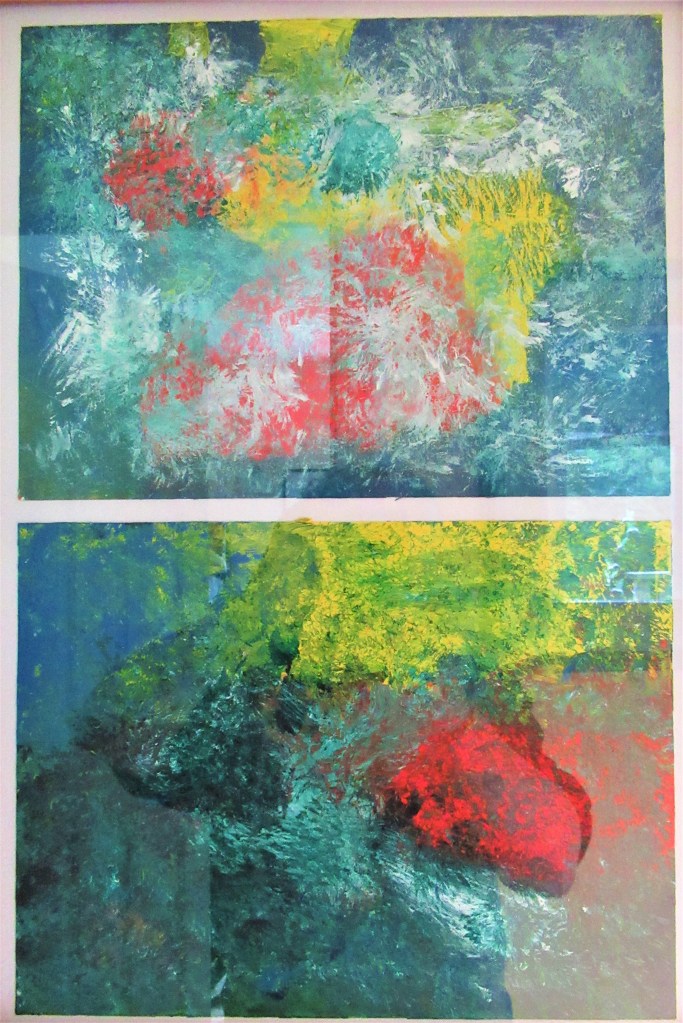
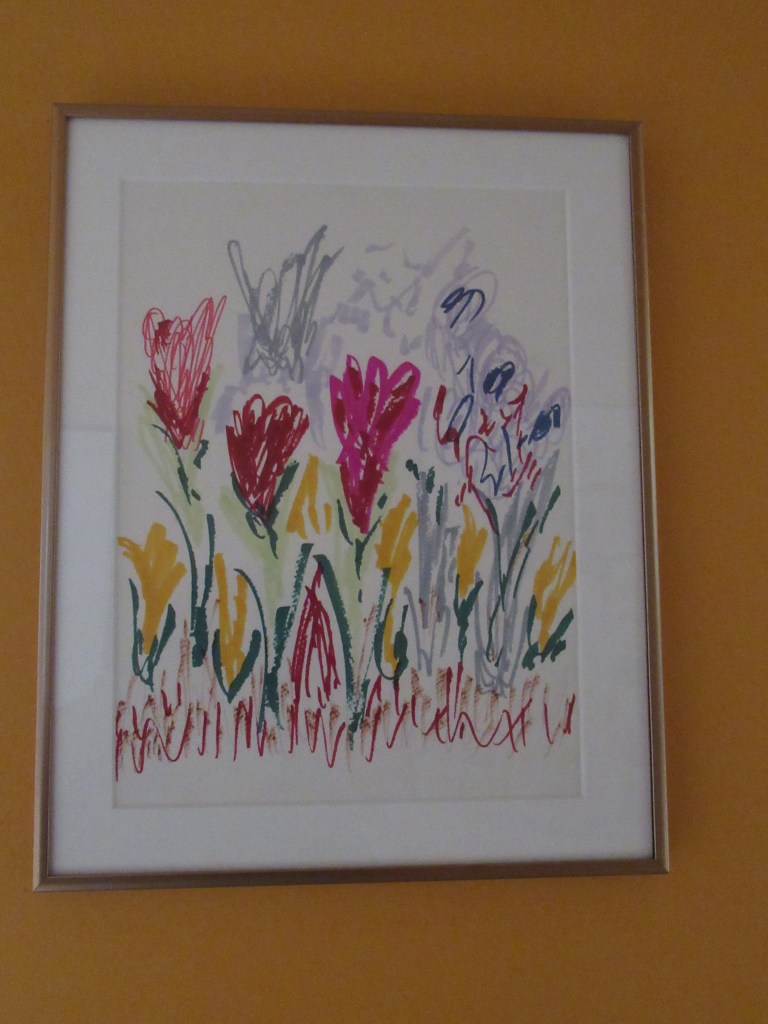
Comment:Autumn in the Garden was framed by Geoff Slater who gifted it to me this summer. Thank you Geoff. A double picture, it shows the flowers and the trees with that first touch of drifting snow. NB it snowed here in Island View early September this year while we still had flowers and leaves. The poem, Carpe Diem, is from a series of quasi-sonnets. Quasi, because they rarely have 14 lines! Oh Petrarch: shake in your shoes.
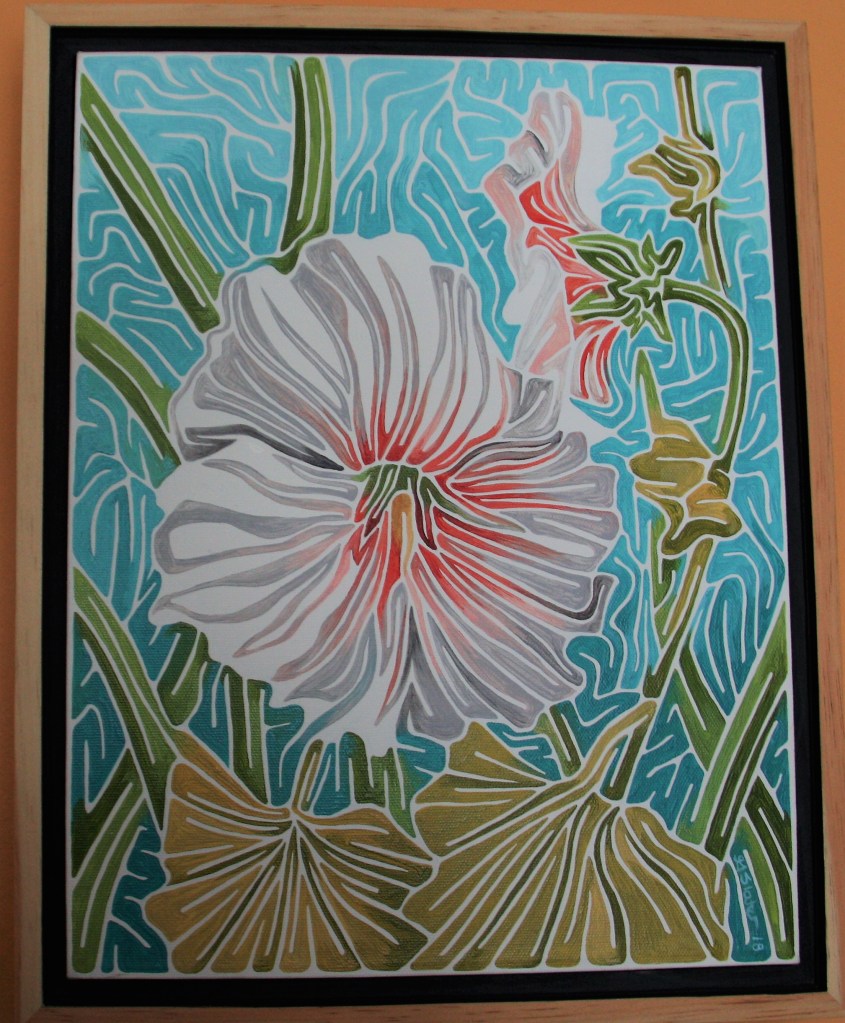
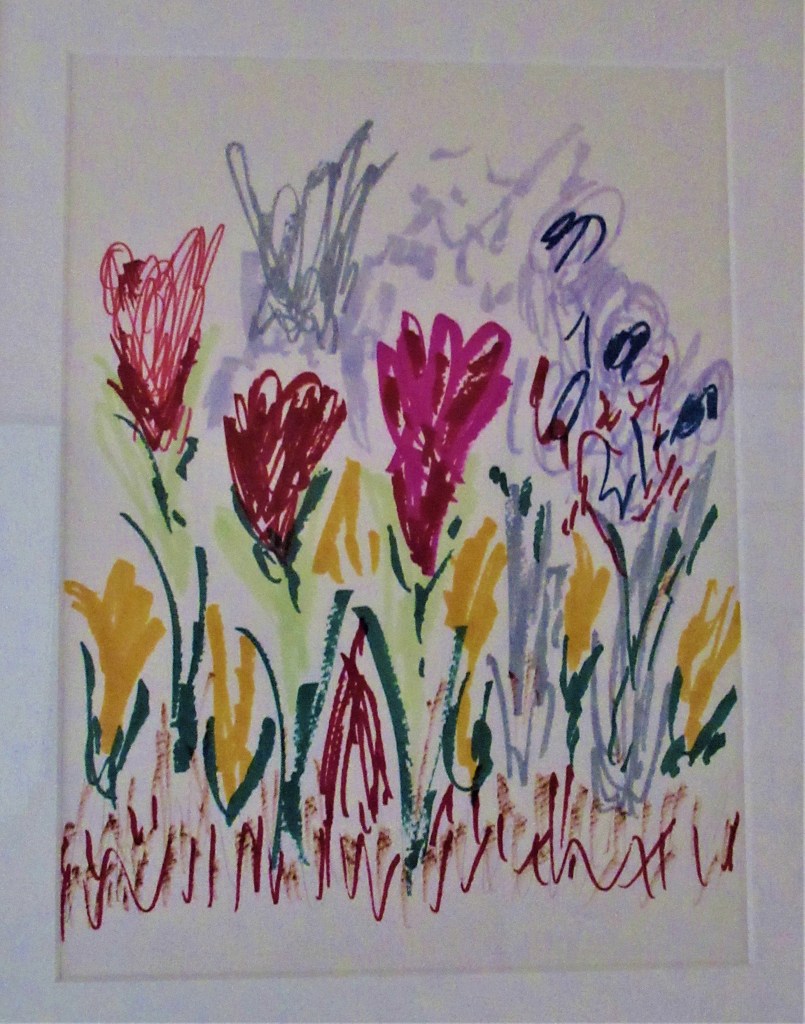
No Exit a line painting by Geoff for Andrea Slater
Where is the entry point, where the exit? This labyrinth of lines, straight, not circular, baffle the eye, confuse with a negative space that lightens colors and begs more darkness.
Mystery surrounds the sitter’s form: the board walk, no Dutch kitchen this, the chair on which she sits, the locket she wears, the landscape, seascape against which she is framed. White noise, perhaps,
but noise that turns to a single voice, a single line, that of the paint-brush tip-toeing, delicate its thread through interior, exterior meaning, just beyond
the viewer’s grasp. Yet walking past, each person stops, stands still, as the painting draws them in, ties them up, binds them with an ineffable thread, stronger than words,
mightier than the eye that traces its way along paths that deceive, disturb, throw us from the high-wire created by an artist who turns circular colors into linear space.
Comment:No Exit forms a part of my manuscript collection The Nature of Art and the Art of Nature that placed second in the WFNB’s Alfred G. Bailey Award (2020). This collection will soon be made available online at Amazon / KDP.
Geoff Slater the inventor of line-painting, gifted me this painting, one of my hollyhocks about two years ago. This is indeed a gift that keeps on giving.
A feather upon the cheek, this fern held fragile, hesitant between fine fingers. Touch and smell: two senses engaged.
A paint brush sounds, brush-brushing lightly on expectant skin. Faint the taste tested suggestive on tongue tip.
No sight, just insight. I have a sense of senses lacking. My words reach out like fingers, but they can neither retain nor explain the meaning of it all.
Eyeless in Kingsbrae, They push me, blindfolded, around the garden. Gravel crunches beneath the wheelchair wheels, sharpens my inability to be sure of shadows and shapes that are no longer there.
The ones who push me talk and tell but cannot show. How could they hold a rainbow before my sightless eyes or explain those lights that crisp and crackle in the night sky?
There’s warmth in a color, and heat’s visible to the touch. Shocking pink has a different feel beneath blind fingers, and it has no name that you and I, sighted, would ever know.
Oh, Song of Songs, and the singer deaf to his own sublimity. Oh dealer of false cards, fingerless pianist, and dancer shuffling on amputated stumps.
Comment: The poem Eyeless in Kingsbrae Garden is contained in my book One Small Corner: A Kingsbrae Chronicle (2017), available online at Amazon / KDP.
Here, in Island View, my lawn’s parched grass longs for water, long-promised but never drawing near. Do my flowers remember when the earth slept without form and darkness lay upon the face of the deep?
The waters under heaven gathered into one place. When they separated, the firmament appeared. Light sprang apart from darkness and with the beginning of light came the word, more words, and then the world …
… my own world of water in which my mother carried me until her waters broke and the life sustaining substance drained away throwing me from dark to light.
In Oaxaca, water was born free, yet everywhere lies imprisoned in bottles, in jars, in frozen cubes, its captive essence staring out with grief-filled eyes.
A young boy on a tricycle pedals the streets with a dozen prison cells, each with forty captives: forty fresh clean litres of drinkable water. He holds out his hand for money and invites the villagers to pay a ransom, to set these prisoners free.
Real water yearns to be released, to be spontaneous, to trickle out of the corner of your mouth, to drip from your chin, and fall to the ground.
It is a mirage of palm trees upon burning sand. It is the hot sun dragging its blood red tongue across the sky and panting for water like a great big thirsty dog.
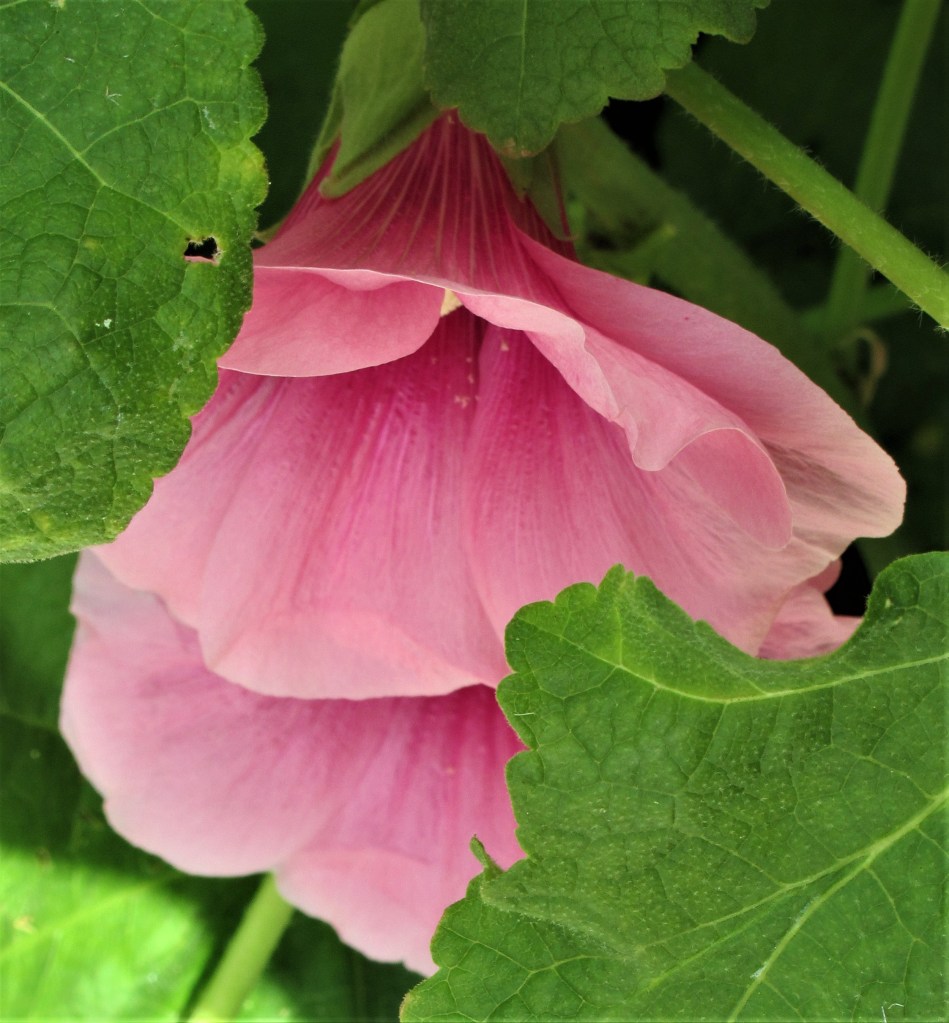
So, the holly hocks are back and this year we have some red ones to go with the lovely yellow ones that reseeded, in a different place, from last year. The red ones are very shy and are hidden away by the back steps where they are very hard to see.
I spy, with my little eye …
The red and green go well together. More a deep, blushing pink, I guess, with very dark centre. You can see the wood of the steps just behind them. I posted this yesterday, incidentally, but the computer munched it and I had to rewrite it today. It has been a slow time for me. The Corona-19 finally got to me, not in the physical sense, but mentally. As a result I have been feeling isolated, trapped, and a little bit depressed. Alas, there are many more like me suffering in today’s world. Luckily, the flowers help. As does the sunshine.
We’re back
Here are the new seeds from last year’s hollyhocks. They are similar in color, but much smaller this first season. They have also shifted location and I have been surprised at how many seedlings have sprouted and started to grow. Next year we may have a bumper crop.
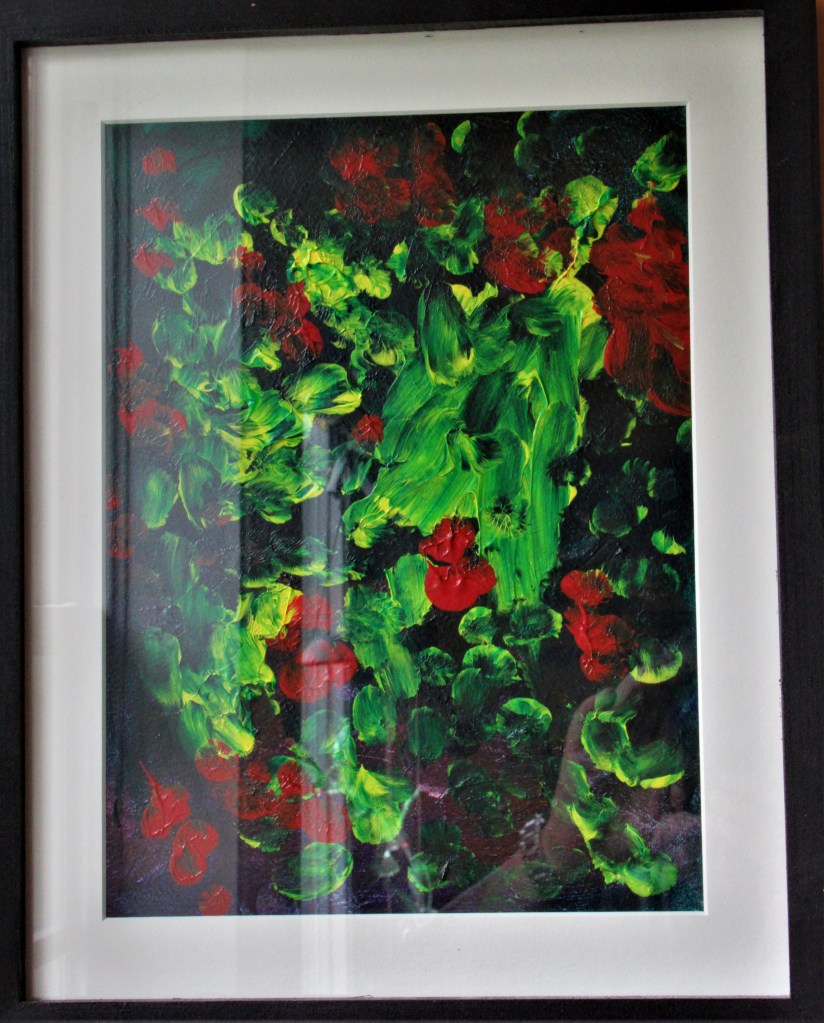
Night Garden
And here we have a painting of the garden at night, flourishing without us, but beneath the stars. “The garden going on without us.” Given the current situation, I prefer the garden going on with us still here to watch it.
“The flowers that bloom in the spring, tra-la, bring promise of merry sunshine …” Gilbert and Sullivan, from The Mikado, if I remember correctly, and not at all anonymous like the Anonymous Bosch artist who painted this painting. Still, I like it, and it certainly lends a little bit of color to the pale cheeks of these walls.
“And we merrily dance and we sing, tr-la, as we welcome the promise they bring, tra-la, of a summer with roses and wine …” I can remember my grandfather singing that in the kitchen in Swansea. He would conduct with one hand, and encourage me to join in with the other. And I did. Merry days, they were, before the fire in winter and out in the greenhouse in early spring.
So, where have all the flowers gone? Gone with the grosbeaks, everyone. Which reminds me, I saw an Evening Grosbeak at the feeder this morning. The first one in years. There used to be several nesting nearby and they were regular visitors, as were the Gray Jays, aka Whisky Jacks, aka Gorbies, aka Ghosts of the Woods and all of them long, long gone.
Will they naw come back again? Who knows? The world is changing even as I sit at my window and watch it go by. February, March, April, May, June, and now July. The lock down has been lifted, but the fear of going unmasked in the great outdoors is still with us, as are the anonymous givers of the virus, a donation I do not want, and nor does anyone else, in their right minds, compus mentis, and not yet willing to on the anonymous ranks of the Gorbies, the Grosbeaks, the Swallows, and the other birds that have fled elsewhere, leaving our yard to the crows, the blue jays, the squirrels, the chipmunks, and the occasional more colorful visitors.
“Ah, would some power thegiftie ge us / to see ourselves as others see us.” Robbie Burns, a Scottish Poet.
And sometimes I think the flowers would like to be seen as they see themselves, not as we see them with our imperfect eyes, not with the cataracts of the Elderly Monet, not with the blunted vision of many artists who have stopped, and sniffed, and bent their heads, and wondered at the colors that entered their paint brushes through the nostrils. Vision and reality: the photo versus the objects as we see and sense them. The reality versus our own version of it.
So who is this anonymous artist who delivers these visions to my blog and allows me to glimpse alternate realities that are so different to my realities. I think of Lorna Crozier, The Garden Going on Without Us. I think of Kingsbrae Gardens, at night, when the flowers are alone and talk only to themselves. I think of Monet at Giverny as his vision lessened and his instincts grew. Who are we? What are we? Do we see ourselves as others see us? Do others see what we see? Color, shade, light, hue … El ojo que ves no es ojo porque lo ves, es ojo porque te ve / the eye you see is not an eye because you see it, it is an eye because it sees you (Antonio Machado). Does the man or woman looking out at us from the television set see him or herself as we see them?
The night before last I sat alone in a hotel room. The television screen was much, much wider than it was high. All the facial images were greatly distorted. I didn’t recognize the people I saw, except by their voices. Who will distinguish the reality of the flowers, each by each and one by one, privatim et seriatim? Who will listen to their floral voices and call them by the names they have given themselves, rather than by their horticultural names?
Tell me, what reality do we see when we see the flowers? What reality do the flowers see when they see us? The anonymous painter who painted this picture that Geoff Slater, my anonymous friend, framed so nicely did not see those flowers the way that I saw those flowers. Why not? Why can’t I see like him (or her)? and why can’t she (or he) see like me?
Every trip to Kingsbrae Garden in St. Andrews, New Brunswick, opens my eyes to more beauty. Yesterday, I brought back this painting, Night Garden, and placed it on the wall by the garage door so I would see it regularly when entering and leaving the house. Alas, I caught the reflection from the window in the photo, but the night flowers and their colouring make up for any lapses in my amateur photography.
The painting is neither signed nor dated, so this night artist will have to remain anonymous for now. My friend Geoff Slater framed the painting but my photo does not do justice to the beauty and skill of the frame. My apologies. Alas, I must live with my inadequacies, but at least I am aware of them!
I spent a wonderful day in Kingbrae / KIRA, incidentally, chatting over a glass of wine with some exceptional local visual artists who are spending four weeks (June and July) in day residencies and working out of the artists’ studios at KIRA. Geoff Slater, the Director of Art at KIRA, led the conversations and I joined in, as did Alana, Ann, Simone, Stephanie, and Simone’s visiting friend, Renate. When artists gather at KIRA to discuss their art, the conversation is wide ranging and varies from the intensely personal to universal theories of creativity. Visiting KIRA is an experience like no other and one that I delight in every time I visit.