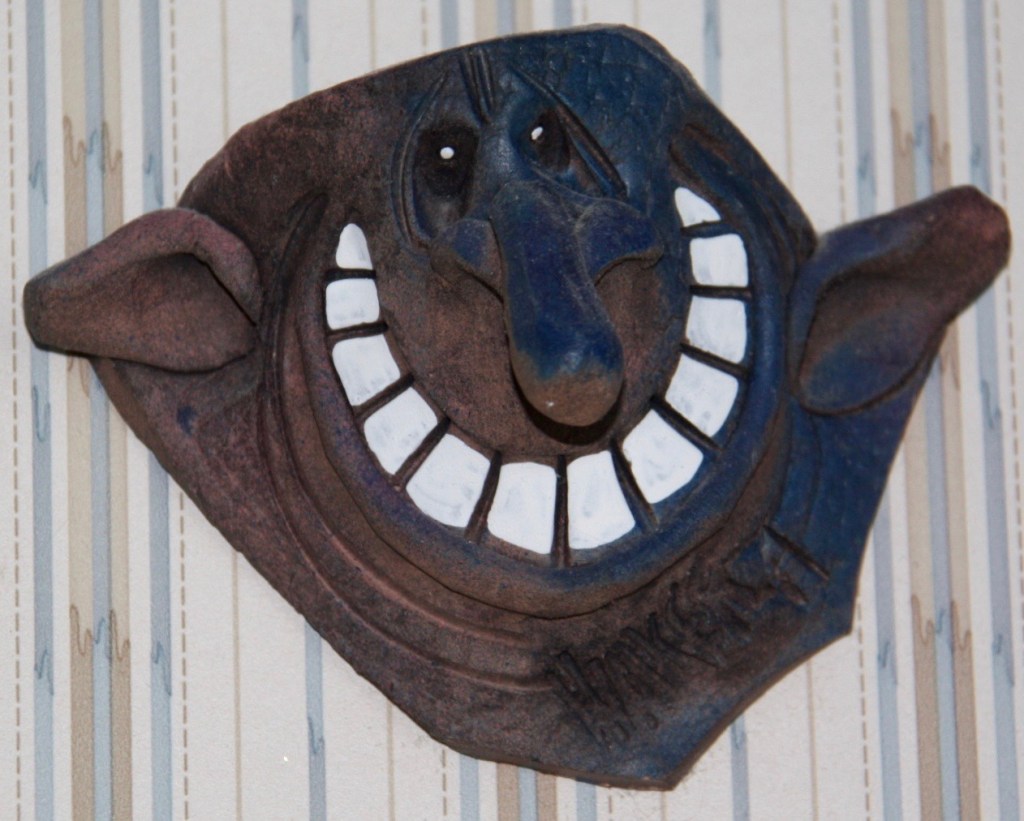
Teeth WFNB 5 March 2022

Teeth WFNB
5 March 2022
This is the story I was reading last night when Island View suffered its brief power outage and I was cut off from the WFNB Zoom reading. My apologies for the break in communications. First the text and then the live reading.

Lunchtime.
            I open a can of tom8to soup and heat it on the stove. I slice the remains of yesterday’s loaf of bread into one-inch cubes and fry them in olive oil and garlic. Tom8to soup with croutons. Then I put two slices of bread in the toaster. My father will only eat toast soaked in butter and layered with Marmite when he eats tomahto soup.
            “Lunch is ready,” I call out.
            The black American Cocker Spaniel, bought by my mother in a moment of madness, by telephone, unseen, camps in the kitchen. It nests at the far end of the table, by the stove, and defends its territory with warning growls and a snapping of yellowed teeth. I do my best to avoid the dog.
            “Dad, your lunch is ready,” I call out, a little bit louder. Dog, as my father calls it, growls and clatters its teeth. It has hidden a treasure in the folds of its old, gray comfort blanket, and guards it with the fierce, loving worry of a dragon protecting its golden hoard.
            My father enters the kitchen just as I place the soup on the table.
            “I’m not ready to eat,” my father growls. Put it back in the pot.”
            “What’s wrong, dad? I thought you were hungry.”
            “My teeth,” my father mumbles through a mouthful of pink gums. “I can’t find my teeth.”
            “Where on earth did you put them?”
            “I don’t know. If I knew where I’d put them, I wouldn’t have lost them.”
            My father circulates round the kitchen opening drawers, lifting saucepan lids, and shaking empty yogurt pots to see if they’ll offer up the rattling sound of lost teeth.
            “I can’t find them anywhere. I can’t eat lunch without my teeth.”
            “But it’s only soup, dad, tom8to soup.”
            “I don’t like tom8to soup. Your mother always made tomahto soup. Why can’t you be more like your mother?”
            “Sorry, dad. I’ll call it tomahto soup, if that will make you feel better. But it’s still made out of tom8toes.”
            “Don’t be so sarcastic. Help me find my teeth,” my father stomps towards the stove and Dog growls fiercely from its blanket as it guards its treasure.
            “Take that, you dirty dog,” my father pokes Dog in the ribs with his stick and Dog howls and spits out what it is chewing.
            “There they are,” my father’s voice trembles with excitement. He bends down, picks up his teeth, still hairy from the blanket and bubbly from Dog’s saliva, and pops them into his mouth. “That’s better,” he says, sitting down at the table. “Now I can enjoy my lunch.”

Click on this link for a ‘live’ reading of the story,
complete with Welsh accent.
One Goldfish

Ephemera

One Goldfish

A great big thank you to Allan Hudson, editor of the South Branch Scribbler Blog. He e-mailed me on my birthday, last Sunday, and asked me if I had a story that he could use on his new blog page Short Stories from Around the World. These will be published every other Wednesday, starting today. I am very honoured and proud to be the author of the first story, One Goldfish, third place in the WFNB non-fiction award (2020), that opens the series. It was revised and reworked in the Advanced Writing Course, run by Brian Henry of Quick Brown Fox fame. I would like to thank Brian and all my fellow participants who helped me rework the story. On Allan’s blog you will find links to other contributions from me. You will also find a series of featured authors, from New Brunswick, the Maritimes, Canada, and all around the world. Allan does a great job for us minor, struggling literary figures, not just for the greats. I encourage you to follow his blog and support him.

Ephemera

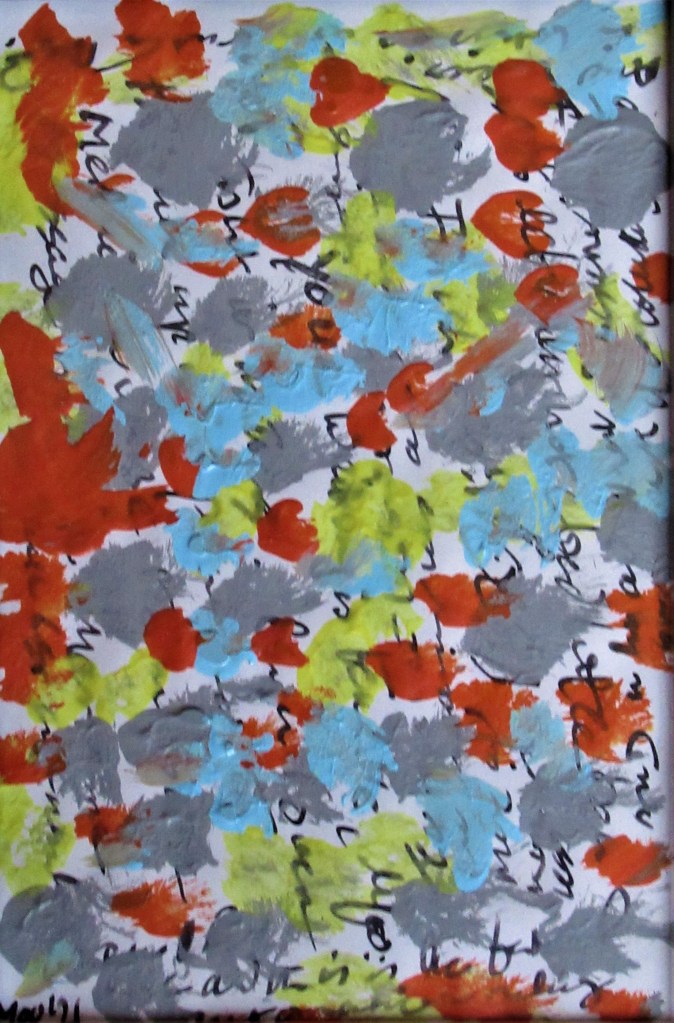
My painting (above) is entitled Ephemera. It shows a literary text semi-obliterated by various colors and devices. If we have learned anything from Covid it should be the fragility of life, the insubstantiality of existence, and the enormous powers of the natural world that surrounds us. My friends: take nothing for granted. Carpe Diem – seize the day – and “Gather ye rosebuds while ye may – for time it is a’flyin – and that poor flower blooming today – tomorrow may be dying.” This is Robert Herrick, of course. Here is my own version of the theme from The Nature of Art and the Art of Nature.

Daffodils

Winter’s chill lingers well into spring.
I buy daffodils to encourage the sun
to return and shine in the kitchen.
Tight-clenched fists their buds, they sit
on the table and I wait for them to open.

Grey clouds fill the sky. A distant sun
lights up the land but doesn’t warm the earth
nor melt the snow. The north wind chills
body and soul, driving dry snow
across our drive to settle in the garden.

The daffodils promise warmth, foretell
the sun, predicting bright days to come.
When they do, red squirrels spark at the feeder.

For ten long days the daffodils endure, bringing
to vase and breakfast-table stored up sunshine
and the silky softness of their golden gift.

Their scent grows stronger as they gather
strength from sugared water. But now
they begin to wither, their day almost done.

Dry and shriveled they stand this morning,
paper-thin, brown, crisp to the touch, hanging
their heads as oncoming death weighs them down.

Click on this link for Roger’s reading.
Daffodils

Lolly Lady

Lolly Lady

I guess if she were a boy she’d be a Lolly Laddy, or a Loblolly Laddy, depending on the circumstances. Did this one at 4:00 am when I was non compus mentis, whatever that means at that time of the morning. Just trying to keep from falling downstairs, I guess. I love the colors: violet for tranquility, red for strength and energy, yellow for clarity, and blue for feeling blue at that time of the morning.

I suppose, if I were Rimbaud, I would be able to write letters instead of colors. Alas, now I no longer know where to hang these things: I am running out of wall space. And frames. And nails. “A nail, a nail, my kingdom for a nail”… Richard III aka the Hunchback of Loblolly Alley. Mind you, I think his nail was detached from the shoe that fell from his horse. “To lose one horse is a tragedy. To lose two is careless.” Oscar Wilde on parenting.

I love the sparkles though. We have several sparklers and we keep them for the sad times when the world needs brightening, as it does all too often nowadays. The seasons roll on. The year is trickling by. I have decided to sleep under my duvet. It is certainly warm under there and the Teddy Bears really appreciate it. They want to hibernate, but I refuse to let them. If I let them hibernate the cat will be up on the bed, and we can’t have that, can we? Not me, and definitely not the bears. And here’s why not: Teddies or Cats? Click and you’ll find the answer. Or maybe you won’t. So try clicking here: Teddy Bears FFS. Oh dear, I think there’s a typo there: a Teddy Bear Typo. Never mind. I am sure you won’t mind.

I wouldn’t go down to the woods today, if I were you. And I think you know why! You shouldn’t go alone, either. But if you venture out, think twice about taking your teddies. They might run away to join the picnic and leave you all alone with the Night Bumps, the acorn throwers, the wild folk, and the Wood Chuck wood-chuckers.

Winking Night Bump

Winking Night Bump

If you have been following my blog for any length of time, you will know all about Night Bumps. Blueberry certainly knows all about them as we found out in Blueberry and the Night Bumps https://rogermoorepoet.com/2020/06/30/blueberry-and-the-night-bumps/

However, not all Night Bumps are nasty and this is a baby Winking Night Bump caught by the camera, or was it the paint brush, in the act of winking. I’d have written ‘red-handed’ but not all Night Bumps have hands. Some are just wormy squirmy wrigglers. And they can be the worst.

This isn’t what he really looks like, or is it a she? I cannot tell the difference. Well, not until they bump and grind anyway. Then they are like dentists’ drills. Sharp ones, blunt ones. Keeps you awake all night, they does, just thinking about ’em.

I don’t know what happened to the photo of the painting. But we all knows all about that too, don’t we, oh faithful followers of this faithless blog that sometimes arrives and sometimes doesn’t. Oh dear. Just look what happens when you look into the sunset. https://rogermoorepoet.com/2021/10/08/into-the-sunset/ It gets all distorted. Maybe I’ll have to have another go with the camera. A camera, a camera, my Night Bump for a camera. Or should that be ‘a camera for my Night Bump’.

Oh dear. This is getting out of hand. I’d better call for Blueberry. Oh, I forgot. He’s having his Sunday Siesta. No Nasty Night Bumps in action on a Sunday Afternoon, even if it is raining.

Now that’s a bit different. Well, shiver me timbers. And I bet I can do better than that. “Pieces of silver! Pieces of eight!” And all hands to the Naval Volunteer. Ship-shape and Bristol Fashion down on the docks that are no longer docks, not down by St. Mary’s on the Quay. “Aye aye, skipper.” And look out for that black patch. Whisky is the life of man. But rum rules at the Admiral Benbow. And everyone must eventually pay on the nails. Unless they gets dispensation from the Green ‘Un on a Satterday Nite. But watch out for those wheelbarrows tumbling down Christmas Steps during Rag Week. And thee must bist recall: it’s never safe in this aerial, especially under a tiny little ‘aat that like.

Dancing Bananas

Dancing Bananas

“The only difference between a madman and me is that I am not mad,” Salvador Dali. It is a great honor to borrow his words and to be able to make the same declaration: the only difference between a madman and me is that I am not mad.

Mikhail Bakhtin: carnival, the world turned upside down, the world going bananas and those bananas dancing, as you can see in the painting above. It is a mad moment frozen in the still time of paint. And why shouldn’t bananas dance? Some one out there will remember Thunder Bay, 1981: ‘you just have to go bananas’ and the bananas duly appeared at half time instead of the oranges. Saint John, 1985: same thing.

And now the dancing bananas have emerged once more to fill your minds with pleasure and your hearts with joy. Go, bananas, go. Bananas-a-go-go. Way to go, bananas. And I tell you, given the current state of society, going bananas is the only way to go. So, in the next election, I shall form the Banana Party and we can all stand firmly, shoulder to shoulder and shout “Oh, Mighty Banana!” and “Go, Bananas!”

Ah yes, and my next painting? Maybe it will be Banana Custard or Banana Splits, not that I have ever done the splits!

Hot Line to God


Hot Line To God

What would you do if you had a hot line direct to God? What would you say? You wouldn’t need to punch in a number, he’d be right there, at the other end of the line when you picked up the phone. Hello, is that you, God? Yes, I am who I am. Would you then give your name? It’s me, John. I know. How do you know? Have you got one of those little screens that tells you who’s calling? No. I’m omniscient. You’d pause a little at this point, wouldn’t you? What would you say next? What’s omniscient? I am. But what does omniscient mean? It means I am God. I know everything. That would make you think.
            So, would you ask for definitions, like you just did, or would you move in another direction? Like this. So you know why I’m calling, then? Of course. Wow, that’s another conversation stopper. If he knows why you’re calling, why did you call in the first place? To ask him something? It’s sunny here. What’s the weather like where you are? The same as always. How’s that exactly? Heavenly. Maybe this conversation isn’t going the way you thought it might. You could try again. Well, if you know why I am calling, what are you going to do about it? Nothing. Why not? Free will. But you’ve got to do something. Why? Because I think you should. Are you omniscient? No. Then why should I do what you think I should do? Because… because …
            And there you are. On the telephone to God. Left speechless. Perhaps you wonder if the phone’s been hacked. You go ahead and ask him. Has this phone been hacked? No. Are you really God? Yes. And this is your direct line? Yes. Can you prove you are God? Of course. Will you prove it to me? No. Don’t you have a code word or something that proves who you are? No. What about a security number? No. So how can I believe what you say? Either you will or else you won’t. But what if you’re a con artist, an evil genius, a thief who wants to lead me astray? Some have said I am just that. What? Who? Throughout the ages, there have been doubters. There have? Of course. But I’m not a doubter. Then why are you asking these questions? If you’re omniscient, you know why I am worried. I do. So what are you going to do about it? Nothing. Why not? Not free will again?
            Knock and it will open, seek and you will find. You mean I called you to hear those words? You will hear them if you want to. Some have ears and do not hear. But you could do something about that? What do you have in mind? The churches are empty. Make people go to church on Sunday. On Sunday? Only on Sunday? What about Friday, or Saturday? What about the other days of the week? You’re all powerful. What would you advise? Advise? I don’t give advice. Or orders. I have given people free will. They can choose what they want to do. If they want to go to the mosque, the synagogue, the church, they may find me there. There again, they may not. Some have eyes and cannot see. These would walk right past me and even if I hung there on the cross and winked at them, they’d never recognize me.
            You find it frustrating, eh? It’s like a Socratic Dialog where you only get to answer yes, or no, or three bags full. How persistent are you? Will you keep going? What other direction would you like to take? If the weather’s heavenly where he is, perhaps he’s in heaven. Why not ask him if he ever leaves heaven? Do you ever leave heaven? No. Why not? I am ubiquitous. What does that mean? It means I am everywhere. The people who really seek me can find me anywhere they look. I don’t understand. You’re not omniscient. But how can you be in two places at once? If I am everywhere, as I am, heaven travels with me, wherever I go. So I could find you anywhere I looked? If you knew how to look properly, you would. Others did. Where did others find you? John the Baptist found me in the wilderness. St. Francis of Assisi found me among the flowers and the plants, the flora and the fauna. As did St. John of the Cross. St. Teresa of Avila was slightly more mundane. She found me walking in the kitchen among the pots and pans. 
            Where should I look for you? How would I know? Because you’re omniscient. But I gave you free will. I cannot tell you how to use it. If I did, it wouldn’t be free. Couldn’t you give me a little hint? Not one. Why not? Because a hint from me would be the Word of God. And I am tired of being carried down from the mountaintop with my words carved in stone, only for the misguided to twist them out of shape and give them alternative meanings. People do that? Of course. That’s why so many no longer go to church on Sundays. Where do they go? Some of the good ones go out into the woods and contemplate the snow in winter, the leaves in summer and fall, and they find me there. Others work in the kitchen, or at their knitting, and they find me among the pots and pans, or between their stitches. Still others find me in the crossword puzzle, or the Sudoku, or in one of those brief moments when, alone, they close their eyes, breathe deep, listen to their bodies, and find that I am there within them.
            You are within us? Deus est in nobis. Meaning? God is in us. So I don’t need a telephone with a direct line to you. Not at all. And remember, telephone lines are dangerous. They can always be hacked. Now I’m confused. Sorry. Must go. There’s an emergency on the other line.
            You hear the click on the other end of the line as the phone goes down. You are overcome by a tsunami of sorrow and grief, a tidal wave of loneliness and abandonment sweeps you away and you cry out in your anguish that which you have never heard or spoken before, the words of the twenty-second psalm or of Christ on the Cross: Eli Eli Lama Sabachthani? My God, my God, why hast Thou forsaken me?

Click here to listen to Roger’s reading.

Hot Line to God

Pianissimo

Pianissimo


            You sit at the piano, my old piano, still extant in my father’s house, yet soon to be given away, though we don’t know that yet. It’s an upright, iron-frame Bechstein, a piano that I was given when I was the same age as you are now. Handel’s Largo, the Harmonious Blacksmith, hours and hours of scales. They locked me in the front room, my mum and dad, and there I stayed for an hour, two hours, or more. I came to hate music. As soon as I could, I gave up the piano, I rejected piano practice, I turned my face away from the discipline of the lock up.
            Now, I listen to you. Your untaught fingers tickle the black keys, then the white keys, one after another. You are six years old. You’ve never had a lesson, but you have music in your blood and some residual instinct latches on to rhythm and sound. Your fingers are long and supple and your touch is light, so much lighter than mine used to be, and now, on the deep bass notes of the left hand, your stronger hand, you pound away, awakening the dark ghosts of soul music that pour through my memories awakening echoes in this piano.
            I think of you as a jazz musician. Thelonius Monk, perhaps, a tinkle here, a light touch there, now a chord or two, inexplicable, and who would want to explain. It is a joy to sit here, to see your smile of absolute absorption. Mood music you call it, and today your moods are as dark as the shadows that tug at my heart, and as light as the sunlight that floats through the windows and makes the dust motes sparkle. It also frames a halo round your head. You hum to yourself as the morning sunshine fragments into colored gems and you sculpt your rainbow of sound.
            “Stop that noise. You’re driving me mad,” your grandfather, my father, stumbles into the room. He has taken his last cigarette out of the packet and the white cylinder hangs down from his lips, like an extraneous chalk outcrop hanging from the lip of an errant teacher. He pats his pockets. “Where are my matches? Has anyone seen my matches?”
            “They’re on the table in the kitchen,” I reply. “Where you always put them.”
            “I thought I left them in here,” my father leans on his stick then turns and stumbles out of the living room and into the kitchen.
            You hop off the piano stool, take the matches from your pocket, and carefully place them on the arm of your grandfather’s favorite chair.
            “Sssssh!” you say, putting a finger on your lips. Then you skip back to the piano and start playing pianissimo on high notes that float like tiny raindrops of sound produced by miniscule angels.          
            Your grandfather returns, glances round the room, spots the match box, and pounces upon it, a caged tiger finally served his red meat.
            “That’s funny,” he mutters. “They weren’t there a moment ago.” He takes out a match, strikes it, lights up his cigarette, inhales a lungful of smoke, then exhales it in a great locomotive puff of cloud. He grimaces at you through a haze of smoke.
            “There’s nice music you’re playing.”
            Your young lungs, unaccustomed to a house of smokers, can’t cope with this thin, grey, choking cigarette waste. You stop playing, put a hand over your mouth, and start to gag.

Listen to the Podcast here:
Pianissimo

Crocodile Tears

Crocodile Tears

The crocodile lives in the wind-up gramophone. The gramophone lives in the top room of the house. The boy winds up the gramophone with a long brass handle, round and round, till the spring is tight. A tight spring frightens the crocodile and he sits quietly in his cage. But as the record goes round and the spring loosens up, the crocodile roars and demands to be freed. He’s the Jack that wants to jump out of the box. His long-term dream is to eat up the witch who looks out of the window and watches the boy as he plays in the yard.
            Last week the boy decided to dig. He picked up a spade and dug a deep hole that went all the way down to his cousin in Australia. The little dog laughed and joined in the fun, scraping with his front paws and throwing earth out between his back legs like happy dogs do. The witch in the window cackled with laughter and the rooks in the rookery rose up in a cloud and cawed in reply. Only the boy is able to see the witch and he only sees her when she sits in the window. But he knows she wanders through the house, and the air goes cold when she enters and exits the rooms, especially when she brushes past the boy and sweeps his skin with her long, black gown.
            When the boy got tired of digging, he drove the spade into the ground and left it standing by the hole. When his father came home it was well after dark. He didn’t see the hole but he saw the spade. So he didn’t fall in to the shaft of the coal-mine that went down to Australia. No free trip to the Antipodes for that unlucky dad. He beat the boy for that, for digging that hole. Then he beat him again for lying because the hole didn’t go to Australia. Australia was too far away and the angle was wrong. The boy laughed when he saw that his dad didn’t know where Australia was.
            “Ha-ha,” he laughed. And his dad beat him again, this time for laughing.
            Sometimes at night the boy can hear rats running through his bedroom walls. They scuttle and scuffle as they hunt through the guttering. The crocodile growls from time to time in that upstairs room. The witch cackles with laughter. The boy puts his head under the blankets and cries himself to sleep. Sometimes he wishes the crocodile would come and eat up his dad. But he loves his dad like the dog loves his dad even though his dad beats both the boy and the dog. Sudden beatings, they are, that arrive without warning: hail and thunder from a sunny summer sky.
            “Well, you’re not laughing now,” his father announces as he beats him one more time. “A beating a day keeps disobedience away. There will be no disobedience in this house.” When the father beats the boy, the dog cowers beneath a chair. The boy hears the crocodile growl and smiles through the tears as he wipes salt water from his eyes.
            “Are you laughing at me? I’ll make you laugh on the other side of your face,” the father taunts the son and beats him again.
            The crocodile growls. The old witch cackles. The rooks in the rookery rise up in the air and the father’s hair stands up on end like it does when lightning lights up the sky, and thunder rolls its drums, and the sky’s wheels rattle like an old warrior’s chariot whose wheels have not been greased. The veins stand out in his father’s cheeks as the old man once more raises his hand to the boy.
            The old man tells the same old jokes again and again. The boy must always remember to laugh at them as if he had never heard them before. If he doesn’t laugh, his father gets angry. Some of the jokes are good, and the boy likes the one about the Catholic with the pet crocodile who goes into a bar in Belfast and asks the barkeep if they serve Protestants. ‘Of course we do,’ says the barkeep. ‘Good,’ says the man. ‘I’ll have a pint of bitter for myself and a Protestant for the crocodile.’  Or is it the one in which the Protestant goes into the bar and ask the barkeep if they serve Catholics … anyway … whatever … one night, the boy dreams and it happens like this. The crocodile escapes from the gramophone. The witch hands the boy a leash and a collar and between them they restrain the crocodile.
            “Walkies?” says the boy.
            The crocodile nods his head and crocodile and boy walk down the street to the Kiddy’s Soda Fountain on the corner. When the boy walks in with the crocodile, the waitress raises her eyebrows and opens her mouth.
            “Do you serve grown ups in here?” the little boy asks her.
            “Of course we do,” says the waitress.
            “Good. I’ll have a glass of Dandelion & Burdock for myself and a grown-up for the crocodile. Please.”
            The witch says grace, the boy sips his Dandelion & Burdock, and they all shed crocodile tears as the boy’s pet crocodile chomps on the fast-disappearing body of the boy’s dad.
            Next morning, the boy wakes up. The witch and the crocodile are sitting on his bed.
            “I had a funny dream last night,” says the boy.
            The witch cackles. The crocodile burps, then sheds crocodile tears. The boy starts to laugh. He laughs until he cries and then the witch sheds crocodile tears too.

Teddy Bears’ Nit-Pick

Teddy Bears’ Nit-Pick
Friday Fiction
27 August 2021


            “So, Teddy, how did we all end up in here like this?”

“Kicked him out, she did, just like that, Freddy. Told him to sleep in the spare bedroom. She couldn’t take it any more. She couldn’t sleep. He had to go.  It was the diuretic that did it, mind, the diuretic.
            After the radiation treatment, they gave him hormone injections, told him he’d put on ten to fifteen per cent of his current body weight, but not to worry. It was quite natural. It was the hormones, see?
            He told me all about it. Told me how he used to stand on the bathroom scales without a care in his heart. Watched his weight rise, five per cent, ten per cent, fifteen per cent. When he reached twenty per cent, he started to worry. Swollen ankles. Swollen knees.
            At twenty-five per cent, he was really worried. Socks no longer fitted. Couldn’t put on his shoes. Couldn’t bend to tie his laces. Had to wear sandals and slip-ons.
            At thirty per cent, he started to cry. He told me he was ugly, so ugly. He was down to one pair of shoes and one pair of sandals that fitted. He went to the pharmacy. The pharmacist took one look at his feet and gave him a long list of Latin names. Told him he’d need a prescription, from his doctor, to get pressure socks, and medical shoes that would help him walk.
            ‘It’s the feet, see, the feet,’ the pharmacist told him. ‘Once they start to swell, you’re in big trouble. There’s nothing we can do. Go see your doctor.’
            ‘I’ve seen the doctor.’
            ‘Go see him again.’
            So he did. Told me he broke down crying when he entered the surgery.
            ‘I’m down to one pair of shoes. You’ve got to do something, doc.’
            So the doctor wrote him out a prescription for pressure socks, medical shoes, appointment with a psycho-something, attendance at a clinic, everything the doc thought he needed. Then, just as he was about to leave, the doc stopped him.
            ‘Hang on a sec,’ doc said. Sat at the desk. Checked the computer. Wrote out another prescription. ‘New tablets,’ he said. ‘Take these brown ones. Stop taking those white ones.’
            He went away happy. Stopped at the pharmacy. Got the new pills. Went home. Took them. And straight away started to pee. Told me he’d peed all day and then I watched him as he peed all night. Every 15 minutes. That’s when the missus kicked him out of bed.
            ‘Go. Sleep in the spare room,’ she said. ‘You’re peeing every fifteen minutes. I can’t sleep anymore. I can’t stand it. And take that teddy bear with you.’
            So he went. Grabbed me, his faithful Teddy Bear, tucked me under his arm, and we went to the spare room with its cold, lonely bed. Except he had me, his Ted.
            Lost four pound that first night. Twelve pound the first week. Twenty pound the first month.
            ‘Ted,’ he said to me one morning, ‘I feel good. Time for us to go back to the old bed.’
            We tried. But the missus wouldn’t let us back in.
            He’s looking pretty good now. Back down to ten per cent body weight up. Says he can live with that. Likes sleeping with all his Teddy bears he tells me. Says we don’t snore. Unlike that missus of his.
            It’s the first anniversary next week. He told me to gather all the bears, Rosie, and Blanche, and you, and Blueberry, and Basil of course. And that French bear, Pierre.
            ‘We’re going to have a midnight dormitory feast and a Teddy Bears’ Nit-Pick.’
            Sorry Fred, I don’t know what the missus is going to say about that.”

Pepe’s Bar

Pepe’s Bar

Friday Fiction

Pepe’s bar was at the top of a steep, cobbled street, on the left-hand side. When we got there, it was crowded with men, mostly fishermen off the North Atlantic ships that cross the sea to the Grand Banks of Newfoundland. The men stay away for weeks at a time, and when they get back home, they too have a huge thirst, large and curious appetites, and money with which to indulge them. We all pushed our way into Pepe’s bar to join the crowd.
            “Phew! Let’s get out of here. The place stinks of fish!”
            “We can’t go without drinking something. You know what Pepe’s like.”
            “Let’s share a porrón.”
            And a porrón of red wine duly appeared. The porrón is designed for a small boat in the open sea. It is a glass flask of variable size, holding half a litre or a litre of bright red wine, depending upon the number of people drinking from it. It has a wide funnel at one end through which the wine enters and a thin spout at the other through which the wine exits in a fine ruby jet which the experts shoot directly into their mouths; done with skill, no lips ever touch the flask which circulates from hand to hand amidst cries of appreciation for the skilled and jeers for the careless (and the educational tourists, like me, here to learn about the language and the culture) who suddenly choke and cough as they squirt a red stream of wine up their noses and onto face, shirt, and tie. By dint of hard work, some of it done in the bath tub at home while nobody is watching, I can manage a porrón in the quiet confines of the bar; but I still don’t know how I would fare, out at sea, in an open, wind-swept boat.
I was soon going to find out.