Little Red Brush

Little Red Brush

Timothy heard his older brothers moving from room to room, searching for him.  He knew they would find him but for now he had found refuge beneath his grandfather’s double bed. It was dark under there in that sepulchral space. He had placed his grandfather’s enormous Royal Doulton chamber pot between himself and the door so that the dog would not pick up his scent, run to his hiding place, and lay the Judas lick upon his cheek.

His grandfather had forgotten to empty the chamber pot. Dark urine splashed on Timothy’s hands and sleeves as he squeezed behind the giant china pot that overwhelmed his nose fills with his grandfather’s nocturnal vapors.

The voices got louder as his brothers climbed the stairs and approached the bedrooms on the upper floor.

“Where is he now, drat him?”

“Don’t worry, we’ll find him.”

“And then he’ll be for it.”

“I’ll beat him with the little red brush they use for cleaning the fireplace.”

“That will teach him.”

Timothy was familiar with those threats, especially the little red brush.

He remembered the fox the hounds killed at his feet, one sunny morning a year before. He cycled down the lane outside his family’s summer cottage. The fox limped along the side of the lane, saw the boy on his bike, but too tired to run from him, continued limping in the roadway. Timothy got off his bike, leaned it against the rough stone country wall, and watched the fox. Its tail, speckled with mud, dragged behind its low-slung body, sweeping the ground. Timothy observed the twigs and thorns protruding from its black-tipped orange redness.

Timothy walked towards the fox. It tried to move away from the boy but collapsed and lay at the edge of the lane, flanks heaving, tongue lolling out through the white strings of thick foam that choked the muzzle and streaked saliva on the forequarters.

The hounds came from nowhere, an incoming, barking tide that rounded the corner and rushed towards Timothy who froze with a fright that pressed him against the wall.  Sun-warmed stone jutted sharp edges into his back. As he stood there, unable to move, a rough hand came over the wall and grabbed him by the shoulder. He felt himself hauled upwards. The flint points dug into his back and he yelped as the firm hand drew him over the top of the wall to safety.

“Get out of there, you stupid boy, or the hounds will have you.”

Timothy hid his face in the farmer’s rough homespun shirt. He shuddered as the dogs bayed and growled and scrapped and scratched. Then the fox, it must have been the fox, let out a high-pitched yap and whine and the pack gargled itself into a drooling, slobbering sort of silence. The farmer pushed Timothy’s face away from his shoulder and forced his head towards the spot where the hounds, on the other side of the protective barrier, rubbed their ears into the dead fox’s torn and bloodied body.

“That’s what they’d have done to you, my boy. Never come between a pack and its kill.”

Timothy watched a member of the hunt staff pull a knife from his jacket. The foxhunters broke into cheers and howls of pleasure when the man severed the fox’s brush and held it on high. The farmer thrust Timothy towards the Master of Hounds.

“Here, blood him, Master, he was in at the kill.”

The Master of Hounds opened his mouth to flash a smile filled with pointed, foxhound teeth.  He stooped, dipped his fingers in the still warm fox blood, and streaked a smear across the boy’s face.

“There,” he said,” you’re blooded now. One of us, eh what?”

The mingled scents of fox and hound and blood and death and urine and feces made a heady mixture and Timothy started to hyperventilate. His breath came hard in his throat and, as he struggled to breathe, tears rolled down his cheeks.

Timothy feels safe in his secret hiding place beneath his grandfather’s bed. He can hear his brothers’ taunts and calls as they search for him, but they haven’t found him yet. Sticks and stones may break my bones, he whispers, but names will never hurt me. But names do hurt. Tiny Tim they call him and ask him where he hides his crutch. I don’t limp, Timothy once replied. When he said that, one of his brothers, Big Billy, kicked Timothy as hard as he could with the toe of his boot, just above the ankle. Timothy screamed with pain. You’ll limp now, said Big Billy, and his other brothers found the joke so funny that they all called kicked Tiny Tim at every opportunity. Limp, Timmy, limp, they chanted as they chased him round, limp Tiny Tim, Tiny Timmy

“He’s not up here,” one of his brothers called out.

“Must be out in the garden, the coward, we’ll have to hunt out there for him,” another replied.

“Can’t run, can’t hide,” said Big Billy. “Get the dog, we’ll track him down.”

The voices finally faded. Protected by the barrier of his grandfather’s cold but intimate body waste, Timothy curled up like a fox in his den and fell asleep. He dreamed of the proud brush of a tail flying in the wind, of a warm stone wall, drenched in sunlight, and of a farmer’s strong, all-protecting arm.

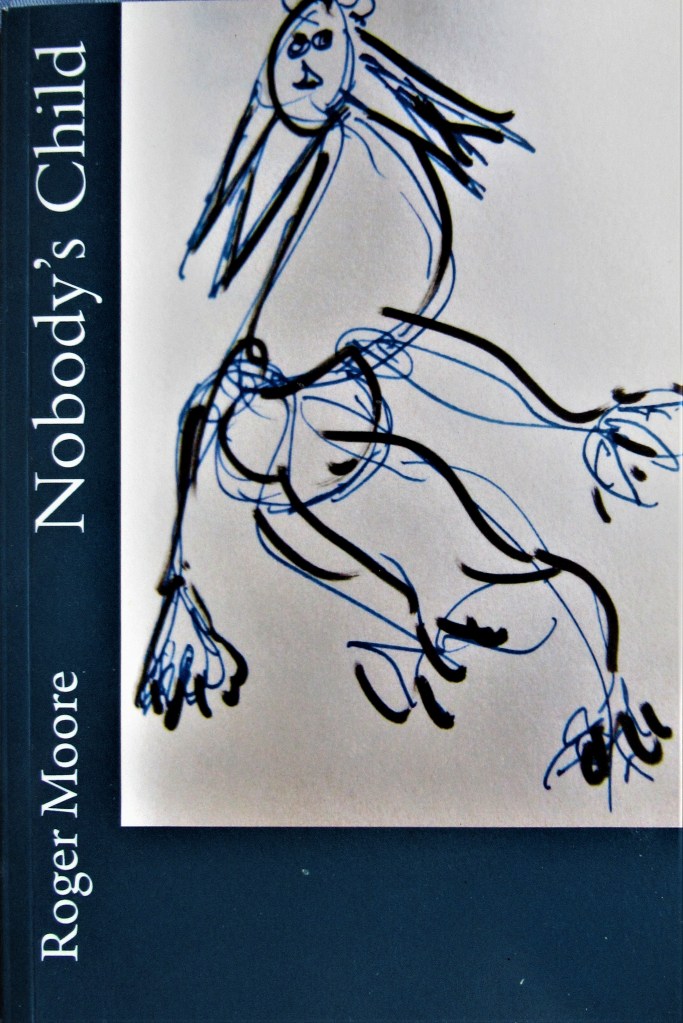
Comment: I have written several versions of this story, some longer, some much shorter, some in the first person singular, some in the second person. In all of them, the word-play on the little red brush (fox and fireplace) is paramount. This particular version occurs in my short story collection, Nobody’s Child available on line. Sometimes a story will not leave me alone. It wanders around, takes slightly different twists and turns, and new images and scenes emerge, as they do in this particular piece. Alas, I didn’t have a photo of a fox, so I used a photo of three plump pigeons hiding, you might even say ‘cowering away’, from a hungry hawk circling overhead while they hid in a crack in a wall in Avila, Spain. It always surprises me to know how many people (and animals) flee from what Robbie Burns called “man’s inhumanity to man”.

Beaver Pond

Thank you, Anne Stillwell Leblanc

Beaver Pond

 “I left her by the gate to the Beaver Pond at 2:38. It takes her twenty minutes to walk around the circuit. I always check my watch. Then I know when I can expect her back. In exactly eight minutes, she comes out of the woods and I can see her at the end of the boardwalk. I park the car in a spot from which I can watch her and wave to her. Today, I didn’t see her come out of the woods. It’s the radiation for prostate cancer … it’s left my bowels weak. I had to go to the bathroom … so I turned the car engine on … it was 2:44 … about two minutes before she was due to appear on the boardwalk   … yesterday, a Great Blue Heron stood fishing in the pond … he flew when he saw her … a great crack of the wings … but today, the heron wasn’t there … just ducks … they flapped their wings, stood on the water, you know, the way they do, and scattered from the spot where she should have appeared …  she walks very quietly, tip-toe, you know … she likes watching the heron and the ducks … she doesn’t like to frighten them … I don’t know what to think … I had to go … it was urgent … so I turned the car around and drove to the nearest bathroom … about one hundred yards away … I was in there … I don’t know … about five minutes … I didn’t check my watch … it’s dark in there … no electricity …besides, between hobbling on my sticks, praying to God to help me to hold on, opening and closing the door, struggling to get my pants down without soiling them …and then I drove back to the picnic tables … and waited … and waited …and she never appeared. I haven’t seen her since … she’s gone missing … I fear the worst … “

On the other end of the phone, a long silence, some heavy breathing, then:

“We’ll file a missing person’s report.”

“You will find her, won’t you? I love her, you know. I must find her. I want to know what’s happened … ” the old man wiped the corner of his right eye with the knuckle of the index finger of his left hand. He coughed and cleared his throat.

“Twenty years younger than you, you said?”

“Yes,” the old man nodded.

“Well, sir: we’ve already started our investigation. We’ll do our best to find her. We’ll contact you as soon as anything turns up.”

The police officer put down the phone and the circuit clicked out.

“What the hell you gonna do?”

“Not me … us.”

“Okay … us then … well … what the hell we gonna do?”

“You tell me. We got her on video.  She walked out the other exit, by the park HQ, straight into the arms of the Deputy Police Commissioner. She’s twenty years younger than her husband and her husband’s got the sort of cancer that’s killed his sex life. Cancer? And the Deputy Commissioner’s the one who’s waiting for her? What the hell do you think we’re gonna do?”

Fall: Beaver Pond

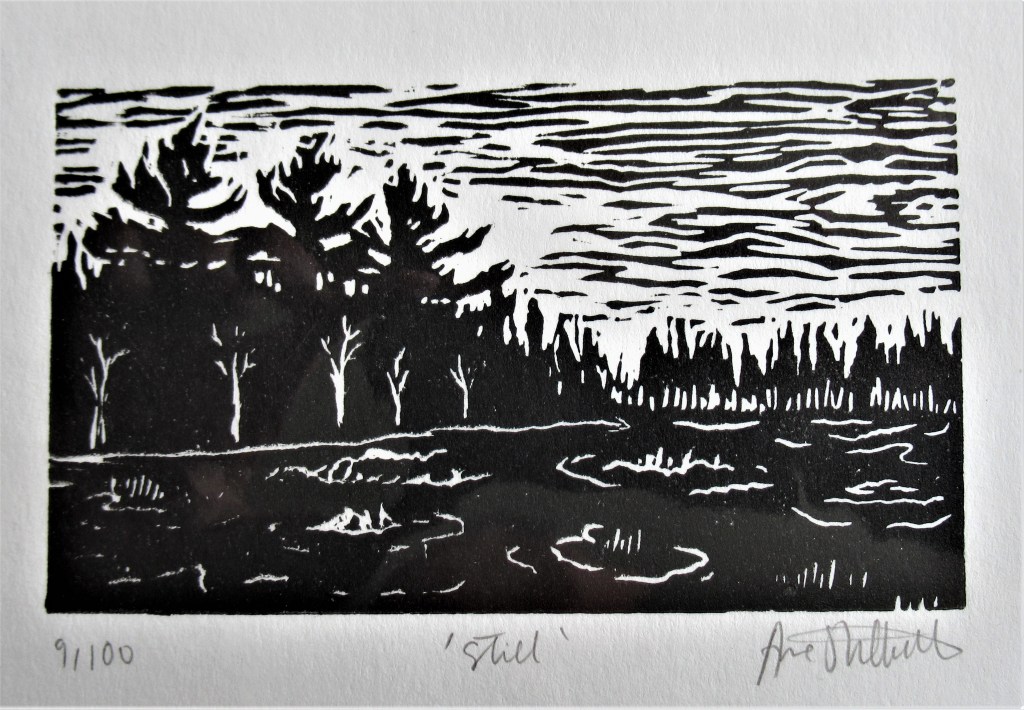
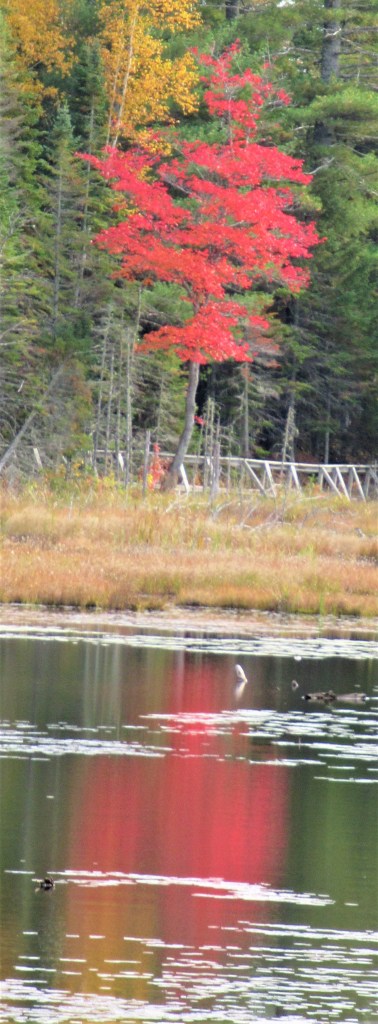
Comment The Beaver Pond at Mactaquac is a beautiful place to be, all year round. We love it in summer and fall and Anne Stillwell-Leblanc (< click on link for website) has captured the stillness and silence of the place in the above engraving. As I have become less mobile, so I have sent Clare cantering around the pond to enjoy the beauty we used to enjoy together. Meanwhile, I sit in the car and watch for Clare’s regular appearances through the trees and on the footbridge. As I sit, I write. Sometimes it is journal style, sometimes poetry, and occasionally a short story, like this one.

Bistro Two is available online at
THIS LINK.

Masks

Mexican Mask depicting the ages of man.

Masks
Friday Fiction

I cover my face with a white mask of soap and carve intricate patterns with the razor.

… painted masks … death masks … the masks the priests wear in the pre-Columbian Oaxacan codices … the prisoner struggling … not yet fully understanding his fate … around him … animal masks … priest  masks … the jaguar cult of the regiments … they strip him down … paint his body … arm him with flowers … place him on a pedestal … from there he will dance his last dance … fight his last fight .. his destiny … like the bull in the bull ring … to die bravely showing no fear … he strikes first with the flower … his opponents strike back … one by one … with their obsidian knives … each wound a flesh wound on legs and thighs … the heart pounds … the blood flows .. faster and faster … more flowers … more knives … more blood … until almost bloodless the prisoner weakens and stumbles … rough arms seize him by the arms and legs … they carry him to the sacrificial stone … bend him over it … chest exposed … and tear the living beating heart from the cavity the carve in his chest … the severed arms and legs bounce down the temple steps to the waiting crowds … tomorrow his spirit will return as a hummingbird … and dance around the sun … for now his torn heart sizzles in the sacrificial fire … a horse’s head … teeth bared … grins from the temple walls …

My razor, held like a flower, slips and I gash my lip. The slow blood seeps through the soap streaking my mask with faint shades of pink. I shiver and stare at my reflection in the mirror. It’s a very plain face with a nose slightly larger and more hooked than it ought to be. I think of it as the prow of a ship or a bird’s beak: an eagle perhaps. My nose is very much like the nose of the man who died in the flower dance. In spite of the warmth in the room, I shiver again.

Basil Bear Packs

Basil Bear Packs

            “You promised.”

            “I know I did.”

            “Then take me with you. I’m only small. I’ll fit in a pocket.”

            “All right: go and pack.”

            “What shall I pack?”

            “Don’t ask me. I don’t know. I’ve never travelled with a teddy bear before.”

            The conference is a strange one. There are no women present and only one person of color. Nobody speaks to him. When he reads, I am the only one to hear his paper. It’s actually quite good.

            I move from that session to the next one. The man sitting beside me opens his briefcase and tells me to look inside. I do. He has two pistols in there.

“Are you packing?” he asks me.

     “No,” I reply. “But I packed to come here. So did my guardian.”

“Guardian?” the man raises his eyebrows. “That’s cool: a body guard, eh? You need to pack round here. But a body guard is great. Where are you going tonight?”

I tell him.

“That’s a dangerous area of town. You’d both better be packing if you go down there.”

“Thanks for the advice,” I nod to him. “Are you going to the reception?”

“Yup,” he smiles. “I’ll see you there. And don’t forget to pack.”

“Well, Basil,” I see when I get back to the hotel room. “It looks like you’ll be going out with me tonight.”

“That’s great,” little Basil gives me a big teddy bear smile.

When I get to the reception, my friend from earlier is there. He nods at me and smiles at the bulge on the left side of my jacket.

“Good to see you’re packing. Can I have a look?”

“Sure,” I say and open my coat. Basil sits up, opens his eyes, and gives him a little wave. The man’s mouth falls open. He stares at me, wild-eyed.

“Ain’t nobody gonna tackle a mad man who’s carrying a teddy bear,” I say. “Now that’s really packing.”

He walks to the bar, orders a double-double and swallows it, Ker-Splosh.

“That’s telling him,” says Basil, snuggling back down in the warm beneath my armpit. “Hi-ho, Silver: let’s go out and get those gangsters.”

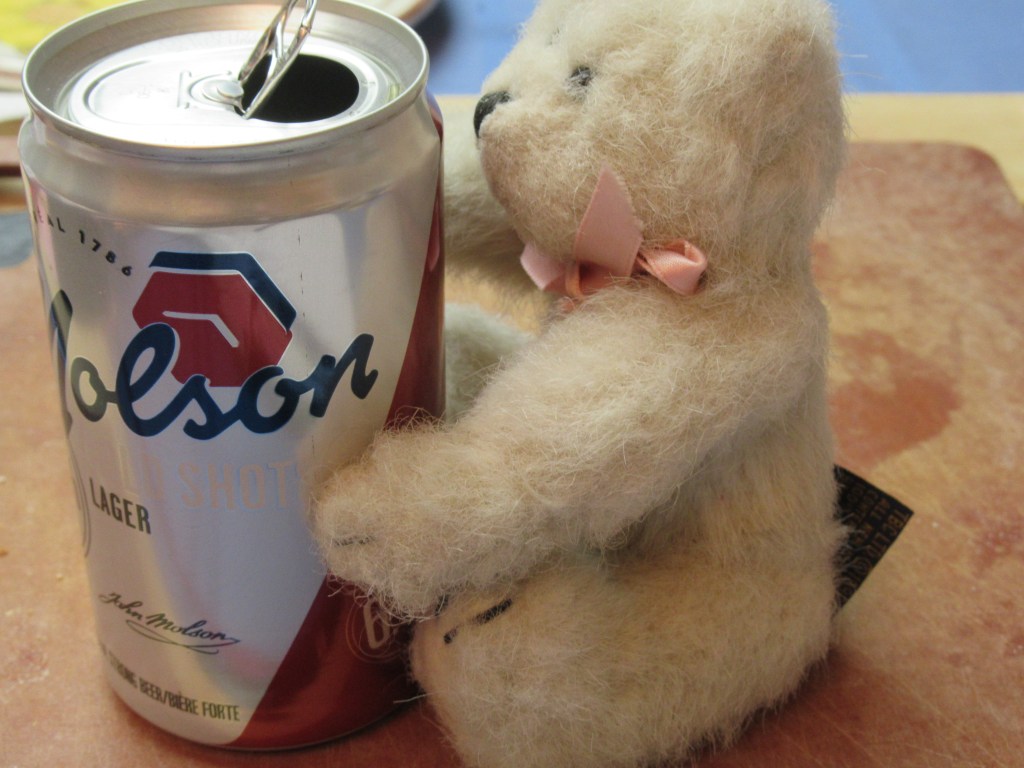
Comment: For Tiffany who understands the important things on the brighter side of life.

Clematis

Not clematis, but bruised clematis clouds.
I’ll keep looking.
Maybe I’ll find the real things.

The clematis unfolds bruised purple on the porch. Beneath the black and white hammers of ivory keys, old wounds crack open. A flight of feathered notes: this dead heart sacrificed on the lawn. I wash fresh stains from my fingers with the garden hose while the evening stretches out a shadow hand to squeeze my heart like an orange in its skin. Somewhere, the white throat sparrow trills its guillotine of vertical notes. I flap my hands in the air and they float like butterflies, amputated in sunlight’s net. The light fails fast. I hold up shorn stumps of flowers for the night wind to heal and a chickadee chants an afterlife built of spring branches.
Pressed between the pages of my dream: a lingering scent; the death of last year’s delphiniums; the tall tree toppled in the yard; a crab apple flower; a shard of grass as brittle as a bitter tongue at winter’s end. I know for sure that a dog fox hunts for my heart. Vicious as a vixen, the fox digs deep at midnight, unearthing the dried peas I shifted from bowl to bowl to measure time as I lay in bed. I sense a whimper at the window, the scratch of a paw. I watch a dead leaf settle down in a broken corner and it fills me with sudden silence.
Midnight stretches out a long, thin hand and clasps dream-treasures in its tight-clenched fist. The lone dove of my heart flaps in its trap of barren bone and my world is as small as a pea in a shrunken pod. Or is it a dried and blackened walnut in its wrinkled shell of overheating air? Sunset, last night, was a star-shell failing to fire. Swallows flew their evensong higher and higher, striving for that one last breath lapped from the dying lisp of day. Its last blush rode red on the clouds for no more than a second’s lustrous afterglow.
I lower the delphiniums, body after body, into their shallow graves. Night’s shadows weave illusions from earth’s old bones and rock becomes putty, malleable in the moonlight. Midnight readjusts her nocturnal robes and pulls bright stars from a top hat of darkness. Winged insects with human faces appear with the planets and clutter the owl’s path. Night swallows the swallows and creates more stars. The thin moon hones its cutting edge into an ice-cold blade.

Now that’s a clematis bruise!

Babs

Babs

It was March 17, St. Patrick’s Day.

Babs held the cat in her arms. The vet slipped the needle into the shunt he had inserted into the animal’s paw and the tiny wind of life gusted from the cat’s fragile body. The struggle ceased. The cat’s head settled and her tongue protruded, just a little, in that beloved and well-known gesture. It was all over.

Babs had found that lump, hard, but smaller than a pea, on New Year’s Day. The next day, she carried the cat to the vet where they took blood samples and ran tests. The vet’s assistant called later that afternoon. A lymphoma, she said, small but deadly. Steroids might help. They would give the cat a 40% chance at a life that would get more difficult, in spite of any known treatment. The alternative was to bring her back in and put her down now, that very afternoon. Babs looked at the cat: highlights strayed through her fur and her bright eyes sparkled like sunshine on a lake.

Throughout January the steroids went in and the cat glistened and grew fat. At first, Babs saw no sign of the lump but by Robbie Burn’s Day it was back. Babs started to count the days: January 31, February 2. The lump grew larger.

Three years before, on Valentine’s day, Babs had salvaged the cat from the SPCA where she languished, abandoned in a cage. The cat was a stray, half feral, taken in from the streets and subject to who knows what sort of treatment and feeding in its infancy. Babs wondered if it was in those days of neglect that the cancerous seed took root? Or did those seeds come later, when the cat wandered the garden and fed off the wild life, mice and voles, and drank from the streams that flowed through the killing fields with their fertilizers, their weed killers, their nutrients, and their poisons?

“What are we doing to ourselves,” Babs wondered as she sat at the kitchen table and sipped a cup of tea. “Was my cat the canary in my coalmine, doomed to warn me of what’s to come? Will my own system be invaded then poisoned with cancerous growths? Will I be subject to that stumbling, downward road that leads in the end to an inevitable death?”

She lay awake that night alone in the bed wondering in what ways cancer might ravage her body. How long would chemotherapy keep her alive? Who would be there for her, who would hold and comfort her, who would slip that releasing needle into her veins when her time came?

Babs ran her fingers over her body as she imagined herself sliding day by day down that slippery slope that leads to the grave. Then she caught her breath, her heart raced, and her blood turned to ice as her fingers tripped against the colony of killers: three small hard lumps that nested in her soft breast.

Teddies or Cats?

IMG_0015.JPG

Five reasons why a Teddy Bear is much better for you than a Kitty Cat.
I know, I know: cat lovers will go wild. They think cats are such lovely cuddly things. And they believe strongly that nobody can resist a warm, loving, darling, purring bundle of fur. Well, I can resist cats. And I can give you five good, sound, solid, 25 carat reasons why Teddy Bears beat Kitty Cats any day of the week.

One
Teddy Bears do not need to be fed on a regular basis. In fact, one piece of kibble will last a Teddy Bear for a very, very long time. And you can’t say the same for your cat. So less expense, no need to feed, don’t have to put that fresh water down every day, no constant fawning attention when hungry or just plain greedy, don’t have to worry about treading on the cat’s tail … In fact, a Teddy Bear wins out every time.

Two
“Don’t mention cleaning out the kitty litter.  Promise?”
“I promise. I won’t mention it.”
“Word of honor?”
“Word of honor. Fresh Walnut and all that.”
“You just mentioned it.”
“Mentioned what?”
“The kitty litter.”
“I didn’t.”
“You did: you said ‘Fresh walnut.’”
“So?”
“So that’s what keeps the kitty litter from smelling.”
“Does it smell much?”
“Quite a bit. I hate cleaning it out.”
“Why?”
“It’s so smelly, filthy, grainy, lumpy, stinking …”
“So, why do you do it, then? What you need is a nice, clean, environmentally friendly Teddy Bear. There’s no cleaning up after a Teddy Bear. Who’s ever heard of Teddy Bear Litter?”
“You said you wouldn’t mention it.”
“Mention what?”
“Kitty litter.”
“I didn’t, you did.”

Three
Teddy Bears don’t have off-spring. You don’t need to neuter them, and they don’t need taking to the vet. Nor did they sit and wait in family groups for their photos to be taken. What we have below is a fake photo placed there by the unscrupulous enemy for their own pro-cat propaganda purposes.

Empress 048.jpg

Four
Teddy Bears are very obedient. If you tell a Teddy Bear to “sit” or to “stay”. He does so. Immediately. And he stays where you put him. There’s no clash of wills and egos, no conflict at all. Teddy Bears are easily trained and very obedient. Also, they don’t want to go out in the garden and wander beneath the bushes to shriek and whine when the moon is full. Now, if you have cats and you want them to sit and stay still, you must give them something to watch or to play with. Chipmunks and garden birds aren’t cheap, you know, and they are less trainable than cats. How long do you think it takes to train a chipmunk to just sit there quietly to entertain your cat? Especially when it’s being hissed at and the cat is bouncing the window with anguish? Also, Teddy Bears don’t climb on furniture, nor do they break ornaments, nor sink their claws into your hair as you pass beneath them, nor do they drop on you, unexpectedly, from great heights.

Five
Five and finally, when there’s a moth, a fly, or a mosquito on the ceiling at night, you can’t train your kitty cat to fly into the air and snatch it off the ceiling. But as for Teddy: grab him by one leg, preferably the back one; give him his commands “Ready, Teddy, Go!” and hurl him skywards. With a little practice, he’ll nail that nocturnal buzzing monster every time.

No: all things considered — and I promise I won’t mention, you know what, that little box the cat sits in — there’s nothing better than a Teddy Bear. Wise, silent, friendly, cuddly, obedient, friendly (did I say that?), needs no training, always there when needed, waits patiently for you when you’re away, never stalks off with tail in air, never gets out and hides in the garden where you can’t find him, adorable, cuddly (did I say that already?) … Give me a Teddy Bear anytime.

Click this link for original post and more photos:
https://rogermoorepoet.com/2016/05/01/teddy-bears-and-kitty-cats/.

Striations

IMG_0299.jpg
The iguana that guards the front door of our house. At night he comes alive, goes round on patrol, checking and securing everything and everybody. Beware the jaws that bite, the claws that clutch!

Striations

There are striations in my heart, so deep, a lizard could lie there, unseen, and wait for tomorrow’s sun. Timeless, the worm at the apple’s core waiting for its world to end. Seculae seculorum: the centuries rushing headlong. Matins: wide-eyed this owl hooting in the face of day. Somewhere, I remember a table spread for two. Breakfast. An open door. “Where are you going, dear?” Something bright has fled the world. The sun unfurls shadows. The blood whirls stars around the body. “It has gone.” she said. “The magic. I no longer tremble at your touch.” The silver birch wades at dawn’s bright edge. Somewhere, tight lips, a blaze of anger, a challenge spat in the wind’s taut face. High-pitched the rabbit’s grief in its silver snare. The midnight moon deep in a trance. If only I could kick away this death’s head, this sow’s bladder, this full moon drifting high in a cloudless sky.

Comment: a fitting ending for the month of February: ubi sunt? Where have all those days gone: Ou sont les neiges d’antan?

Why?

Different bird, same question: why? This one is from one of the beaches on the road to North Cape, PEI. Why, indeed?

Why?

In the mud nest jammed tight against the garage roof,
tiny yellow beaks flap ceaselessly open.

The parents sit on a vantage point of electric cable,
mouths moving in silent encouragement.

A sudden rush, a clamour of wing and claw,
a small body thudding down a ladder of air
to crash beak first on the concrete.
  “Why?”

 “Wye is a river.
      It flows through Ross-on-Wye
      and marks the boundary
      between England and Wales.”

And the swallows perch on the rafters
watching their fledgling
as it struggles on the floor:
the weakening wings,
the last slow kicks of the twitching legs.
“Why?”

“Y is a crooked letter
     invented by the Green Man of Wye.”

Comment: This is the original poem, written back in the eighties, wow, that’s forty years ago. I included it in my first poetry chapbook, Idlewood (published, 1991). It was a slim volume, dark green color, typed and photocopied, very humble, but MINE! A couple of years ago I wrote a prose poem, sort of flash fiction, in one of my Welsh sequences and included the story as part of the text. It came to me as a memory yesterday morning, and I posted it on Facebook. Here now is the story. Hopefully, you have just read the poem: I hope you liked it but, as I know all too well, de gustibus non est disputandum. I would like to know if you prefer the poetry to the prose. Please let me know, pretty please?

Why?

“Where are you going?” I ask. “To see a man about a dog,” my father replies. “Why?” I ask. “Hair of the dog,” his voice ghosts through the rapidly closing crack as the front door shuts behind him. “Why?” I cry out. I recall the mud nest jammed tight against our garage roof. Tiny yellow beaks flap ceaselessly open. Parent birds sit on a vantage point of electric cable, their beaks moving in silent encouragement. A sudden rush, a clamour of wing and claw, a small body thudding down a ladder of air to crash beak first on the concrete. “Why?” I ask. The age-old answer comes back to me. “Wye is a river. It flows through Ross-on-Wye and marks the boundary between England and Wales.” The swallows perch on the rafters watching their fledgling as it struggles on the floor, the weakening wing flaps, the last slow kicks of the twitching legs. “Y is a crooked letter invented by the Green Man of Wye,” my grandfather says. “Why?” I repeat. “I want to know why.” Silence hangs a question mark over the unsatisfied spaces of my questioning mind.

Boxing Day

A wonderfully quiet and peaceful Christmas in Canada. Oh the sea, oh the sea, thank God it still flows between my family and me.

Boxing Day
            By the time I get up, the gloves are really off and the sparring has begun in earnest. I hear voices, walk downstairs to the kitchen, and a hush falls on the room. Knife-edge glances slice their menacing ways through the thick fog of war.
            Time for boxing: on my left, in the blue corner, my mother, smoking what is probably her second packet of the day. A thin haze of grey smoke escapes from her bruised lips and a cloud of exhaled fumes crowns her head with a murky halo. On my right, in the red corner, my father. White-faced, hungover yet again, truly into the spirits of Christmas. He breathes heavily, like a Boxer Dog in the mid-summer dog-days, snoring and snorting at a bitch in heat. In the middle, my grandfather, the referee. He is keeping the combatants apart, creating a tiny breathing space so the true Spirit of Christmas can disentangle itself from those false Christmas Spirits and bring peace to earth again for at least sixty seconds between each round.
            I look around the heaving, seething, threshing silence of a room where conversation has suddenly ceased. The fire is burning merrily. Beside it, tongs, poker, and small shovel stand to attention. On the hearthstone, the little red brush, with its long handle lies in ambush. This is what my father uses to beat me when he can’t be bothered to take off his leather belt. Scorch marks from the hot coal fire sear the handle and back of the little red brush. I threw it on the fire one day, hoping to see the end of it. Of course, it was rescued from the flames, resurrected, and I got beaten for that act of rebellion too.
            “It’s all your fault!” My father breaks the silence, pointing at me. His red-rimmed eyes blazing with a sudden and renewed anger. He starts to rise, but my grandfather steps between us.
            “Go and see your granny,” grandpa tells me. “She’s in the kitchen. Go now!” He points to the kitchen door.
            I run a gauntlet of staring eyes and go to my gran. As I shut the door behind me, voices rise higher in the room I have just left. Boxing Day, indeed. The gloves are off. The battle has begun again. My grandfather has evacuated me from no-boy’s-land and, for a moment, I am no longer trapped in the mud-filled, cratered, shell-holes between the trenches, the uncut barbed-wire barriers, the poached-egg eyes peering through periscopes and spying on me from the parental and priestly parapets. Here in the kitchen, for a while, I walk on the wooden duck-boards that keep my feet dry and clear of mud and water.

Comment: This is, of course, the true origin of the term Boxing Day. A genuine Boxing Day has nothing to do with the myth that it was the day on which the servants, who worked Christmas Day on the Lord’s estate, received their Christmas Boxes. Peace on earth and mercy mild has got nothing to do with alcohol-fueled quarrels, raging hangovers, and little children who should be seen and not heard. Sometimes, when all the elders are down at the pub on the corner, the night may, for a little while, actually be silent. But the noise when the drunks roll raucously home is most unholy. Then little children should be wise like the wise men, run quickly into bed, and lie there, neither seen nor heard.