If you were forced to wear one outfit over and over again, what would it be?

Daily writing prompt
If you were forced to wear one outfit over and over again, what would it be?

If you were forced to wear one outfit over and over again, what would it be?

Oh dear – such a difficult question. I have seen so many people puzzling over which dress they would choose, which blouse matched the skirt, which tie best highlighted the shirt, what color hanky, suitably folded, best suited the little breast pocket of the suit. Why do we have to have outfits? Couldn’t we have infits.

Now that’s a great idea. The one infit that I wear, every day, regardless, is my birthday suit. I have worn it, day in, day out for 80 years and it still (in)-fits me and, quite honestly, I have never spent a day without out it. Of course, it has worn a bit over the years. And no, I will not show you any photos.

However, I can say that the six pack that I once sported has become a rubber tire. There are bruises and scars where once the skin was white and tight, or bronzed and shining bright. Muscles have shrunk. Back has bent. Arthritis kicks in, now and again, but my birthday suit adapts to everything. It really was a wonderful invention.

And, guess what! Every day is my birthday now and today I am 29,370 days old. Not everyone can say that. And yes, I can also tell you, in all confidence, that I wear my birthday suit every day now in celebration of each passing birthday.

In Spain everybody has two birthdays – the day they were born and their saint’s day. The saint’s day is the day on which the saint after whom they are named is celebrated. Two birthdays is lovely – but to have 365 birthdays a year, to wear my birthday suit for every one of them, is spectacular. And it’s even better to have 366 birthdays in a leap year.

I know you know that a leopard cannot change its spots, but did you know that a leopard had 365 spots on his coat – one for every day of the year? Now that’s a fact that not everybody is aware of. What about a leap year, you ask. Well, on the 29th of February, every four years, to find that extra spot, you just have to lift the leopard’s tail. And don’t ask me how I know, because I am not going to tell you.

How do you waste the most time every day?

Daily writing prompt
How do you waste the most time every day?

How do you waste the most time every day?

Answering stupid questions like these – now that would be a great response. But there are other ways to waste time – like mousing around on the computer – some call it surfing, which sounds like fun – but acting like a mouse that’s chasing its own tail / tale, well, that is most surely a waste of time. Playing verbal cat and mouse games is a good way to go too.

Most devilish of all, sitting in a car, beside a lollipop person, who has just stepped out and stopped you from joining the car, ten yards ahead of you, that is now the last car in the latest convoy to be held up, while you are now the first car waiting to go next time. You sit, and sit, and wait.

Then – INSPIRATION – I turn my disc player on and lo and behold – Pete Seeger sings The Abraham Lincoln Brigade, from the Spanish Civil War. What’s special about that, you ask? Well, how about the chorus? – “No pasara’n! No pasara’n!” / “They shall not pass! They shall not pass!” sang the Abe Lincoln Brigade as the battle for Madrid thundered on. I open the car window, turn up the volume, bellowing it out loud while waiting to count the cars coming from the opposite direction.

It was a very long wait. And then the first of 109 cars, trucks, and various other vehicles appeared. Bored now with The Abraham Lincoln Brigade, I changed quickly to Viva la Quinta Brigada, kept the volume up high and “No Pasara’n! The pledge that made them fight” rang out as the official truck with its magic sign “Follow me!” crept up in front of me, turned, and started to crawl, snail mail style, down almost two kilometres of highway at 10 KPH.

When we got to the end of the road works, he turned into someone’s driveway, and I, and the next two cars behind me, followed him. I learned a few choice words to add to my vocabulary – “Like WTF do you think you are doing?” “It says follow me! on your truck.” I replied. ” I just did.” And off he went again on a long, four letter rant. Then, on foot, he stood in front of the convoy that had stalled anyway, now having nobody to follow, and guided his three black sheep out onto the road that led to freedom.

Well, that was an adventure and an absolutely total waste of time. As the court case will be, when I appear before the magistrate next week. Believe you me, if you believe all this, you would believe anything. And, congratulations, you have just successfully wasted another five minutes of your precious time and I have wasted ten of mine writing this piece.

We’ll Rant and We’ll Rage …

We’ll Rant and We’ll Rage …

Spring is here. An election is near. Road repair season has started.

1. Spring potholes – they are terrible and they are everywhere.

It was so bad in one area of town that people filled them with water and put out little plastic yellow ducks to float on them.

That way they could be seen, which saved the loud clunk of them being heard and felt.

In one place, some street artist used the potholes as the centerpiece for porno pictures.

Success –  early next morning, the potholes had been filled in.

2. Spring road repairs – horrific – and all too abundant.

We have a sign at the bottom of road saying “Caution – Construction  – drive carefully for the next 6 kms.”

At the 1 km mark, a lollipop person with a STOP sign. 

Ahead of us, 24 cars – behind us, the traffic line up is building. 

We wait 15 minutes.

A white half ton appears, followed by a line of cars. 

The half ton pulls into a drive ahead of us.

We count the cars as they drive past.

99 of them. Then a pause.

The white half ton reverses out of the drive and pulls up in front of us.

On his tail gate a sign that says “FOLLOW ME”.

He pulls away, and the first car follows him, as do we all.

He drives at 10-15 kph.

After 1.4 kms, we see the road works – the actual working space is less than 200 meters long.

We keep driving. 

At the 3 km mark, the white half ton turns off, into someone’s drive.

Alas, the driver of the first car has no sense of humor and doesn’t follow the leader into the drive but sets off at speed down the road.

I count the cars that are waiting to return – 59 of them and more arriving.

It has taken us close to 25 minutes to negotiate 200 meters of road repair.

3. Bridge closures – there are three bridge crossings from the south side to the north side of the river.

One is at Mactaquac, over the dam, about 15 kms up stream from the Westmoreland Bridge, the central crossing point. 

The Mactaquac crossing has been reduced to ‘one way at a time’ traffic for the last two or three years, and will stay like that for most of the summer. 

Don’t ask, they won’t tell and I can’t tell, because I don’t understand.

The third bridge is the Princess Margaret. 

It is closed to all traffic for the next five weeks and this is the third year that someone has been working on it.

So, for the next five weeks, we are all reduced to crossing the river by one bridge, the Westmoreland, unless we drive 15 kms to a ‘one way at a time’ crossing or 20 kms down river to the Burton Bridge at the Town of Oromocto.

Rage, rage, against the dying of the light!
My thanks to my good friend, Dana Webster who inspired me to write this by sending me a rant of her own. NB Click here to link Dana’s Creative World.

Solar Eclipse

Solar Eclipse

(Devil’s Kitchen, PP. 118-120)

            … with my angels … face to face … the ones I have carried within me since the day I was born … the grey-one … winged like a whisky jack who arrives in dreams… the white-one that hovers dove-like as I lie asleep … the multi-colored-one who wraps me in his feathered wings when I am alone and chilled by the world around me … the black-one who flaps with me on his back when I can walk no further and who creates the single set of footprints that plod their path through the badlands when I can walk no more …
            … ‘the truth’ my black angel says to me … I say ‘he’ but he is a powerful spirit, not sexed in anyway I know it … and yet I think of him as ‘he’ …awesome in the tiny reflection he sometimes allows me to glimpse of his power and glory … for, like Rilke, I could not bear meeting his whole angelic being face to face … as I cannot bear the sun, not by day, and not in eclipse … not even with smoked glass … this is the moment of truth when human values turn upside down and earth takes on a new reality … wild birds and bank swallows roosting at three in the afternoon … and that fierce heat draining from the summer sky … I remember it well … and the dog whimpering as a portion of the angel’s wing erased the sun until an umber midnight ruled … a simple phenomenon, the papers said … the moon coming between the earth and the sun …but magic … pure magic … to we who stood on the shore at Skinner’s Pond and sensed the majesty of the universe … more powerful than anything we could imagine … and the dog … taking no comfort from its human gods … whimpering at our feet …
            … during the eclipse I saw a single feather floating down and knew my angel had placed himself between me and all that glory … to protect me … to save me from myself … and I saw that snowflake of an angel feather bleached from black to white by some small trick of the sunlight … and knowledge filled me … and for a moment I felt the glory … the magnificence … and there are no words for that slow filling up with want and desire as light filters from the sky and the body fills with darkness … and I was so afraid … afraid of myself … of where I had been … of where I stood … of what I might return to … of my lost shadow … snipped from my heels …
            … I don’t know how I heard my angel’s words … ‘the time of truth is upon you’ … ‘all you have ever been is behind you now’ … ‘naked you stand here on this shore’ … ‘like the grains of sand on this beach’ … ‘your days are numbered by the only one who counts’ … I heard the sound of roosting wings … but I heard and saw nothing more … I felt only midnight’s cold when the chill enters the body and the soul is sore afraid …
            … ‘it is the law’ my angel said … I saw a second feather fall … ‘and the law says man must fail’ … ‘his spirit must leave its mortal shell and fly back to the light’ … ‘blood will cease to flow’ … ‘the heart will no longer beat’ … the spirit must accept the call and go’ … ‘do not assume’… ‘nobody knows what lies in wait’ … ‘blind acceptance’ … ‘the only way’ … ‘now’ …  ‘in this twilight hour’ …  ‘now when you are blind’ … ‘only the blind shall receive the gift of sight’ … ‘all you have’ … ‘your wife’ … ‘your house’ … ‘your car’ … ‘your child’ … ‘everything you think of as yours’ … ‘I own’ … ‘and on that day’ …’ I will claim it from you and take it for my own’ … ‘now I can say no more’ …
            … the sea-wind rose with a sigh and one by one night’s shadows fled … the moon’s brief circle fell away from the sun … light returned, a drop at a time, sunshine flowing from a heavenly clepsydra filled with light …
            after the eclipse … birds ceased to circle … a stray dog saw a sea-gull and chased it back to sea … and the sun … source of all goodness … was once again a golden coin floating in the sky …

… on my shoulder a feather perched … a whisper of warmth wrapped its protective cloak around my shoulders … for a moment, just a moment, I knew I was the apple of my angel’s eye … and I knew that one day I would meet him again … and understand …

Devil’s Kitchen
Short Stories and Flash Fiction

Click here to purchase this book.

Share what you know about the year you were born.

Daily writing prompt
Share what you know about the year you were born.

Share what you know about the year you were born.

How much does anyone know about the year when they were born? When do childhood memories begin? What do we really know about those early days, those first surroundings, the family, the friends? I only know what I have been told – and not all of it is pleasant. Here for example is the song my grandfather used to sing to me when I was a very young child.

“I’ll never forget the day, the day that you were born.
They took you to your father and he looked at you with scorn.
Said he, ‘if that’s his face, the best thing you can do,
is stick a tail the other end and take him to the zoo.'”

I don’t remember what I looked like, acted like, or sounded like. I don’t remember much at all. But I have never forgotten that song with its innate cruelty. Oh yes, people laughed and pointed. Maybe you did too. But is it really funny? And what if your only childhood memory is a sense of being unwanted, rejected, left on the shelf, sent to the zoo… ? “Little boys should be seen and not heard.” Another piece of wisdom from the ancients.

Mind you, I have heard stories, and written them. Here’s one.

The Stork

My story almost didn’t begin in Number One, the first house that I recall from Gower, Wales. My mother gave life to me, a very long time ago, in the middle of a frost-bound winter in that land now distant in time and space. Yet begin it did just as the clock struck eight, that Sunday evening, in January, mis Iawnor. I know this is meant to be my story but the beginnings are swathed in a misty past that tells of a lack of awareness, a search for the meaning of shape, color, and form, the realization, however slow, of the need for language, words, a map, a direction, a slow growth of the seed from baby hood to boyhood, to manhood, and beyond.
 My parents told me I was flown in by a meandering stork that just happened to pass by our house at eight o’clock that night. I don’t remember much about the flight, although I have always dreamed of tumbling through that sky-blue air, only to be trapped at the last moment, my hips and legs caught in a vice that squeezed and squeezed until I could no longer breathe. This nightmare haunted me for years. All through my childhood, I climbed through ever narrowing tunnels and caves until I was trapped, struggling, suffocating, trying to get out. Many times, I would wake myself up with my own panicked screams. The twin holes in my temples, marks made by the doctor’s forceps, remind me to this day of the last stages of that journey.

Our dog, a black Labrador called Paddy, after St. Patrick, of course, and all the Paddies who worked the Paddy fields in Ireland and Wales, had been exiled to a neighbor’s house until after … after what? After the delivery? Were they afraid the dog might frighten away the stork? Who knows what they thought back then? In Galicia they still throw stones at storks to keep them from bringing babies to houses. It’s cheaper than contraception, which is illegal there anyway. When the clock struck eight, Paddy, curious and maybe jealous, turned herself into a stone, threw herself through the neighbour’s front bay window, and rushed home barking. The stork, scared by the noise, dropped me, plop, right down the chimney, and when the doctor held me upside down by the heels and slapped me, I started to scream.
How do I know all this? I don’t. I merely repeat what I’ve been told. Simpletons at heart, poets and babies believe so many things, myths and legends, fairy tales, tall stories, the stories of storks … can you tell talk from mutter, or Stork* from Butter as the TV ads used to ask? I know I can’t. But this is my tale to tell, even though I don’t know how it began (Alpha) nor how it will end (Omega). So many mysteries hide behind thick curtains of mist that conceal both the future and the dimly remembered past, a past that we often reconstruct while calling it ‘memory’.

*Stork: a brand of margarine that the tv ads said “tasted just like butter”. Hence: “Can you tell Stork from butter?”

Tell us about your first day at something — school

Daily writing prompt
Tell us about your first day at something — school, work, as a parent, etc.

Tell us about your first day at something — school

My father held my hand all the way to the convent. I wiggled, squirmed, dug in my heels, but it did me no good. Too firm, his grip, too determined his grim, muscled chin. When we arrived, he dragged me up the gravel path leading to the stark, red-brick building, and jangled the bell that hung from an iron clasp. He kept a tight hold of my hand as the bell’s echoes faded away into the interior corridors. A tapping of feet, and the wooden door opened just enough to let a small, four-year old boy in. My father pushed me through that gap. I turned to wave good-bye, only to see his back as he walked rapidly down the drive.
            “Come along, child, we’ve been expecting you,” a figure in flowing black robes with a white wimple framing her face emerged from the shadows.     The nun closed the door and banished the sunlight. “Welcome,” she said. “Wipe your feet.”
            “It’s not raining. My shoes are clean.”
            “When you enter this convent, you do as you are told. Wipe your feet. Blow your nose and dry your eyes. You should be ashamed: crying at your age.”
            A rough brown coconut mat lay by the door. I stood on it and moved my feet backwards and forwards, sniveling as I did so.
            “Now follow me.”
            The nun walked down the shadowy corridor, her leather sandals flip-flapping against the polished wood floor. The scent from the highly waxed boards rose up and flooded my nostrils. I looked down to see my face distorted by the floor’s polished woodgrains.
            We approached a classroom from which a babble of young voices echoed down the corridor. The nun opened the door and all chatter stopped. She led me to an empty seat on a wooden bench and there I sat. The nun went to the teacher’s desk in front of the class.
            “Class: you will all stand. I ordered you to be silent in my absence. You were talking when I opened the door. Who started the talking?”
            My new classmates stared silently at their feet.
            “I heard voices, many voices. Who started talking? Was it you? You? You?” She stabbed her finger at the class. Nobody said a word and nobody moved. “Will someone tell me who was the first to disobey my orders?”
            Silence.
            “Then I shall punish you all. You will kneel on the floor. You will raise your arms to shoulder height. Like this.” The nun imitated the arms of Christ as he hung from the Cross. “You will recite ten Hail Mary’s,” she turned to me. “Your new classmate will count them. His name will now be Joseph, a good Catholic name that will help him establish his convent identity. Joseph: you may stand, not kneel. Class, begin.”
            The piping of shrill voices chorusing a prayer filled the room.

I looked at the girls as they knelt there, arms out, all dressed alike, and I realized that I was the only boy in this particular class.

My Knapsack

My Knapsack

Throughout my childhood,
I carried a knapsack on my back.
Into it I stuffed my darkest secrets.
Along with all my dirty washing
they filled every cranny and nook.

Words of hate, carved into my life-slate,
shuffled and cut, but unchanged,
unchangeable, remained engraved
on the tombstone I took from above
 the hole I dug to bury the casket
in which I hid the shards of my heart.

On a rainy day, when push came
to shove, I left my childhood home
to wander the world, alone, on my own.

I walked to the station, boarded a train
and never went back home again.

At journey’s end, I left my knapsack
and its contents in the luggage rack.
I never want to see them again.

Comment:
“Pack up your troubles in your old kit bag, and smile, smile, smile.” My maternal grandfather used to sing me this song from WWI. “While you’ve a Lucifer to light you fag, smile, boys, that’s the style.” I wonder how many people now remember what a Lucifer is, let alone a ‘fag’, in that sense of the word. It has, of course, morphed into many other meanings, some of them not necessarily pleasant. I remember my grandfather, standing in the kitchen, before the coal fire, and saying “I remember when Wills’ Woodbines were a penny a packet.” Wills’ is still with us, but may not be for much longer. I can’t remember when I last saw a Woodbine. I certainly never smoked one, in fact, I never ever smoked at all. But as for that kit bag aka knapsack aka backpack aka rucksack, well, put all your troubles in it, tie them up tight, and take it somewhere safe where you can leave it and forget about it, and then start life again. “Good-bye old friend, I am on the mend. And that’s the end.”

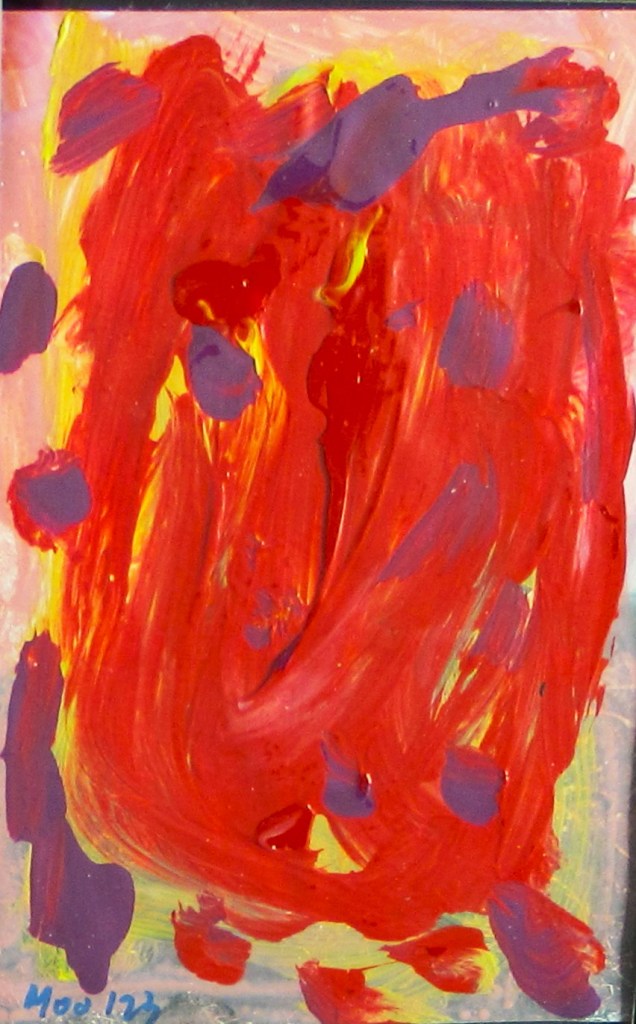
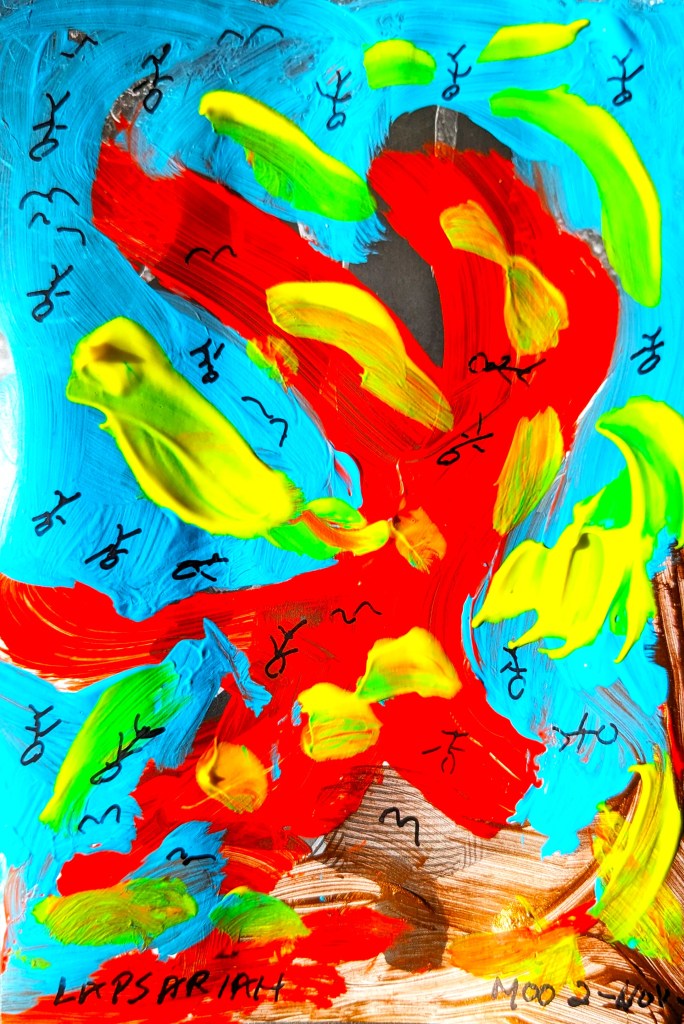
As for the painting, by my good friend Moo, that shows The Fall – Pre-Lapsarian / Post-Lapsarian – when all the devils, demons, and black angels were tumbled out of Paradise and abandoned to the depths below, where, alas, they still roam. So, if you meet any of them along the way, shove them in that old kit bag and get rid of them too. You’ll feel much better afterwards.

What is good about having a pet?

Daily writing prompt
What is good about having a pet?

What is good about having a pet?

Good heavens – what a strange question. Here in New Brunswick – Nouveau Brunswick, Canada’s only bilingual province, I guess it depends on whether you are Anglophone or Francophone. Nothing like a nice, healthy ‘pet’, if you are a Francophone, though you have to be wary, very wary, of them at my advancing age. And nothing like some ‘pets de ma soeur‘ for breakfast, with a nice cafe au lait, unless you would rather ‘un bon bin de beans‘.

On the other hand, if you are Anglophone, then the term takes on a different series of meanings, doesn’t it, my pet, I ask my wife. Happily, she neither woofs, nor woofs her cookies in reply. And if this is all double-Dutch to you, don’t worry. It’s all tied up with discourse analysis and the meaning of meaning. Don’t be so mean! What do you mean by that?

I suppose we are all talking about cats and dogs, and budgerigars – not budgie smugglers – and other two and four-legged friends, along with sliding ones, like baby boa-constrictors, that can – like pythons in Florida, grow to an enormous size. Such an enormous size, in fact, that you end up being the pet when the monster rules, and your flush your once-a-baby, now a problem, alligator down the New York toilet to grow even bigger and become a danger to the men and women who patrol the subterranean sewage systems.

And don’t forget Julius Caesar, the pet parrot who told the burglar, in an Irish accent, that “Jaysuss” was watching him” as the burglar tried to burgle the house. Alas, Julius Caesar failed to warn the house-breaker that Jaysuss was in fact a huge, pet Rottweiler that was standing – we stand on guard for thee – right behind the unfortunate man. Who needs a burglar alarm and an AI system, when you have two or three pet, and not petits, Rotties patrolling the house 24/7? Mind you, I wouldn’t call them pets, those Rotten Rotties, though they may cause them in certain people, and very generous ones at that.

What was your favorite subject in school?

Daily writing prompt
What was your favorite subject in school?

What was your favorite subject in school?

I never had one. I hated every school I attended with a passion. I hardly passed an examination during my school days and I remember, in Mathematics, dropping from Level I, to Level II, to Level III. I failed the first exam in Level III and earned this comment on my school report “Now I know why he descended to Level III.” I still have those school reports, incidentally, complete with the signatures of the Masters of my – limited, very limited – universe. How I appreciated Pink Floyd’s The Wall, when I first heard it. “We don’t need no education, we don’t need no thought control, no dark sarcasm in the classroom, hey, teacher, leave those kids alone. You’re just another brick in the wall.” And yes, I built walls around me, many of them. But I survived.

Another comment from that report: “He has read widely and indiscriminately – I do hope it has done him some good.” That reading included the complete works of Jean-Paul Sartre and Albert Camus, lots of Andre Gide, the theatre of Jean Anouilh – some of which I saw live in Paris -, an immersion in the Existentialist philosophical movement, the complete plays of Corneille, Moliere, Racine, Beaumarchais, a variety of French Poets, including Apollinaire and Jacques Prevert, a selection of Spanish poets, novelists, and playwrights, and a series of modern-(ish) British poets, including John Manley Hopkins, Wilfred Owen, Dylan Thomas, Vernon Watkins, and ‘indiscriminate others’! I wrote a great deal of poetry at that time, some of it in imitation of Francois Villon and Gilbert Chesterton (of whom I read many works as well).

Alas, my enthusiasm was not appreciated, especially as I scorned many of the texts that I was forced to read for my examinations. I should add I also scorned the limited, authoritarian interpretations of them that were forced upon us. The slavish imitation of ‘teacher’s remarks’ gained an A+. Any attempt to think outside the authoritarian boxes built oh so carefully for us, earned an F-.

But, if I had to choose one subject, it would be Myself. Protecting that self, developing that sense of self, growing into myself, understanding myself, and finally, having left those schools, those ideas, and that country far, far behind me, becoming the self that I am – and have always wanted to be. “What do you want to be when you grow up?” “I just want to be me.” And I am, thank heavens. And it’s a good job too, for, as Oscar Wilde once said “Everyone else is taken.”

When you think of the word “successful,” who’s the first person that comes to mind and why?

Daily writing prompt
When you think of the word “successful,” who’s the first person that comes to mind and why?

When you think of the word “successful,” who’s the first person that comes to mind and why?

What exactly does “successful” mean? I googled it and here are some of the answers – successful – well that’s a good answer. Successful means successful. It reminds me of my geography master in school – “The earth is geoidal, i.e., earth-shaped.” The earth is earth- shaped – I guess that leads to a successful education. Slightly better alternative meanings are – effective and productive. Taken literally, both have their problems, of course. The spud-bashers of WWI, sitting, peeling their potatoes at the cookhouse door, they were productive, but were they successful? Did they even survive the war? Do any names spring to mind? I am not so sure about that. But how about efficacious, another proffered meaning? Well, that certainly turns me on.

Basil, the Teddy Bear in the photo above, is embracing a can of Molson’s Lager. I didn’t know Teddy Bears liked lager until I saw him doing this. Caught in the act, all sticky-pawed. I asked him what he was doing and he replied that he was taking his medicinal compounds. When I asked him why, he started singing “most efficacious in every case.” “Who do you associate that with?” I asked. He started whistling the tune of Lily the Pink. “And was she successful?” I asked. “Of course she was,” Basil replied. “She’s the Savior of the the Human Race.” Wow!

So, I hereby nominate Lily the Pink, the Savior of the Human Race as both successful and nameable. And remember – “when Lily died, she went up to heaven. You could hear the church bells ring. She took with her, her medicinal compounds, hark the herald angels sing.” Now that’s a true life success story. And what an ending!