
Flash Fiction
Scrambled Eggs

Scrambled Eggs
The door to her father’s house opened before Tiggy could raise the brass knocker.
“At last,” said her father. “You’re just in time to cook breakfast. Come in. Come in,” He stood aside to let her pass and she pecked a kiss at his cheek as she hurried by, overnight bag in the hand closer to him. Tiggy held her breath as she went. She knew the smell emanating from her father would be as ripe as it was during her last visit, if not worse.
“I’ll make you breakfast in a moment, dad. I’ll just take these upstairs first.”
When she came down, her post-drive ablutions completed, she went straight to the kitchen. Her father sat at the breakfast table, restless fingers playing the piano of the table top in arrhythmic Morse Code messages.
“At last,” her father muttered. “Where have you been?”
“Just tidying up, dad,” Tiggy smiled. “You know it’s a long drive.”
“I want scrambled eggs. On toast. Make them like your mother used to.”
Tiggy thought of the dry overcooked eggs her mother used to scrape out of the burnt-to-a-crisp saucepan and sighed. Her almost-liquid, cordon bleu divinity was the real thing. Scrambled eggs, indeed. And so much salt. More like bacalao, dried salt cod with a little bit of turmeric to make it look like scrambled egg.
Tiggy picked up a saucepan. Filthy. She went to the sink and started to scrub.
“You don’t need to do that,” her father said. “It’s clean.”
“It’ll be cleaner when I’ve finished, dad. Don’t you worry.”
“Here,” her father handed her some plates. “You night as well wash these as well. They were clean enough for your mother but they won’t be good enough for you.” Greasy films layered the plates where yesterday’s bacon had solidified. Hard lumps of egg stuck to the cracks that road-mapped the plates’ surface.
“I’ll look after it, dad. You sit down and rest. I’m home now.”
“At last,” Tiggy’s father grunted.
Tiggy took in her father’s face. He had put on weight and veins ran red and blue tattoos across the unshaven surface. He breathed with difficulty, but she knew he angered with ease.
Tiggy looked for the end of the roll of paper towels she had bought on her last visit. When she found it, she dried saucepan, plates, and cutlery, putting the saucepan on the stove and laying cutlery and plates neatly in a space she created on the cluttered table. Her father pushed his setting aside and struggled to his feet.
“Here, let me help you.”
“That’d be great, dad. You do the toast, I’ll get the eggs,” Tiggy walked to the fridge, searched in vain for some butter, and carefully selected three large brown eggs.
Her father followed her to the fridge.
“Here, use up this cracked one,” he handed her a brown egg with a large fissure that mapped a thin contour from big end to little end.
Tiggy reached for the egg. She grasped it and felt the cold icy creep of the army of white maggots that seethed along the line. She shuddered and the egg slipped from her fingers and dropped to the kitchen’s flagstone floor where it shattered. A rich, ripe stench arose and ghosted through the air to tickle Tiggy’s nostrils. Her stomach heaved.
Having washed her hands, she cracked each egg individually into a saucer, inspected it, then poured it into the saucepan. Next, she took a wooden spoon from the drawer and started to blend the eggs.
Meanwhile, her father sat back down at the table, toast forgotten, and recommenced his Morse Code messages.
Tiggy opened one cupboard, then another, in search of bread. Finally, she found the remains of a sliced loaf in a dark corner and brought it out into the light. The first slice she extracted from the bag was a painting from Picasso’s Blue Period, the second, a breeding ground for mold, but the third might be salvageable …
“Don’t worry,” her father said. “Just scrape the blue stuff off. It’ll be fine. I eat it all the time.”
“You can’t eat that,” Tiggy threw the bread in the garbage. “I’ll just serve you the eggs on the plate.”
When they were cooked to her father’s satisfaction, Tiggy scraped the dried-out eggs from now charred saucepan. They landed on her father’s plate with a harsh, unforgiving sound.
“Lovely,” he said, licking his lips. “Just like your mum’s.”
Friday Fiction: Teeth

Friday Fiction
13 April 2018
Teeth
Lunchtime.
Tiggy opens a can of tom8to soup and heats it on the stove. She slices the remains of yesterday’s loaf of bread into one inch cubes and fries them in olive oil and garlic. Tom8to soup with croutons. Then she puts two slices of bread in the toaster. Her father will only eat toast soaked in butter and layered with Marmite when he eats tomahto soup.
“Lunch is ready,” she calls out.
The black American Cocker Spaniel, bought by Tiggy’s late mother, in a moment of madness, by telephone, unseen, camps in the kitchen. It nests at the far end of the table, by the stove, and defends its territory with warning growls and a snapping of yellowed teeth. Tiggy will not go near the dog.
“Lunch is ready,” Tiggy calls out, a little bit louder. Dog, as they call him, growls and clatters its teeth. It has hidden a treasure in the folds of its old, gray comfort blanket, and guards it with the fierce, loving worry of a dragon protecting its golden hoard.
Tiggy’s father enters the kitchen as she places the soup on the table.
“I’m not ready to eat. Put it back in the pot.”
“What’s wrong, dad? I thought you were hungry.”
“My teeth,” he mumbles through a mouthful of pink gums. “I can’t find my teeth.”
“Where on earth did you put them?”
“I don’t know. If I knew where I’d put them, I wouldn’t have lost them.”
Tiggy’s father circulates round the kitchen opening drawers, lifting saucepan lids, and shaking empty yogurt pots to see if they’ll rattle.
“I can’t find them anywhere. I can’t eat lunch without my teeth.”
“But it’s only soup, dad, tom8to soup.”
“I don’t like tom8to soup. Your mother always made tomahto soup. Why can’t you be more like your mother?”
“Sorry, dad. I’ll call it tomahto soup, if that will make you feel better. But it’s still made out of tom8toes.”
“Don’t be so sarcastic. Help me find my teeth,” Tiggy’s father stomps towards the stove and Dog growls fiercely from its blanket as it guards its treasure.
“Take that, you dirty dog,” Tiggy’s father lashes out at Dog with his stick and cracks it across the head.
“Dad, stop that. It’s not Dog’s fault.”
Dog howls and spits out what it is chewing.
“There they are,” Tiggy’s father bends down, picks up his teeth, still hairy from the blanket and bubbly from Dog’s saliva. He pops his teeth into his mouth.
“That’s better,” he says, “now I can enjoy my lunch.”
Wednesday Workshop: Reading
Wednesday Workshop
11 April 2018
Reading for Writers
Miguel de Cervantes once wrote that he was so fond of reading he would pick up even the scraps of paper he found in the street to read them if anything was written on them. This is well-known. What is less known is that Don Quixote, his immortal novel (DQI, 1605, DQII, 1615) is a masterpiece, not only of writing, but also of reading.
From the initial sortie, a prose transcription of an earlier short play, to the Scrutiny of the Library, Cervantes demonstrates right from the start his awareness of current trends in poetry, theatre and prose. In addition, he shows (especially DQI, chapter 47) his acquaintance with contemporary literary theory, as E. C. Riley has so ably established in Cervantes’s Theory of the Novel.
Cervantes begins with the traditional Renaissance novel (DQI, 1605) in which he experiments with plays and poetry turned into prose, oral and written histories, pseudo-autobiographical episodes, the picaresque novel, the pastoral novel, the Italianate Novel, the picaresque novel (briefly), his own versions of the realistic Spanish short story, and then, after a ten year gap during which he receives all kinds of reader feedback, he invents (DQII, 1615), the self-referring modern novel. DQII refers back to DQI as if it were true history. Don Quixote on his ravels meets with people who recognize him, for they have read his story and know all about him. The fictitious character establishes himself as an almost flesh-and-blood living person.
What can we, as writers, learn from this? Above all, we must learn to read copiously, not just once in a while, but all the time. Not only must we read, but we must learn how to read. Yes, we can read for knowledge and information; yes, we can read for pleasure and enjoyment; yes, we can read to lose ourselves and wash away the cares of the world. However, as writers we must learn to read in a different fashion. We must read in search of the narrative structures that inspire other good writers. We must read in search of the iterative thematic imagery that binds a text with meaningful, repeated images. We must read in search of the poetry that sates the soul’s constant thirst for beauty. We must read in search of the dialog that cuts to the bone and reveals the hidden character of the protagonists. We must read in search of the layering that allows us to give extra meaning at all levels of the narrative. We must read in search of the secret that allows us to trim all unnecessary material in order that our stories may be spare and sparse with not an extra word or thought.
Reading: I have just finished taking an eight-week online course with the School of Creative Writing at the University of Toronto. In the course of those eight weeks, I read the following books.
- 3 short stories a week, recommended by the instructor, the wonderful novelist Kerry Lee Powell, to illustrate each week’s lesson. [24 stories]
- 14 first drafts, one from each of the magnificent students in the course (I had the honor of being the fifteenth student). [38 stories]
- 14 revised stories. [52 stories]
- 14 first drafts of a second story. The course asked for two stories to be written by each participant over the duration of the course. [66 stories]
- 14 revised drafts of this second story. [80 stories]
- My own voluntary reading included Raymond Carver’s What we talk about when we talk about love (17 stories), Cathedral (12 stories), and my own short story collection, Bistro (35 very short stories). Recognizing the errors, weaknesses, and inaccuracies in my own collection reduced me to tears. [144 stories]
I have spent eight wonderful weeks exploring creativity and the art of short story writing. Am I a better writer for all that work? Undoubtedly. I can see and think much more clearly and I am beginning to gain a better understanding of how short narratives work. I am a better writer, but I am not yet a good one. There is still a long way to go.
I am retired. A long, cold, icy New Brunswick winter has kept me in the house, close to the fire. I have been gifted the time and mental energy to make the most of this course I have taken. I attended the University of Toronto, as a graduate student, back in the sixties. I was amazed at the quantity of work handed out by the professors in the School of Graduate Studies. My first decision, made very early on in my graduate career, was to take a speed reading course. Accelerating my reading speed and capacity for understanding was the only way I would be able to compete. I am still a fast reader, though not as fast as I was. This speed reading has left me time for long thought and slow writing.
Over the last eight weeks, in addition to the reading, as described above, I have written five new short stories, including two for the course. I have also revised and re-written a series of short stories for my next collection. As a good friend keeps telling me, we are not writers, we are re-writers. After eight very intense weeks, the acts of re-writing, re-reading, re-vising, and re-editing have become much, much easier.
Carpe diem, seize the day: pick up a book and start reading. Pick up your pen and start writing. No excuses. Participaction: don’t think about it, do it.
Friday Fiction: Clematis

Clematis
The clematis unfolds its flowers: bruised purple on the porch. Beneath the black and white hammers of ivory keys, old wounds crack open. A flight of feathered notes: this dead heart sacrificed on the lawn. I wash fresh stains from my fingers with the garden hose while the evening stretches out a shadow hand to squeeze my heart like an orange in its skin. Somewhere, the white throat sparrow trills its guillotine of vertical notes. I flap my hands in the air and they float like butterflies, amputated in sunlight’s net. The light fails fast. I hold up shorn stumps of flowers for the night wind to heal and a chickadee chants an afterlife built of spring branches.
Pressed between the pages of my waking dreams: a lingering scent; the death of last year’s delphiniums; the tall tree toppled in the yard; a crab apple flower; a shard of grass as sharp as glass, as brittle as a bitter, furred tongue at winter’s end.
I know for certain that a dog fox hunts for my heart. Vicious as a vixen, the dog fox digs deep at midnight, unearthing the dried peas I shifted from bowl to bowl to count the hours as I lay sick in bed. I sense a whimper at the window, the scratch of a paw. I watch a dead leaf settle down in a broken corner and it fills me with sudden silence. Midnight stretches out a long, thin hand and clasps dream-treasures in its tight-clenched fist.
The lone dove of my heart flaps in its trap of barren bone and my world is as small as a pea in a shrunken pod. Or is it a dried and blackened walnut in its wrinkled shell of overheating air? Sunset, last night, was a star-shell failing to fire. Swallows flew their evensong higher and higher, striving for that one last breath lapped from the dying lisp of day. Its last blush rode red on the clouds for no more than a second’s lustrous afterglow.
I lower defunct delphiniums, body after body, into their shallow graves. Night’s shadows weave illusions from earth’s old bones. Rock becomes putty, malleable in the moonlight. Midnight readjusts her nocturnal robes and pulls bright stars from a top hat of darkness. Winged insects with human faces dance step by step with circling planets and clutter the owl’s path. Night swallows the swallows and creates more stars. The thin moon hones its cutting edge into an ice-cold blade.
Friday Fiction: Gringos

Friday Fiction
23 March 2018
Gringos
By day, I sit in the shade beneath the grapefruit tree and watch as the sun turns each globe of fruit into a shiny planet. The hummingbirds visit me. They whir their wings, bow their heads, and pay homage with their ruby throats.
On warm days, the sun decks me out in a shining cloak of sumptuous colors, red, blue, yellow, green. When it rains, my captors quickly confine me in a small dark place: no moon, no stars, no worshipers, no forest canopy, no grapefruit planetarium to shape my dreams. Just night and silence. I tuck myself in and hope for the occasional dream to reach out its hand and extract me from my cell.
Fine weather today. I sit beneath the grapefruit tree and the gringos buzz around me. They push grapes, raisins, bananas, crusts, cigarette butts through the bars of my cage. I scorn them. Gringos, I cry with contempt. Gringos. They clap their hands. Bray with laughter. Sway from side to side splitting their sun-red faces with gold-capped teeth. I eat very little of what they offer. An occasional grape. A chunk of banana. I never take food from their fingers: the temptation to bite the hand that feeds is far too great.
I am learning their language. The compound guards who allow the gringos in and out of the gates that lead to the outside world teach me gringo words. I can now say gringos go home and this makes for much merriment. The gringos slap their sides and double over with strange cackled cries of laughter. Sometimes tears come to their eyes.
I drowse in the sun and recall my childhood on the building site. The workers took me from my forest home, placed a chain on my leg, and tethered me to the broken branch of a leafless tree. At first, I couldn’t understand their speech, but they persisted and bit by bit, I picked up their words. When I repeated them, they laughed. Now, I rarely use them and when I do, the compound guards throw a blanket over my head and carry me back to jail.
I am very careful with what I say. Gringos go home. That is fine. But I rarely say what I really want to say. I want to tell the world how much I love the sunlight as it pierces the leaves and filters down to me, sparking fragmented colors from my frame. My greatest desire is to move in a cloud of many colors, all my family together. I love being part of the crowd-cloud, a voice among voices, all of us in counterpoint and tune. Instead, I sit here, isolated, alone, pining for my brothers and sisters.
Gringos, I want to say, gringos, let me go home.
Today, a great event. One of the gringos has picked up my prison and moved it from under the shade of the grapefruit tree to a new spot beneath the balcony. I now sit directly beneath the geraniums. The gringa who lives long-term on the second-floor waters her flowers regularly.
The gringa grows old and forgetful. She knows she must not water her plants during the day, especially when I am around, but today she is out in the sunshine, forgetful, without her hat, dressed in her dressing-gown and grizzled slippers, with her hair in steel curlers, and a watering can in her hand. Water. It is the symbol of my baptism. It is the element that will release me from my bondage. Water will quench my thirst and free my soul.
I hear the water, the blessed water, falling on the flowers. I hear the water filtering down through the flower pots. I feel the water bouncing off the geranium leaves threading its way down to settle on my back. My mind returns to the building site of my youth.
I remember my childhood friends. Their faces flood back and grow like flowers as the waters flow and I remember every word those old friends said as they ran from the building site to take shelter from the rain that stole their money, stole their livelihoods, and stopped them from working.
Fucking rain, I screech, as the water hits me. Fuck this fucking rain. Fuck this mother-fucking rain.
I hear the sound of running feet followed by voices.
“Gertrude’s watered the parrot as well as the geraniums. He thinks it’s raining.”
“ Quick, fetch his bloody blanket. Shut up, you foul-mouthed parrot.”
Alas, my moment in the spotlight is over. The play is done. The curtain falls. Darkness descends. I tuck my head beneath my wing and before I fall asleep, I squawk one last feather-filled word:
Featherless-muffer-fuckers.
Last Rites: FFF
Last Rites
Flash Fiction Friday
11 August 2017
The employee gazed around his empty office. Tomorrow he would leave the work environment in which he spent his entire adult life. He turned out the lights, closed the door behind him, and walked down the stairway to the exit for the last time.
He took the long, solitary walk to the spot where he had parked his car. In the car park, he fondly kissed his wife’s photo and said a quiet farewell to his beloved daughter. Then, he climbed into his car, started it, and began the short drive home.
Later, at the inquest, the driver of the gravel truck swore he had no chance to avoid the head on collision.
“One moment the road was clear, the next this car was heading straight at me,” he paused and blew his nose. “There was nothing I could do.”
“Yes, sir,” the police officer stared back at the coroner. “I was the first investigating officer on the scene,” he glanced down at his note-book. “And yes, I can assure you that the car driver was not wearing his seat-belt.”
“He loved his work,” his wife testified, fingers twisting the white handkerchief that stood stark against her black dress. “There must have been something wrong with the car. He would never have left me alone like this.”
“A wonderful dad,” his daughter said. “He loved me, and the grand-children. He had so much to live for. It was a terrible accident.”
“Unhappy with his retirement?” queried the employee’s Department Head. “I don’t know what you are trying to imply. Nobody forced him into retirement: he made that decision himself. He seemed very happy with it. We all knew he was out of touch and not up to date with his research anymore. That’s why he chose to retire. He told me all that when he came to see me to tell me he was retiring. His decision to retire had nothing to do with me.”
The employee’s DH raised his eyes heavenwards and gazed at the ceiling.
Out of sight, in the safety of the witness box, he rubbed his hands together, again and again, as if he were washing them.
Comment:
It’s been so long since I last wrote and posted an FFF (Flash Fiction Friday). It feels good to be back writing prose. And yes, the last two FFFs were on May 5, 2017, Moonshine, and April 28, 2017, Crocodile Tears.
So much water under the bridge and so glad to start getting back to my creative blogging schedule.
Torticollis

Torticollis
A sudden crick of the neck and I am back in the chalet at Perines with Trini.
“Torticollis,” she says, raising a hand to her neck, except she says it in Spanish, ‘tortículis’.
She offers me tea, very English, from the Wedgewood tea pot I brought her, all those years ago. Beside her, the Pirate with the Parrot on his Shoulder, my Toby Jug, still stands on guard, and protects my memories.
Orphaned, I was, from England, abandoned on that Spanish shore, and left there all summer to learn the language. Trini taught me how to eat, speak, choose my books and my friends … she had lost a son, same age as me, just after the Civil War, and treated me like her son, returned, like the Prodigal Son I was to all who had sent me away from home to improve my lifestyle and my manners.
Wanted? Unwanted by my family? I wouldn’t know the difference.
In that far-of land, in time and space, I only knew the loneliness of being lost, marooned in a foreign land, feeling my way, day by day, among foreigners, still foreign, although they took me into their homes and hearts and loved me as I had never been loved before.
Back home, drowsing at the kitchen table, I doze into my dreams, only to be woken by that beloved voice.
Wistful, I turn my head and glance backwards into that past of sunshine and beaches, where the sun sparkled on hill, sand, and sea and the table cloth was spread on the family table, pure and white, with a dozen of us sitting, talking, smiling, drinking wine, that bottled sunshine that still adorns my dining room table.
“Trini? Is that you?”
Her name slips from my lips as I snap my head towards her voice. As I turn, I twist my neck and raising my hand to the sudden pain, I hear again that word: “¡Tortículis!”
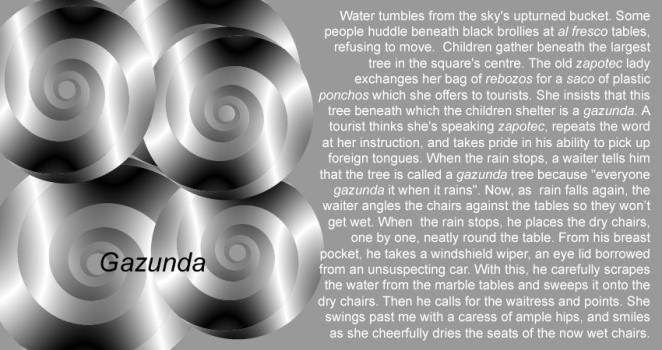
Gazunda
Gazunda
for John Sutherland
John and I were talking about the rare Gazunda tree the other afternoon. I had forgotten that I had indeed written abut the Gazunda trees that flourish in the zócalo in Oaxaca, Mexico. Oaxaca is a magic place, full of mystery and myth and the myth of the Gazunda tree is not well known outside the confines of the city. I was so pleased to discover this account, written many years ago, when I first became associated with the Escuela de Idiomas attached to the Unversidad Autónoma Benito Juárez de Oaxaca (UABJO).
Much remains to be written about my experiences in Oaxaca and I hope to have a collection of prose poems completed fairly soon. They are golden oldies, but like many golden oldies, they are also golden goodies. The Gazunda trees are very welcome when it rains, but they should be avoided, for obvious reasons, during thunder and lightning storms. Then, nobody Gazunda them. By the way, if you do visit the zócalo in Oaxaca, or anywhere else in Mexico, after heavy (or light) rain, be sure to test the seat of your chair before you sit in it. If you don’t, you will soon find out why all the waiters and waitresses have that open, friendly smile the tourists love so much.
Damnatus
Damnatus / Doomed
‘Poor poets of today: condemned to be nothing more than the dry dust of an unread doctoral thesis.’ They languish, empty headed, in dark rooms, those poets, hunched over their computers, waiting fr someone or something to fill up their heads. They hammer away at their keyboards, correcting their spelling with an ever cautious spell-check. Intent on making their poems cryptic, they shrug off the sunshine, the beach, the flowers in the garden, the cardinals, orange and red, who clamor at the feeder, and concentrate on abstract meanings, abstruse words, and twisted thought.
Phone calls go unanswered. Friends are left hanging on the vine to dry. These poets are worse than wallflowers at a dance or lemons out on a date as their crowded heads fill up with metaphors and myths that limp their unsteady ways onto screen and page. Oh pity the blisters on their fingers, the calluses that harden their fingertips to the delights of re-writing, again and again, for they are not real writers but real re-writers, and every thought is a skirmish with unreality, a pledge to continue their servitude to their life’s mission: the curdling of words and the nurdling of poetic thought. What better poetry is there than a hamburger for the hungry or a helping hand stretched out across a street to help a beggar in need … but there are neither burgers nor beggars in these un-windowed buildings, just the poverty of a poetry undiscoverable in its lack of lustre gloom..
Where is the graduate student, earnest, destined to be penniless, who will delve into the notebooks of these poets’ lives and dig out the thought-gems, the diamonds that will make everyone great, publisher and published, poet and practitioner of the uncritical art? Will someone not take that student by the hand and lead him to pastures green, or to the sea, to taste and test the blessed salt and the winds that will drive away the mind’s unwholesome fog and bring light and understanding that will un-cuff the wrists and heal the immortal wounds for, left untreated, they will bleed for all eternity?
Oh the bright bracelet of learning bound round the heart-bleed wrist. Oh the false knowledge gained, that leads poet and critic up and down the slippery garden path towards promotion, tenure, and a seat on the picket fence. Oh those grey human bodies chained to their wooden desks in a dusky library or transfixed on metal seats in academic meditation. Sit and watch while cobwebs sprout in the unused brain and the only certainty lies in footnotes and bibliographical entries that rise like a surging tide to flood the drowsing mind that craves more sleep.
What bright word, what metaphor dim, has poisoned the wit so it effortless moves into the serenity of contemplation? Look on this pathless sea of words, ye mighty, and despair. But take great care: for what if this sylvan warrior awakes, steps out of that figmented dream, sees the reality beyond the shadows, demands a proper challenge, a walk in the park, a vision of the grass that is so much greener on the other side where the administraitors gather and garnish paper and paperclips as they strive for the privilege of herding more and more slovens in their poetic pursuits?
Oh grant them more grants, these purloined poets. Gift them pure visions of things that never were and will never be. Never let them break away from their dissolute dreams that wrap their disadvantaged forms in the ignorance of mental slumber, half-sharpened pencils, and a box of blunt sharpeners..

