Cows

IMG_4757 (2).jpg

Cows

Underneath the bungalow, we find a secret space so small that only the young ones can crawl there. We go after coins that drop through the floorboards of the verandah and we hide there, in that cool, dark grave space, when we wish to be neither seen nor heard. At the far end of the bungalow, in a larger space beneath the floor, Nana has her refrigerator. This space, similar to ours, is where she keeps the thick cream off the bottled milk when she wishes to turn it into Devon Clotted. Here, too she places the jellies when she wants them to set. We have neither running water nor electricity, just the cool beneath the floorboards. We do have two water tanks, one a square, red-rusted, cast-iron tank that collects the rain-water off the roof, the other an old iron-bound wooden barrel that connects to a downspout outside the backdoor.

They have built me a swing in the backyard and on sunny days I throw my head back, thrust my legs forward, and squint at the summer sky through half-closed eyes, as the old folk push me. “Higher,” I cry out. “Higher.” We don’t have a push lawn-mower, though we occasionally borrow one from the neighbors. We do have a scythe, a sharpener, and a pair of bill-hooks. I have never forgotten that head down, half-shuffle of the scythe man using his scythe: one step sideways, swing, feet together, one step, swing. I loved the sweet smell of the fresh-cut grass as I played the grim reaper in the backyard, always with a grin.

I lived in the bungalow for the whole of one summer. I guess my mother had been placed in some hospital or other for the duration of the fine weather. Nobody talked about her and I never knew what was wrong with her or when she was coming back. It was all a mystery, wrapped in stealth and secrecy. Her absence was a pain in my side, a thorn in my heart, and I still don’t know what happened to her.

I slept in the back bedroom with my Nana in her big double bed. I slept on the far side, next to the outside wall. At night I would often hear the cows as they munched away at the grass and wandered through our un-fenced yard. I say ‘I slept with my Nana’ but in actual fact I fell asleep long before she came to bed, often when the sun was still high in the sky. She always got up early in the morning to prepare breakfast for the men and lunch for my uncle, who worked in town and usually took the early morning bus.  My Nana was up and dressed by the time I woke up, so I rarely saw her in bed.

Some nights I woke up during the night, needing to pee. I never liked using the Royal Doulton chamber pot that squatted coldly beneath the bed, especially if she was in the room. We had no indoor plumbing, nor running water, as I have said, and apart from the rainwater the only tap was at the far end of the bungalow field, a long way away, and all but rainwater had to be fetched by hand in large tin cans that we ferried, empty, to the end of the field and brought back, full, at the end of our excursions to farm, local shop, or beach.

Those cows that wandered through our yard at night really frightened me. We would meet them in the lane some times, a noisy, dusty, flowing, multi-colored tide that flooded the pathway and forced us walkers into the next field, if there was a gate close by, or high into the hedge, if there wasn’t a gate. The one black and white cow in the herd really filled me with fear. She had a crooked horn, had gored a dog, and had kicked out at several of the local residents, injuring at least one of them quite badly, a broken leg, I think. That cow had an evil reputation, especially when, isolated from the herd, she meandered around on her own.

When I wanted to pee, I preferred to walk outside, to the outhouse, rather than use the chamber pot. I would grope my way out of the bedroom, turn right, drop down the steps into the kitchen, and slide back the bolts on the door. Then I would half-open that door and peep out, listening carefully for any sound of the cows tearing out the grass with their teeth, or rumbling gently as they chewed the cud, churning it over and over. I would sniff the night air, and if I sensed a cow in the vicinity, I would pee through the narrow crack of the open door and swear in the morning, when someone found the little puddle, that it wasn’t me, that it must have been the cows.

One quiet night, I walked bravely out into the dark and stepped right into a cold cow pat that lay just outside the back door like a landmine, waiting for my unwary feet. I still remember the cow-manure’s soft squish as it sifted upward through my toes and rose to assault my nose. After I had gone pee, I wiped my foot again and again in the long grass beside the outhouse, then placed it beneath the water-spout from the rain barrel, trying to flush it clean before I crept back into bed.

That was the night I left the back door open. Next morning, my Nana woke us all up with a series of long, loud screams and squeals. The black and white cow had wandered through the open door and ended up in the kitchen where my grandmother had come face to face with it in the early morning light.

A cow in the kitchen, that really spooked me and I still have dreams, nightmares, really, of a herd of cows invading the bungalow, breaking down the doors, and climbing in through the windows, and me all alone, trapped in my bed, shivering ferociously, squeezing myself, trying desperately not to go pee.

Billy


IMG_0165.JPG


Chronotopos

A dialog with time and space.

But what is time? A river flowing? A long line leading from our beginnings to our end? Alpha and Omega? An instant held between finger and thumb and so swiftly forgotten? A dream we dream when we are awake. Or asleep. And which is the real dream, waking or sleeping? Sleeping or lying awake?

And what is space? This house in which Billy lives? The garden Billy watches from his widow? Billy’s town? His district? His county? His province? His region?

And how does Billy relate to his “time” or his “place” and what is this being called “Billy”, this dream Billy dreams, this post-amniotic ocean of life in which Billy floats?

Billy dreams he is male. When he reads Carl Jung he learns a large part of him is female. Billy thought he was masculino / macho / male, yet when a large part of him is femenina / hembra / female, he’s no longer sure what he is.

Billy has ten fingers yet he uses only two to type. Two fingers manipulating twenty-six letters and Billy turns his black-and-white keyboard world upside down when he thinks his subversive thoughts and types them onto the page.

Time and place, male and female: Billy lay on his side in hospital and the young urologist shot him full of female hormones so his prostrate cancer would not takeover his inner organs and destroy his life.

Place and time: Billy lies awake at night and shapes disturbing dreams, dreams he never before dreamed of dreaming.

Billy senses the end is drawing near.

He fears it. Yet he loves it. He loves it because it’s his and nobody else’s.

In Billy’s beginning is his end.

Beginning and end: both belong to him.

Time and space, so sacred to Billy’s life … they will continue with or without him.

Billy may not be there to bear witness. But he has been here and parts of him will remain embedded in the mind of each and every one of those who knew him.

On an unusually Odd Sunday at Corked: raise a glass to Billy’s name when he is gone.

Leave an empty glass on the table for Billy and he will be there.

Show Don’t Tell

IMG_0141.JPG


A barber shop quartet, four of them, singing in unison, spring birds at a feeder, early morning sparrows at a jug of milk, abandoned by the milkman on the doorstep.

Except they were none of that. How could they be? They were four brothers, torn apart at birth. They never knew each other, never sang together, never embraced each other, never held each other in their arms. How could they have done so? The first one was stillborn. The second one survived for a while, but struggled to live, succumbed, and drifted away. The third one lived, marked for life by the scars on his forehead where they dragged him from the womb. The fourth one stopped struggling in the seventh month, but the mother carried him to term, even though she knew he was dead.

She carried them, blessed them, gave them all names, and buried three of them. They were her babies and she never got over their loss. Oh, she survived physically, but mentally she was destroyed.

The priests wanted to know what sins she had committed for God to be so angry with her that He destroyed the fruit of her womb. She had no answer. Some refused to bless her. Others ignored her completely. A few used her sorrows to drag the survivor into the tangled web of the church. “He has been spared. He will be one of us,” they said, and rejoiced at the potential strengthening of their celibate ranks.

Three of her children were ever before her. But the fourth lodged like an albatross on her shoulders and hung like a crucifix round her neck. She could never see him clearly. How could she? He was rarely before her eyes, never in the range of her sight. She tried to mold him like putty, but like water or sand, he slipped through her fingers.

Her husband hated him. Was he the father? It’s a wise man knows his father, or his son. Yet they looked alike. But no, they never thought alike, or walked alike. Nor moved in the same circles.

The father, a gambler, had borrowed a large sum of money and placed it with a bookie, betting that this third son would never live and that his death would make his father’s fortune, if the child was indeed a product of the seed his father deposited in his wife’s child bank.

The father lost his bet. The son lived. The father hated him every day of his life.  A rich man he would have been, if … if only … and the scars of that lost bet raged ragged on his face as the father cursed the doctor who had pulled his  son, if he was his son, alive and struggling from the womb.

If he was his son … a strong man, magnificently muscled , it was not his fault, never his fault, it was the fault of that worthless woman, the woman who had carried his seed, if it was his seed, the woman who carried his other three sons, and never brought them alive into this world …

The ostrich sees danger, and buries his head in the sand. The son sees danger and learns to run. The wife sees danger and  learns to suffer, to be beaten, to be abused, to be the victim because yes, she is filled with guilt, and how could it be otherwise, when the spirit is willing and the flesh is weak, so weak that it cannot give birth and eventually takes to the black holes of victimization, of alcoholism, and eventually of oblivion.

And the son learned to hide, to make himself invisible, never to be there, never to accept responsibility, never to sit at the desk when the buck was about to stop anywhere nearby, never to be blamed … never to turn down the solace to be found in the darkest depths of those same bottles that finally destroyed the woman he loved, who was also his mother.

Instructor’s Comments:

Rewrite.
Next time, show don’t tell.
Minimally acceptable.

D


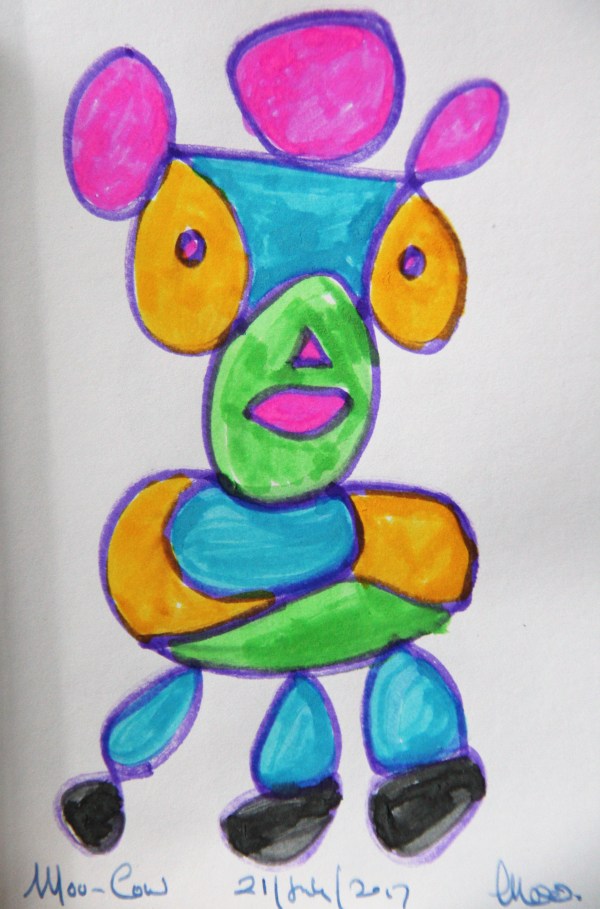
Moo Cow

IMG_0080.JPG

Moo Cow
for Geoff Slater

It’s his story to tell, not mine, but I’ll tell it anyway, since he told it to me.

We were talking after lunch, de sobremesa, as they say in Spain, sat around the table. Chewing the fat, or the cud. The subject turned to farming in Wales and how Welsh farmers were sometimes trapped in the stall with the bull and crushed against the wall when the bull leaned its great weight upon them.

“It nearly happened to me,” he said. “But it was with a cow, not a bull. I was nine years old. One of our cows got into the manger and couldn’t get out. My father sent me in, hoping that I could shoo it out, but instead of leaving, the cow turned and trapped me against the wall. I couldn’t move, couldn’t breathe,” he paused.

“Go on.”

“I carried a pocket knife at the time. I had just enough room to pull out the knife, open it and … ”

I watched him shrink, grow younger. He returned to nine years of age. In his hand, he held an imaginary knife. The room shrank around us until it became the size of a manger. The cow loomed large, filled the room.

” … I stabbed, stabbed, stabbed … ”

His eyes tightened. His face grew grey. A sea-change came over him: white-caps whipped over his flesh. Storm clouds threatened. I watched his clenched hand stab … stab … stab … at empty air.

” … I stabbed it again and again and it turned and moved away … and finally I could breathe. I was lucky.”

He relaxed, started to breathe again. The room returned to its normal size. The cow vanished. The sun shone through the kitchen window, high-lighting us as we sat there, breathless,  in silence.


Double Trouble

PEI + bockle 2008 025


Double Trouble

“I’ll need some ID,” the guy selling Fred a new cell phone said. “Something with a photo on. May I see your driving license?”

“Of course,” Fred pulled out his driver’s license.

The salesman took it, glanced at the picture, walked over to the computer, and started to type in numbers. Fred watched him as he nonchalantly punched the keys. Then Fred saw him stiffen and straighten up as he held the license up to the light, double-checked it, and frowned.

“I’m sorry, sir,” the salesman said, looking very sad. “This license has expired. It’s more than two years out of date.”

“You’re joking,” Fred said

“No sir,” the salesman replied. “This license expired two and a half years ago.”

He handed it back to Fred who also checked it with care. At first, the figures seemed blurred. Fred took out his glasses and put them on.

“You’re right,” Fred said. “It is out of date. I must have the new one in here somewhere.”

He started to rummage through all the plastic cards in his wallet. But there was no new driving license.

“I must have left it at home,” Fred muttered.
“They usually shred the old licenses,” the salesman smiled. “They never let you keep them. You must have forgotten to renew.”

Fred placed his hands on the cell-phone counter, looked down, and saw his face mirrored in the shiny plastic. He gazed into his own eyes and they looked back at him. Then his mind flashed back two and a half years.

He had just been through the biopsy, a messy, painful, and unnerving affair, and the results had come back positive.

The urologist demanded a new battery of tests: X-rays, bone scans, blood tests, MRI’s, examinations, more examinations, questionnaires, discussions about possible forms of treatment …

The different treatments were set out like food in a self-serve restaurant and, like the strange foreign foods that Fred liked to try without knowing exactly what they were, their names meant nothing to him.

Then there was the travel: out on the road between his little place in the country and the major cancer hospitals in the province with an examination here, and a consultation over there. All the medical staff he encountered were kind and helpful and the suggestions they offered were sound. The winter road conditions complicated matters, though, and twice he was forced to cancel appointments because of road conditions.

Then, a week or so after the MRI, the allergic reactions set in and, over a three week period he lost all the skin, first off his hands, and then off his feet. He watched the skin bubble, then he saw it go very dry, and then it just flaked off. He remembered getting out of the shower one morning, drying his feet, and staring down at the little pile of flaked-off skin that had come away with the towel.

A little later on, came the injections, the tablets, and that was before the start of radiation treatment …

Now, two and a half years later, Fred’s driving license, the one that should have been renewed on his birthday, had expired. He remembered that birthday well. He lay on his side in the hospital and the specialist drove that first needle into his buttock … what a birthday present. And now, two and a half years later, he had another special gift from that birthday, an expired driving license.

He thanked the cell-phone salesman, put his expired driving license back in his wallet, and said how sorry he was that he would be unable to purchase the cell-phone at this time.

Early the next morning, Fred went down to the Driving License Renewal Center to discover his fate.

The lady on the counter was most sympathetic. She listened to his story and told him not to worry.
“Don’t worry,” she said. “It happens all the time. But I’m afraid you’ll need to take all the tests again, including the road test. That’s the law. I’ll need to see some documentation. A photo ID is preferable. Do you have your birth certificate or your passport with you?”

Fred nodded. He had checked online to see what he needed and had brought all the right documents. He handed the passport over.

The lady behind the counter took the passport, opened it, and looked up at Fred with a sad little smile.

“I’m sorry, sir,” she said. “You are in double trouble. Your passport has expired as well.”

Double Trouble appears in my short story collection Bistro 2,
also available on Amazon.

Bistro

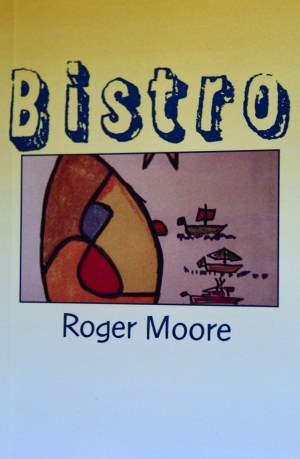
Bistro Cover

Bistro

Thank you, Allan Hudson, for your kind words about my book of short stories entitled Bistro. Allan has also set out a brief introduction to five other novelists, several of them close friends and admired acquaintances.

Bistro was one of three finalists in the New Brunswick Book Awards (2016-17). I think it was the only self-published book to make the finals. So, all of you struggling self-publishers, it can be done and we can get recognized, as we know from the results of one of this year’s major French book awards, awarded to another self-published author, much to the chagrin of all the French publishers who had already turned his book down. The message to everyone is simple: “Don’t get off the bus. Keep believing. Finish the journey.” And remember, you’ll never finish the journey if you get off the bus / train / boat / plane / tram / trolley / whatever … before you reach your final destination.

The cover photo, incidentally, is one of my cartoons that has appeared on these pages before. It shows a bird-man, beak open in astonishment, watching three ships approach his belly-button, as he sits there, naval-gazing, or should that be navel-gazing? “I saw three ships come sailing by …”

You can link to Allan’s Blog, the South Branch Scribbler, by clicking on the link. Bistro, incidentally, is available for purchase on Amazon and Kindle.

Bistro FFF

IMG_0155

Friday Flash Fiction
20 July 2018

Bistro 

LJ sat at a table in a dark corner of the Bistro. He held a plastic bag in his hands and moved what looked like dried brown fava beans, one by one, through his fingers. A priest at prayer, his lips moved in a silent mantra as he counted the beans:  “… twenty-seven, twenty-eight, twenty-nine.”

Robin and Will watched him closely, looking for the tell-tale signs that would announce LJ’s return to his former life.

Same-sex couples danced through the Bistro. They avoided this one corner that formed an oasis of severity amidst the gaiety and noise of Carnival celebrations.

“How much does he remember?” Robin looked at Will. Will shrugged and the two men exchanged worried glances.

A whooping conga of men dressed in garish, feathered costumes that revealed more than they concealed, approached the table where the three friends sat. The conga came to a stop in front of them.

“Now what have we here?” The leader asked. He turned to his followers flashing a white, toothy smile.

“Let’s see what you’ve got, darling,” he reached towards LJ’s plastic bag.

“Don’t touch him,” said Robin, rising to his feet.

Three large men broke away from the line and two grasped Robin while the third put his arms on Will’s shoulders and held him in his chair.

“I’m warning you,” Robin said.

“Shut it,” said the leader.

LJ closed the plastic bag that held the twenty-nine fava beans and put it in is breast pocket, next to his heart.

“Don’t put them away, darling, they look delicious,” the leader grinned his enormous grin. He was a big man, not tall, but broad and heavy. “Give them to me, I want to eat one. C’mon, I’ll just pop it in my mouth and suck it.”

The Conga crowd roared their approval.

LJ got to his feet. He was a small man, but wiry. The night-fighter, they had called him. He was the one who slipped out at night through enemy lines and knifed the sentries. One hand over their mouths, one hand on his knife, all sounds extinguished till they relaxed, lifeless, then that one quick twist of the knife and the ear-lobe severed as the dead man was lowered to the floor.

“Wanna dance?” The conga leader wiggled his hips and ran his tongue over his lips, then puckered a little kiss.

LJ’s face turned red, the veins engorged, and his eyes stood out. Nobody saw him move, nobody ever saw LJ move. He grasped the Conga leader’s windpipe with his left hand and drew him forward until they were locked eyeball to eyeball. LJ’s night-fighter knife lay flat across the man’s jugular.

“LJ, no,” Robin screamed. “Not number thirty.”

LJ kept staring at the man he held. His knife disappeared.

“You’re not worthy,” he said, leering into the Conga leader’s purpling face. “You’d dishonor them.”

Will and Robin breathed a sigh of relief.

Comment: Bistro is the title story in a collection of short stories and flash fiction. Bistro, the book, was one of three finalists (and the only self-published book) in the New Brunswick Book Awards (Fiction, 2017). Bistro (the collection) is available on Amazon. The sound recording below is my own reading of the story and the opening cartoon, Belle Bottom Naval Gazing,  is the picture on the cover of Bistro, the book. It is also my own work.


Teeth

img_0181
Teeth

Lunchtime.

Tiggy opens a can of tom8to soup and heats it on the stove. She slices the remains of yesterday’s loaf of bread into one inch cubes and fries them in olive oil and garlic. Tom8to soup with croutons. Then she puts two slices of bread in the toaster. Her father will only eat toast soaked in butter and layered with Marmite when he eats tomahto soup.

“Lunch is ready,” she calls out.

The black American Cocker Spaniel, bought by Tiggy’s late mother, in a moment of madness, by telephone, unseen, camps in the kitchen. It nests at the far end of the table, by the stove, and defends its territory with warning growls and a snapping of yellowed teeth. Tiggy will not go near the dog.

“Lunch is ready,” Tiggy calls out, a little bit louder. Dog, as they call him, growls and clatters its teeth. It has hidden a treasure in the folds of its old, gray comfort blanket, and guards it with the fierce, loving worry of a dragon protecting its golden hoard.

Tiggy’s father enters the kitchen as she places the soup on the table.

“I’m not ready to eat. Put it back in the pot.”

“What’s wrong, dad? I thought you were hungry.”

“My teeth,” he mumbles through a mouthful of pink gums. “I can’t find my teeth.”

“Where on earth did you put them?”

“I don’t know. If I knew where I’d put them, I wouldn’t have lost them.”

Tiggy’s father circulates round the kitchen opening drawers, lifting saucepan lids, and shaking empty yogurt pots to see if they’ll rattle.

“I can’t find them anywhere. I can’t eat lunch without my teeth.”

“But it’s only soup, dad, tom8to soup.”

“I don’t like tom8to soup. Your mother always made tomahto soup. Why can’t you be more like your mother?”

“Sorry, dad. I’ll call it tomahto soup, if that will make you feel better. But it’s still made out of tom8toes.”

“Don’t be so sarcastic. Help me find my teeth,” Tiggy’s father stomps towards the stove and Dog growls fiercely from its blanket as it guards its treasure.

“Take that, you dirty dog,” Tiggy’s father lashes out at Dog with his stick and cracks it across the head.

“Dad, stop that. It’s not Dog’s fault.”

Dog howls and spits out what it is chewing.

“There they are,” Tiggy’s father bends down, picks up his teeth, still hairy from the blanket and bubbly from Dog’s saliva. He pops his teeth into his mouth.

“That’s better,” he says, “now I can enjoy my lunch.”

Comment:

I included this short story, first published here on my blog on April 13, in Devil’s Kitchen, my new story collection that received third prize in the Writers’ Federation of New Brunswick David Adams Richards Award for prose this year. I will probably read this tonight, at the awards ceremony that follows the banquet here in Quispamsis. It’s a beautiful morning, with sunshine streaming through my bedroom window. Hopefully a full day of sun and warmth will help decrease the already diminishing flood waters that have struck this area of the Lower Saint John River Valley.

Friday Fiction: Woof!

IMG_0040 (3)

Friday Fiction
11 May 2018

Woof!

The old man limped up to the check-out in Chapters and placed a brown, hand-made, Italian notebook on the counter.

“Did you find everything you were looking for?” The check-out girl inquired.

“No.”

“Oh dear, what were you looking for?”

“My dog. I lost my dog.”

“Here? In the store? I can page security. I’m sure they’ll find it.”

“No, you mustn’t do that.”

“It’s no trouble. What color is it? Male or female? What breed? Large or small?”

“No, no. You’re much too kind. I lost him at home.”

“I lost my cat last week,” the check-out girl told him. “We searched everywhere for her.”

“I searched for my dog. All around the block. The dog usually comes home. This time he didn’t.”

“That doesn’t sound good. We never found our cat. My mom said the coyotes got her.”

“That’s not nice. We lost a cat.”

“To coyotes?”

“No. To mapaches, you know, to raccoons.”

“I miss my cat.”

“Me too. I also miss my dog.”

“I hope you find him.”

“I will. Oh, look. Here he is. Safe and sound.”

“I don’t see him,” the check-out girl looked around the store from her vantage point behind the cash register but didn’t see any dogs.

“His name’s Woof,” the old man pulled a small, fluffy, black-and-white dog out of his pocket and put him down on the counter. “Here, you have him. He’ll help make up for your lost cat.”

“I couldn’t possibly …”

“Don’t be silly.”

“No. Thank you very much. But I can’t take your dog. Here, put him back in your pocket. Oh, and that will be eight dollars exactly.”

The old man held out a five dollar bill, a toony, and a loony.

“Thank you,” the girl placed the money in the till and the little bell chimed happily. “Here’s your receipt.”

“Thank you,” the old man turned and limped away.

When he passed through the exit barrier, the alarm bell rang, but he took no notice. He walked rapidly to his car, close by in the wheelchair parking spot. He pressed the starter button, placed Woof on the passenger seat, and drove away before security arrived. As he drove, the old man extracted a brindle hound from his coat pocket and waved him proudly.

“Hello Woof,” he chuckled. “I want you to meet Winnie. Welcome to the family, Winnie. You’re free now.”

He put his hand in his other pocket and pulled out a fluffy Dalmatian, all white with black spots.

“And this is Pooh,” he announced. “Woof, Winnie, and Pooh: all broken out of prison. We’re one big happy family.”

He tooted the car horn and Woof, Winnie, and Pooh sat up straight on the front seat, wagged their tails, and woofed in time to the tooted horn.

Friday Fiction: Sentences

IMG_0010

Friday Fiction
27 April 2018
Sentences

“Use lots of verbs to catch the reader’s attention. Keep your sentences short.”

… people don’t like long sentences … life sentences … things like that … though death sentences may be short, ugly, and brief … unless there’s a power shortage when you’re sitting there all wired up … or they’ve watered down the drugs in the tube they attach to the needle they put in the shunt already plugged into your arm …

… you’ve read the news … seen the pictures … if you live close enough you may even have stood out in the street with a candle and your friends watching the power shortage hit downtown … district lights flickering off … road lights shutting down … big blankets of blackness … as they put all available electricity into the power circuits that lead to the electric chair …

… use short sentences … like the one they read to me when I was six … then they locked me away in a boarding school for twelve long years … until I was eighteen … I ran away … again and again … they beat me … again and again … short sentences … ‘hold out your hand’ … ‘pull down your pants’ … bend over that chair’ … six of the best … no verb in that one … yet the words still strike a note of fear into those who have been publicly humiliated and flogged in a boarding school dining room … in front of all the boarders … and the day boys as well … ‘don’t cry’ … ‘little baby’ … ‘mother’s pet’ … ‘mummy’s darling’ … blubbing like a baby … and this at six years old … or seven … or eight … lashed on hands or backside by a grown man wielding a bamboo cane …

“Keep those sentences short.”

“Bend over.”

“Place your hands against the wall.”

“Don’t cry like a baby.”

“Take it like a man.”