Doing This for Mom

img_0161

Doing This For Mom

“I have to go pee,” Cindy got off the long-distance bus when it pulled into the lay-by on the way to Heathrow Airport airport, broke away from her mother and her grandfather, and ran to the washroom.

“What’s up with her, Tiggy?”

“I don’t know, dad. She just wants to go pee, I guess.”

“You shouldn’t let her go in there alone. Go in with her. Go on. But wait, look what I’ve got for you,” he pulled a wad of fifty pound bills out of his pocket, licked his thumb, and slowly counted them. “Eighteen, nineteen, twenty. Here: one thousand pound. Cash.”

“That’s wonderful dad. You’re very generous, but I can’t take our money. Put it back in your pocket.”

“I know things aren’t going that well for you, now you’re on your own. Take the money.” He waved the cash at Tiggy, but she pushed his hand away.

“No dad. I can’t take your money. You need it more than we do. We’ll survive.”

“Not on your own, you won’t. Not without help. Here, take it.”

“Listen, dad: I’ve seen how you are living. Hand to mouth. Why don’t you sell the car? You know you can’t drive anymore. You’ll save on the insurance. Sell now, while it’s still working. Throw in a thousand pound sterling and you can have taxis galore for the next couple of years. You can shop when you want. You won’t have to rely on unreliable friends …” Tiggy watched a tear squeeze out of her father’s left eye and slide down his cheek. “Don’t cry, dad. You know I’m right.”

“I’m not crying,” he wiped his cheek with the back of his hand. “Some dust blew into my eye. Look, there’s Cindy. Take the money for Cindy. Please. And tell her to sit beside me on the bus.”

“I’ll ask her if she wants to sit beside you,” Tiggy hesitated. “But I won’t tell her. You can’t buy her affection with money, dad. It takes more than cash to rebuild a broken family. I thought you knew that.”

“Hold this,” Tiggy’s dad thrust the money at her. “I’ve got to go to the washroom. I don’t want to go in there carrying this,” leaning heavily on his stick, he limped towards Cindy as she emerged from the rest area, but she skipped quickly away and out of his reach

“Cindy,” Tiggy grasped her daughter’s arm. “When we get back on the bus, will you sit by your grandfather?”

“No,” Cindy’s face was grey, set in stone. Her nose was a hawk’s beak, fierce in her rejection.

“Why not?” Tiggy asked.

“Grampy doesn’t love me, he hates me,” Cindy ground her teeth. “He never wants me back in the house again. He told me so. That day he banged on my bedroom door. He hates me. And I hate him too,” Cindy’s chest heaved and her breath came faster. “He was always trying to open the bathroom door when I was in the shower, and he peeped at me through the keyhole …” Cindy gulped. “He was always rattling the bedroom door and trying to get in.”

“But Cindy, why did you never tell me about this?”

“I was frightened. He threatened to beat me. Then he said he’d give me money if I was good. Is that the money?” Cindy looked down at the dollars in Tiggys’ hand. “I don’t want it.  Give it back to him. Or throw it away.”

Tiggy strode towards her father hen he returned. “It’s blood money,” she said. “Cindy’s told me everything. You’re just laundering your soul.”

The driver tooted his horn and the passengers returned to the bus. Cindy got on first and took her seat by the window. Tiggy followed her and sat beside her. Tiggy’s father, hesitated, hauled himself in, then slumped by the window in the seat on the other side of the aisle. They all gazed out of their respective windows as the bus pulled away.

About half an hour later, Tiggy needed the washroom. She picked up her purse and headed to the back of the bus. As soon as she left, her father got up and lurched into the seat next to Cindy.

“Cindy,” he tapped her on the shoulder.

“Leave me alone,” she stared out of the widow.

“Cindy, you must listen to me. Cindy, your mother’s ill. She needs an operation.”

Cindy sat, a silent stone. Then: “An operation? How do you know?

“She told me.”

“She didn’t tell me.”

“She thought you were too young to know. Families don’t tell everything, you know. Look, take this money. Not for you, for her. Keep it a secret. Give it to her when you’re on the plane. It’ll help pay the fees. Take it now. While she’s gone. I won’t offer again.”

“You hurt me, grandpa.”

“You hurt me too.”

“You were always watching me.”

“I wanted to see you. I’ve only seen you twice in ten years. What did you expect me to do.”

“Be nice.”

“I did my best.”

“It wasn’t very good.”

“It’s the medicine. I get moods.”

“Is that what will happen to mom?”

“It might. But money for the operation will put everything right. Here,” he put the money in Cindy’s lap. “Sorry.”

“You should have said so before.”

“Can we be friends?”

“No. Now go.”

“Look after your mom,” The old man struggled to his feet and stumbled back to his seat.

When Tiggy returned from the washroom, she looked for her daughter and saw her on the other side of the aisle, next to her grandfather. They were both sitting upright, very stiff, not touching, staring straight ahead into the distance. Tears shone in Cindy’s eyes and a wad of bright new fifty-pound notes bills stuck out of the pocket of her jeans. Tiggy saw her daughter’s jaws clench and un-clench but she didn’t  hear the half-swallowed, mumbled words.

“I’m only doing this for mom.”

Commentary: An old story revived and revised. Let me know if you like it.

Sleepless in Island View

IMG_0197.JPG

Sleepless in Island View

I thought nothing could be worse than my current financial situation, until I saw the government shut down in the States and realized how little some very special people earned per month. It’s hard to believe that a hard-hearted government deprived them of even that basic amount for five weeks. I still can’t understand the callous remarks and harsh words of the billionaires who determined that scenario of horror and scandal. “I can’t see why they are using food banks.” “For those on furlough, it’s just one big vacation with pay at the end of it.” “They don’t have to worry, they’ll get their money back.”

My own financial situation is very different. I am on a fixed retirement income that is much, much less than what I used to earn, but sufficient to keep me alive and well. No, I cannot afford Caribbean Cruises. Nor can I have long term winter stays in sunny climes, Mexico or Arizona, or some sultry-sunny palm-tree graced island set among golden sands in a ring of sapphire sea. Summer vacations are out and I haven’t taken a plane for five years or a summer vacation for four. More, as the stock exchange wobbles, my savings decrease. As my savings grow less, the price of food rises higher and our heating bills soar. As the cost of living rises higher, I have more difficulty making my income stretch to the end of each month. Inflation doesn’t help: prices go up, but my income stays the same or steadily diminishes. There is no way, short of winning the lottery, that I can replenish it. And yet still I am blessed, for I have reasonable health, food on the table, and enough (according to my financial adviser) to survive for a little while yet.

Sometimes I wake at night and cannot get back to sleep. Shadows visit me and bad dreams stretch just out of reach of my fingers. So many things might go wrong. So much is out of my control. So many people, friends, relations, colleagues, acquaintances are hurting in so many ways. I work with friends who are suffering with cancer. I stand by friends who are going through the pangs of divorce and separation. I witness the suffering of the survivor in long term marriages when one of the partners fails. These things gnaw away at the central roots of my being. What if …? I say and the shadows gather closer, chattering like sparrows and cawing like rooks and ravens.

Fear: so easy to sow, so hard to put the seeds back into the bag, especially when they have rooted.

I am lucky. I sleep with two Teddy Bears. One, the small one, bears the name of Ted. The other is called Hairy Fred. Ted is an old battered bear. He traveled with me when I used to travel and is a well-bred voyager. Hairy Fred is a more recent acquisition. A lady made him from an old fur coat and yes, he is very hairy. Ted wears a flashlight in his one ear and a clothes peg in the other. Don’t ask: don’t tell. When the night grows dark and a waning gibbous moon sweeps stars from the sky, these two teddies bring warmth and comfort. Beside my bed, Paddington Bear stands on guard. He can stay there. I am not having him in bed with his yellow Wellingtons and his Duffle coat. Besides which he is a rather hard teddy and not a soft one. Blueberry, Rose, and Pierre Bear sit on the cabinet. waiting their turn. When it gets cold and the north wind howls like a wanton wolf, one of them will get the invite and then we’ll have the perfect Three Bear or Four Bear or Five Bear Night. Until then, I may continue sleepless, in Island View.

Boxing Day

IMG_0010Boxing Day

23 December: my mother and I travel to my mother’s mother’s house, leaving my father to follow, if he wants to. No instructions as to where we’ve gone, or how, or when. But he’ll know and follow eventually, like the good dog he is, when the Pavlovian Parties are droolingly over.

24 December: Christmas Eve. Everyone is very secretive, wink, wink, nudge, nudge, and the ‘boy’ is sent from the room while the grown-ups discuss whatever secrets grown-ups discuss when the little one is not present. I never ask questions any more. Why should I? Little boys should be seen and not heard is the only answer I ever get.

25 December:  Christmas is here. Late last night, my grandfather, on hands and knees, shoved a box under the double-bed in the front room where my grandmother sleeps using his walking stick like a billiard cue. I could see him clearly from my bed on the floor on the far side of the room, beyond my grandmother’s sleeping place. I had a feeling it would be him. It’s been a long time since I believed in Santa Claus, let alone the spirit of Christmas. The Christmas spirits, yes, I believe in them. My grandmother keeps them locked up in a little bottle beside her bed labelled Hennessy Cognac. I have sampled the Christmas Spirits. They are nice. I believe in them. My grandmother has already risen. I’ll get up soon. I guess my father will be downstairs and the Christmas Spirits will be here in plenty. My guess is they have already begun. Joy to the world, peace at Christmas, and a truce and a laying down of arms throughout the joyous day. Perhaps I’ll get a soccer ball and we’ll play soccer in the no-man’s-land that lies between the barbed-wire tongues that simulate the trenches.

26 December: Boxing Day. By the time I get up, the gloves are off and the sparring has already begun. I hear voices, walk into the kitchen, and a hush falls on the room. Knife-edge glances slash the thick atmosphere. It’s Boxing Day. On my left, in the blue corner, my mother, smoking what is probably her tenth cigarette of the day. A thin haze of grey smoke escapes from bruised lips. Whether they are beaten or bitten, I will never know. On my right, in the red corner, my father. White-faced, hungover yet again, truly into the spirits of Christmas. He is breathing heavily, like a Boxer Dog in mid-summer heat, snoring and snorting at the leash. In the middle, my grandfather. He is keeping the combatants apart, creating his breathing space so the true Spirit of Christmas can disentangle itself from the Christmas Spirits and bring peace to earth again for at least sixty seconds between each round. I look around the heaving, threshing silence of the room. My father breaks that silence, pointing at me: “It’s all your fault!” he says, his red-dimmed eyes blazing with a sudden and renewed anger. He starts to rise, but my grandfather steps between my father and me. “Go and see granny. She’s in the kitchenette, by the stove,” he says. “Go now.” I run a gauntlet of staring eyes and go to my gran. As I shut the door behind me, voices rise higher in the room I have just left. Boxing Day, indeed. The gloves are off. The battle has begun again.


Xmas Birthdays

IMG_0013

Xmas Birthdays

They come in all shapes and sizes. The ones closest to Christmas, are they the best? Good question. Are the later ones any better? Who knows? In my case, January born, all I remember are the broken promises.

“I’m not buying you a Christmas present this year. I’m saving up to buy you something special for your birthday. What do you say to that?”

“Thank you, Auntie Gladys. You are so kind. I’ll look forward to my birthday.”

I next meet Auntie Gladys two weeks after my birthday. “Oh,” she says. “Was that your birthday just went by? I forgot all about it. Sorry.”

That’s just one example, but I remember many broken promises. I had to be older, sadder, and very much wiser before I realized that perhaps my Auntie Gladys didn’t have enough money to buy me one present, let alone two.

Then there was my mother’s mother’s birthday. It took place on December 23rd every year. During November, my mother never mentioned it. At the beginning of December, silence reigned. When my father’s office parties for Christmas drew closer, around the 15th or 16th of December, my mother’s mother’s birthday grew in stature and importance.

“Where’s your father?”

“I don’t know.”

“It’s late. He should be home. Did he tell you what he’d be doing tonight?”

“No.”

9 pm, 10 pm, 11 pm … then a key in the lock, I’d run to the door and heave at it with enthusiasm, and my father, pushing against a door I was now pulling open, would fall face first onto the mat, writhing and giggling.

Two or three nights like this and, on the evening of the 22nd or the morning of the 23rd, my mother would announce to me in a loud voice and in my father’s absence: “It’s my mother’s birthday. Pack your bag. We’re going to see her.”

“Aren’t you going to wait for dad?”

“No.”

“Aren’t we going to tell him where we’re going?”

“No.”

She’d call a taxi that would drive us to the train station or the bus station. She’d buy us tickets to her mother’s hometown, 40 miles down the road, and off we’d go.

I was often too tired to note the anxious tones of my grandparents’ questions. The mumbled conversations behind my back. The little errands that I was asked to run while the ‘grown-us’ discussed the nature of the current situational crisis.

“What do you want for Christmas?” my mother’s family would ask.

“I want my dad,” I’d reply.

Then, On Christmas Eve, still fatherless, but full of hope and the promises of presents and joy, I would go to bed and fall asleep, too tired to wait up and spy on dear old Santa.

Next morning, my father, hung over, rather smelly having slept in his shirt, unshaven, and looking sleepily sheepish, would appear and offer me whatever special gift he had been looking for during the past three days.

“Just for you,” my father would say, handing me his wrist watch (one year) or his fountain pen (another). “I went up to the North Pole specially to get it,” his smile lit up the room.

“Liar,” my mother would say and her family would roll their own sheep eyes and look at the ceiling or at their shoes.

“Well, maybe not the North Pole,” my father, now a little moth or butterfly, would wriggle on the pin my mother was sticking into him. “I went to London, actually.”

“Liar, liar.”

“But it was the office club’s official party trip. We saved a shilling a week to hire a coach and drive up to London to see Swansea playing Tottenham Hotspur.”

“Liar, liar, liar.”

“Well,” my mother’s father would mediate, “Swansea were playing Tottenham yesterday.”

“Told you so,” said my dad.

It was Christmas. Mistletoe would appear, kisses would be exchanged, peace would be bought, my watch wouldn’t work, and next time my father saw me he was wearing a brand new wrist watch that actually went tick-tock.

23 December … it’s my mother’s mother’s birthday again. I welcome the day with open arms, yet I always fear what might happen, and I always wait for the worst to come when the first of those Christmas birthday ghosts arrives to sit on the end of my bed and taunt me as I lie there, eyes wide open, haunted, sleepless remembering …


Twits, Tweets, and Twitter

img_0281


Twits, Tweets, and Twitter
aka
Bits and Bytes

After a very cold and snowy December, with low temperatures, way below average and dropping at times to -24C, with snow on the ground almost all month, and all this in the fall, aka autumn, since winter didn’t officially begin until 6 pm yesterday, December 21, it was a real shock and surprise to listen to the rain fall and high winds batter the windows all night as the overnight temperature rose to +14C and we received 40 mms of rain. As a result, we awoke to warnings of flash floods from melting snow and an influx of rain as winter has begun with a more of a whimper and a watery splash rather than with a flash freeze and a bang as your bottom hits the ice. I wonder what the deer think as they paddle through the puddles on their way to and fro from the water-logged feeders. I know what I’m thinking: ‘thank heavens we don’t have to shovel it’, but it will be a totally different story when it all freezes over, the road are like bottles, and we descend the hill in first gear with an ever-present fear of a much too welcoming ditch.

I have just read an interesting article on how, accustomed as we are to Twits and Tweets, many of us are no longer capable of unravelling a long interesting sentence that rambles on and on and refuses to make an immediate Twitter Point, usually underlined by the use of CAPITAL letters for KEY WORDS and all of this for a sound byte audience that is becoming less and less literate as social media proliferates and news is telescoped into tiny jam jars of meaning that are spread around with an illiterate spoon and many exclamation marks. There: you have just read a 96 word sentence. I wonder how you did with it? Did you persevere? Did you give up half way through?

In my former life, when I encouraged young people to read Miguel de Cervantes’s Don Quixote from cover to cover (and they did), I was surprised to discover the difficulties they had with his long sentences, some so long that they continued for a whole paragraph or a full page. I was also surprised to discover that many Spanish speaking people are now incapable of reading Don Quixote in the original Spanish as it is too complicated for them and too difficult in meaning and structure. I have cartoon versions of Cervantes’s master-piece, but have always found them to be simplistic and undignified. I have read the original, in Spanish, twenty-seven times, usually in the Martin de Riquer edition, and have never found the language to be a problem. Indeed, it is refreshing to enter the labyrinth of a long sentence and to struggle for a little while with the exact meaning of a complicated structure that offers so many multiple readings that no single meaning can easily be extricated, if at all, and so the mind wanders on and on in the Cervantine maze spun by a spider-web pen and a brilliant mind, now no longer accessible to the multitudes: a paradise now closed to so many, a garden open to a only a select few / Paraíso cerrado para muchos, jardines abiertos para pocos.

The spirit of Cervantes, the creator, appeared to me last night in a dream. ‘Rogelio,’ the master said. ‘Spare me and spare my creation.’ ‘Don Miguel,’ I mumbled sleepily, ‘here sit beside me on my bed. Welcome to my humble home.’ ‘I am not don Miguel,’ Cervantes replied. ‘I never was a don and I never will be one. I am humble Miguel, writer, poet, and son of a vagabond surgeon who, like father, like son, often entered the debtor’s prison’. ‘That same debtor’s prison where the history of your hero was engendered,’ I replied. ‘So they say, but I am not here for that. I have come for you to save me.’ ‘How, my Lord, how can I save you?’ ‘Rogelio, I am not a Lord, but a rumor has reached me in my after-life, that they have modernized my knight, given him a car, not a horse, set the Civil Guard against him, ridiculed him with condoms that he blows up like balloons, sent him to Salamanca, and Galicia, where he never went, continued his adventures, reborn, in a foreign language that I loathed …’ ‘That is bad, my Lord, I mean don Miguel, I mean Miguel …’ ‘Worse is to come.’ ‘Worse? How can it get worse?’ ‘Indeed, it arrived at my ears, you might say a little bird told me, that they are releasing my book in a series of 240 word tweets on a thing called Twitter that speaks like a Jesuit with false flickering words.’ ‘But you were brought up by the Jesuits …’ ‘That’s how I know of what I speak. This cannot be, the history of my knight reduced to episodes of 240 words, the whole 124 chapters, 1000 pus pages of finely scrawled ink, reduced to tweets on twitter by some poor twit … you must stop this nonsense. I and my knight depend upon you.’ ‘How can I stop it, don Miguel?’ ‘Charge the windmills of Twitter. Attack the falsehoods of Tweets. Stand up for the long, soulful sentence that will withstand the winds of time …’ ‘As your book has withstood, until now, the literary storm that is about to engulf it in an Alfred Hitchcock swarm of wild birds that is poised to twitter and tweet you to your doom?’

The ghost of Miguel de Cervantes vanished with a howl, only to be replaced by that of Pierre Menard, Borgian author of the renewed Quixotic page. ‘To tweet,” the ghost whispered in a thin, shrill voice, ‘or not to tweet, that is the question, and therein lies the Cervantine rub.’

Even tho it was Xmas


IMG_0150


Even though it was Christmas

I am as free as my father was free. He was free to walk on his walker, as far as he could go down the street. Free to walk in the wind and the rain. Free to sit on his neighbor’s wall when his legs and back got tired. Free to sit there, although it was raining, until he had recovered his strength and energy. Free to get soaked so badly that he caught a cold. And the cold was free to turn into bronchitis and the bronchitis was free to turn into pneumonia and the pneumonia was free to perform its assassin’s work as it tried to kill him. But my father was still free and strong enough to call the doctor and the doctor was free enough to call at the house and visit my father and write him a prescription for a free anti-biotic that would free his body from the pneumonia that was free to leave when it’s time was up and it felt ready to go. Pneumonia, the old man’s friend, they used to call it, sitting there, in my father’s lungs, muttering away to him, day after day, louder at night, and my father slowly getting stronger and the pneumonia growing weaker until one day it felt free to leave and freed my father from his immediate ills. Then my father was free to get up or to stay in bed. Being a free man, he chose to stay in bed all day and to listen to the radio and to read a book and when he got bored with reading he just lay there and counted the dots on the wall “one, two, three…” and “seventy five thousand, one hundred and forty three,” he told me one day when I was free to visit him, “though I have lost count once or twice and have had to start again from the very beginning. And the sun gets up at seven-oh-three, and strikes the third dot at seven fifty-three … and goes round the wall thirty-three dots to the minute; and leaves that third dot from the right at a quarter past three …” And there he stayed, day after day. But he was free. And sometimes the home help came and sometimes she didn’t, for she too was as free as the birds in the garden. And sometimes she remembered to buy him some food and sometimes she didn’t. And she was free to come and go, free to remember or forget. And my father was free to mumble or complain or grumble, though he rarely did. And he was free to eat, so long as there was food in the house. But when I went there to visit him I often saw that the cupboard was bare and my father had neither milk, nor eggs, nor bread nor cereal, nor tea nor butter. And all those people, those acquaintances, those friends, they too were as free as the sea-gulls in the sky. But to find the time to set my father free from the hunger and thirst he seemed predestined to freely suffer, they were never free enough for that.

Neither was I. Even though it was Christmas.

Even though it was Christmas
Voice Recording


This story is dedicated to all who spend time alone this Christmas, be they street people, homeless, or merely forgotten and neglected. Please consider sharing this story. And if you know someone who is alone at this time of the year, please phone them or visit them.


Touch and Go

15-may-2002-pre-rimouski-224


Touch and Go

            Rain. Persistent rain. Cornish mizzle that chills and wets. Basque chirrimirri penetrating flesh and bone. Low clouds blanket buildings, wrap themselves round the windshield. Cling with the tenacity of Saran wrap. Visibility variable, now clear, now a muffler round the car’s headlights. Darkness gathered, still gathering. Lights moving, cars moving, the road moving, blending first with the lights then with the shadows, shape-shifting.

            Down the hill now, out of the city lights, into the countryside. The road changing, patches and potholes, lights flickering in and out, darkness and light. Small animals of light, the potholes, shimmering, bumping by. Another pothole, moving, turning from side to side, a pothole with a ringed tail and two tiny eyes. A baby pothole, misses the front wheels, not the back. One dull, dry thump.

            What were you doing there, in the middle of the road? Why alone? Why no mother, no brothers? Why so small? I didn’t mean to … I didn’t want to … Why me? Why you? Why now? If only …

            Light breaks through the darkness clouding my mind. Memories: the driver on the road to Kincardine, chasing a jackrabbit, trapped in the headlights, a Belgian Hare, dodging down the middle of the country road. Laughing, the driver, with the joy of his hunt. Then: one dry thump. The car stopped, the hare, still twitching, held by its long ears, shown as a trophy at the car window, then thrown in the trunk. Memories: two lads in a half-ton, on a back road by Grand Lake. A sunny Sunday. Spotting the ground hog at the roadside. Driving at it with the truck. Swerving to hit it. The joy and laughter in their faces, looking back. One dry thump. The ground hog, front half viable, spine fractured, back legs paralyzed, dragging itself with its forearms to the roadside, dropping into the ditch.

            Legend tells of the man who met Death in Cairo. Death looked surprised to see him. “What are you doing here?” he asked. Fear filled the man. He ran, packed his bags, left Cairo with its vision of Death. Traveled to Baghdad. Met there with Death, who welcomed him. “Why were you surprised to see me in Cairo?” the man asked. “Because we had a meeting here in Baghdad, tonight,” Death replied. “And I didn’t know if you’d show up.”

“Every morning, at day break,
oh Lord, this little prayer I make,
that thou wilt keep thy watchful eye,
on all poor creatures born to die.”

            Dylan Thomas wrote those words in his poetry play for radio, Under Milkwood. All poor creatures born to die. That’s us. That’s you and me. We don’t know how, or why, or where, or when. And it doesn’t matter. That’s the whole point: it doesn’t matter. Our death was born with us, walks with us, lives inside us, and one day will take us by the hand, each of us, we poor creatures, born to die. What matters is that we live while we can, rejoice while we can, thrive while we can, think while we can, write while we can, enjoy every moment of every day that is gifted to us …

            Enlightenment came last night, at the darkest, warmest of times. It followed me home and crept with me into my bed. I thought of all the creatures found each spring morning, their lives cut short at night along the sides of our New Brunswick roads: deer, porcupine, squirrels, groundhogs, foxes, domestic and feral cats, dogs, skunks, and yes, one, very special, baby raccoon, a tiny raccoon, so small as to be almost invisible in chirimirri, mizzle, and mist.

            His spirit came to me in the under-blanket dark, wrapped itself warm around me, and brought me comfort. “You too,” he whispered. “You too. But not just yet. My work is done. I can go now. But you still have lots of work to do. Remember: Vis brevis, ars longa,” his raccoon spirit nuzzled me and I reached out and patted him. Then both of us settled down to dream our different dreams of a life and death that is surely nothing but a dream, or a game of touch and go.

Rejection

IMG_0023.JPG


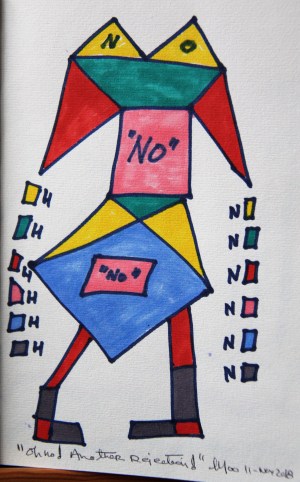
“Oh no, another rejection!”

“And rejection equals dejection, or doesn’t it?”

“Only if you let it get you down. I wait until I am in a foul mood and ready to tear things to pieces because my mean streak is surfacing. Then I go to my rejections pile, re-read the rejection letters, then read again the pieces that have been rejected.”

“Why on earth would you do that?”

“Above all to work out why the work was rejected. What did the editors see that I didn’t? When I write, I wear rose-tinted glasses and all my little babies are the prettiest, the strongest, the fairest in the land, especially when I give them the ‘mirror, mirror on the wall’ test.”

“I’ve never heard of that.”

“It’s simple: you look in the mirror and ask ‘Who’s the fairest writer of all?’ and the mirror answers ‘Why, you are, of course.’ If you believe that, and as writers, we often do, then rejection becomes a hard realistic rock, shattering both Ego and Id. The immediate response is to deny the editor’s taste and judgement. It is amazing how many stupid, dumb, and uncultured editors there are out there. They hate us and don’t understand us.”

“That’s true.”

“No it isn’t. The fault, dear Brutus, lies in ourselves, not in our editors, that we are not great writers. Understand that, and you have a chance to succeed and to improve. Re-reading allows me to try and understand what went wrong, why the mirror lied, how the rose-tinted glasses distorted the actuality of the written page. Understand the other and how the other perceives what and how you write and maybe, just maybe, you can condition yourself to improve. Many budding writers are dropped on stony ground and fall by the wayside. Others land in the desert and their things of beauty bloom where nobody sees them. Some fall on seemingly fertile ground and earn an immediate immortality that fades in a season when the fad wears off. A few writers, an occasional few, go back to the drawing board and water their flowers with the sweat of their brow. Eventually, if they are lucky, their work may be accepted.”

“You always preach the bus story, Julius.”

“Of course I do. Get off the bus early, and you’ll never finish your journey. Remember Sir Walter Raleigh: ‘it’s not the beginning, but the continuing of the same until it be thoroughly finished that yieldeth the true glory.’ He didn’t sail the Golden Hind around the word by setting up house in Cadiz and living in luxury on a beach in the south of Spain. He continued on and on, always forward, until he arrived back in his home port.”

“So we must just keep going, then?”

“Of course. But never blindly. Take criticism to heart, remembering that it comes from another’s heart. Learn from your mistakes. Correct them when you find them. Never give up.”

“You’re always happy, Julius. I bet you never get rejected.”

“Oh I do, Brutus, I do. And each rejection is a dagger to the heart. But I keep going. For example, last week I received my fifteenth consecutive rejection. So much work, so much genius, and all denied.”

“But you’re still smiling.”

“Indeed I am. I have just received my second acceptance in two days. I no longer feel betrayed by my editors.”

“I’ll never betray you, Julius.”

“You will, Brutus, you will. Never fear, et tu, Brute.”

Anniversary

Empress 048


Anniversary

Kicked him out, she did, just like that. Told him to sleep in the spare bedroom. She couldn’t take it any more. She couldn’t sleep. He had to go.  It was the diuretic that did it, mind, the diuretic.

After the radiation treatment, they gave him hormone injections, told him he’d put on ten to fifteen per cent of his current body weight, but not to worry. It was quite natural. It was the hormones, see?

He stood on the bathroom scales without a care in his heart. Watched his weight rise, five per cent, ten per cent, fifteen per cent. When he reached twenty per cent, he started to worry. Swollen ankles. Swollen knees.

At twenty-five per cent, he was really worried. Socks no longer fitted. Couldn’t put on his shoes. Couldn’t bend to tie his laces. Had to wear sandals and slip-ons.

At thirty per cent, he started to cry. He was ugly, so ugly. He was down to one pair of shoes and one pair of sandals that fitted. He went to the pharmacy. The pharmacist took one look at his feet and gave him a long list of Latin names. Told him he’d need a perscription, from his doctor, to get pressure socks, and medical shoes that would help him walk.

“It’s the feet, see, the feet. Once they start to swell, you’re in big trouble. There’s nothing we can do. Go see your doctor.”

“I’ve seen the doctor.”

“Go see him again.”

So he did. Broke down crying when he entered the surgery.

“I’m down to one pair of shoes. You’ve got to do something, doc.”

So the doctor wrote him out a perscription for pressure socks, medical shoes, appointment with a psycho-something, attendance at a clinic, everything he wanted. Then, just as he was about to leave, the doc stopped him.

“Hang on a sec,” he said. Sat at the desk. Checked the computer. Wrote out another perscription. “New tablets,” he said. “Take these yellow ones. Stop taking those brown ones.”

He went away happy. Stopped at the pharmacy. Got the new pills. Went home. Took them. And straight away started to pee. He peed all day and he peed all night. Every 15 minutes. That’s when his missus kicked him out of bed.

“Go,” she said. “Every fifteen minutes. I can’t stand it.”

So he went. Grabbed his faithful Teddy Bear and went to the spare room with its cold, lonely bed. Except he had his Ted.

Lost four pound that first night. Twelve pound the first week. Twenty pound the first month. God, he felt good.  Tried to get back to his own bed. Missus wouldn’t let him in.

“Go sleep with your Teddy,” she said. So he did.

He’s looking pretty good now. Back down to ten per cent body weight up. Says he can live with that. Likes sleeping with his Teddy. Says it doesn’t snore. Or kick. Or punch him. Unlike his missus. It’s the first anniversary next week. He says he and his Teddy are doing fine. They’re going to have a Teddy Bears Picnic to celebrate.

No, sorry, I don’t know what his missus thinks about that.

Show Don’t Tell

IMG_0141.JPG


A barber shop quartet, four of them, singing in unison, spring birds at a feeder, early morning sparrows at a jug of milk, abandoned by the milkman on the doorstep.

Except they were none of that. How could they be? They were four brothers, torn apart at birth. They never knew each other, never sang together, never embraced each other, never held each other in their arms. How could they have done so? The first one was stillborn. The second one survived for a while, but struggled to live, succumbed, and drifted away. The third one lived, marked for life by the scars on his forehead where they dragged him from the womb. The fourth one stopped struggling in the seventh month, but the mother carried him to term, even though she knew he was dead.

She carried them, blessed them, gave them all names, and buried three of them. They were her babies and she never got over their loss. Oh, she survived physically, but mentally she was destroyed.

The priests wanted to know what sins she had committed for God to be so angry with her that He destroyed the fruit of her womb. She had no answer. Some refused to bless her. Others ignored her completely. A few used her sorrows to drag the survivor into the tangled web of the church. “He has been spared. He will be one of us,” they said, and rejoiced at the potential strengthening of their celibate ranks.

Three of her children were ever before her. But the fourth lodged like an albatross on her shoulders and hung like a crucifix round her neck. She could never see him clearly. How could she? He was rarely before her eyes, never in the range of her sight. She tried to mold him like putty, but like water or sand, he slipped through her fingers.

Her husband hated him. Was he the father? It’s a wise man knows his father, or his son. Yet they looked alike. But no, they never thought alike, or walked alike. Nor moved in the same circles.

The father, a gambler, had borrowed a large sum of money and placed it with a bookie, betting that this third son would never live and that his death would make his father’s fortune, if the child was indeed a product of the seed his father deposited in his wife’s child bank.

The father lost his bet. The son lived. The father hated him every day of his life.  A rich man he would have been, if … if only … and the scars of that lost bet raged ragged on his face as the father cursed the doctor who had pulled his  son, if he was his son, alive and struggling from the womb.

If he was his son … a strong man, magnificently muscled , it was not his fault, never his fault, it was the fault of that worthless woman, the woman who had carried his seed, if it was his seed, the woman who carried his other three sons, and never brought them alive into this world …

The ostrich sees danger, and buries his head in the sand. The son sees danger and learns to run. The wife sees danger and  learns to suffer, to be beaten, to be abused, to be the victim because yes, she is filled with guilt, and how could it be otherwise, when the spirit is willing and the flesh is weak, so weak that it cannot give birth and eventually takes to the black holes of victimization, of alcoholism, and eventually of oblivion.

And the son learned to hide, to make himself invisible, never to be there, never to accept responsibility, never to sit at the desk when the buck was about to stop anywhere nearby, never to be blamed … never to turn down the solace to be found in the darkest depths of those same bottles that finally destroyed the woman he loved, who was also his mother.

Instructor’s Comments:

Rewrite.
Next time, show don’t tell.
Minimally acceptable.

D