Do lazy days make you feel rested or unproductive?

Daily writing prompt
Do lazy days make you feel rested or unproductive?

Do lazy days make you feel rested or unproductive?

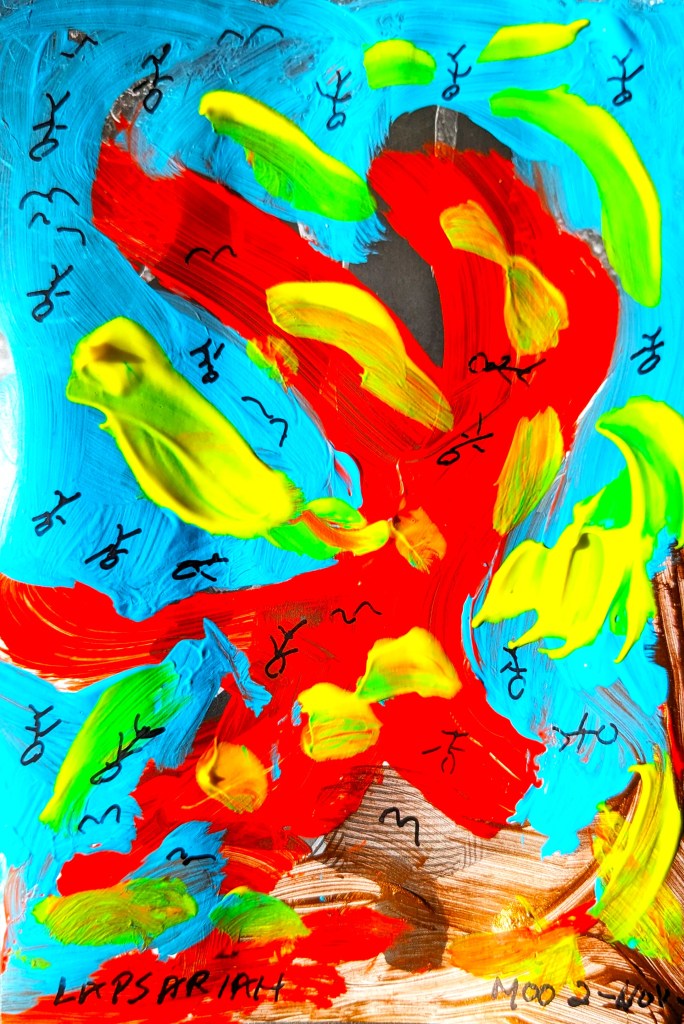
How on earth do you define a lazy day? If a Lazy Boy is a chair, what is a Lazy Day? Is it something like a Lazy Rocker? Or a Lazy Twister? ‘Come on, let’s twist again’! Is it no more than a lazy, hazy, crazy day of summer, as the song would have it? In which case, is it possible to have a lazy day when summer has gone, the days grow cold, and autumn is on the way? And who is having the lazy day, anyway? And is that a lazy painting I see before my eyes?

Enjoying retirement, as I am, busy or not, I feel quite rested, most of the time. As for being productive or unproductive, well! I feel productive when I post an answer to a blog prompt. So today, I am being productive. Ipso facto, I suppose I am not being lazy, though the sun is shining outside, the leaves are actually staying on the trees, after the overnight frost, and are not hurrying and scurrying and busying themselves in falling to to the ground. It’s a lazy leaf day – they are definitely not being productive. If they were, they would be littering the yard for me to tidy them up and then they would be productive by making me labour, and I would not be having a lazy day, because I would be busy picking up the leaves, putting them into piles, then waiting for the busybody wind to stop being lazy and to interfere with my work and scatter leaves around the garden again.

So, back to the original prompt – Do lazy days make you feel rested or unproductive? Let us give a totally non-committal, political answer – after all, it is the election season – and say – “It depends”. It depends on the multiple meanings of a lazy day, rested, productive, or unproductive. If the hen doesn’t lay an egg, is she being lazy and unproductive? Or does she feel fulfilled and rested? I could ask any one of the dozen or so eggs I keep resting in the fridge. Oh boy, do they have a restful time, lying there, eggs-in-waiting. And what are they waiting for? That joyous moment when they appear in public, are cracked open and whisked into omelets or scrambled like the brain – rested, rusted, busy, productive or unproductive – of anyone so twisted that they would write anything like this in response to a simple prompt. A simple prompt, you say? Now that’s a great departure point – what do you mean by a simple prompt? Answers on an egg-shell fragment please!

Ah yes, it’s another busy, productive day and my scrambled brains, like the scrambled eggs I devoured for breakfast, are all as busy as little bees can be, even though the bees are now out of season and there are none left in the garden. And with that I bid you farewell, au revoir, or is it adieu? I’m too lazy to care? Please choose whichever buzz word suits you best!
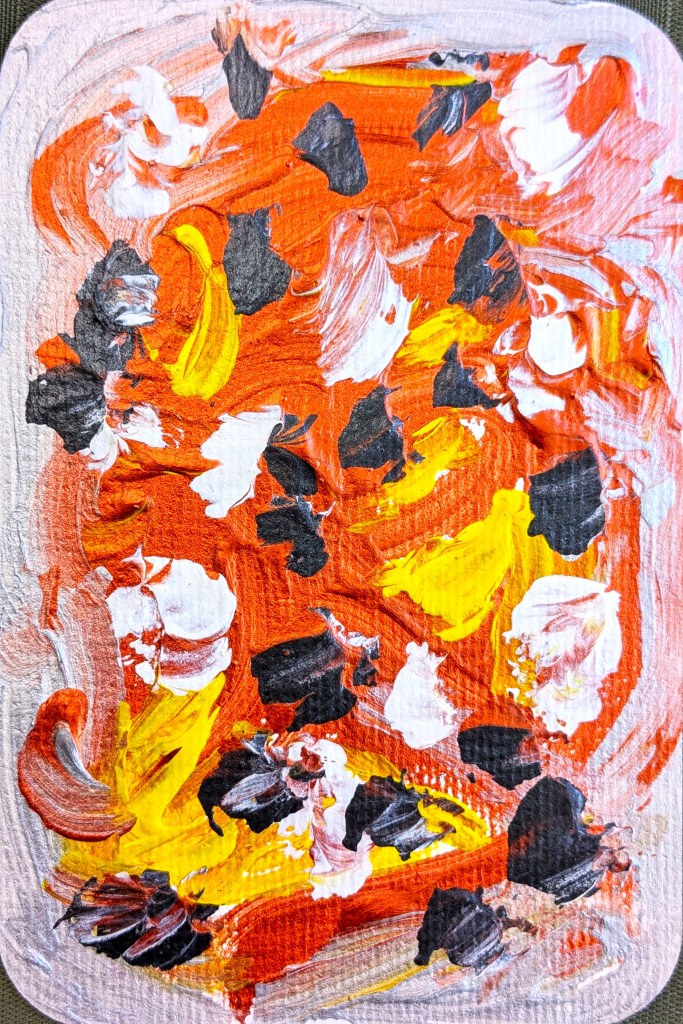
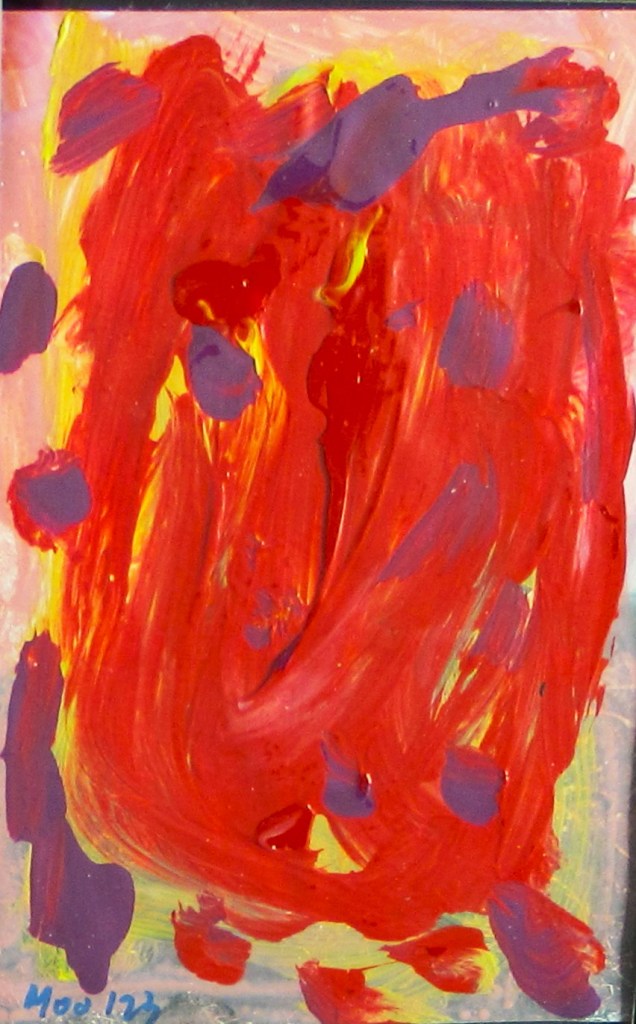
A Touch of Frost

A Touch of Frost

1

Cooler nights
have brought
a touch of frost
to higher ground.

At night,
temperatures fall.
By day,
they build.

I watch as Autumn,
finger on lips,
tiptoes
through the garden.

2

With a wave of its wand,
winter threatens.

A gust of wind
swirls the leaves,
bears tufts of snow
dancing round the tree.

I watch
as my grandchild grows,
my child grows older.

She has a gentle
touch of frost,
a grey fringe
at the curl’s roots.

When I glance
in the mirror,
I see the full effects –
drifts of snow
gathered on my head.

I look
at my beloved.
Her hair –
a crab apple tree
in full spring bloom.

Comment:
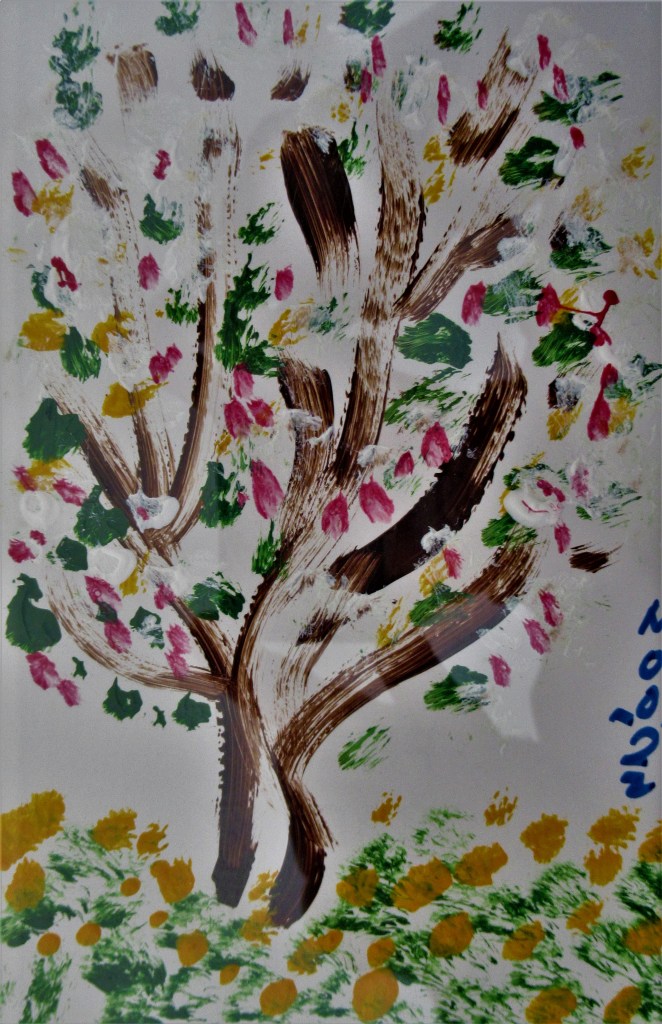
Nice to add a new poem of my own to this poetry page. Today’s poem came as a result of discovering Moo’s painting – A Touch of Frost. Painting and poem, painter and poet – a great collaboration.

Share what you know about the year you were born.

Daily writing prompt
Share what you know about the year you were born.

Share what you know about the year you were born.

How much does anyone know about the year when they were born? When do childhood memories begin? What do we really know about those early days, those first surroundings, the family, the friends? I only know what I have been told – and not all of it is pleasant. Here for example is the song my grandfather used to sing to me when I was a very young child.

“I’ll never forget the day, the day that you were born.
They took you to your father and he looked at you with scorn.
Said he, ‘if that’s his face, the best thing you can do,
is stick a tail the other end and take him to the zoo.'”

I don’t remember what I looked like, acted like, or sounded like. I don’t remember much at all. But I have never forgotten that song with its innate cruelty. Oh yes, people laughed and pointed. Maybe you did too. But is it really funny? And what if your only childhood memory is a sense of being unwanted, rejected, left on the shelf, sent to the zoo… ? “Little boys should be seen and not heard.” Another piece of wisdom from the ancients.

Mind you, I have heard stories, and written them. Here’s one.

The Stork

My story almost didn’t begin in Number One, the first house that I recall from Gower, Wales. My mother gave life to me, a very long time ago, in the middle of a frost-bound winter in that land now distant in time and space. Yet begin it did just as the clock struck eight, that Sunday evening, in January, mis Iawnor. I know this is meant to be my story but the beginnings are swathed in a misty past that tells of a lack of awareness, a search for the meaning of shape, color, and form, the realization, however slow, of the need for language, words, a map, a direction, a slow growth of the seed from baby hood to boyhood, to manhood, and beyond.
 My parents told me I was flown in by a meandering stork that just happened to pass by our house at eight o’clock that night. I don’t remember much about the flight, although I have always dreamed of tumbling through that sky-blue air, only to be trapped at the last moment, my hips and legs caught in a vice that squeezed and squeezed until I could no longer breathe. This nightmare haunted me for years. All through my childhood, I climbed through ever narrowing tunnels and caves until I was trapped, struggling, suffocating, trying to get out. Many times, I would wake myself up with my own panicked screams. The twin holes in my temples, marks made by the doctor’s forceps, remind me to this day of the last stages of that journey.

Our dog, a black Labrador called Paddy, after St. Patrick, of course, and all the Paddies who worked the Paddy fields in Ireland and Wales, had been exiled to a neighbor’s house until after … after what? After the delivery? Were they afraid the dog might frighten away the stork? Who knows what they thought back then? In Galicia they still throw stones at storks to keep them from bringing babies to houses. It’s cheaper than contraception, which is illegal there anyway. When the clock struck eight, Paddy, curious and maybe jealous, turned herself into a stone, threw herself through the neighbour’s front bay window, and rushed home barking. The stork, scared by the noise, dropped me, plop, right down the chimney, and when the doctor held me upside down by the heels and slapped me, I started to scream.
How do I know all this? I don’t. I merely repeat what I’ve been told. Simpletons at heart, poets and babies believe so many things, myths and legends, fairy tales, tall stories, the stories of storks … can you tell talk from mutter, or Stork* from Butter as the TV ads used to ask? I know I can’t. But this is my tale to tell, even though I don’t know how it began (Alpha) nor how it will end (Omega). So many mysteries hide behind thick curtains of mist that conceal both the future and the dimly remembered past, a past that we often reconstruct while calling it ‘memory’.

*Stork: a brand of margarine that the tv ads said “tasted just like butter”. Hence: “Can you tell Stork from butter?”

My Knapsack

My Knapsack

Throughout my childhood,
I carried a knapsack on my back.
Into it I stuffed my darkest secrets.
Along with all my dirty washing
they filled every cranny and nook.

Words of hate, carved into my life-slate,
shuffled and cut, but unchanged,
unchangeable, remained engraved
on the tombstone I took from above
 the hole I dug to bury the casket
in which I hid the shards of my heart.

On a rainy day, when push came
to shove, I left my childhood home
to wander the world, alone, on my own.

I walked to the station, boarded a train
and never went back home again.

At journey’s end, I left my knapsack
and its contents in the luggage rack.
I never want to see them again.

Comment:
“Pack up your troubles in your old kit bag, and smile, smile, smile.” My maternal grandfather used to sing me this song from WWI. “While you’ve a Lucifer to light you fag, smile, boys, that’s the style.” I wonder how many people now remember what a Lucifer is, let alone a ‘fag’, in that sense of the word. It has, of course, morphed into many other meanings, some of them not necessarily pleasant. I remember my grandfather, standing in the kitchen, before the coal fire, and saying “I remember when Wills’ Woodbines were a penny a packet.” Wills’ is still with us, but may not be for much longer. I can’t remember when I last saw a Woodbine. I certainly never smoked one, in fact, I never ever smoked at all. But as for that kit bag aka knapsack aka backpack aka rucksack, well, put all your troubles in it, tie them up tight, and take it somewhere safe where you can leave it and forget about it, and then start life again. “Good-bye old friend, I am on the mend. And that’s the end.”

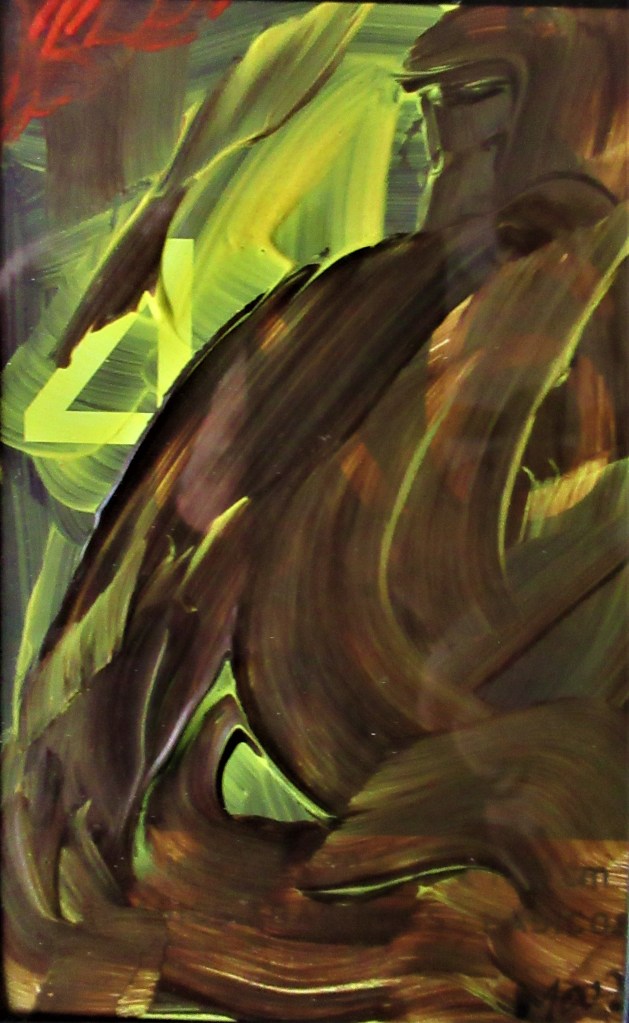
As for the painting, by my good friend Moo, that shows The Fall – Pre-Lapsarian / Post-Lapsarian – when all the devils, demons, and black angels were tumbled out of Paradise and abandoned to the depths below, where, alas, they still roam. So, if you meet any of them along the way, shove them in that old kit bag and get rid of them too. You’ll feel much better afterwards.

On Writing Poetry

On Writing Poetry

I sit here writing poetry
and, head in hands, I cry
at all the things I’ve left unsaid,
and then I wonder why
I wasted so much time on things
that perished before my eye.

Outside the night is dark and cold
and shadows flit and filter by.
I know that I am growing old,
that soon my story will be told,
and when it ends, I’ll die.

I know that death is not the end,
yet I do not want to die.
I want to paint the autumn trees,
the clouds that float on high,
with evening lights that stain the sky.

But rhyming is not all I do.
I’ often write in prose, with words
that wound and sow dark seeds
that root and flourish, grow like weeds,
and nourish other people’s needs.

Alas, I know not what I do,
nor yet what I have done,
nor when, nor where, the seeds
were sown, nor if they aided anyone
to turn away from the dark inside
and walk in the light of the sun.

What will your life be like in three years?

Daily writing prompt
What will your life be like in three years?

What will your life be like in three years?
Well now, that depends on several things. I love the fall. Who doesn’t love the fall in New Brunswick? The trees changing color, warm by day and cool at night, then the leaves falling off the trees and blowing here and there with the wind. I stood in the garage yesterday and listened as the north wind herded rustling, complaining Maple leaves down the roadway past my house. The sound of dry leaves bouncing and skittering. Pure fall magic.

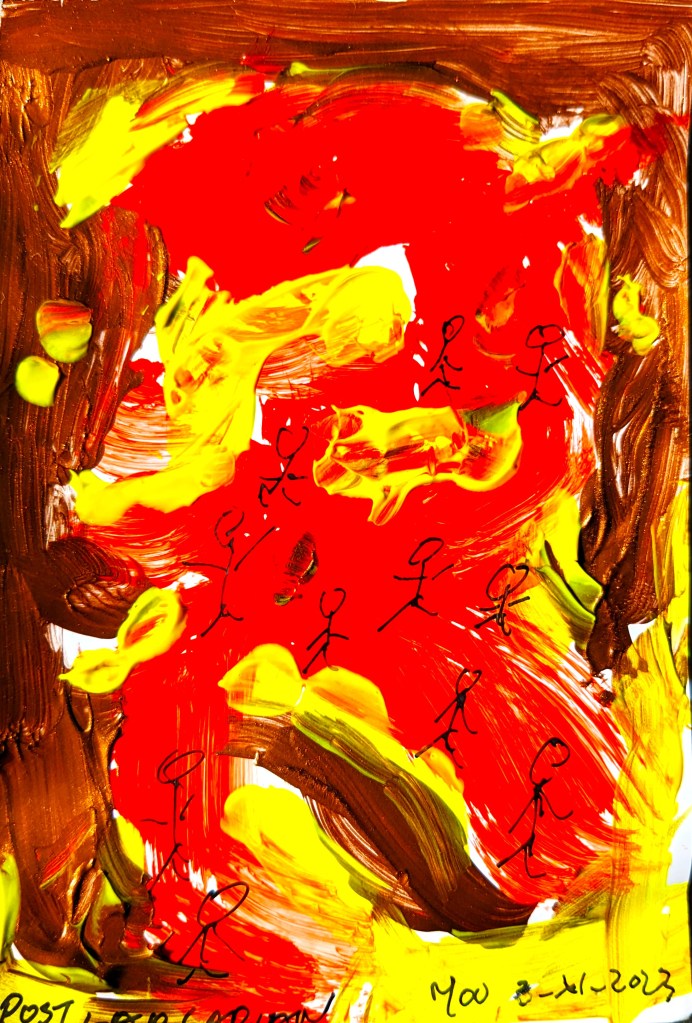
But when I fell on Thursday night, it was a different kind of fall. One moment I was a tree, standing free on my own two feet, the next I was a sawn-off log, tumbled to the ground. When trees fall, they often bleed bark or sawdust, if they are sawed. I just bled blood. On the floor boards, on the carpet, on my shirt. I had just painted the painting above – Prelapsarian – and there I was, lying on the floor, having fallen myself.

And there I lay, fulfilling my own prophecy – Postlapsarian – lying bleeding on the ground. The fall was stunning and I was stunned. I managed first to roll over onto my tummy. Next I managed to get into the push-up position and from there I was able to draw my knees up. Kneeling, I reached out to the spare bed and started to try and haul myself to my feet. But I was spent and exhausted and drained.

I called out and Clare, dear woman, came to my rescue. She helped me to my feet, staunched the bleeding, mopped up the floor, and the carpets, and me. Then she went to the medical chest and bandaged me up so I would heal and wouldn’t bleed all over the bed and my pajamas. What a mess. What a bloody mess – and no, I am not swearing, I am only telling you what I saw. Blood everywhere.

So, what will my life be like in three years? I hesitate to think about it. Maybe I’ll be in a garden somewhere, helping the trees to grow their leaves, so that the life cycle may continue. And maybe not. Right now, I feel very, very fragile. I just don’t want to think beyond the current moment.

Rites of Passage

Rites of Passage

Summer slid silently away. Autumn’s
harvest is upon us. Slowly the mountain ash
is stripped of its fruit, from top to bottom.

Robins flit from branch to branch until
the whole tree shakes with bouncing birds
pouncing on the few remaining berries.

Berries gone now. Leaves will soon follow.
The Farmer’s Almanac forecasts a long, cold
winter, filled with wind, ice, and snow.

All too soon, the deer will appear, ghosting
their silent steps at wood’s edge. They’ll arrive
at dusk and wander all night, just to keep warm.

At dawn, they’ll leave, having exercised their
ancient rites of passage, the routes engraved
in their racial memory since the dawn of time.

When my time is up, I too shall follow them
into the lonely silence of that long, wintry night.
Restless, or at peace, I’ll hope for dawn’s light.

September Song

September Song

In the gathering autumn shadows
summer flares as bright as the berries
adorning the Mountain Ash.

Beads of blood,
they hold late evening light,
as do the Black-eyed Susans
growing wild beneath my window.

Rain wet, wind swept some nights,
yet still they glow
with their bottled sunshine.

Fairy lights, Christmas garlands,
ash rosaries will circle another tree,
enlightening wrapped presents,
lighting up the vacant crib
waiting for that little child,
soon to be still-born.

Comment: Poetry is where you find it. The inspiration for today’s poem came from the Poem of the Week in The Guardian. Inspiration, I found it in two places – 1. the photograph at the head of this blog and 2. in the analysis of the poem, not in the poem itself. The twilight of this autumn world is indeed wonderful.

Magician

Magician

I stand on a tiny platform, high above
the upturned faces of the clamouring crowd.
Before me, the high-wire stretches across
the diameter of the circus tent.

Clad in the enormous shoes of a clumsy clown,
I grip the wire with the toes of one foot.
Now I must choose – umbrella or pole?

The spotlight outlines my face’s whiteness,
the bulbous nose, the fixed, painted smile.
My jaws clamp tight in concentration.

Clutching the brolly, a good old gamp, I walk
the thin wire plank of my current destiny.
One step, two steps, tickle you under the chin,
and I pretend to fall, grasp the wire, and raised
by the crowd’s gasp of despair, swing back up.

Then, a yard from the finish line, I swallow dive,
turn a somersault in the air, and land on my back
in the middle of the safety net as the crowd goes wild.

“The magician works on the threshold that runs between light and dark, visible and invisible.” John O’Donohue, Anam Cara, p. 145.

“The most difficult role in the play is that of the fool – for he who would play the fool must never be one.” Don Quixote.

Painting: Fire Sky by Moo.

Challenge

Challenge

What is the biggest challenge you will face in the next six months?

The months change but the challenge never does. How does one stay alive? How does one survive? How does one pass the time from one minute to the next, one hour to the next, one day to the next, one week to the the next, and one month to the next?

I faced a challenge this morning. I got to the shop and could not climb over the piled up ice to reach the slippery step that led to the salted sidewalk that led to the shop’s entrance. Fortunately a kind young man took my arm, and helped me upwards, onto the sidewalk. He waited while I shopped and brought me back down to the car, arm in arm, and carrying my shopping. I gave him a poetry book, Septets for the End of Time, as a reward.

What will be the next big challenge? I honestly don’t know. Starting the snow blower at -20C, perhaps? Blowing the snow and avoiding a slip, a fall, a sit down on a snow bank from which I cannot get up? Who knows? I don’t. I need more medicine – will my biggest challenge be finding that the pharmacy has again run low on my medication and I have to wait for my renewals? I have just had a blood test – three months late – and I don’t know what the results will be? Will that be my biggest challenge – coming face to face with a negative result that demands more action? I just don’t know. Driving out the other day, I met a speeding car on my side of the road, in my lane, coming straight towards me. The driver was staring at his cell phone, one hand on the wheel, eyes down, concentrating on something that certainly wasn’t the road. I swerved aside, towards the snow bank, honked the horn, and he looked up, eyes wide with shock, and swerved away. Brown trouser time, I guess, for that unfortunate individual.

It would be so nice to have a smart answer. My biggest challenge will be to find a solution to the chess problem that has puzzled me for years – how to defend Queen side openings when Black. My biggest challenge will be to draw the cards for a perfect hand of cribbage. My biggest challenge will be to pay the grocery bills as the prices rise. My biggest challenge will be to pay the dentist’s bills when I have no dental coverage and the savings dwindle every month. My biggest challenge will be how to avoid the pain in my teeth now that I can no longer afford the dentist. My biggest challenge will be to crawl to the telephone and get help if I manage to fall in the kitchen and cannot get up.

So, what is my greatest challenge over the next six months? Living from day to day, without falling downstairs and killing myself – how about that for an answer?