Carved In Stone

Carved in Stone

Brief Introduction

“Poetry explains itself. If it doesn’t, it’s inexplicable.” Pedro Salinas.

I entered this collection of poems for the Alfred G. Bailey Awad (poetry manuscript), WFNB, 2025. Alas, it did not win an award, but the judge, Kathy Mac, made some excellent suggestions as to how I might improve the manuscript. I have followed her advice to the best of my ability.

Carved in Stone is the second dialog (Chronotopos II) in my Bakhtinian Dialogs with my time and my place. Clepsydra, Chronotopos I, won third place in the Bailey Award (2025) and has already been published. I have one, possibly two, more Dialogs planned.

Reception Theory – I write, you read. Any meaning that you extract from my poetry will depend on your own culture and background. Tolle, Lege – Take and read. Read slowly, and with care.

I am a poet, a dreamer, if you will. These are my dreams. When you enter my world, you mingle your dreams with mine. The result, I hope, will be an interesting intellectual blend of new creativity. Pax amorque.

1

Behold me here,
filled with a sort of shallow,
hollowed-out wisdom
accumulated over decades
while listening with my eyes
to the words and thoughts
of writers, long-dead.

Imprisoned in book pages,
do they bang their heads
against walls that bind,
or hammer with their fists
at the barred lines
of their printed cages?

These spirits long to break free,
but they choke on library dust
and pollen from verbal flowers
that bloom unseen.

Those old ones avoided
the traps of temporal power,
or, once trapped,
gnawed off a precious limb
to limp into freedom.

Comment:
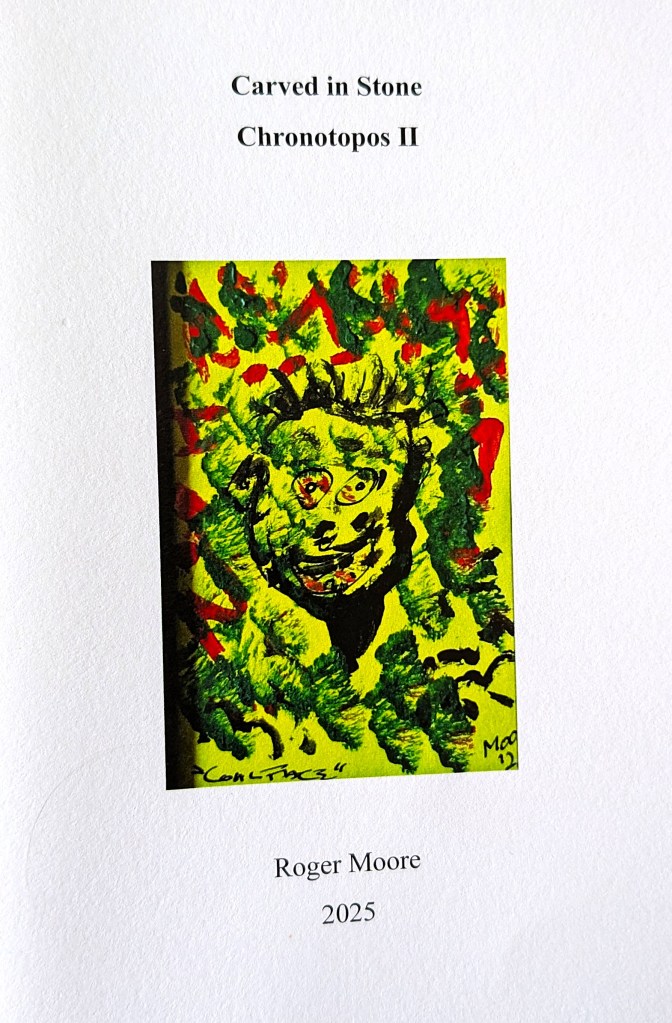
The cover painting, painted for me by my friend Moo when he read the manuscript of this book, is called Coal Face. It refers to the young Welsh boys in the Rhondda coal fields, aged 8-12 years old, who went down the mines to work at the coal face. This happened when the coal seams grew thin and only small children had the ability to work at the coal face and carve and mine the coal. Here are the relevant verses (44 – 45).

44

The old man, withered,
last house on the left,
leaning on his garden wall,
coughing, spitting up
coal dust and blood.

He’s not old, when you get close,
just grown old, underground,
where emphysema
and pneumoconiosis
devour men and boys.

He spits on the side walk.
Mining souvenirs,
Max Boyce calls them,
and they appear
every time the young man,
turned suddenly old,
starts to cough.

He can’t walk far,
wearing carpet slippers,
soft and furry,
just leans on the wall.

He fell, or was pushed,
into the trap at an early age,
when the coal seams
had grown so thin,
that only a small boy
could kneel at the coal face
before the black altar
of the underground god.

There, with a pick and shovel
he learned to carve and shape
those seams.

45

No candles burned at that altar.
A single match, let alone
a candle flame,
would spell the end,
if gas leaked from the seam.

Only the canaries,
confined in their cages,
sang songs.

Doomed,
like the blind pit ponies,
never to see the light of day,
they lived out their lives
down there.

So many died underground,
unable to get out,
buried alive,
before they were even dead.

Clepsydra

Clepsydra

WFNB 2025 BAILEY PRIZE: 3rd Place
Citation

Clepsydra relates a process of identity loss, as time’s passing removes the people closest to the eroding narrator. Its consistent form – the manuscript is one long poem made up of 48 sections of varying length, each of which begins and ends with an ellipsis – provides a framework in which the narrator strives to describe how their sense of self drains away, drop by drop, the way the liquid in a clepsydra (a water clock) marks the passing of time. Amazingly, the poems convey existential dread through remarkably vivid and grounded images of things like “seals basking in sunshine, / knowing themselves, being themselves, / thinking themselves safe, / kings and queens of their seal-dom, / never questioning” (19) and “…an osprey, sudden, the swoop, / turned into a stoop, water shattered, total immersion, then emerging, / lusty thrust of wings, claws clasping, / prey imprisoned” (20). Sense slides in and around the sounds of the words as well as in their dictionary meanings. In Clepsydra the author rigorously plumbs a difficult subject: the loss of subjectivity.

Exhortation

Thank you for the privilege of reading your poetry manuscript, Clepsydra. I was quite taken with all of its virtues: a meaningful concept, carried out in an impressive form which is followed both rigorously and nimbly in each section.

Introduction

     The National Museum of Wales, in Cardiff, had a working Clepsydra that fascinated me. School children could enter free, and every week day, during the school holidays, I would visit the museum and also the Clepsydra.

     I have built the structure of the Clepsydra into the verses of this book. The words flow down, from left to right, just like the waters of the Clepsydra. Sometimes they overflow the line, and sometimes they hold back, just a little. This visual construction fortifies the idea of the ebb and flow of time, water, and memories.

     I first met the poetic image of the Clepsydra in the poetry of Antonio Machado – No temas. Tú no verás caer la última gota que en la clepsidra tiembla. / Never fear. You will not see the fall of the last waterdrop that trembles in the clepsydra. I have, for better or for worse, repeated this theme throughout the poetic dialog.

     I would like to thank the judge, the poet Kathy Mac, for her comments and her excellent suggestions. I have followed most of them in this revision of the original manuscript. My thanks go to all who have read Clepsydra at one time or another.

Clepsydra

1

… time, and my own place
     not this dry museum
          filled with dust

its ghosts, running rampant,
     raging silent
          over ancient artefacts

the clepsydra dreaming
     time like its liquid
          slipping
               through clay fingers
 
runnels of water
     ebbing flowing
          continually running down

earthen-throated
     its hour glass structure
         
each terracotta bowl
     lower than the one before
   
a mini-cataract
      a constant waterfall
            second by second
                    time dwindling away…

Fall Foliage

Fall Folly Age

Fall Folly Age aka Fall Foliage is a play on words.
Thank you, Moo, my painter friend, for putting this title
on your painting and allowing me to use it for one of my book covers.

After intense heat
the garden is dusty dry.
The hollyhocks,
stressed out,
bow their heads
and tumble down.

Before the heat,
heavy rain drenched
the flowerbeds.
The yucca subsided
beneath waves of water.

One hollyhock,
regally proud,
stored so much liquid
in its flowery crown
that it bent and broke.

The mountain ash
bears a host of berries.
Bright orange,
they are already turning
to their winter shades.

I see so much stress
in the little world
I inhabit.
I no longer listen
to the news
or watch TV.

So much is beyond
my control.
Yet I can control
the radio and the TV
by turning them off.

The friends I meet
now have white hair.
Like me and my flowers,
they are dried up
and bent, held up
by sticks and canes.

My beloved and I
are growing old together.
We watch each other
with great care
wondering who
will be the first
to topple and fall.

Comment:

It has been a long, long time since I last wrote on my blog. Many things have distracted me, including editing books for friends, working on my own books, journaling, painting, and surfing the web in search of something positive to read. As for my own books, I published four this summer. Clepsydra Chronotopos I, Carved in StoneChronotopos II, Rage RageChronotopos III, and No Dominion Chronotopos IV. Maybe I will try to post on a regular basis and copy some of those poems here, in my blog.

The End of Time

The End of Time

A thin violin crying
its cat-gut heart out
in tears of sound, falling,
rhythmic raindrops,
down a grey-streaked face
tight with stress and taut with pain.

Such concentration,
such soulfulness packed
into each mindful note.

An audience of one,
I sit, head bowed, meditating
on the meaning of meaning
and the nothingness
of a being condemned
to oblivion, yet oblivious
of the how and when.

Each note a hammer-blow,
then, the piano pounding nail
after nail into this living coffin,
this body I drag through the motions
of extracting meaning
from this meaningless life.

Comment:

The End of Time is the second poem in the first sequence (Crystal Liturgy) of Septets for the End of Time. The painting, by my friend Moo, expresses his impressions of the nature of the end – but he doesn’t tell me the end of what. Certainly not of our friendship, I hope.

I am always worried by those last two lines: extracting meaning from this meaningless life as I don’t think that life is meaningless. However, there are times when it certainly feels that way. Those are the times when we need our beliefs in truth and the purity of art to survive. But how do you define them, you ask me. In all honesty, I don’t. I can’t. Art changes. What we consider to be true changes. Relativism? Yes, to a certain extent. I know what I believe. I don’t know what you believe. But I would never try to inflict or enforce my beliefs on to you. That is not how I work.

As for Moo, I don’t know how his mind works. I think he just sees things in color and shape and in the creation of movement within the stillness of a two dimensional illusion. I also think he thinks like a child. Maybe, like me, he has entered his second childhood, though I don’t really remember ever having had a first one. Oh dear – the meaning of meaning – one of the great enigmas of this wonderful world in which we live.

Crystal Liturgy

Crystal Liturgy

Here, in the abyss,
where song-birds pluck their notes
and send them, feather-light,
floating through the air,
here, you’ll find no vale of tears,
no fears of shadow-hawks,
for all blackness is abandoned
in the interests of sunlight and song.

Here, the crystal liturgy surges,
upwards from the rejoicing heart,
ever upwards, into the realms of light,
where color and sound alike
brim over with the joy that, yes,
brings release to head and heart.

Here, seven-stringed rainbows reign,
the everlasting harp is tuned and plucked,
and an eternity of music cements
the foundations of earth and sky.

Here, the master musician conducts
his celestial choir, their voices rising,
higher and higher, until they reach
the highest sphere, and song and voice
inspire, then expire, passing from our eyes
and ears into unbounded realms of light.

Here, the seven trumpets will sound
their furious dance, a dance that will announce
the end of this singer, the end of his song,
but never the end of song itself.

Comment:

Crystal Liturgy is the first poem in the first sequence of my poetry book Septets for the End of Time. My friend Moo, the painter, supplies the paintings for the book covers. He and I have decided to hold a dialog on our views of how the painting and the poem relate to each other. Hopefully, we will continue this dialog throughout Septets for the End of Time.

“I have tried to join the ideas of sound, light, song, and voice to the idea of the Platonic Universe, where the planets dance to the music of the spheres. I wrote these poems listening to Messiaen’s Quartet for the End of Time. I allowed the music to flow through me and I responded, in words, to the images that came from the sounds, and the silences, of the music.”

“I see no sorrows here, no woes,” Moo told me. “I only see the the joy of light and existence. The shadows have been dispersed, and my painting contains a generous helping of sunshine and light. I find it very suitable for this particular poem. My painting’s starburst of energy enhances the poem’s sense of movement, strength, and light. It also contains the message that all will be well.”

Where did my mojo go-go?

Where did my mojo go-go?

Wow! My first post since January 8, 2025. What on earth has happened to me? Good question – I just don’t know.

Today’s painting, from the last day of 2024, is taken from The Idylls of the King, Tennyson. “The olde order changeth lest one good custom should corrupt the world.”

This quote is used in my Old Boys magazine at the end of each school year when the students leave the college and go out into the real world. This happened to me in 1962 – 63 years ago. Certainly I changed, and for the better, without the college. Whether the college changed or not, in my absence, I really don’t know. I suppose it did. It became co-educational, quite the thing for a boys’ boarding school. It expanded into larger grounds. It tore down at least two of the old houses, including the one in which I boarded for four years. I read about these things, but I have only been back on one or two occasions, so I don’t really know. And living in Canada, I rarely see any old boys from the school. They don’t cross the pond to visit me.

I receive the old school magazine regularly, by e-mail. However, I no longer recognize faces or places, unless the places are totally unchanged since I was there. And not many of them are. The most important page for me has become the obituaries, and I study with care those who have passed on before me and those who remain. I grieve when I see the names of old friends. But I grieve even more when I see the names of people so much younger than me falling by the wayside.

As for that mojo of mine, well, I guess that writing on a regular basis has become more and more difficult. “Don’t sit with your head in your hands thinking of time past,” says the Spanish poet. Yet time past seems preferable, in many ways, to time future. I am beginning to feel a bit like a pin-cushion, on account of all the needles now being stuck into me. Perhaps that’s where all my mojo went? Still, for anyone interested, I am still here. Still happy. I am working on my latest novel and I have two books of poetry waiting to be published. So maybe my mojo hasn’t done a bunk, just my blog mojo! I shall have to kick start it. Or maybe I’ll get that little yellow duck who wears blue gumboots to stand on a brick and give me a hearty booted boost. Yup! That should do the trick.

And so, in the words of Dylan Thomas, “I’ll take a bow, and say ‘good-bye’ but just for now.

Do you play in your daily life? What does ‘playtime say to you?

Daily writing prompt
Do you play in your daily life? What says “playtime” to you?

Do you play in your daily life? What does ‘playtime say to you?

Poesía de juego y poesía que expresa la autenticidad del ser / poetry as play and poetry that expresses the authenticity of being. For me, poetry is play. However, it is far more than just ‘play‘ – because it is a play that expresses the authenticity of my being.

I write in my journal on a daily basis. As I write, I sometimes spot little gems, thoughts or word clusters that can be turned into poems. For me, playtime is when I start to elaborate the words (signifiers) and turn them into thoughts (signified). The meaning may be the message, but the words that carry the message are the building bricks of the poetry of play which sometimes, with a happy Midas touch, turns into the poetry of gold that expresses the authenticity of who and what I am.

But play is also what I do when I paint. And sometimes I sit beside my mirror image friend, Moo, and paint with him. While Moo is great with colours, he is sometimes at a loss for words. Then I help him by playing with words, shuffling them around, until he finds the title that he wishes for his poems. Sometimes I consult, on Moo’s behalf, with other friends, and they are the ones who join in the game, and settle the dispute by agreeing upon the name that Moo will finally choose for his painting.

But, speaking of painting, there is no play better than the game of making meaning out of color [does it really matter how you spell it? ] and shape while taking a line for a walk and turning it into something playful yet meaningful. Mix and match, and stitch and patch, and then add the lines and title that ease the metamorphosis of color into shape and meaning.

There are other games I play to help fill in the daily gaps that have entered my post-retirement life. Online games of patience, crosswords, chess games with their intricate patterns of red and white or light and dark. Then their [now it does matter how you spell there!!!] are mining games when I dig deep into other people’s poetry and search among the gems of Octavio Paz, Antonio Machado, Dylan Thomas, John O’Donohue, Milton Acorn, Valverde, Quevedo, St. Teresa of Avila, Gongora, Sor Juana, Cervantes, or many other friends, their voices now silences, with whom I speak with my eyes, in order to find something that inspires me to play yet another game – hunt the symbol.

Re-reading Rudyard Kipling is a game too. “Do you like Kipling?” “No, I never Kipple.”And in books like Kim, the great game of life goes on and on, and Kipling’s signifiers (words) turn into a signified (meaning) that is warped by my creative mind and changed into my ideas of a new game in which hunt the symbol turns into the game of Brillig where the slithey troves of new words, fresh words, are reborn into my game-world and emerge from their game-whirled into my own word-play conversation with my own thyme and plaice [or should that be time and place?] And long may Moo and I play that game!

What are your thoughts on the concept of living a very long life?

Daily writing prompt
What are your thoughts on the concept of living a very long life?

What are your thoughts on the concept of living a very long life?

A simplistic question in so many ways as so many definitions are needed. How long is long? 100 years? 200 years? Back to 1066 to watch the Battle of Hastings? 1588 to see the Spanish Armada sailing up the channel? 1815 to see the Battle of Waterloo and talk with Wellington and Napoleon – why not? I am Anglo-Welsh and New Brunswick is bilingual, French and English, so why shouldn’t I – or anyone else who wants to live such a long life – have a talk with both of them?

And does living a very long life include the concept of being healthy, and happy, and wise, and not living in squalor or poverty or in a permanent war zone? How about being kept in an incubator, or an iron lung, or on permanent life support? How long is long under those (or similar) conditions. And what about friends and family? In the Celtic myths, men who visit the fairies in Ireland and live and eat with them, come back to reality [now define that word in this day and age] only to find their friends and families long dead and gone. So what would the conditions of the ‘return’ be like if a long life meant watching the passing of everyone and everything you know or returning to a world you no longer recognized?

And change is so rapid nowadays. AI is developing so quickly, how can anyone keep up? I know that as I slow down (mentally and physically) I understand less and less about the machines I use, including my Nexus Rollator. Does a ‘very long life’ include sipping from the Fountain of Youth? Or does it consist of an enlarged old age – post molestam senectutem, nos habebit humus after a troubled old age, the earth will have us. I am sure we all recognize Gaudeamus igitur, in Latin, and its theme of Ubi sunt qui ante nos in mundo fuerewhere now are those lived in this world before us, and if we don’t, then how swiftly we have forgotten the power of Latin is with its memorable phrases and omnipresent seeds of memento mori .

For me the question is a clear one – do you wish for quantity (a very long life) or quality (a very happy and successful one, even if it is a bit shorter)?

A close friend of mine, one of the most honest and courageous people that I have known, suffering in a horrific way from terminal cancer, asked for, and received, MAID (Medical Assistance In Dying). It was a long legal and medical process to get MAID, involving famiy members, lawyers, doctors, and many other things. As the Romans used to say mors omnia solvit death resolves everything. My friend and his family preferred to shorten life – on their own terms – rather than prolong it under such prolonged suffering and torment. My friend, I salute you and your family and commend you for your bravery.

So, define the terms within which that very long life would be lived – and then ask yourself the question once more. Because as it stands right now, with no further understanding, the answer should only be “depends”. And remember, lives are like swimming pools – they have shallow ends and deep ends. All too often when you talk about life and the end of life, so much depends.

Comment:

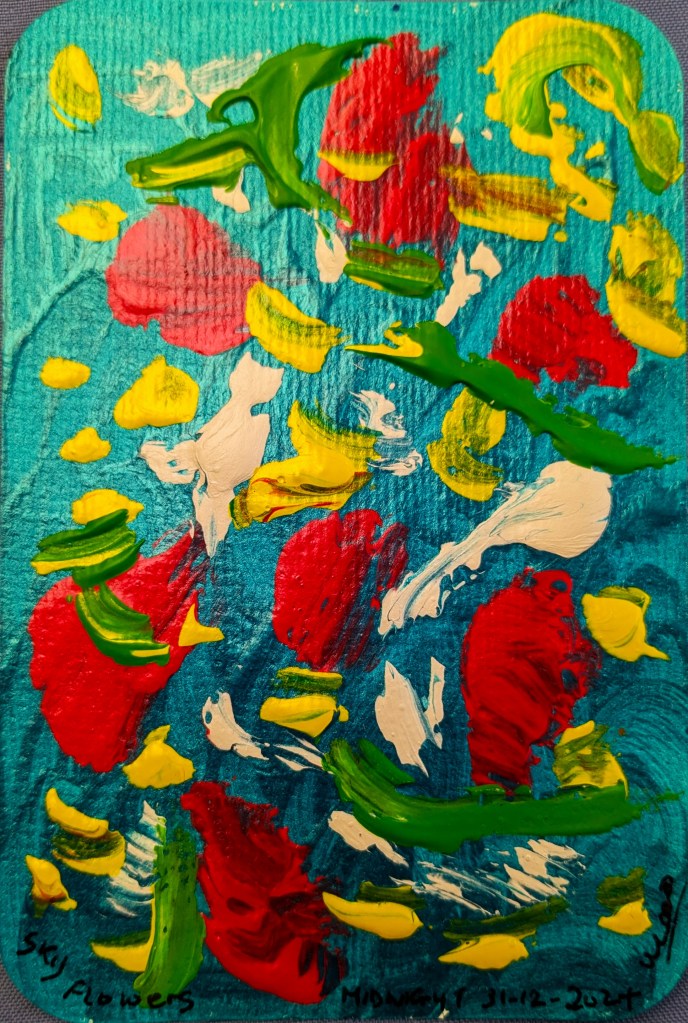
I must thank my friend, Moo, for his depiction of the fireworks from New Year’s Eve. Sky Flowers, he calls it. The fireworks have gone already – but – vis breve, ars longa – his painting still survives.

Poppy Day

Poppy Day

Remembrance Day
11 November 202
4

I wasn’t there
I never saw the gas clouds
            rolling over our positions
            never felt the barbed wire’s bite
            nor the bayonet’s jab

I never hung out my washing
            on the Siegfreid Line
            (“Have you any dirty washing, mother dear?”)
            never broke out of barracks
            never did spud bashing
            nor feasted on bread and water
            nor heard the rifle’s rapid rattle

I wasn’t there
            to see them carried away in carts
            coughing spluttering vomiting
            or bandages over their eyes
            walking slowly to triage a hand on
            the shoulder of the man ahead
            the sighted leading the blind

I wasn’t there
            but both my grandfathers were
            both decorated
            one mentioned in dispatches
            signed by Winston Churchill
            that one uninjured
            the other one gassed
            coughing up his lungs
            bit by bit for forty years

I am here now
    to remember
    and to honor them
           though so much
    has been lost

Comment:
My friend, the painter known as Moo, painted this poppy today. My generation, unless they served voluntarily, as many have done, was never conscripted. As a result, the horrors and tragedies of combat were never known to us, except as seen through they eyes of other people. I think of Wilfred Owen and his magnificent, heart-rending poems from WWI.
Today, I pay tribute to those members of my family who served in the armed forces by land, sea, and air. I also pay tribute to the veterans who survived, and to those who gave their lives in the defense of our country.

What things give you energy?

Daily writing prompt
What things give you energy?

What things give you energy?

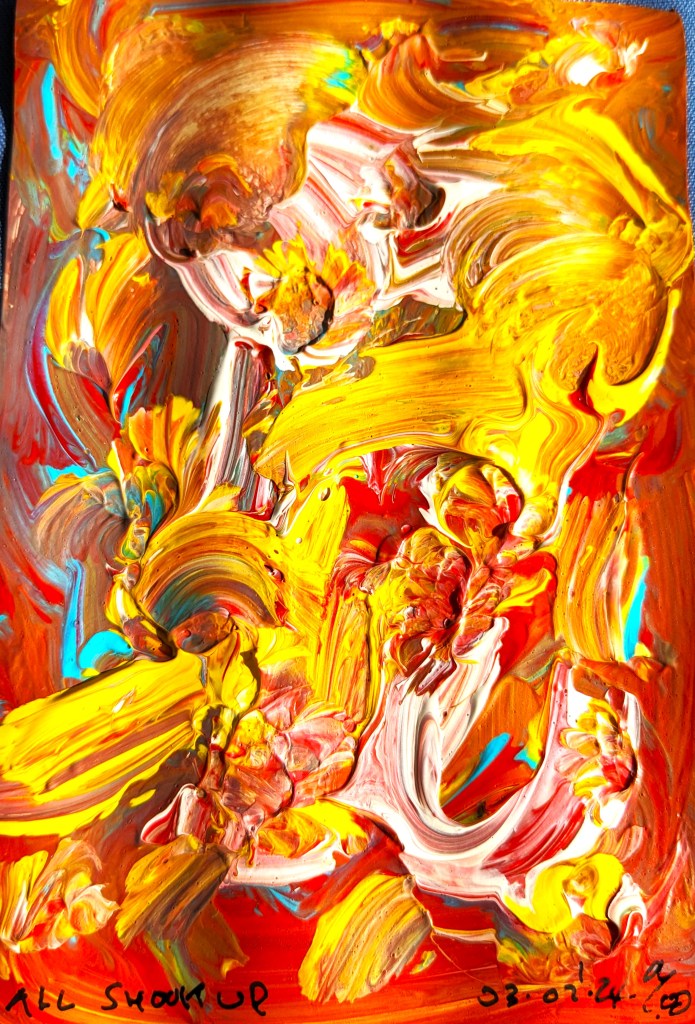
What on earth do you mean by energy? And why should energy be associated with things? For example, today’s painting (above) is by my friend Moo. He calls it Joy to the World. It is indeed a joyous painting, full of light and creative energy. The photo does not do justice to the painting, which sparkles and reaches out to draw the viewer in. We must never underestimate the energy that comes from the creativity and art that creative people put into their art works. It is like bread cast upon the waters – it will return tenfold. The world would be a sad place if we lost our powers of creativity and invention. May we always keep them close by us, and turn to them when the skies are grey – for with our ingenuity and skills we can always turn those grey skies blue again. It just takes time, trust, belief, creativity, and a little bit of energy.

Or is the prompt referring to the energy that comes from food? Vonnegut refers to such energy as comes from the breakfast of champions. Was that really Scott’s Porridge Oats? Certainly used to be – and all those caterwauling bagpipes puffing out their oaten tunes. More foods, please. Cornish Hens and Kedgeree, unzipped bananas, eggs – preferably fresh and free range – boiled, poached, scrambled, fried, or served in various types of omelets … energy from food – oh, I could go on and on and on … caws wedi pobi, cennin a tatwystortilla espanola, paella de mariscos, calamares en su tintachapulines from Oaxaca … food as a source of energy … wow! And who said the foods had to be written in English?

Mind you, an alternate source of energy is the current news cycle. When not a storm in a tea-cup, sugared or un-sugared, it is ferocious and opinionated enough to set people banging their heads against the walls so the pain will come from an alternate source. And noise demands energy – energy in (and also garbage) and energy out (mainly garbage), and all that rage, fury, wind, despair, blather, generated by written, printed, spoken, televised, radio borne waves of noise. We could start a wind farm if we trapped the blatherings of congress, the senate, the houses of parliament.

Meanwhile, we live in a large house, almost a barn really. Some of our friends call it our hacienda. They are the ones who speak no Spanish and can’t pronounce Quevedo correctly, even though I’ve known them for a quarter of a century. Actually, strictly speaking, most of them are ex-friends now. Many went AWOL when I retired and the rest disappeared, fates unknown, during Covid.

That house has an electric furnace that warms us in winter and circulates cool air, in summer, from the basement (cool) to the upstairs bedrooms (warm). We also have a fireplace insert that burns wood. But we only use that in emergencies (power loss during cold weather or storms) or for decoration (the yule log) at Christmas and over the New Year.

A large house means large heating bills. About ten years ago, we installed a wonderful heat pump that serves the whole house. It heats in winter and cools in summer. It also halves (or more) our electricity bills. Most of the house functions on electricity, hydro-electricity from the dam at Mactaquac, just up the road. No coal-fired furnaces for our electric supply. We do, however, have the ability to connect to a petrol-driven generator. But we rarely, if ever use it and that, too, is for emergency use only.

Otherwise, many of the things we use on a daily basis – computers, cell phones – can be battery driven (when the power fails) and those batteries can be charged in the car (during emergencies) or from reserved chargers hidden away. The car itself is a normal gas engine – nothing special – as is the snow blower. We do not use solar power – nor wind power – but we do have candle power and our fireplace insert can be used for heating food and boiling water.

So there, as a challenge to your lack of clarity, you have a clear account of my many sources of different types of energy. Oh, and don’t forget, I am energized by earing your prompts apart and chomping them into tiny pieces.

Comment – revised, Sunday, 22 September 2024.