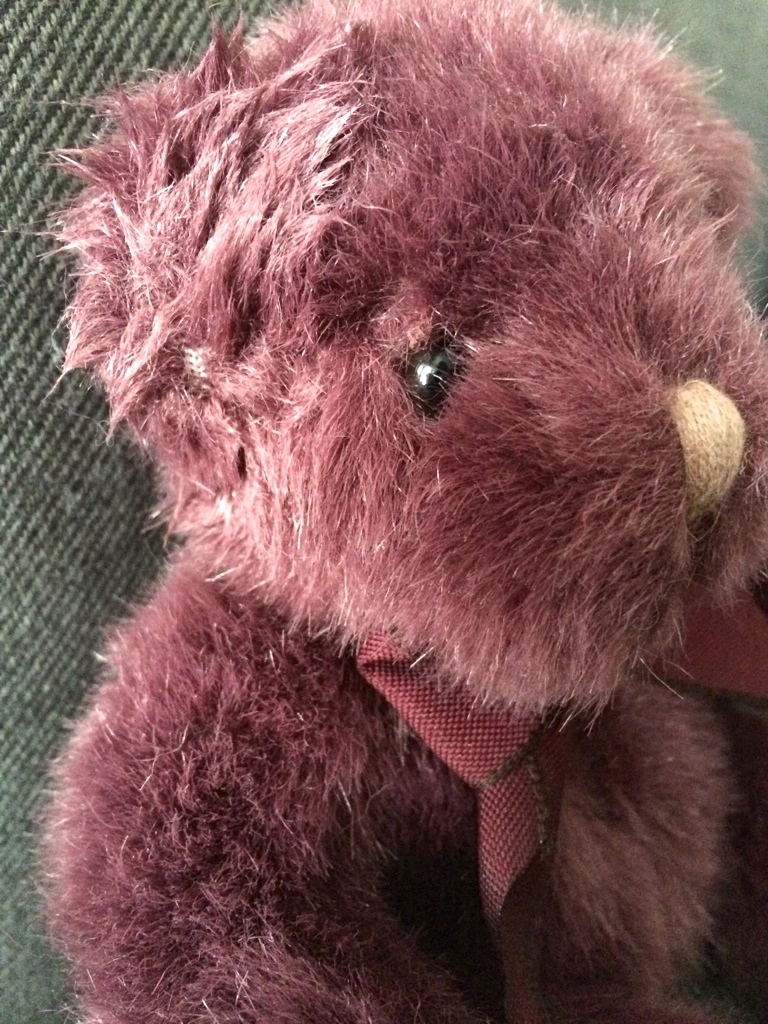
This isn’t Blueberry. It’s Purple Martyn the Purple Peril. Never mind. He looks sad. Perhaps he’s feeling blue.
Blueberry and the Night Bumps
Blueberry is a nocturnal teddy bear. At night he stands by the side of my bed and protects me all night long. Before I get into bed, I take Blueberry from the dresser and place him beside my bed. Only when he is there, on guard, do I get into bed tuck myself in.
“Goodnight, Blueberry,” I say to him, but he never replies. He has a job to do. As I drop off to sleep, he comes alive. Some nights I pretend to fall asleep. When I start to fake snore, Blueberry begins to walk around the bedroom.
He walks to the door and makes sure it is properly shut. Then he looks under the chairs and behind the dresser. Next, he opens the closet door, looks in, and checks that no Night-Bumps are hiding in there waiting to go BUMP in the night.
I am afraid of those Night-Bumps. One night, when Blueberry wasn’t there, a Night-Bump came and sat on my head and went bump-bump-bump all night long. I couldn’t get any sleep. Next morning, my head ached and I didn’t want to eat my breakfast. Nasty Night-Bumps.
The last thing Blueberry does is to check beneath the bed. Sometimes he crawls right underneath it. One night, I woke up to hear an awful noise, squeaking and screaming and a gnashing of teeth. Then silence fell.
Blueberry emerged from beneath the bed holding something that once had wriggled but that would never wriggle again. He walked to the waste-paper basket in the corner, took out and old sheet of paper, wrapped his little bundle in it, dropped it into the basket, then came over to see me.
“That’s the last Night-Bump,” he said. “It struggled wildly, but I got it before it could go bump. You can go back to sleep now. No Night-Bump will go bump in here again. They are all too afraid of me to come back. And don’t worry: if there’s anything else comes in, I’ll get it.”
“Oh Blueberry,” I said, and reached out to hug him.
“Can’t do it,” he sat down and showed me the soles of his feet, one by one. LOVE YOU: these words decorate Blueberry’s two back paws, with one word sewn into each. Usually, I can only read the message by day, when Blueberry sits down and rests.
LOVE YOU stood out as he sat down and raised his legs to show me his message. Then he got back up.
“No hugs. I’m on duty. No nightmares. No worries. Sweet Dreams. And back to sleep you go now.”
And I did.
Next morning, I picked Blueberry up, gave him a big hug, and set him down on the dresser, feet up. LOVE YOU, his feet said.
“Love you too, Blueberry,” I said. And then I added: “Everybody needs a Blueberry.”
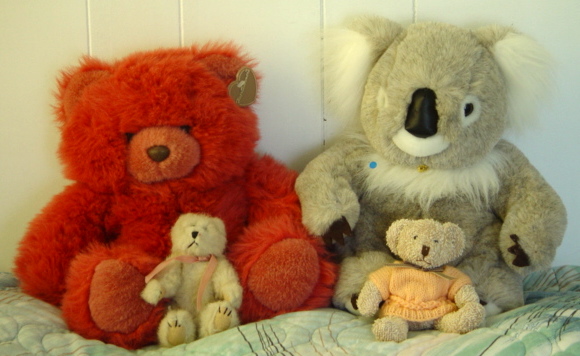
Rosie, Teddy (BR, LR) Basil, and Orange (FR, LR). They are on holiday in Ste. Luce-sur-mer. Blueberry gets car sick and refused to travel.
Teddy and the Angels
Warm in Bed. Cozy. I roll over and the flashlight clipped to my Teddy Bear’s ear drives its hard, metal lump into my face. “Are you awake?” Teddy’s soft voice lilts across the pillow. “I am now.” “Look!” Teddy points with his little leather paw. “The moon: it’s climbing the fir tree.” Sure enough, a thin fingernail of gold is perched on a branch. It hides its face among the fir’s darkness and vanishes for a moment. “The maple tree has a garland of tiny Christmas lights,” says Teddy, pointing again. “Those aren’t Christmas lights, they’re stars.” “Spoilsport. Look, that one’s moving. I think it’s an angel.” “What time is it, Teddy?” “I don’t know.” “Here, lend me your flashlight.” I pull him towards me, switch on the torch, and focus its light on my wristwatch. “4:55 AM. That’s the early morning flight from Toronto. It’s a plane.” “I’d much rather it was an angel.” “Me too.” “Can we pretend it’s an angel?” “Of course we can. But it’s gone now.” “Perhaps angels don’t live long when they come to earth.” “I think they live for ever. Especially if we believe in them.” “Do you believe in angels?” “I was taught to believe in my guardian angel.” “What’s a guardian angel?” “He’s the one who looks after you when you sleep at night.” “But you don’t need a guardian angel. You’ve got me.” “But you’re a teddy bear, not a guardian bear.” “That’s true, but you’ve got Blueberry. He’s your guardian bear. Look at him standing there, on guard, all night long to protect you from the Night-Bumps.” “Ah yes, good old Blueberry. I’ve got a busy day today. I need some more sleep.” “Okay. Blue berry and I will watch over you. I’ll watch over you. I’ll let you know if any more angels climb the tree.” “That would be nice. Now I’m going back to sleep.” “Good night. Or should that be ‘good morning’.” Some days, when I wake up, I think I have dreamed all of this. Other days, I believe in talking teddy bears and angels. Today, I’m not so sure.
I can’t put a real ice-cream up here, it might melt and spoil the computers, yours and mine, so here’s a cardboard one instead!
… after my grandfather died I slept with my grandmother in her large double bed when I was there on my own … but when all the cousins were there we shared a double bed and three or four of us slept at the top and three or four of us slept at the bottom and we were so small and short in those days that our feet never touched in the middle and the bed was like an earth worm … an octopus earth worm with several heads and no feet … or all the feet in the middle … like a centipede … and sometimes my parents would have to snuggle in with us too … though we scarcely woke up when they arrived or departed … and with tears we would go tired to bed … and the grown-ups would promise that it was only for an hour or two … for a little rest … and we were so far north that the summer sun was in the sky until late at night … but sleep we did and they never woke us up … and we didn’t wake up until the dawn chorus of birdsong … bird after bird chirping and singing in the hedge with its bluebells and primroses … the hedge that divided one bungalow field from the other …
… and we were in the first bungalow field, which was the best one, obviously, because we lived in it … and there was another bungalow field behind us and we could look through the gaps in the hedge and occasionally there were gaps we could crawl through … but they were well guarded because there was an all out war between the two fields and we didn’t like the boys in that second field and they didn’t like us … and we fought our skirmishes through the hedge and at the gaps in the hedge and the people in the field behind us would rent out their bungalows to boys with strange accents who would be instant enemies the moment they opened their mouths or heard us talk and vice versa, the other way round … and it was the silent arrow or spear shot or thrown through the hedge … and the long trailing root set out to trip the unwary, and once we tied a rope across the field, a trip wire to trip those foreign warriors, and we meant to take the rope down before it got dark, but we forgot and we missed the enemy but we caught my father and all the uncles walking back home in the dark from the local pub … and didn’t they trip and all fall down in a great big squealing piglet pile … and the aunties thought it very funny because once they were down, they couldn’t get up again … and the aunties said it had nothing to do with the rope … that they were all falling down anyway, falling down all the way home from the pub they were, and stumbling … but we had hoisted our allies with our own petard and next day we were brought to justice and the justice was severe … and what, they said, if we had caught one of the farmer’s cows … and if it had broken a leg … then who would be responsible then, to the farmer, for payment, and we all hung our heads in shame for those days everyone was big on responsibility and being responsible was a big thing … and even the dog, our scout and protector, our war horse and chariot, for we were Ancient Britons that summer, sat there silent and serious and hung his head in shame at the hot bitter words and he wasn’t even wagging his tail … and the adult jury, twelve sober uncles, tried men and true, all pronounced us guilty and sentenced us to a day without cricket, a day with no jam on the bread, a day in which we must eat up all the greens, a day with no puddings, a day with no sweets, no treats, no ice cream …
… but summer was ice-cream! Who wants ice cream in winter when the hands are cold and the ice wind blows straight down from the Arctic? But in summer, to rob a child of ice-cream is to commit a capital crime against childhood … and the ice cream was miles away, and to run to get it and to bring it back before it melted was a rare adventure that had to be carefully planned … go to the end of the field, run through two sets of lanes, stop at the first ice cream shop and if there was no ice cream there because it had all been eaten by that awful foreign army, run another mile to the next shop … and if you were lucky there would be some ice cream there … and no we didn’t want cones … cones were for the babies … the tiny children who couldn’t control their ice creams … we wanted wafers, like the big boys we were, although we were all still in short trousers … and there were three penny wafers and six penny wafers, and even chocolate bars with thin chocolate on the outside and the ice cream inside … and there were lollipops and other marvels … like Cadbury’s ’99’ … but that day all this was forbidden … forbidden because we had set a trip wire for the enemy and caught, by accident, our very own men … oh the injustice, the burning injustice of it all …
I don’t have a photo of Pwll Ddu. Here’s the Beaver Pond at Mactaquac instead!
… and once when we went to Pwll Ddu, to the Black Pool, in English, where the stone bank holds the river back and we can sail our boats on the pool and the water is warmer than the sea … and one day, a long time ago, we saw this snake swimming across the backed up river, between the banks of reeds at the end of the valley, of Bishopston Valley, where the trees meet the salt marsh which leads into the sea … and he was a big snake, though I don’t remember what sort of snake he was … and he didn’t have a care in the world, just swimming across the water in the sunshine, hissing to himself, then he climbed the bank with a slither and a slurp … and was gone as quickly and as mysteriously as he came and we were left there playing, paddling, building dams, throwing stones at lumps of wood and pretending they were enemy battleships, waiting to be sunk … and playing ducks and drakes … and making the flat stones, like pieces of slate, slip and skip across the surface, one bounce, two bounces, six, seven, eight, and nine bounces … and the little ripples on the pool’s surface moved slowly outwards and suddenly my cousin trod on a broken bottle and there was blood everywhere … because someone had used a bottle for a battleship and had broken it with a broadside of stones … and we had to stop everything and strap him up and take him home and then he went to hospital and they gave him stitches, eighteen stitches, in the sole of his foot, and an injection … and suddenly what with the snake and the broken bottle, we cursed the pool at Black Pool, at Pwll Ddu, the name of which the boys from London could never pronounce, with their different accents and their capital styles, and though they were a part of us, like their mother was a part of us, they weren’t really part of us and they didn’t speak like us and they didn’t have our accents and they couldn’t pronounce the Welsh … and the neighbours laughed at them behind their backs …
Fish weirs in Fundy Poles in Passamaquoddy anonymous local artist
… and speaking of fish, there are the fish nets on their poles stretched from horizon to horizon, at low tide, and the fishermen in their waders walk out to the nets where the mud is squishy from the sewage system which dumps all the sewage in Swansea bay, but the tide was younger then, and stronger, and there weren’t so many people, so the beach was always swept clean in those days by the tide, and the sewage was always swept out to sea … and the fish were nice and fat and healthy and you could buy a couple of whiting or flounders, dirt cheap, and bring them home, if you asked nicely, and plaice and sole, well, they’re all flat-fish, really, and our cousins from London could never tell the difference between them, but we can, and I’d tell you, but it’s so long ago, that I’ve almost forgotten, and it’s partly size and partly colour, and partly spots, and I forget so many things now … but I don’t forget the sea as it licks at your toes, and you standing there, early in the summer, as white as an ice cream, and the sea climbs up to your ankles, and then your knees, but on Swansea Sands, at the Slip, or at Brynmill, you have to walk miles and miles before it reaches your waist … especially when it’s out and low … but you have to be careful for there can be deep holes and the mud can be slippery … though nobody ever falls down, oh, we were so much cleverer when I was young, … but there are rumours of quick sands out there at low tide, out beyond the fish nets … out where the banana boats ride … out where the bright lights are seen at midnight … the flashes and flares … the mysteries of the unidentified flying objects, saucers and the like, that visit us in Swansea, to learn to speak Welsh, or so the locals say, so that later they may n=mingle among us, and eventually take us over … once upon a time, when I was young, and the world was all new-born, that was not a conspiracy theory … and it was not fake news … maybe that’s why we moved to Cardiff …
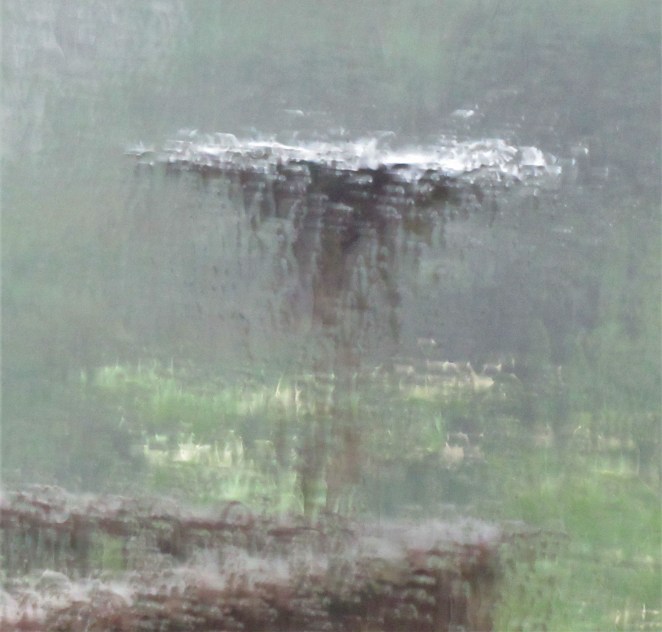
We got an incredible one inch of rain in ten minutes last Friday evening. I got some wonderful photos and no, that is not my hand shaking.
In fact the weather in June has been most strange. The end of May saw four consecutive days at 32 C / 90 F. This was followed by four consecutive nights of frost. And then this devastating rainstorm on Friday evening.
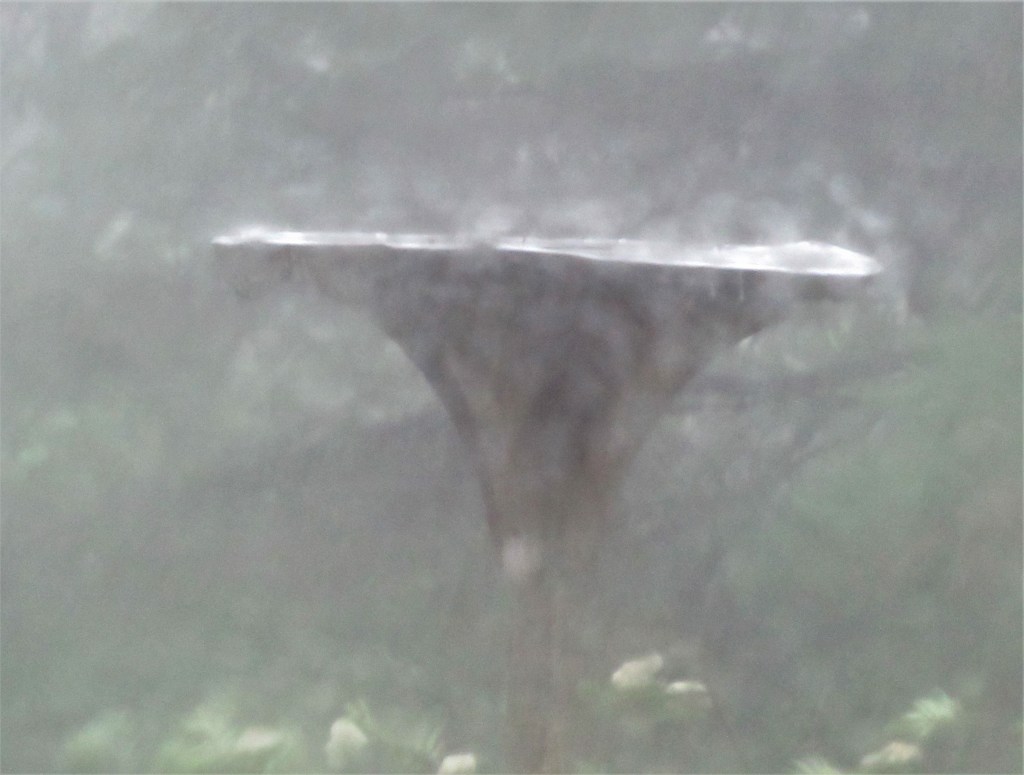
Bird Feeder in Winter
Los Días de Noé / the days of Noah, as they say in Spanish. But our one inch of rain fell in just ten minutes and the wind was horrendous. Similar storms are called chubascos and I’ve also heard tromba.
Whatever: it was cold, dark, windy, and wet and 13,000 homes went without power.
The worst punishment of all was to be sent to bed early. You climbed upstairs by candlelight, if you were lucky, or groped your way upwards in the dark, if you had been really bad. You entered the cold, dark, damp of the bedroom and punishment was not to have supper, and not to have a warm hot water bottle or a warm baked brick to keep you warm in bed. I loved that hot brick, baked in the oven or by the fireside, then wrapped up in a towel. Bricks and bottles: they banished damp from the bed and kept you warm for a while, or burned if the wrapping fell off. The hot water bottles: they were made of tin not rubber, and once, I remember a cast iron duck, that my grandmother baked in the oven, then wrapped in swaddling clothes, like a little baby. But if the grown-ups said you had been naughty, or nasty, or cheeky, or just plain wicked, then you were given nothing to keep you warm, and you lay in bed and shivered until you cried yourself to sleep.
I dreamed last night that angels lofted me skywards and wrapped me in cotton-wool clouds.
The nearest rainbow was a helter-skelter that returned me to earth where I landed in a pot of golden sunlight.
Red and yellow were my hands and face. I stood rooted like an autumn tree covered in fall foliage with no trace of winter’s woe.
“May this moment last forever,” I murmured, as the rainbow sparkled and I rejoiced in my many-colored coat.
Comment: I have noticed on several occasions that when I am reading a text, I change the wording on the page to a new wording that seems more in keeping with the rhythm of the moment. I see that I have done this here, more by accident than by plan. I have noticed this too when listening to Dylan Thomas’s recordings of his own verse. Each reading then becomes a new variant on the poem. In this case, I rather prefer the second variation, but I am not sure that I approve of the first one, nor nor do I approve of leaving words out. Naughty! I am afraid that I still haven’t developed the skill of reciting instead of reading my poems. I guess it will happen soon enough. In the meantime, I’ll just have to put up with these little flaws.
Dream … A poetry reading from One Small CornerFall Foliage in Island View