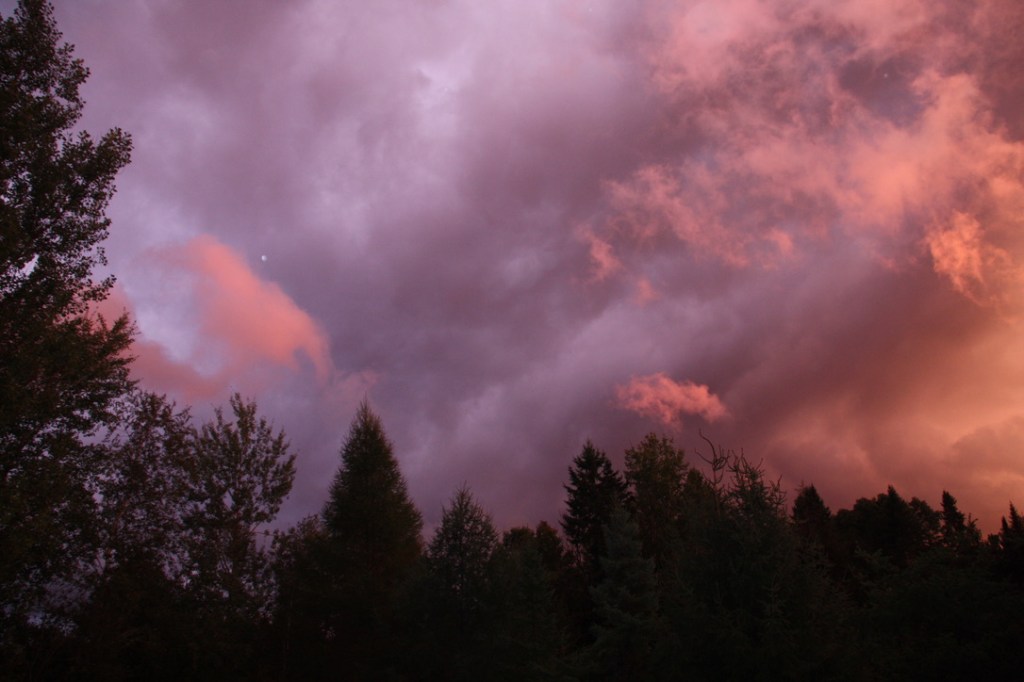
Dreams are important throughout mythology.Do we create them ourselves?Or do they come to us as celestial messages?Can they exist without us?Or do we form a symbiotic relationship, each dependent on the other?
Dreams
I once stole the nose from a sacred statue. Today I watch it cross the square attached to a face. Eight Deer walks past with a fanfare of conches: you can tell him by his donut with its little tail.
A shadow moves as zopilote wings his way across the square. I spoke with him once on a midnight bus. He begged me to fold his wings and let him sleep forever.
A gringa called Nuttall sells tins of watery soap. Her children fill my days with enchantment as they blow bright bubbles through a magic ring.
Eight Deer, eight years old, sets out on his conquests. Nine Wind births nine of his people from flakes of flint, or was it from the magic tree in Apoala?
The voices in my head slip slowly into silence. Sometimes I think they have no need of me, these dreams that come at midnight, and knock at my window. Other times I know they cannot live without me.
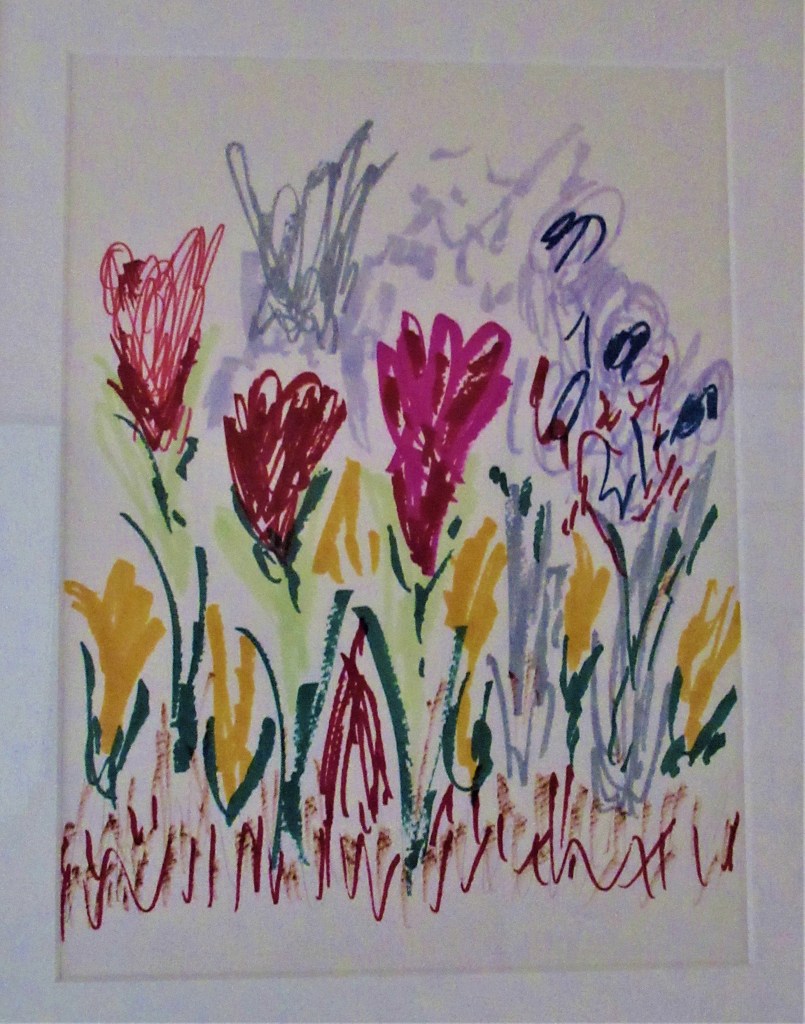
March 1 is St. David’s Day: Dewi Sant, patron saint of Wales. While we are here, immersed in cold and snow, in Wales, spring is arriving, the daffodils are out, trees are budding. This poem is a reminder that winter will end and sunshine and spring will return. So for St. David’s Day, I wish you joy and hope.
Earth to Earthlings
“Get out and about,” she told me. Take off your socks and shoes. Walk barefoot on the earth and grass: twin pleasures, you can choose.”
I took two canes, one in each hand, and left the house to walk the land.
In the garden I took off my shoes to walk barefoot on the lawn; when grass sprang up between my toes I was instantly reborn.
I stood in the shade of the crab apple tree and let leaf and flower spill over me.
Sunlight took away my frown and freckled a smile on my face. I was blessed again with hope and light; earth and grass filled me with grace
When white blossoms filtered down they gifted me a flowery crown.
I stooped to reach my shoes and carried them home in my hand, maintaining as long as I could my contact with this magic land.
Duermeivela: that time when the waker dreams he is waking, yet is still asleep. His mind wanders through a labyrinth of old memories, streets and squares, myths and legends. It is a mythical time of great creativity. To wake up from it is to be filled with hiraeth: a longing for all that is lost and can never be recaptured.
Daydreams
The alarm clock shuffles its pack of sleeping hours: a clicking of claws, needles knitting outwards towards dawn’s guillotine.
A knife edge this keening wind sharpening my bones tingling fingers and toes.
Ageing eyes refurbished in the morning’s sky fire. Ravishing rainbows dazzling the eyelash of day.
Old myths grow legs. They wander away to gather in quiet corners, where the wind weaves dry leaves into endless figures of eight.
An old man now, I dream of white rabbits, running down tunnels, escaping the hunter’s hands.
When my dreams break up, they back into a cul-de-sac: a wilderness of harsh black scars.
Scalpels, my finger nails, carving red slashes on white-washed walls, trenchant shadows, twisted dancers, old warrior kings bent into pipe wire shapes.
He knows the frogs are in there. He doesn’t need to hear them sing. But he loves to make them croak.
Croaking Angels
Their tunes are one note symphonies, croaks of joy that move their fellow frogs to ecstasy, exhorting them to share the splendors of ditch life, in a springtime bonding that will loft them skywards.
There’s an ancient magic in this calling: water and laughter, sunlight, warmth, and all those joyous things that fill the newborn spring.
Moonlight swings its cheerful love lamp. New leaves and buds are also known to sing.
Comment: This always makes me think of the croaking chorus from Aristophanes. I do hope all those wonderful ancient plays, songs, myths, and legends are not forgotten in our croaking frog chorus of modern jingoistic advertisements and propaganda. Ah well, what’s a source for the proper goose is probably a source for the proper gander. Who knows nowadays? What we do know is that spring is just around the corner. Warmth and the absence of snow will help change our lives. And yes, that croaking chorus will be back.
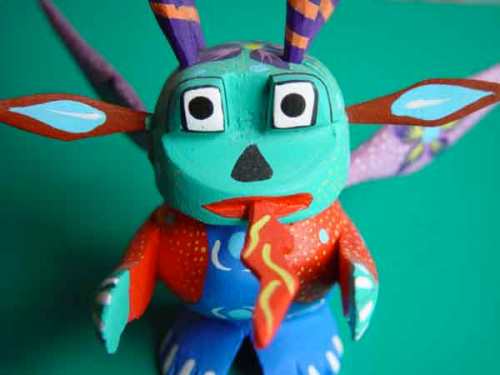
This is one of the first alebrijes I bought in the zocalo (main square) in Oaxaca. He has lost his ears and probably his tongue. They started falling out so we wrapped them up carefully and now we can’t find them. He’s still a happy chappy, hough, and has been in this house for a quarter of a century. Happy Birthday Alebrije!
Alebrijes step out from dried wood and stand in the shower of paint that falls from the brush’s tip. Yellow flash of lightning, pointillistic rain, garish colors that mirror those of the códices. The carvings take the form of fantasy figures, anthropomorphic animals, and mythological creatures. Sometimes one individual selects the wood, carves it, then covers it in paint. Occasionally an entire family takes part in the work of making the alebrije. One person collects the wood and prepares it for carving. Another carves and sands it. A third works on the undercoat, and a fourth applies the final patterns of paint. The great debate: does the form in the wood reveal itself to the carver or do the carvers impose their own visions on the wood? In the case of the team, do the family members debate and come to a joint conclusion? These thoughts, exchanged with wood-carvers in Oaxaca, have led to a series of interesting conversations. What exactly is creativity? Where does it come from? Do we, as artists, impose it upon our creations? Or do we merely observe and watch as new ideas float to the surface of our minds? How does the creative mind really function? And, by extension, how much of the sub-conscious creative sequence can be placed into words?
Alebrijes
Are they half-grasped dreams that wake, wide eyed, to a new day’s sun?
Or are they alive and thriving when they fall from the tree?
Does the carver fish their color and shape from his own interior sea, or does he watch and wait for the spirit to emerge from its wooden cocoon to be reborn in a fiery block of color?
Daybreak: in a secluded corner of my waking mind, my neighbor’s dog greets the dawn with sparks of bright colors born from his bark.
My waking dream: dark angels with butterfly bodies, their inverted wings spread over my head to keep me warm. In the town square, the local artist plucks dreams from my head and paints them on carved wood.
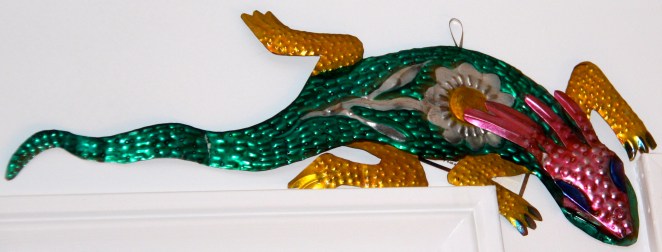
Our house iguana: he is not an alebrije, but is made out of painted metal foil, carved first, and then decorated. He’s the one who guards the front door and falls upon unwanted intruders when they least expect it. Never stay home alone without one, or two, or more. But watch out if you have too many and they get hungry.
Photo by my good friend, Geoff Slater. Books by yours truly, who stayed on the bus and believed.
To be a writer ….
He who would true valor see, let him come hither. One here will constant be, come bad or fair weather. No line length can him fright, he’ll with a paragraph fight, and he will have a right, to be a writer.
Those who beset him round with dismal stories, do but themselves confound: his strength the more is. There’s no discouragement will make him once relent his first avowed intent, to be a writer.
Rejections nor bad critics can daunt his spirit. He knows he at the end will a book inherit. So critics fly away, he’ll fear not what they say, he’ll labor night and day to be a writer.
Comment: John Bunyan tempted me and I fell into temptation. In fact, as my good friend Oscar Wilde once said: “I can resist anything except temptation.” So, ladies and gentlemen, change the he to a she or the pronoun of your choice, turn the writer to a sculptor, stoneist, poet, playwright, painter, novelist, dramatist, comedian, song-writer, singer. Breathe deep. Believe in your own artistic talent and remember: “Genius is 99% perspiration and 1% inspiration.” Remember this too: “You’ll never get to Vancouver by bus, if you get off the bus at Montreal or Toronto.”
Couldn’t find a picture of a cross-bill, so I found some genuine humming birds instead. Listen carefully: you can hear them hum.
Crosswords
I wander a vacant, black and white wonderland of empty, accusing, crossword puzzle squares. Most mornings, I sit at the kitchen table, head in hands, puzzled by the news and the crossword puzzle’s clues.
Outside my window, crossbills squat on the feeder, squabbling, heads turned sideways, blinking,
and winking sly eyes. A yellow-bellied sapsucker hops over syrup-sticky squares. His hand-carved chess board
glistens as feasting flies swarm beneath the sun.
My own thoughts are rooted in a stark, new reality. They walk wordless through threatening spaces where unmasked people wander grey, concrete streets or walk in shops, in the opposite direction to arrows, painted on the floor to guide them.
Cross-words, cross-purposes: why do some people obey the current laws while others ignore them and risk their health as well as the health of others by doing what they damn well please, in spite of the scientists who beg them to do otherwise? Like the puzzle’s clues: I just don’t know.
Comment: Well, last year was a year like no other that I can remember. It is so easy to dismiss it as an aberration, but we shouldn’t do that. Hopefully next year will be better. But it might get worse. Let’s look on the bright side and hum along with the song the humming birds are humming: “Yesterday is history, today is still a mystery, but what a day it’s going to be tomorrow.” I still can’t workout how or why some shoppers just head up the shopping aisles, walking or pushing their carts in the wrong direction. Nor how they can stand for five minutes at a time choosing a breakfast cereal, one hand on the handle of their angled carts, another poking at the cereal boxes, and the aisle totally blocked. I also love the people who still handle every apple in the box before choosing just one of them. For apple you may substitute grapes, pears, avocadoes, tomatoes. Oh the joys of ageing in an age of skepticism and pandemic. Mind you: if life is, as Albert Camus always insisted, absurd, or if it is, as Calderon told us, nothing but a dream, I guess none of it matters anyway. Il faut imaginer Sisyphe heureux / we must believe that Sisyphus is happy!
Couldn’t find a photo of Don Quixote so I attached this instead. A suitable symbol for Brexit!
A Thought for the New Year
“Sábete, Sancho, … Todas estas borrascas que nos suceden son señales de que presto ha de serenar el tiempo y han de sucedernos bien las cosas, porque no es posible que el mal ni el bien sean durables, y de aquí se sigue que, habiendo durado mucho el mal, el bien está ya cerca.” Miguel de Cervantes : Don Quixote de la Mancha.
“Know this, Sancho, … All these squalls that beset us are signs that the weather will soon clear up and better things will come to us, because it isn’t possible for good or ill to endure, and from here it follows that, these ills having lasted so long, good times are now close.” My translation.
Comment: This quote was sent to me by Marina, my close friend from Avila, with whom I have maintained contact, even though it is now twelve full years (2008-2020) since we last saw each other and talked, except on Messenger. Break ups and lost and absent friends and families: it seems to be the story of my life. And how could it be otherwise when one is a migrant who emigrates and immigrates and passes on and through, rarely resting in the same place for long? I guess it is also the story of the Intelligentsia: those whose learning and understanding and life experience moves them out from one place and into many others. Cualquier tiempo pasado fue mejor / any time from the past was better. Hiraeth: the knowledge that the past is lost, save in our minds, and can never be recovered, even though sometimes we wish so badly to do so. The Intelligentsia: always dissatisfied, both with the past which they can never recreate and which they view through the pink lens of nostalgia and with the present which is never as beautiful as that pastel pink past, that in reality probably never existed. Toda la vida es un sueño y los sueños sueños son / The whole of life is a dream and dreams are just dreams, and nothing more (Calderon de la Barca).
A wonderfully quiet and peaceful Christmas in Canada. Oh the sea, oh the sea, thank God it still flows between my family and me.
Boxing Day By the time I get up, the gloves are really off and the sparring has begun in earnest. I hear voices, walk downstairs to the kitchen, and a hush falls on the room. Knife-edge glances slice their menacing ways through the thick fog of war. Time for boxing: on my left, in the blue corner, my mother, smoking what is probably her second packet of the day. A thin haze of grey smoke escapes from her bruised lips and a cloud of exhaled fumes crowns her head with a murky halo. On my right, in the red corner, my father. White-faced, hungover yet again, truly into the spirits of Christmas. He breathes heavily, like a Boxer Dog in the mid-summer dog-days, snoring and snorting at a bitch in heat. In the middle, my grandfather, the referee. He is keeping the combatants apart, creating a tiny breathing space so the true Spirit of Christmas can disentangle itself from those false Christmas Spirits and bring peace to earth again for at least sixty seconds between each round. I look around the heaving, seething, threshing silence of a room where conversation has suddenly ceased. The fire is burning merrily. Beside it, tongs, poker, and small shovel stand to attention. On the hearthstone, the little red brush, with its long handle lies in ambush. This is what my father uses to beat me when he can’t be bothered to take off his leather belt. Scorch marks from the hot coal fire sear the handle and back of the little red brush. I threw it on the fire one day, hoping to see the end of it. Of course, it was rescued from the flames, resurrected, and I got beaten for that act of rebellion too. “It’s all your fault!” My father breaks the silence, pointing at me. His red-rimmed eyes blazing with a sudden and renewed anger. He starts to rise, but my grandfather steps between us. “Go and see your granny,” grandpa tells me. “She’s in the kitchen. Go now!” He points to the kitchen door. I run a gauntlet of staring eyes and go to my gran. As I shut the door behind me, voices rise higher in the room I have just left. Boxing Day, indeed. The gloves are off. The battle has begun again. My grandfather has evacuated me from no-boy’s-land and, for a moment, I am no longer trapped in the mud-filled, cratered, shell-holes between the trenches, the uncut barbed-wire barriers, the poached-egg eyes peering through periscopes and spying on me from the parental and priestly parapets. Here in the kitchen, for a while, I walk on the wooden duck-boards that keep my feet dry and clear of mud and water.
Comment: This is, of course, the true origin of the term Boxing Day. A genuine Boxing Day has nothing to do with the myth that it was the day on which the servants, who worked Christmas Day on the Lord’s estate, received their Christmas Boxes. Peace on earth and mercy mild has got nothing to do with alcohol-fueled quarrels, raging hangovers, and little children who should be seen and not heard. Sometimes, when all the elders are down at the pub on the corner, the night may, for a little while, actually be silent. But the noise when the drunks roll raucously home is most unholy. Then little children should be wise like the wise men, run quickly into bed, and lie there, neither seen nor heard.