Man from Merthyr

Spotify:
Remember to scroll down to the appropriate audio episode.

Man from Merthyr

 Memory loss punched holes in your head
and let in the dark, instead of the light.
Constellations faded from your sight,
erased by the arch-angel’s coal-dust wing.

 “I’m shrinking,” you said, the last time I saw you,
you, who had been taller, were now smaller than me.

 Tonight, when the harvest moon shines bright
and drowns the stars in its sea of light,
I will sit by my window and watch for your soul
as it rockets its way to eternity.

My eyes will be dry. I do not want pink runnels
running down this coal-miner’s unwashed face.
I’ll sing you this lullaby, to help you sleep.

“When the coal comes from the Rhondda
down the Merthyr-Taff Vale line,
when the coal comes from the Rhondda
I’ll be there,” with you, shoulder to shoulder.
Farewell, my friend, sleep safe, sleep deep.

Memory

Spotify:
Remember to scroll down to the appropriate audio episode.

Memory

Marigolds, Oaxacan flowers
grown to guide the dead,
leave so many memories at my door.

Milk bottles placed on the concrete step:
every morning, sparrows peck holes
in the silver tops to drink the cream.

Memory:
its once open door
now slowly closes.

Keys no longer turn in the lock.
Sleep gathers in forgotten rooms,
falling like dust on silken flowers.

Shadows double themselves in the mirror:
recycled shades carve the shower’s glass.

Wary of shade and flame I bathe beneath
a dust-laden beam of sunlight.

Motes in my mind:
flesh and blood chessmen
playing their game
on checkered boards of day and night.

Fate Accompli

Spotify:
Remember to scroll down to the appropriate audio episode.

Fate Accompli

Life begins with the glow-worm of a match.
Luciérniga, Lucifer, the bringers of light.
Sun-flames flicker on the weaver’s fingers,
lighting day’s candle, bringing an end to night.

The shuttle clatters away, plotting our fate.
Tiny, we await our doom on the maker’s loom.
Wooden teeth braid each of the threads
the mid-wife will tie when she cuts the knot.

Three witches stand beside the newborn’s cradle.
One spins the yarn, one measures the thread,
the third one wields the journey-ending knife.

Infants, we walk, unwitting, our planks of fire.
We cast star-crossed shadows on cave walls.
Three witches smile as false omens forge our fate.

Mountain Ash

Spotify:
Remember to scroll down to the appropriate audio episode.

Mountain Ash

Honey sweet bark drilled by beaks
bleeds the rowan’s life away.
Who do we kill: bird or tree?

Decision made, the sap-suckers,
claws trapped in sackcloth, fluff
their feathers, leave their feast.

Red beads on the mountain ash:
a rosary of bright berries.

Bitter on the tongue, sunset’s
first flourish tinting my dream.

Midnight gnaws at the moon.
Its white skull drifts, a stone knife,
sharpened, in the sky’s iron hand.

At shadowed garden’s shallow
edge, the sorbus aucuparia bends,
its spirit walking night’s waters.

Nochebuena

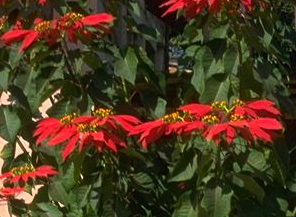
IMG0034_1.jpg
Poinsettia is called nochebuena in Oaxaca.
It also means ‘Christmas Eve’ in Spanish.

Spotify:
Remember to scroll down to the appropriate audio episode.

Nochebuena

Nochebuena / Christmas Eve:
last year, a star fell down the chimney
and landed on the poinsettia.
The cat and the dog stood up to deliver
new versions of their Christmas vision.
Birch bark: ghosts on the snow bank turned
white in the moonlight as they danced,
so slender and so bright.

This year an obsidian knife
hacks through my mind
slicing it into two uneven pieces.
Snowflakes invade its split personality.
Thin ice spreads across glacial fires.
Incarcerated birds sing deep in my rib cage.
A child’s world: with its lost toys lies
buried beneath fresh snow.

Tears freeze in my eyes,
drip from my eyelashes,
and fall to the earth as stars.
Soon I will be an enormous sunflower,
trapped in this wet clay rag of a body.

If I sit here in silence
will the world, like a garden
growing wild, go on without me?
The flowers in my yard close
their mouths and refuse to answer.

Obsidian’s Edge

Obsidian’s Edge
From morning to night
a day in Oaxaca

To purchase this book click on the following link

Obsidian’s Edge Print

Obsidian’s Edge Kindle

Obsidian’s Edge started out as At the Edge of Obsidian and was the second volume in the Oaxacan Trilogy (Sun and Moon, At the Edge of Obsidian, Obsidian 22). When I republished it in Create Space (now Kindle / KDP) I rewrote the last two volumes and turned them into a single book, Obsidian’s Edge, so that the Oaxacan Trilogy is now a Oaxacan Duology. My apologies to those who are eagerly awaiting the third book in the series.

Early Morning in Oaxaca

… dream worlds circle outside my bedroom window … starry sky … two full moons floating, one real, one mirrored in the glass …  inside the bedroom, tulips inscribe red gashes on white-washed walls … sharp fingernails scrape across paint, blood red shadows trickle down to the floor …
            … above the azotea, the temples of Monte Albán string out their sheets on the sky’s washing-line, glowing in the moonlight … against a background of granite and stucco, trenchant shadows sculpt dancers into grotesque, pipe-wire shapes as they struggle to escape their carved imprisonment …
            … priests in long black robes gape at the night sky. From their sanctuary in the observatory, they plot how they will persuade the people to believe the future they will foretell as night’s giant finger herds the wild-cat stars …
… three young women walk at an angle up the temple steps … when they reach the top, a moonbeam holds them in its spotlight and they wax with the full moon’s beauty …  the doorway to an unclosed grave opens its crocodile jaws and the three women descend the temple steps, ageing as they walk … at the temple’s foot, they enter the tomb’s dark mouth … an old man in a faded grey suit walks behind them … the grave swallows them all, burying them in the hidden depths beneath the mound …
            … dreams back themselves into a cul-de-sac, a wilderness of harsh black scars … an ancient Aztec god catches Rabbit by his ears and throws him against the second sun that sizzles in the sky … his sharp teeth burrow, burying themselves deep in the sun-fire’s light … the second sun loses its glow and turns into the moon’s cold stone …  the rabbit’s skull simmers in the new moon’s dwindling pool …
            With a clicking of claws, knitting needles come together to pluck me outwards from my dreams and upwards towards death’s golden guillotine that floats in the sky. The moon sharpens its knife edge on the keening wind and sets my blood tingling. I want to be free, free from those nightmares, those nocturnal visions that rise up from the past and stalk me as I lie in bed.
Drowsing, I long for the alarm clock to shuffle its pack of sleepless hours and to waken me with its piercing call as it tears me from these winding sheets, these grave clothes in which I lie. I wait for the sun to shine into my window.

Sun and Moon

Sun and Moon
Poems from Oaxaca, Mexico

is available at the following link:
Click here to purchase Sun and Moon

Introduction to Sun and Moon

Oaxaca

A city of legends where the dead walk among the living and the stones beneath your feet come alive and talk to you. A city where the animals have voices and the songs of tree and leaf can be clearly heard. A city of hallucinations and spirits, of mystery and myths, a city, young in itself, built on land so old that memories clutch at you with treacherous fingers and lay siege to your heart claiming you for their own. This is the land of Sun and Moon. Come, enter its world. Join me there, if you dare.

Meeting my father in the main square

I saw my father yesterday evening, in Oaxaca. I walked through the zócalo, opened the main cathedral doors and walked in. The doors closed behind me. I looked towards the main altar and there my father stood, motionless. The evening light shone through the engraved glass panels and illuminated him as if he were some long passed saint come back to visit me. We stared at each other, but I couldn’t open my mouth to speak. The hairs on my neck stood on end and my hands shook. When I forced my mouth open, words stuck in my throat. He wore his best grey suit over a light blue shirt and a dark blue, hand woven tie: the outfit in which I had buried him.
            Three old women, dressed in black, broke the spell. One stood in front of me and wouldn’t let me approach my father. She held a large bag of knitting in her hands and the wool spilled everywhere as she pushed me away. The second threatened me with a pair of scissors that she held in her left hand and thrust towards my face. The third smacked a tailor’s measuring rod against my father’s head.  He nodded, smiled sadly, and they all turned their backs on me and hurried away out of the cathedral and into the square.
            Just for a moment, I stood there in silence. Then I pulled the doors open and ran in pursuit of my father. The setting sun filled the square with shadows that whispered and moved this way and that, as if a whole village had come down from the hills to walk beneath the trees and dance in the rays of the dying sun. I stood on the cathedral steps and called out my father’s name, but I could see no sign of him among the cut and thrust of the shadowy crowd.
            I ran out into that crowd and pushed at insubstantial people who stood firm one moment and then melted away the next like clouds or thick mist. I came to a side street and saw real people, flesh and blood beings, a group of villagers gathered behind their band. I stopped and as I did the village elder put a live match to the taper of the rocket that he clutched between his thumb and forefinger. The taper caught on fire and the rocket soared upwards with a searing whoosh. The village band marched forward and started to play a traditional dance as the rocket clawed its way into the sky to explode with a loud knock on the door of the gods.
            Tired of grasping at shadows and afraid of this living phalanx of men that marched towards me I went back to the cathedral and knelt at the altar of La Virgen de la Soledad, the patron saint of Oaxaca. Real wax candles stood before her altar, not tiny electric lights, and I inserted five pesos in the slot, took a taper, and lit a fresh candle from an ageing one that had started to sputter. I knelt and, for the first time in years, I prayed. I prayed for the soul I had saved from extinction by lighting my candle from another’s flame. I prayed for my father and my mother and, above all, I prayed for myself.
            On the way home to my second-floor apartment where I live alone, I bought two litres of mescal, one to send me to sleep, and the other so I would survive the next morning.


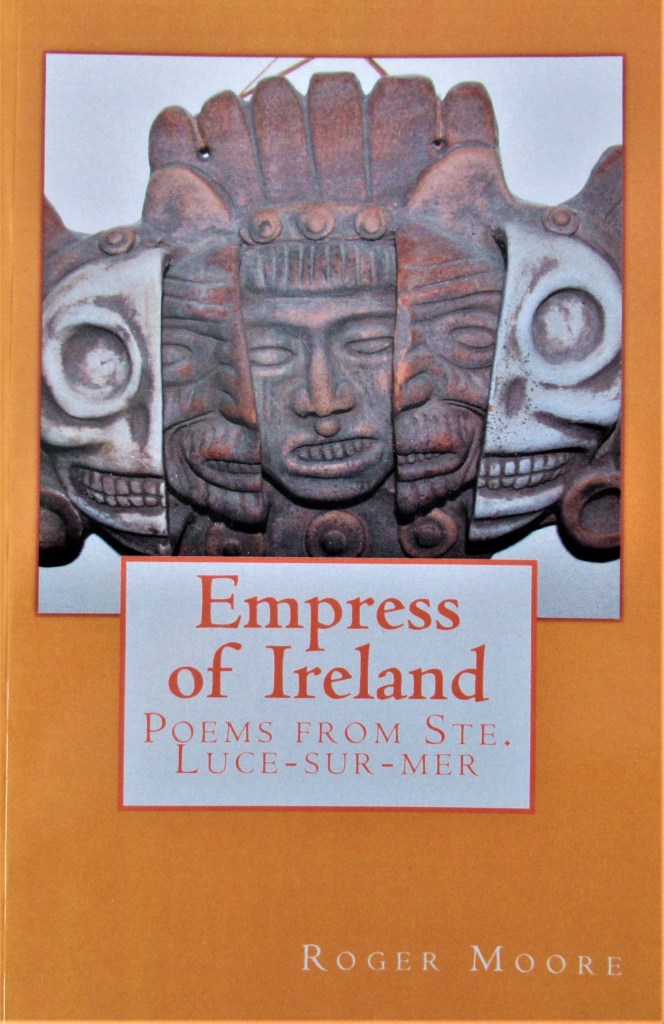
Empress of Ireland

Empress of Ireland
Poems from Ste. Luce-sur-mer

is available at the following link:
Click here to purchase Empress of Ireland

The Empress of Ireland

The poems which have come together to form the Empress of Ireland were begun in Ste. Luce-sur-mer, Quebec, in May 2002. It was off-shore from Ste. Luce, in the early hours of the morning of the 29th of May, 1914, that the Empress of Ireland collided, in dense fog, with a converted Norwegian collier whose bows had been strengthened for ice-breaking. There were approximately 15 minutes between the moment of impact (1:55 am) and the moment the Empress caught fire and sank (2:10 am). Although the disaster has received little international attention, more passengers perished in this accident (840) then in the loss of the Titanic (832) or the sinking of the Lusitania (791).

Introduction to the Empress of Ireland

Click on the link below to read an early post with a new sound recording of
A Survivor lights a candle
https://rogermoorepoet.com/2020/11/23/a-survivor-lights-a-candle/

I first heard voices in the cries of the sea birds on the beach at Ste. Luce-sur-mer.

Borne on the wind, over the sigh of the waves, they seemed high-pitched, like the voices of children, or of men and women in distress. These were lost voices, the cries of people alone and frightened by the dark. I heard them calling to me.

That night, there were knocks at my cabin door and finger nails scratched at my window. Tiny sounds, almost beyond the range of human hearing: the snuffling of puppies when they turn over in their sleep and tug at each other, whimpering in their dreams.

“Who’s there?”

I started from my sleep. But there was only the wind and the waves as the tide’s footsteps climbed a moonbeam path to ascend the beach. When I walked on  the sand next day, at low tide, there was a whispering behind my back. Little voices crying to be set free.

“Who’s there?”

A lone gull flew past my head and battered itself against the wind’s cage with outraged sturdy wings.  That night, the mist descended. The church stepped in and out of its darkness and shadows gathered, persistent, at my door.

I walked out into the night and saw a lone heron surrounded by gulls. It was as if an adult, clamoured at by children, was standing guard over the beach. Then I saw the shadows of little people searching for their parents, the shapes of mothers and fathers looking for their off-spring, lost among the grains of sand.

Beyond them, on the headland, the church stood tall above the shadows. I saw grandmothers and grandfathers, their lips moving in supplication, kneeling before the granite cross which stands above the sea. As I approached, they turned to me, opened their mouths, mouthed silent words, then disappeared.  When I went back to bed, faces and voices visited me in my dreams. When I got up next morning, they came to me in the speech of birds hidden in the foliage, in the words dropped by the osprey’s wing, in the click of the crab’s claw as he dug himself deeper into the sand.

“Release us”

“Speak for us!”

“Set us free!”

The words of the M Press of Ire are not my words. They could never be my words. Foundered words, they are, rescued from the beach, and dragged from the high tide mark with its sea weed, carapace, charred wood, old rusted iron, and bright bones of long dead animals polished by the relentless action of wind, sea and sand.

Aubade

IMG_0033.JPG

 Aubade

Fluffed up in their look-out points,
the birds in the garden complain of the cold
with short, sharp calls.

A life of ease they seem to live,
but when the mercury descends and water freezes
icy blinds inside our window panes and snow-
squalls bluster in from north and west,
who knows what’s best for those poor birds?

Crows, aloft in their crow’s nest spars,
sailing snow’s seas,
steadfast in their skippering of wind-bent trees
don’t seem to suffer so much.

This Arctic cold is such
that neither man nor beast can love it,
crouched close to whatever warmth there is,
shivering in the wind’s cold touch.

Driving home from the hospital,
bullied by fierce winds on a snow-packed road,
I dream as I drive.
I envision a past that never was,
a future that may never be.

As I hibernate in that past,
last summer’s flowers flourish in my mind.

The car skids into a snow bank
and my world shakes in shock.
A thirty wheeler rumbles by:
there are so many ways to die.

Clematis

Not clematis, but bruised clematis clouds.
I’ll keep looking.
Maybe I’ll find the real things.

The clematis unfolds bruised purple on the porch. Beneath the black and white hammers of ivory keys, old wounds crack open. A flight of feathered notes: this dead heart sacrificed on the lawn. I wash fresh stains from my fingers with the garden hose while the evening stretches out a shadow hand to squeeze my heart like an orange in its skin. Somewhere, the white throat sparrow trills its guillotine of vertical notes. I flap my hands in the air and they float like butterflies, amputated in sunlight’s net. The light fails fast. I hold up shorn stumps of flowers for the night wind to heal and a chickadee chants an afterlife built of spring branches.
Pressed between the pages of my dream: a lingering scent; the death of last year’s delphiniums; the tall tree toppled in the yard; a crab apple flower; a shard of grass as brittle as a bitter tongue at winter’s end. I know for sure that a dog fox hunts for my heart. Vicious as a vixen, the fox digs deep at midnight, unearthing the dried peas I shifted from bowl to bowl to measure time as I lay in bed. I sense a whimper at the window, the scratch of a paw. I watch a dead leaf settle down in a broken corner and it fills me with sudden silence.
Midnight stretches out a long, thin hand and clasps dream-treasures in its tight-clenched fist. The lone dove of my heart flaps in its trap of barren bone and my world is as small as a pea in a shrunken pod. Or is it a dried and blackened walnut in its wrinkled shell of overheating air? Sunset, last night, was a star-shell failing to fire. Swallows flew their evensong higher and higher, striving for that one last breath lapped from the dying lisp of day. Its last blush rode red on the clouds for no more than a second’s lustrous afterglow.
I lower the delphiniums, body after body, into their shallow graves. Night’s shadows weave illusions from earth’s old bones and rock becomes putty, malleable in the moonlight. Midnight readjusts her nocturnal robes and pulls bright stars from a top hat of darkness. Winged insects with human faces appear with the planets and clutter the owl’s path. Night swallows the swallows and creates more stars. The thin moon hones its cutting edge into an ice-cold blade.

Now that’s a clematis bruise!