The Book of Everything

Discourse Analysis
and
The Meaning of Meaning

Words have dictionary definitions that allow us to agree on what they mean. In this fashion, when I say ‘my grandmother’, you automatically know that I am referring either to the mother of my mother (maternal grandmother) or the mother of my father (paternal grandmother). This is the dictionary meaning of the word ‘grandmother’.

But words have lives of their own, and their meaning changes when used by individuals. You, the reader, never knew my grandmothers. You never will. They both passed away a long time ago. I loved them both, but for very different reasons, and to me they were as different as different can be.

This means that when you, the reader of these words, reach the word ‘grandmother’, the faces you see, the emotions you feel, the memories conjured up by that word are totally different from mine. Same word, same dictionary definition, different personal memories, experiences, relationships. In addition, the role that our grandmother(s) played in our lives will be very different too. That role may vary from culture to culture, from language to language, and from the social structure of the changing society in which we live.

For example, when I first went to Santander, Spain, I visited a family who lived in a large, detached house that contained three generations of the family – grandmother and siblings, father and mother, grandchildren, and an assortment of aunts and uncles. No need for babysitters in that household. Everybody had a vested interest in the development of the young ones and the older ones received tender, loving care, twenty-four hours a day, every day of the week.

I lived from time to time in the same town as my own grandparents. I saw them regularly, but rarely on a daily basis. When my parents sent me to my first boarding school, age six (if I remember correctly), I lost contact with my family. My paternal grandfather died when I was away at school. My maternal grandmother died while I was away at school. My paternal grandmother died when I was living in Spain. My maternal grandfather died when I was living in Canada. Alas, after those early years, I scarcely knew them. My experience, then, was so different from that of other people.

When I moved to Canada, the Atlantic Ocean separated me from my parents. My daughter, born in Canada, grew up with no close knowledge of her grandparents. The word ‘grandmother’ did not mean the same to her as it did to the grandchildren in Santander, or to me. How could it? All those miles between the families, and visits limited to a couple of weeks every other year at best. Although the dictionary meaning is always the same, what a difference in the emotional meanings for each person using that word.

Discourse Analysis, the way I use it, builds not on the dictionary meanings of words, but on their emotional and personal resonance. I take the standard, dictionary meaning of words, twist it, look for meanings at different levels, and then build an alternative narrative on that changed meaning. I have great fun doing so.

Part of that verbal fun comes from my childhood. I listened to Radio Shows like The Goon Show and Beyond Our Ken. Giles’ Cartoons gave my names like Chalky White, the skeletal school teacher, or Mr. Dimwitty, a rather dense teacher in another school. These shows also twisted the meaning of words and drew their humor from such multiple meanings. The Goon Show – “Min, did you put the cat out?” “No, Henry, was it on fire?” Or on an escaped convict – “He fell into a wheelbarrow of cement and showed every sign of becoming a hardened criminal.” Or from Beyond Our Ken – “My ear was ringing. I picked it up and answered it. ‘Ken here, who am I speaking to?’ ‘Larry Choo.’ ‘Ah, Choo.’ ‘Bless you, Ken.’ Verbal scenes like these – it’s hard to get visual pictures from listening to the radio – remain engraved in my memory banks. More than engrained, they become part of the verbal system from within which I write.

This system includes Direct Discourse, Indirect Discourse, and the Twisted Discourse of an Inventive Mind that still wishes to create. It also comes from Francico de Quevedo’s Conceptismo, from Ramón del Valle-Inclán’s esperpento, and from certain aspects of Albert Camus’s Theory of the Absurd, all blended with the poetry of Jacques Prévert and the songs of Georges Brassens. This from the latter – “Tout le monde viendra me voir pendu, sauf les aveugles, bien entendu.” Everyone will come to see me hanged, except the blind of course.

This is not always easy humor, nor is it a comfortable way to see the world. But it is a traditional one with a long literary history. The title of my book goes back to Francisco de Quevedo, of course, who, in 1631, in Madrid, published El libro de todas las cosas y otras muchas más / The book of everything and a lot more things as well. Don Roger turns to his good friend Don Francisco whenever he needs a helping hand.

The pieces themselves were first published on my blog rogermoorepoet.com. They have been revised, and I have added some more pieces in a similar vein. Tolle, lege – Take and read.  Above all, enjoy this world of mine, with its subtle and not so subtle humor, its sly digs at many of our follies, and its many forms of creativity.

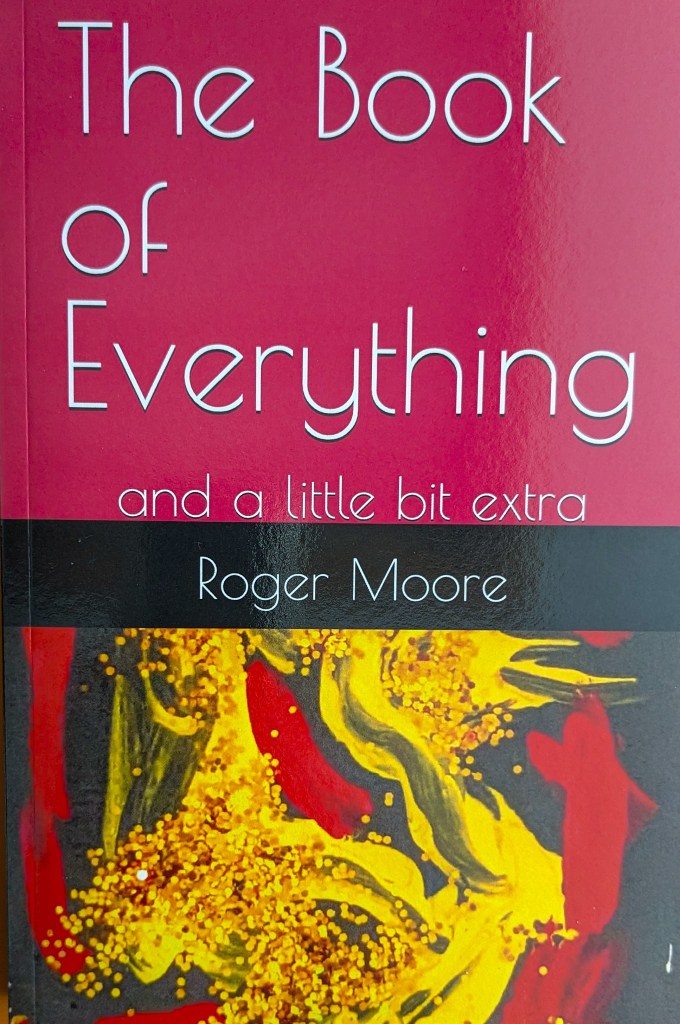
The Book of Everything
and
a little bit extra

Click on the title to purchase this book.

Time Flies

Time Flies

… bends like a boomerang,
flies too rapidly away,
limps back to the hand.

Endless this shuffle of unmarked
days dropping off the calendar.

Hands stop on the clock.
The pendulum swings:
time and tide stand still,
do not move.

‘As idle as a painted ship
upon a painted ocean.’

The painting in my grandma’s room:
seemingly moving seas,
sails swelling out,
but the ship doesn’t move,
it stays firm in its frame.

Our garden fills with birds
and squirrels, light and dark.
Morning ablutions: each day
a twin of the day before.

The TV screen churns ceaselessly,
tired, shadow faces boring us
with shallow wit
and worn-out wisdom.

Time:
an albatross around the neck,
an emu, an ostrich, a dodo,
an overweight bumble bee,
too clumsy, too heavy to fly.

What brings a tear of joy to your eye?

What brings a tear of joy to your eye?

Peeling onions, of course. As my Welsh grandfather told me, years and years ago

“If, if, if,
onions climbed a cliff,
potatoes would rise
with watery eyes
if it wasn’t for if.”

There you have it, in a nutshell, or should that be an onion skin? So, why does peeling onions bring a tear of joy to my eye? Because of the things that I make with them, of course. Where would paella be, if there were no onions in the mix? Can you imagine French Onion Soup with no onions in it? How about a Spanish Omelet / tortilla española? Okay, okay – I know some purists, especially in Galicia, say that the tortilla española should consist of egg, potato, salt, and nothing more, save a touch of olive oil, perhaps. But most of the tortillas españolas that I have enjoyed (and made) include an onion or two to blend with the potatoes. And how about salsa mexicana or salsa pico de gallo? Unthinkable without their dash of sliced onion.

So, peeling onions – that always brings a tear of joy to my eye, because I know how I am going to use them and how tasty they will be. And for those who have forgotten the hungry in this world, myself included in this particular post, do not forget Miguel Hernández and his poem Las nanas de la cebolla / The Onion Lullaby. Reading that poem and understanding its background will surely bring a tear to your eye, as it always does to mine. This time, however, it won’t be a tear of joy!

Why do you blog?

Why do you blog?

Good question. And there’s no easy answer. I guess, in my case, that my computer and my teaching (I have been retired for 16 years) were closely linked. I used programs like Blackboard and WebCT to teach hybrid courses, online and in the classroom. The online factors – chat groups, info sharing, course analysis – backed up the in-class material and gave students a space in what was, back then, late 20th Century, a new, but rapidly developing teaching space and style.

I found the development of a web page allowed me to preserve course notes, to construct class material, to allow students to access material (in their own time and space) and many found this useful. I also encouraged students to build their own web pages (and this was in the twentieth century, remember!). I also told them that they would probably, long term, find the web page building more important than the material that I was teaching them, for my material, like that of many other teachers, had a limited shelf life, and was not carved in stone and everlasting. This was particularly true as rapidly changing times, methodologies, and students – often from different cultures and with different styles of learning and levels of knowledge – spelled the end of the single course outline imposed, top down, on all members of the class.

When I retired from teaching, I kept the web pages I had built. Then, some five or six years after retirement, I decided to start a blog, rather than just have a webpage. Now, blogging has become a habit. Not an incurable one – just this year I missed four months ‘blog time and space’ on this web page / blog of mine.

But is this web page of mine a blog? Not really. I don’t sell anything on it, rather I give my books away to friends who wish to read them. I don’t charge for accessing my ideas, my thoughts, my creativity, my poetry, my photos, my paintings, my philosophy. My oh my, look at all those ‘my -s’!

At this point in time I am wondering whether to continue blogging or not. I have been approached by many people who wish to enrich themselves by enriching my webpage so I can then enrich myself. But I neither want nor need that. Rather, I follow the philosophy of Miguel de Unamuno, the great Spanish philosopher. “If I can reach out and help just one person,” he said, “I will not have lived in vain. And I guess that’s why I blog – to reach out on the off-chance that one or two of my words will touch someone in a meaningful fashion and help them to understand the world a little bit better and even, maybe, to help reshape their lives.

What’s your favorite recipe?

What’s my favorite recipe?

I find it hard to talk about my favorite recipe at a time when so many people in this world of ours are desperately short of food. I get regular messages from the local food bank – can I help them out? And I try to do my best. Alas, my pittance is a drop in the ocean of want and need.
Our local supermarkets have food baskets that you can add to your food bill. These will then be handed over to those who distribute food to the needy. Then there are the checkouts where I am regularly asked if I will add $2 to my bill for the food bank. I usually give $5 or $10.
I see old men sitting at the entrances to stores, a coffee cup before them with some petty cash in it. I also see homeless, workless people at traffic lights with signs held up, asking for cash.
I don’t want to start on war zones, on the accidental-on-purpose starvation of people, on the targeted destruction of homes, animals, and crops. Nor do I want to contemplate the rising prices of what used to be staple groceries and are now becoming luxury items – olive oil, meat, coffee.
While I can still afford some, but not all, luxuries, far too many people can’t. And yet you ask me what is my favorite recipe? Well, here goes –

Take one pound of charity, stir in a pound of love, add a spoon full of humanity, mix with half a pint of the milk of human kindness, sprinkle the mix with a half cup of sugar – to take away some of life’s bitterness, pepper it with ground Good Samaritanism – to add some neighborly love, and complete it with essence of humanity – to remind us that we are still human. Then distribute it, free of charge, everywhere you possibly can but, above all, not just to the needy, but to those who are capable of changing the situation, but for some reason or other, refuse to do so.
Pax amorque.

What is your mission?

Daily writing prompt
What is your mission?

What is your mission?

Let us begin, as usual, by asking, what do we mean by ‘mission’? Here are some examples of the meaning of mission. (a) an important assignment carried out for political, religious, or commercial purposes, typically involving travel. (b) the vocation or calling of a religious organization, especially a Christian one, to go out into the world and spread its faith. (c) any important task or duty that is assigned, allotted, or self-imposed. (d) an important goal or purpose that is accompanied by strong conviction; a calling or vocation.

I can happily dismiss (a) and (b) from the start. I do not consider an assignment to be a mission, not in my case anyway. I am not one to wander the world, good book in hand, heart on sleeve, convincing people to believe what I believe. That said, I can work with (c) and (d) because, as a life-long teacher, who was offered, at various time, an array of other jobs, I am happy to say that I was a teacher by vocation, by calling. Teaching was my mission. My mission was accomplished.

I taught, in Canada, from 1966 to 2009. Then I reached retirement age. On June 30, 2009, I was a teacher. On July 1, 2009, I was nothing. The shock was enormous. It took me a long time to recover and discover that no, my life was not over, and yes, I had many other things to do. Thankfully they all involved teaching, in one way or another. I used my teaching / research experience to sit on the editorial boards of various learned journals. I even edited a couple of them. I also translated, usually from Spanish to English, and worked with the translations of other people. I also wrote articles on teaching and on creativity.

Creativity gradually took me over. I offered workshops on prose and poetry, wrote and edited books, penned introductions for other writers, and even published some books by other people, usually my family or close friends.

There was never much money in teaching or in creative writing. I always did it for love – love of the subject, love of learning, love of the students, love of watching them grow and develop. When I work one-on-one with another writer, or with a small group of writers, that love is still there. Alas, as I grow older (much older!), I feel the ability to motivate slipping away. The will, the vocation if you like, is still there, but body and mind are growing weak, and that, my friends, is the saddest thing of all.

Dark Angel

He will come to me, the dark angel,
and will meet me face to face.

He will take all that I own,
for my wealth is only temporary:
health, wealth, possessions are all on loan.

My house, my wife, my car,
my daughter, my grand-child,
 my garden, my trees, my flowers,
my poetry, my works of art.
I use the possessive adjective
knowing full well that these things
are only on loan. I will never be able
to preserve and possess them.

I even rent this aching heart,
these ageing, migrant bones,
this death that has walked beside me,
step by step, every day
since the day that I was born.

My death alone is mine.
It belongs to nobody else.
It will be my sole possession.
It will soon be the only thing
I have ever really owned.

Comment:

Dark Angel is from my poetry book – Septets for the End of Time / Poems for the end of Time. The lead painting in today’s blog is by my friend, Moo, and he calls it Storm-Me.

Do you play in your daily life? What does ‘playtime say to you?

Daily writing prompt
Do you play in your daily life? What says “playtime” to you?

Do you play in your daily life? What does ‘playtime say to you?

Poesía de juego y poesía que expresa la autenticidad del ser / poetry as play and poetry that expresses the authenticity of being. For me, poetry is play. However, it is far more than just ‘play‘ – because it is a play that expresses the authenticity of my being.

I write in my journal on a daily basis. As I write, I sometimes spot little gems, thoughts or word clusters that can be turned into poems. For me, playtime is when I start to elaborate the words (signifiers) and turn them into thoughts (signified). The meaning may be the message, but the words that carry the message are the building bricks of the poetry of play which sometimes, with a happy Midas touch, turns into the poetry of gold that expresses the authenticity of who and what I am.

But play is also what I do when I paint. And sometimes I sit beside my mirror image friend, Moo, and paint with him. While Moo is great with colours, he is sometimes at a loss for words. Then I help him by playing with words, shuffling them around, until he finds the title that he wishes for his poems. Sometimes I consult, on Moo’s behalf, with other friends, and they are the ones who join in the game, and settle the dispute by agreeing upon the name that Moo will finally choose for his painting.

But, speaking of painting, there is no play better than the game of making meaning out of color [does it really matter how you spell it? ] and shape while taking a line for a walk and turning it into something playful yet meaningful. Mix and match, and stitch and patch, and then add the lines and title that ease the metamorphosis of color into shape and meaning.

There are other games I play to help fill in the daily gaps that have entered my post-retirement life. Online games of patience, crosswords, chess games with their intricate patterns of red and white or light and dark. Then their [now it does matter how you spell there!!!] are mining games when I dig deep into other people’s poetry and search among the gems of Octavio Paz, Antonio Machado, Dylan Thomas, John O’Donohue, Milton Acorn, Valverde, Quevedo, St. Teresa of Avila, Gongora, Sor Juana, Cervantes, or many other friends, their voices now silences, with whom I speak with my eyes, in order to find something that inspires me to play yet another game – hunt the symbol.

Re-reading Rudyard Kipling is a game too. “Do you like Kipling?” “No, I never Kipple.”And in books like Kim, the great game of life goes on and on, and Kipling’s signifiers (words) turn into a signified (meaning) that is warped by my creative mind and changed into my ideas of a new game in which hunt the symbol turns into the game of Brillig where the slithey troves of new words, fresh words, are reborn into my game-world and emerge from their game-whirled into my own word-play conversation with my own thyme and plaice [or should that be time and place?] And long may Moo and I play that game!

What are your thoughts on the concept of living a very long life?

Daily writing prompt
What are your thoughts on the concept of living a very long life?

What are your thoughts on the concept of living a very long life?

A simplistic question in so many ways as so many definitions are needed. How long is long? 100 years? 200 years? Back to 1066 to watch the Battle of Hastings? 1588 to see the Spanish Armada sailing up the channel? 1815 to see the Battle of Waterloo and talk with Wellington and Napoleon – why not? I am Anglo-Welsh and New Brunswick is bilingual, French and English, so why shouldn’t I – or anyone else who wants to live such a long life – have a talk with both of them?

And does living a very long life include the concept of being healthy, and happy, and wise, and not living in squalor or poverty or in a permanent war zone? How about being kept in an incubator, or an iron lung, or on permanent life support? How long is long under those (or similar) conditions. And what about friends and family? In the Celtic myths, men who visit the fairies in Ireland and live and eat with them, come back to reality [now define that word in this day and age] only to find their friends and families long dead and gone. So what would the conditions of the ‘return’ be like if a long life meant watching the passing of everyone and everything you know or returning to a world you no longer recognized?

And change is so rapid nowadays. AI is developing so quickly, how can anyone keep up? I know that as I slow down (mentally and physically) I understand less and less about the machines I use, including my Nexus Rollator. Does a ‘very long life’ include sipping from the Fountain of Youth? Or does it consist of an enlarged old age – post molestam senectutem, nos habebit humus after a troubled old age, the earth will have us. I am sure we all recognize Gaudeamus igitur, in Latin, and its theme of Ubi sunt qui ante nos in mundo fuerewhere now are those lived in this world before us, and if we don’t, then how swiftly we have forgotten the power of Latin is with its memorable phrases and omnipresent seeds of memento mori .

For me the question is a clear one – do you wish for quantity (a very long life) or quality (a very happy and successful one, even if it is a bit shorter)?

A close friend of mine, one of the most honest and courageous people that I have known, suffering in a horrific way from terminal cancer, asked for, and received, MAID (Medical Assistance In Dying). It was a long legal and medical process to get MAID, involving famiy members, lawyers, doctors, and many other things. As the Romans used to say mors omnia solvit death resolves everything. My friend and his family preferred to shorten life – on their own terms – rather than prolong it under such prolonged suffering and torment. My friend, I salute you and your family and commend you for your bravery.

So, define the terms within which that very long life would be lived – and then ask yourself the question once more. Because as it stands right now, with no further understanding, the answer should only be “depends”. And remember, lives are like swimming pools – they have shallow ends and deep ends. All too often when you talk about life and the end of life, so much depends.

Comment:

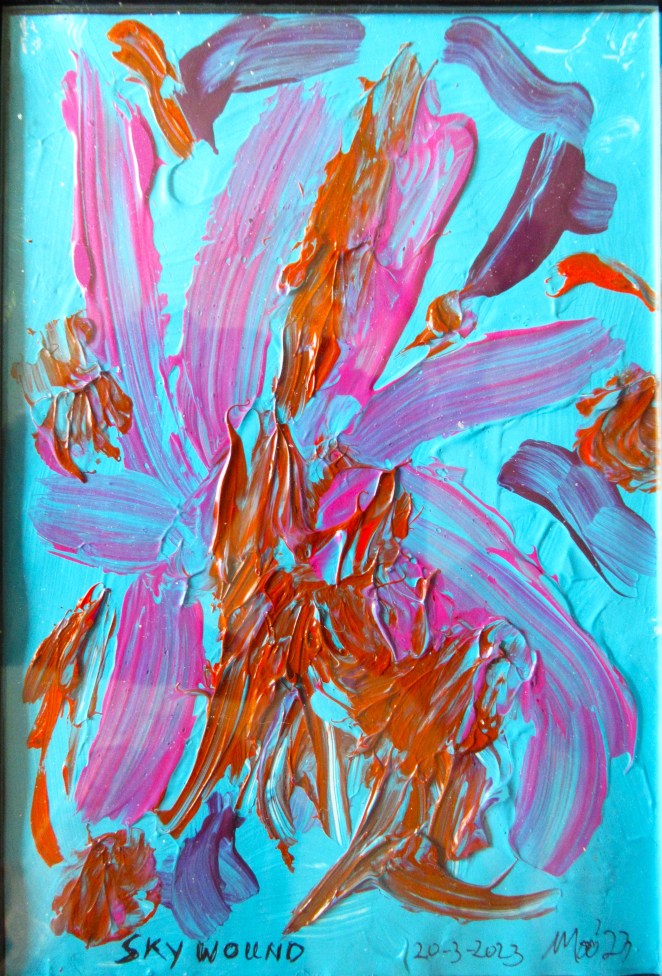
I must thank my friend, Moo, for his depiction of the fireworks from New Year’s Eve. Sky Flowers, he calls it. The fireworks have gone already – but – vis breve, ars longa – his painting still survives.

Nightmares

Nightmares

The jaws that bite,
the claws that snatch,
the hands grasping you
through the railings
as you scuttle upstairs.

Those same hands descending,
beating, shaking you,
back and forth, a rag doll,
then thrusting you into
that cold, dark cupboard
beneath the stairs, no story,
your childhood reality.

And now, those dreams come back
and you lie awake watching
as the grey revenants return
and the nightmares repeat
themselves, again and again.

And return they will, until
that final curtain call,
when the stage turns black,
and you’ll never be taunted,
haunted, and hunted ever again.

Comment:
On Thursday night we discussed the difference between poetry of play and poetry that expresses the authenticity of being. Into which category does this poem fall. Intertextuality – the idea of texts talking to texts. How many different texts can you count, talking to each other in this poem that may even be a Jackpine Sonnet?


When are you most happy?

Daily writing prompt
When are you most happy?

When are you most happy?

What on earth does that mean? When? Are we talking time of day, or time of night? Are we talking a season of the year? Are we talking mood swings – happy now, oh dear, mood swing, not happy now? Are we talking Hen Wen, the magic white pig at the feeding trough? “I am at my happiest, oink-oink, when I am eating a big burger from …” – and here you name your favorite burger outlet. None of that Hen Wen nonsense applies, of course, if you are vegetarian, vegan, or have an allergy to burgers or buns!

I can tell you when I am least happy – 7:30 am, on a wet, damp, cold, icy, snowy winter morning, when I have to get up, get dressed, and go out in the mush and the slush to have an early morning blood test – no food or drink for 12 hours – at the local hospital. Last time I did that, I couldn’t find a parking spot, and drove round and around until eventually one opened up, as far away as possible from the hospital of course. No, I was not a happy camper on that occasion. Especially when I slipped on the ice, returning to my car, and then found someone had driven into my side while I was parked there. Oh, that made me so happy and so jolly, I laughed until I cried. [I do hope you can recognize sarcasm when you see it.]

So, let us reverse the question and reframe it by saying that I am perfectly happy when the things that make me miserable do not happen. No fender-bender in the ice and snow – I am a happy man. Caught speeding or jumping a red light – totally by accident, of course, – and the man in blue asks me for my license, sees that it’s my birthday, and lets me drive away with a verbal warning and a jovial ‘happy birthday”! Ah yes, reverse psychology, that sort of thing does make me happy.

So, above all, it’s the little things in life that go right, and not wrong, that make me happy. This morning’s boiled egg, boiled to perfection – not too hard, not too soft. My coffee a perfect blend designed to bring joy and happiness. Marmalade on blue cheese, the Welsh equivalent of Chinese sweet and sour – oh yes, and actually making someone laugh or smile when they read this nonsense I write. Even Hen Wen grunts with joy – oink! oink! – at that one. So if you have enjoyed this post, please take the time to send me an oink or two, and I will be happy. Thanking you in advance is, yours sincerely, Hen ‘oink!’ Wen ‘oink!’ Wink, ‘oink!’