Share a lesson you wish you had learned earlier in life.

Daily writing prompt
Share a lesson you wish you had learned earlier in life.

Share a lesson you wish you had learned earlier in life.

I wish I had learned earlier how hard it is to grow old and how difficult it is to prepare for it. My first serious rugby injury, age 16, torn cartilage in left knee. Doctor’s advice: give the game up now. Later, you’ll regret it if you don’t. My response: I’m tough. 60+ years later, my left knee still creaks and I rub ointment in every morning. My second serious rugby injury, age 20, damaged lower back. Doctor’s advice: give the game up now. You’ll regret it later if you don’t. My response: I’m tough. 60 years later, my back really hurts. I rub ointment in every morning, take pain killers, and stretch. Same with hips, from kicking! One of my rugby friends, about the same age as me, has two knee replacements, one shoulder replacement, and one hip replacement. If he’s not the $6,000,000 man, he must be pretty close.

But there is a story beyond that story. I was sent to a series of boarding schools and no, I didn’t go there willingly. In the summers, I travelled abroad to learn foreign languages that were foreign to others but became familiar to me. I never saw my grandparents as they aged. Often, when they died, I was in school, or away on the continent. I never understood the ageing process. I never witnessed the natural decay of those whom I loved. I never learned that lesson. When I left university, I emigrated, and the same sequence happened with my parents. I was never there when it mattered. I was always somewhere else. And when I was there, I heard the usual litanies: “This never happens when you are not here. It’s your fault.” Or else, “this wouldn’t have happened if you had been here.” Told to me by a close relation at my mother’s funeral. I flew back home, though it was never really my home, to be present for that.

But what is the lesson that I wish I had learned earlier? Alas, there is not just one lesson, but a series of lessons. How to deal with the ageing process. How to face sickness and ill health in age. How to face diminishment with grace and humor. How to accept the natural process that occurs whether we want it to or not. How to face the gradual decline in someone, close to you, your life companion whom you really love. How to face the fear of passing (FOGO to some) and how to pass that lesson on to our own young ones. How to face my own end and how to die with as much dignity as possible.

What’s your all-time favorite album?

Daily writing prompt
What’s your all-time favorite album?

What’s your all-time favorite album?

My stamp album, of course. I am old enough to remember the joy of receiving letters from friends and pen-pals in far-away places with strange sounding names and oh, the joy of those colored squares of paper stuck in the top, right hand corner of the envelopes.

Then there were stamp dates, and stamp parties, where we gathered and swapped stamps, each trying to improve his or her collection. Not that I remember many young ladies saving stamps in those days, it seemed to be a boys only sport, like Conkers. I guess that was because those games were all dependent on one-up-man-ship. And yes, we have boycotts (some of them even open the batting for England), but I have never heard of girlcotts or one-up-woman-ship. I guess there are flaws in the language, all languages. Ceilings as well, probably – the height of linguistic folly.

Then there were stamp competitions when we could take our collections, more or less specialist, and show them off to our friends, admirers, and bitter rivals, hoping to gain fame and fortune. I for one never did. But I learned so much about the world, the rapidly changing world, as maps changed, borders changed, kings and queens changed, countries changed their names, divided their borders and morphed into something else.

Don’t forget those FDCs – First Day Covers – with their postal histories, not to mention the little booklets with the tear-out pages telling us all about Peter Rabbit, Flopsy Bunny, Mrs. Tiggy Winkle. and a dozen other tales. And then there were the special stamps – the penny blacks with their multiple Maltese Crosses, the Queen Victoria 9d green (mint), the Sea Horses, the French Painting Series, the Spanish Civil War stamps, issued on, and by, both sides of the conflict, and you mustn’t forget my own face as it appears on a Mexican do-it-yourself stamp, photo taken in Oaxaca, and the stamp sent back to Fredericton, NB, Canada, just for the fun of it.

My own stamp collection now sits in a cupboard, all covered in dust. I guess it is worthless. Nobody sends or receives letters anymore. Nobody collects stamps. Used stamps are now so much rarer. And those pristine new issues, so bright and cheerful, have never felt the lick of a lover’s tongue. And those envelopes have never borne the imprint of our secret messages – SWALK – PHTR – ICWTSY – and so many other little joys of a life that is long past, but never forgotten.

Do you see yourself as a leader?

Daily writing prompt
Do you see yourself as a leader?

Do you see yourself as a leader?

First, I want a definition of leadership. Here’s one – Leadership is the ability of an individual to influence and guide followers or members of an organization, society, or team. Leadership often is an attribute tied to a person’s title, seniority or ranking in a hierarchy.

Let us begin with the last sentence. Leadership often is an attribute tied to a person’s title, seniority or ranking in a hierarchy. I am without a title, I have no seniority and, furthermore, I do not belong in any hierarchy. So, having nothing onto which to hitch my leadership, I am clearly not a leader. In addition, I can say, in all honesty, that I have no followers. Where on earth would they follow me? I have no wish to go anywhere, let alone to lead other people into the wilderness that so often surrounds us.

So, what am I, if I am not a leader under that definition. Am I a follower? I doubt it. I cannot remember following anyone in thought, word, or deed. A maverick, then? Possibly. All in all, I have always felt that, rather than ‘belonging’, I was outside the hierarchical cultures in which I found myself and was merely an outsider, looking in through the window and watching and observing others as they boldly led, or meekly followed.

So being neither a leader nor a follower, what might I be? Well, I am a creative person. I see the world in a very different light. I also encourage others to see things differently and to present different points of view while embracing their own authenticity. I see myself as an innovator. I see myself as a problem solver. But my solutions have all too often come up against the red taped inhibitions that bind those hierarchical cultures into their unbending, iron strangleholds that limit or deny fresh visions of truth and beauty.

I always remember a story my grandfather told me about one of his experiences during WWI. “See that pile of sand over there?” “Yes, Sarge.” “Well, move it over here.” “Yes, Sarge.” “Right. Well done. Now move it back again.” “Yes, Sarge.”

Ah yes, leadership. And in those days to disobey a direct order was to volunteer yourself for ‘forty days in prison’ or ‘back to bread and water’ or, even worse, to qualify you for a blindfold and a firing squad.

Are you holding a grudge? About?

Daily writing prompt
Are you holding a grudge? About?

Are you holding a grudge? About?

I have reached the stage in life when grudges belong to a distant past. Some of that past I still regret, but I have come to accept most of it as the normal rites of passage through which human beings must pass, if they are to grow and develop. This acceptance also comes from the understanding that the steps that led me to my current life and situation, were beneficial, even when I didn’t think they were at the time.

Garcilaso de la Vega once wrote: Cuando me paro a contemplar mi estado / y a ver los pasos por do me ha traído, hallo, según por do anduve perdido, que a mayor mal pudiera haber llegado. The Wikipedia translation offers us this – When I stop to contemplate my state and see the steps through which they have brought me, I find, according to where I was lost, that it could have come to a greater evil.

That said, I have learned to see the lesser evil in things that actually happened and the greater evils into which I might have fallen. I remember bearing grudges, but I feel that I have now set them aside. Reading John O’Donohue’s book Anam Cara, for the fourth or fifth time, has helped me to achieve that state of mind.

Some things do annoy me though. Speed reading is one of them. Well, not speed reading but the application of speed reading to any and all situations. In today’s Guardian, for example, I read that – “A lot of people, myself included, complain that they don’t have time to read but everyone has time to read a poem. You can read Ozymandias, for example, in just 17 seconds.”

One of the first things that I did in Grad School at U of T was to take a speed reading course. I found it absolutely essential in order to read and process the quantity of new material that was thrown at me by my profs. In my undergraduate education (Bristol University) I was told that “It is better to read one poem a hundred times than to read a hundred poems once.” As a poet, and a student of poetry, I prefer to dwell on a poem, to absorb its essence, its meaning, its subtleties, its associative fields, rather than to gulp it down in 17 seconds, for example, and then move on to something else. The poet and dreamer who live within me need that time to re-create, poeticize, and dream.

“What is this life if, full of care, we have no time to stand and stare, no time to stand beneath the boughs and stare as long as sheep or cows,” wrote W. H. Davies, author of Autobiography of a Super Tramp.

I realize just how much our lives have speeded up, how we are inundated by information, how we drown in sound-bytes, memes, and mini-clips. I also know that, however fast we read, we will never take it all in, not in one lifetime. Sometimes, less is more, slower is faster, we need to take time, to make time, to stand and stare. Seamus Heaney expresses it well – “Some time, take the time…” I don’t hold a grudge against those who can’t, or won’t, make and take that time. But I truly believe that many, many people would benefit by doing so. I also believe that a benevolent society would allow many more people to do just that.

Meanwhile, I will agree with the Guardian columnist that reading a poem in 17 seconds is much better than reading no poetry at all. So, some time, take the time….

What TV shows did you watch as a kid?

Daily writing prompt
What TV shows did you watch as a kid?

What TV shows did you watch as a kid?

Well, first of all I want to define the age group that outlines the meaning of ‘kid’. Here’s one definition: What age range is a kid? Children (1 year through 12 years) Adolescents (13 years through 17 years. They may also be referred to as teenagers depending on the context.) If we start with the 1-12 year old age group, then I can safely say I had no favorite TV shows as a kid, quite simply because during those years, we didn’t have a TV. Ipso facto, not having a TV, I couldn’t watch one.

That said, our first family TV was bought by my maternal grandfather in June, 1953. It was very small, black and white, very grainy, and was the only one on the street where he lived. I remember all of us crowing into the sacred room where the TV stood and watching the Coronation of Queen Elizabeth II. I was 9 years old at the time. I don’t remember much about the Coronation, but it was my first TV show.

Early TV. In the beginning, there were black and white sets. The BBC had only one channel. It came on from 12 noon until 1:30 or 2:00 pm, then shut off until 5:00 pm when it opened for evening programming until 9:30 pm or 10. I was safely tucked into my bed by then. And since I visited my grandparents at odd times, I rarely saw any TV shows. I do remember Sooty, a hand puppet, hitting Harry Corbett, the puppet-master, with a hammer (!), and I have vague visions of Muffin the Mule, a string puppet, dancing on a piano.

By the age of nine, I had been removed from my first boarding school and was attending my second. There were no television sets in boarding schools in those days. So, guess what? There were no favorite programs. In the holidays, with both parents working, to make enough money to send me to boarding school, as they so frequently told me, I often spent time with aunts and uncles (no TV) or with my paternal grandmother (no TV). The bungalow was our favorite summer residence, and that didn’t even have running water or electricity, let alone a TV set. It had one radio, an item of religious importance, that ran off a battery, and was for the sole use of my uncle. It sat on a high shelf and was untouchable. One bungalow in the bungalow field actually had a telephone, and that was only used for emergencies.

So, in the age group I am writing about, age 1-12, I rarely, if ever, saw a TV set and I certainly had no favorite programs. Radio programs, yes. But that is a different story, one that tells of a single radio in the dormitory, to the sound of which, eight or ten or twelve boys, in rows of beds, fell asleep to the sound of music. It also tells of prowling masters who would enter the dorms and switch the radios off. I will not go into the horrors of boarding school life during those formative years. I have done that elsewhere. But the shows that I remember were all true life horror shows where real flesh and blood, in the 6-12 age group, suffered appallingly, at the hands of older boys and brutal masters. But those shows, and I remember them well, were never seen on TV and were denied vehemently by the perpetrators, boys who had been bullied in their turn, and masters who claimed they were only doing their duty and making men of us. Men, indeed, and an adulthood that I, among many others, never wanted to enter.

What is the most important thing to carry with you all the time?

Daily writing prompt
What is the most important thing to carry with you all the time?

What is the most important thing to carry with you all the time?

Things I carry with me

            That old black cast-iron stove, wood-fired, that baked the best ever breads and cakes and warmed the bungalow on cold, summer mornings. The Welsh dresser with its age-blackened rails that displayed the plates, and cups, and saucers. The old tin cans that ferried the water from the one tap located at the end of the field. Full and wholesome, its weight still weighs me down as I carry it in my dreams. The Elsan toilet from the shed by the hedge and the shovels that appeared, every so often, as if by magic, as my uncle braved the evening shadows to dig a hole on the opposite side of the field, as far from the bungalow as possible.

            The outhouse at the end of the garden. The steps down to the coal cellar where they went when the sirens sounded, to sleep in the make-shift air raid shelter, along with the rats and mice that scurried from the candles. The corrugated iron work shop in the garden where my uncle built his model ships, the Half-Penny Galleon and the Nonesuch. The broken razor blades I used to carve my own planes from Keil Kraft Kits, Hurricanes and Spitfires, an SE5, and once, a Bristol Bulldog. Twisted and warped, they winged their ways into nobody’s skies, though once we built a paper kite that flew far away in a powerful wind and got tangled in a tree. The greenhouse from which I stole countless tomatoes, red and green. Kilvey Hill towering above the window ledge where the little ones sat when there were more guests than chairs in the kitchen. The old bombed buildings across the street. The bullet holes in the front of the house where the Messerschmidt strafed us.

            The old men spitting up coal dust from shrivelled lungs. The widows who took in lodgers and overnight travelers. The BRS lorries, parked overnight, that littered the street. The steep climb upwards into those lorries. The burrowing under dirty tarpaulins to explore the heavy loads, and many other things. The untouchable, forbidden drawer where the rent money waited for the rent collector’s visit. The old lady, five houses down who, when the shops were shut, sold warm Dandelion & Burdock and Orange pop for an extra penny a bottle.  The vicious, snub-faced Pekinese that yapped fierce defiance from the fortress of her lap. The unemployed soccer referee who on Saturdays walked five miles to the match and five miles back just to save the bus fare, his only financial reward. My father’s shadowy childhood. His first pair of shoes, bought at five years old, so he wouldn’t go barefoot to school. 

            Wet cement moulded onto the garden wall, then filled with empty bottles to be smashed when the cement set solid. The coal shed where the coal man delivered the coal: cobbledy-cobbledy, down the hole. The outside toilet with its nails and squares torn from yesterday’s newspaper. The lamp-lighter who lit the lamps every evening as the sun went down. The arrival of electricity. The old blackout curtains that shut in the light and shut out the night. The hand rolled fabric sausage that lay on the floor by the door and kept the heat of the coal fire in the kitchen. The kitchen itself with its great wooden chair drawn up by the fire. That chair: the only material possession I still have from that distant past.

What change, big or small, would you like your blog to make in the world?

Daily writing prompt
What change, big or small, would you like your blog to make in the world?

What change, big or small, would you like your blog to make in the world?

Looking around me and seeing the way that the world I know is so totally divided, and knowing that words and ideas will bounce off people’s backs like rain off a duck’s back, I do not expect my blog to make any changes, big or small, to the world. Would I like it to? Yes, I would. But whether it will or not is a different question.

My blog consists of several elements. Let us start with the poetry. If I can reach out and touch somebody with one or more of my poems, then I will be very happy. This is, after all, a poetry blog. And part of that blog is a continuing discourse on creative writing and poetic creativity. If one of my articles / posts on creativity can help one person, just one, to improve their creativity, then I will feel justified with all the hard work and thought I have put into the posts.

I also write about Discourse Analysis, the meaning of words and texts. In our current, doubt-ridden world, it is often the loudest voice that carries the most weight, and he wildest ideas that get the most attention. I always remember that still, small voice that comes after the fire and the thunder: “What doest thou here, Elijah?” Alas, I am not an Elijah, nor am I a prophet, nor am I out to make a profit. But if someone, somewhere, recognizes my voice as a still, small, voice speaking a little bit of sense in this wilderness of wild words, then I will be satisfied. My creative prose comes next. It is mostly composed of flash fiction, memoirs, and short stories. If I can bring tears or laughter to the eyes and the heart of just one reader, then again I will feel that I have done my work.

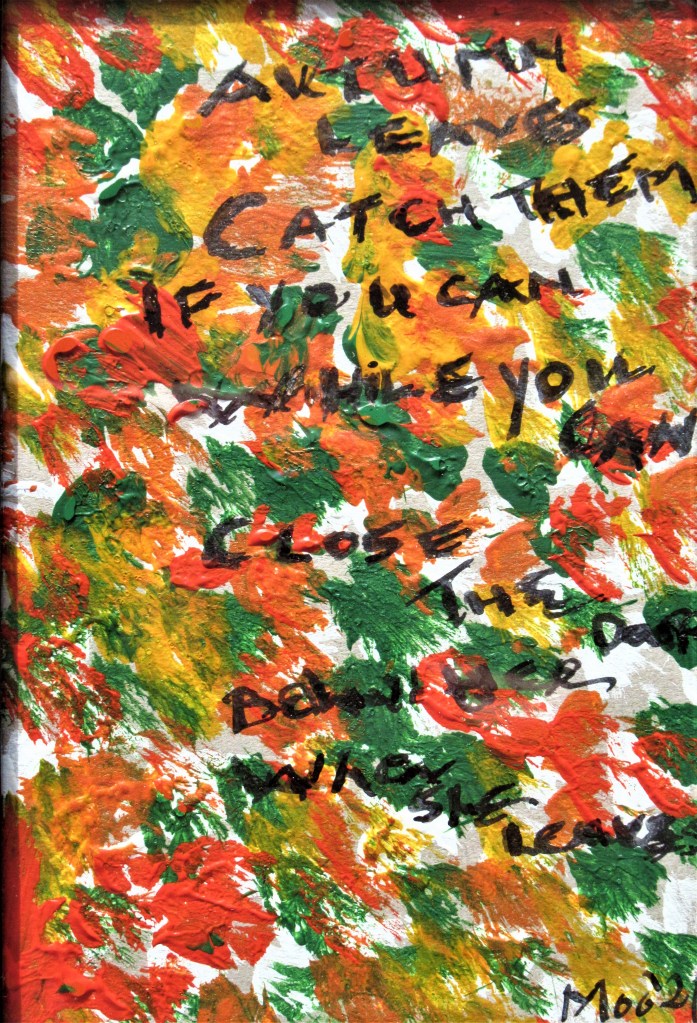
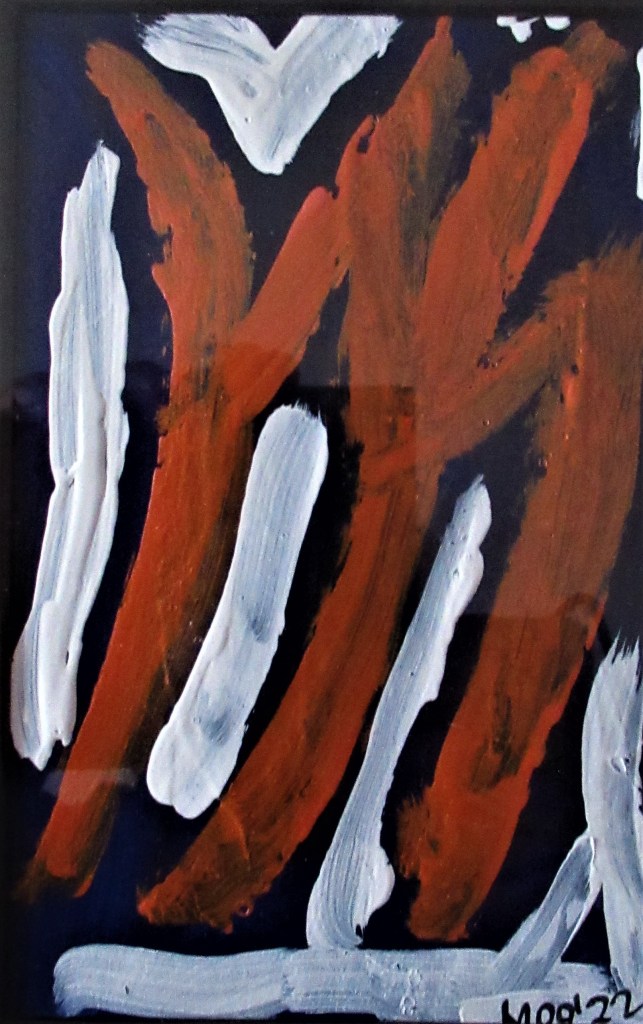
Then there is my art work. I have always been told that I am useless at art. Mind you, I think those people came from the same school of thought that told me, as a teenager, that I would never go to university – except on a train. However, I discovered Matisse and his words ‘making meaning out of color and shape’. Then came Dali – ‘I don’t know what it means, but I know it means something.’ Out of those words have come cartoons and paintings, some funny, some sad, and all of them unique. Again, if one reader / viewer finds joy in them, then I will be happy. And if my own work persuades one battered, belittled artist that he or she can paint, create, make meaning out of color and shape, then I will have achieved the minor miracle of helping to change someone’s life for the better.

As for these prompts, I have only just started to be prompted into doing something. Why? I am not sure why. I just think that I have a different view of the world from most people. If I can offer that alternative view of reality, a joyous reality, I might add, to one, or maybe even two people, then once more, I can feel that yes, my blog has made one, small change to the world around me. And I cannot ask for more than that.

Meanwhile, I think of the studies I did on the Spanish Civil War (1936-1939). The right kept moving further right. The left kept moving further left. The middle ground where discourse, creative thinking, and debate can flourish, slowly vanished. Then, when positions and thoughts became so deeply entrenched that there was no room for mainoeuvre / manouver / maneuver, whichever way you wish to spell it, then shooting broke out and people went to war and found, all too often, their often-violent deaths. I would not wish that fate on any person, government or country. If just one person would read that powerful and bitter history, and learn from it, then the world might be a better place.

To talk to one person at a time, that’s what I want from my blog. Then I want that person to talk to another person, and the third one to a fourth, and so on and so forth, until we have established, one person at a time, a linked chain that may, just may, be long enough and strong enough to help lighten the darkness and head off the dangers into which we seem to be steering.

Apologia

Apologia
pro vita mea

The fairground’s distorting mirrors distort.
I change as I walk past one and then another.

Rage, rage against that hump-backed shape
that looks back at me from the bottle-glass.

Magic: eye of a newt, eye of a toad, cat’s
eyes at night lighting the road to bed.

Bedlam all around me. Absurd this world,
gone carnival mad in the blink of an eye.

I need a white stick to walk through
this fog that clings to my clay-bound soul.

This wine I drink, these thoughts I think,
life’s fountain pen soon runs out of ink.

Watch the tides as they ebb and they flow.
When your time runs out, pack up, and go.

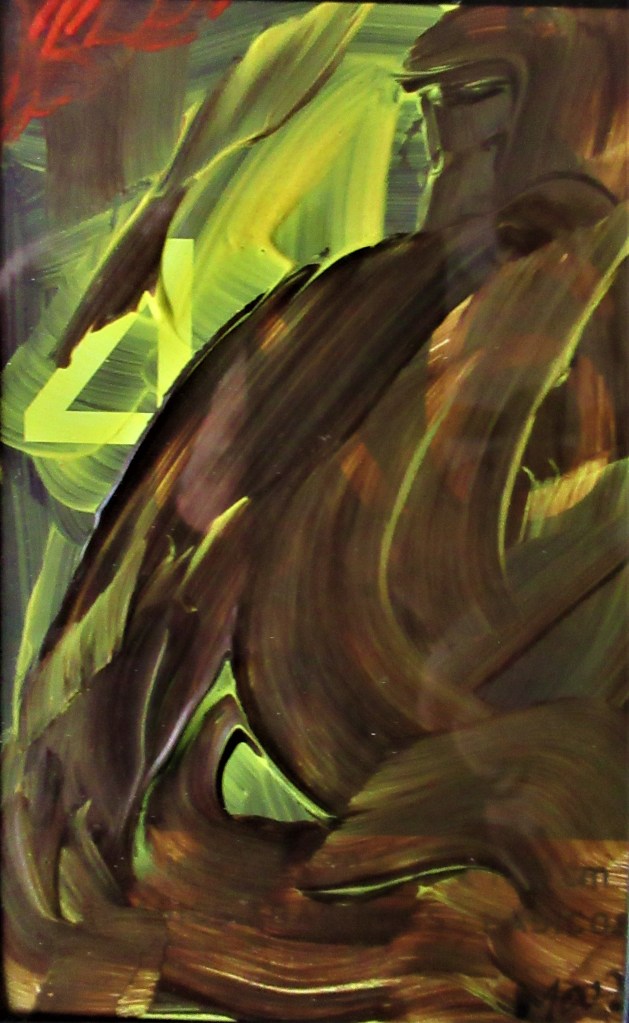
Comment: My friend Moo did himself proud with the above painting. What is it? I asked him. Dunno was his reply. I have shown it to several friends and speculation is rife: the dancer and the dance, dancer and diver, a blur of three figures, headless mermaid (I love that one). And yes, life is absurd (Albert Camus), a carnival (Bakhtin) in which knowledge is power and civilization is mad (Foucault).

Originality and imitation – how many genuinely original ideas are there? Very few. And the same goes for poetry – original poems are very rare. Most of our ideas come from elsewhere, even if we do not know it. The title of the above poem comes from Petrarch. It’s structure is traditional – a sonnet. Its ideas are borrowed from Camus, Bakhtin, Foucault. And yet, shuffle the cards (Cervantes) throw the dice (Mallarme’) and this poem and this post have both achieved a kind of originality and uniqueness by linking disparate ideas in a new unity.

Write about a random act of kindness you’ve done for someone.

Daily writing prompt
Write about a random act of kindness you’ve done for someone.

Write about a random act of kindness you’ve done for someone.

Sir Alex Ferguson, one of soccer’s greatest managers, once said that it wasn’t the victories he remembered, but the defeats. So it is with my own coaching career – it’s the losses I recall. Same thing with random acts of kindness. There have been many, too many to count. I will not paper my e-walls with glowing memories of past kindnesses. But what about those random acts of kindness I failed to do? Here’s one of them.

            Crave More: I hate those words. I always choose a cart with the shop’s name on the handle. I can handle that. I can’t handle a shopping cart that screams Crave More at me every time I stoop down and place another item in the wire grid. If stores were honest, they would inscribe their shopping carts with a sign that said Think More, Crave Less, and Save Your Money. I bet that would quickly cut into profits.

            Anyway, there I was, in La-La-Land, leaning on my cart, still half asleep, when this ghost drifted towards me. “Help me,” it said. “I’m hungry. I need food.” I woke up from my dream, looked at the ghost, tall, skeletal thin, cavernous eyes and cheekbones protruding, gaps in the teeth, grey face drawn and lined. The single word “Sorry” came automatically to my lips. Then I felt shame. I looked at him again. “I only carry plastic.” The excuse limped heavily across the air between us. I saw something in his eyes, I knew not what, and I turned away.

            Then, as I walked away, I added 100 lb of muscle to the scarecrow frame. Took forty years away. Filled his body with joy and pride, and remembered how he played when I used to coach him, hard and fast, but true. I ran my hand through the card index of former players that I had coached. I knew their moves, and attributes, the way they played the game, their stronger / weaker side, their playing strengths, their weaknesses. I remembered him holding up the Champion’s Cup. But I couldn’t remember his name.

            I pushed the cart all over the store in a frantic search for him. I went to the ATM and took out cash. I could hand it to him. I could tell him he had dropped it. I went through a thousand scenes. I could invite him to the snack bar. I could tell him to buy what he needed and follow me to the check out lane where I would add his purchases to my cart. I looked everywhere. He was nowhere to be seen.

            A single opportunity. One chance. That’s all we get. Miss it, and we blow the game. Take it, and we win the Championship and hold up the Cup.

How would you describe yourself to someone who can’t see you?

Daily writing prompt
How would you describe yourself to someone who can’t see you?

How would you describe yourself to someone who can’t see you?

Well, that would depend on why they couldn’t see me. “Those who have eyes, but cannot see.” Many have stood beside or before me, looked into my eyes, as I looked into theirs, and never saw me. “The most difficult role in the play is that of the fool,” said Don Quixote, “for he who would play the fool must never be one. So many people saw me deliberately playing the role of the fool and forgot the above quote. They also forgot what Antonio Machado wrote: “The eye you see is not an eye because you see it, it is an eye because it sees you.” And there you have it: why would I bother describing myself to people of that ilk, so stupid and blind with their own limited wisdom, that they couldn’t see me anyway.

Keenan’s Well, by Seamus Heaney, is a wonderful poem. It tells us about Rosie Keenan, his blind from birth neighbor, who played the piano and sang all day. She let them touch her books, like books of wallpaper, and feel the letters of braille by means of which she was able to read. They allowed her to touch their faces with her oh-so-sensitive fingers, and she said she saw them, as well as knowing them by their voices. When he read her a poem about Keenan’s well, she told him that she, blind from birth, ‘could see the sun shining at the bottom of it now.”

How would you describe yourself to someone who can’t see you? I wouldn’t waste my time and energy trying to do so.