Heart

IMG_0040 (2)

Heart
(sonnet for Hanna and Cherry)

club-foot the pigeon feet
burned off by frost and lime
cracked this egg shell in its cup
the world’s heart overflowing

this silver spoon carved from milk
-tops pecked by morning birds
who placed it in my mouth

song of the blackbird
sung from the corrugated iron roof
where he whistles his virtuosity

playing cards placed face down
who holds the jolly joker
with his floppy cap and jingling bells
who holds the red ace key to my heart


Words

IMG_0127

Words

Waxing gibbous:
gibberish to most, or jabberwocky.
How now the moonraker
dragging the village pond for gold,
or the witch on her ducking-stool
accepted by God if she drowns,
but burned alive if she survives
and the Omnipotent rejects her?

Words rise and fall like trout to flies.
In words, out words, taboo words,
code words, the ebb and flow words
that see conversational tides
rising and falling, waning gibbous
beneath a failing lexicon, sacrificed
at the altar of barbaric speech to appease
the new gods and falsify the old:
nuance, shades of meaning, language,
meta-language, para-language,
raised, a supercilious eyebrow,
that lip curled in the snort of a sneer.

Dreams

weir 2

Dreams

Sometimes, when we dream
there is neither time nor space:
all things are ever before us.

That child’s swing in the orchard
suspended from the apple tree,
primroses and bluebells
at the garden’s edge, delicate
their dance in morning’s light.

That old woman in the kitchen,
humming her morning hymn
as she bakes the breakfast bread.
That old man in the evening,
scything weed and dry grass.

Time’s fragility dwells ever
in our bones, not our minds.
Though dreams fade fast
with morning’s light, our day-
dreams will rule the day,
and we can still dream
those other dreams, at night.

Roger

IMG_0067

Roger
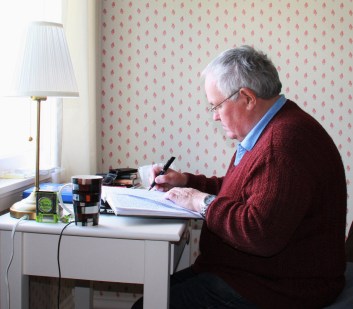
Writing in the Red Room at KIRA

I sit at my desk in the Red Room
overlooking Passamaquoddy Bay.

Minister’s Island peeps through
its bandage of low, thin mist.

Sunshine illuminates me
as, pen in hand, I write in my book.

Timeless, that photo, these words.

I will sit forever by that window,
deep in thought, writing in sunshine.

Losing Weight

IMG_0094

Losing Weight

First, you must study Nature.
It will make you aware that trees
lose weight by shedding in the fall
their useless leaves. Do they ever
grieve you wonder, when winter
winds strip twig and branch?

That dog who owns your heart,
he sheds his coat and shakes
away both water and fleas.
Dogs can lose weight
whenever they please.

Don’t bother to diet.
Step fully clothed
on the bathroom scales
and weight yourself.
Step off, and shed your clothes,
leaves, twigs, branch, and fleas.
Then naked to the world
step on the scales and weigh again.

I bet you’ve lose a pound or two.
Believe me … and try it.

Twits or Tweets

IMG_0010

Twits or Tweets
(A Roger’s Rant)

Poor poets of today
sweet birds reduced
one hundred and forty letters
the song you tweet

oh twitter away your tune
your readers will not swoon
over anything longer
than the shortest rune

and if go on you must
the tv commercial calls
thirty seconds to adjust
words for everyone’s lust

sound bytes bark louder
than sonnets now beware
the dog byte of radio
and tv making a mockery
of all you once held good

no film rights for a sonnet
no actors no models
on the cat walk no talk
of moneyed contracts
honeyed words that brook

no contacts with either
upper or lower class
none of whom today
would stoop to make a pass
at passing poets
or offer to kiss their arse

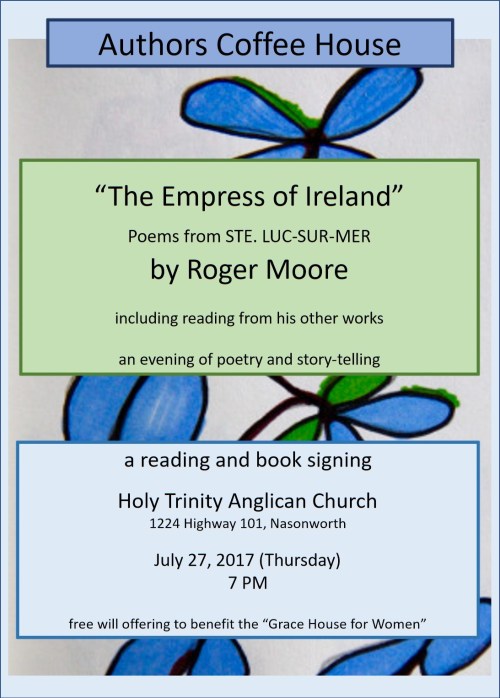
Coffee House

Roger poster 1

I have not been very active on the reading scene for some time now, so I welcome this chance to appear in public behind a microphone and with a book in my hand.

My thanks to Jane Tims for organizing this reading and creating the poster.

If anyone is in the area, please drop in and visit. I’ll be on my best behavior.

I promise.

Identity: Wednesday Workshop

IMG_0067


Identity
Wednesday Workshop

5 July 2017

Today’s workshop settles on the question of identity, loss of identity, and the attempt to recover any form of cultural identity that one feels one has lost. These questions are particularly important in the current age when so many differences are so easily erased. Language, culture, identity, music … they are all tied closely together.

The search for identity runs parallel to the search for the poetic voice (or the writing voice) that is so unique to each good writer. In fact, one can distinguish between good writers and lesser writers merely on the basis of voice. Lesser writers rarely establish a distinct voice while good writers usually have voices that are uniquely their own.

What to do we mean by voice? When we read Shakespeare or Miguel de Cervantes we know almost immediately whose work we are reading. The same is true of the great musicians. Bach, Mozart, Beethoven, Mahler, all have sequences and styles that are individual to them, as do Scarlatti, Brassens, The Beatles, Gordon Lightfoot, Gilles Vigneault, Edith Butler … their style, their voice is established. We listen to them and we know who they are.

Cultural identity is also very important. It is tied into language, childhood beliefs, fairy tales, myths, the basic culture that we receive as children. When we all listen to the same radio stations, or download the same ITunes, or watch the same TV programs with their infinity of ad nauseam advertisements, then we are socially engineered to be the same or, if not the same, remarkably similar within a series of very limited and extremely limiting patterns. When we establish our own identities, — and this is always difficult both for people who have had their culture taken from them and for immigrants, or the children of immigrants, who want to retain their culture at the same time as they blend in and fit in socially — then at the same time we develop our own voices.

When I hear the poetry of Lorca, of Antonio Machado, of Miguel de Unamuno, of Octavio Paz, of Dylan Thomas, of Gerard Manley Hopkins, of Wilfred Owen, I hear their very distinctive voices and recognize their individual styles and the cultural / poetic identities that they have established. The goal that we, as writers, are aiming for is to establish our own style, our own voice. To do this, we must listen to ourselves and discover how we think and how we feel. Then we must listen to others of our own generation. We must make comparisons and establish what we do differently, why we are different, what forms our differences … our own individual voice may come from speech rhythms, from language usage, from the establishment of a certain form of narrative, from the use of imagery or metaphor … there are so many different ways in which we are, each of us, different … or capable of being perceived as different.

When we write often enough and frequently enough, we at last begin to recognize those words, those phrases, those rhythms, those ideas, that are ours and nobody else’s. This is when we start to discover our own voices and our own personalities. It is a goal worth striving for … step by step … poco a poco … little by little … and a step forward everyday … until we grow into the type of writer or poet, fully established (or establishing), that we were always meant to be.

It is never easy to capture oneself and place oneself on the page in readable form. It’s a bit like trying to draw Picasso’s blue vase using only one blue pencil: not easy. It’s much easier to take a selfie with a flashy cell-phone.  Cell-phone selfies are easy, but verbal selfies are what we are seeking for. They take much longer to ‘produce’ and it is only when we finally achieve them, that we realize how difficult they are to actually achieve. But remember, read and re-read my earlier postings: don’t give up; don’t get off the bus!
 

Residency: Thursday Thoughts

Chaos

Residency
Thursday Thoughts
29 June 2017

Application:
I would not have applied for the residency at KIRA had I not have been encouraged to do so by my writing group friends and by a friendly voice on the Kingsbrae phone.

Acceptance:
I was surprised to receive notification of my acceptance. It arrived on 2 March 2017. On 3 March 2017, I started to peruse the Kingsbrae web page and make the first drafts of poems that I would later complete on site.

The Red Room:
I was lodged in The Red Room in the KIRA Residence and I had a small desk at a window overlooking Passamaquoddy Bay. I spent a whole month looking out of that window and writing at that desk … or was it the other way round?

Community Commitments:
These were multiple, but they were always art orientated and therefore most enjoyable. They included working with school children, attending various unveilings and openings, and being present in our studios and discussing our art with visitors. On 26 June we had an exhibition in which each one of us either showed our work or produced a live performance.

Evening Salons:
Most evenings we had a literary / artistic salon in which we discussed various aspects of our art. These lasted two to three hours and some were summarized while others were video-taped. These quick-fire exchanges provided a backbone to our daily work.

Trips:
There was time for local trips and we travelled, individually or in groups, to many places including Deer Island, Passamaquoddy, Campobello, St. Stephen, New River Beach, Holt’s Point, Greenlaw’s Mountain, Jarea, Minister’s Island, Ile Ste. Croix, and several other locations. The photographic records enabled us to build our creativity.

Artistic Development:
This was individual to each of us, but we all remarked on a widening of our perspectives, a new commitment to narrative and theme, and a broadening of our artistic horizons.

Returning Home:
On my return home, I turned to my everyday life in which art, in my case writing, was of secondary, not primary, importance. The need to cook, to shop, to do normal household duties suddenly conflicted, once again, with my need to be a writer.

24/7:
24/7 is indeed a cliché. But for 28 days it became the pattern of my writing life. It was indeed a fertile time. I wrote some 100 poems, 25% of which will be rejected, with a possible thematic structure and three revisions already completed. Sooner or later, I will produce a book about this experience..

Conclusions:
This type of time commitment turns us from budding /artists into the real thing. We must strive to re-create these last 28 days in what remains of our creative lives. There can be no lesser or secondary choice, if we are to be serious about our art.

The Journey:
If we wish to travel from Halifax to Vancouver by bus, we must make several decisions.
1. We cannot get off at Moncton.
2. We cannot get off at Montreal, nor at Toronto.
3. Winnipeg, Regina, and Calgary are beautiful; but we mustn’t get off the bus.
4. If we do, we will never get to Vancouver.

Conclusion:
Art is a life-time journey: don’t get off the bus.