The Joy of A New Book

IMG_0915 (2).JPG

The Joy of a New Book

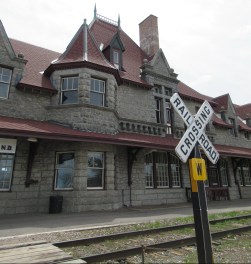
Very little to beat it actually, the joy of receiving and opening a new book, especially when it is one you have written yourself, in cooperation with a group of friends. In this book are the twenty-four (24) poems that I wrote for McAdam Railway Station.
IMG_0921 (2).JPG

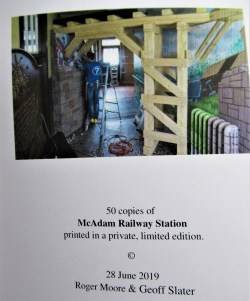
I went to McAdam to watch Geoff working on his mural and installation (diorama). While there, I heard stories about the railway and started to write them down in stanza form. While I did write them, most of them were based on stories and anecdotes heard or overheard while the guides were guiding the tourists round the site. This is indeed a limited edition. We originally intended to print only 50 copies, but when we heard that there might be up to 300 people at the unveiling of Geoff’s mural, in McAdam, at 1:00 pm, Sunday, 30 June, 2019, we doubled the number of books we printed. I will be donating the majority of the 100 to McAdam Railway Station Historical Association. They can either give them away or sell them to help fund and support the impressive restoration work they are doing.
IMG_0923 (2).JPG

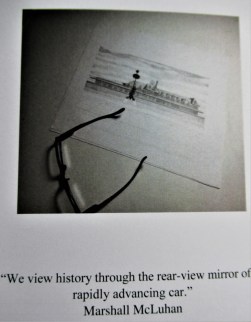
“We view history through the rear-view mirror of a rapidly advancing car” … and writing these poems was a veritable journey back into the past. Geoff left his glasses by his half-finished drawing, and that’s when the idea of linking McLuhan to Moore to McAdam occurred. Several of the poems focus on my own experiences of railway stations. Travel by train was a frequent choice in my childhood and  I went almost everywhere by train. A local in-town train ran from the station at the end of our road and I often took it when visiting friends, shopping in town, or following the local soccer team, Cardiff City, aka the Bluebirds. As a result, much of the imagery within the poems involves my own knowledge and love of trains, while the narrative structures themselves are often based on those overheard words.
IMG_0919 (3).JPG


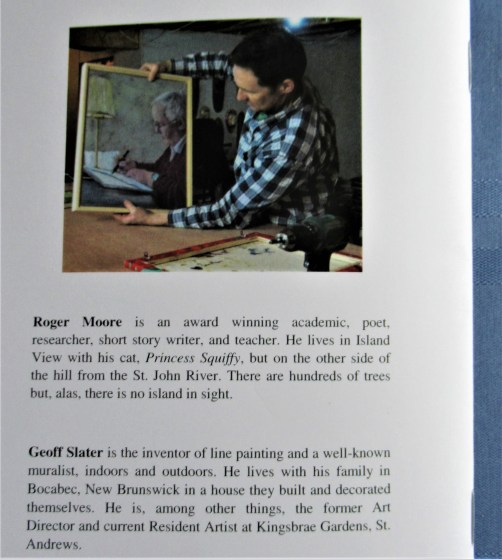
We wanted a photo of Geoff and me on the back cover and I discovered this one in my files. The portrait was done by Ruby Allan, my fellow artist in KIRA (June, 2107). She painted Roger Writing in the Red Room from a photo taken by another KIRA resident artist, Carlos Carty, the Peruvian pipe, as I was working at the desk in my room. Geoff framed the portrait and Mrs. Lucinda Flemer gracefully allowed it to be hung over the desk in the Red Room at KIRA, an honor for which I am exceedingly grateful. What a nice way to put our pictures on the cover of our book! If you are down McAdam way this Sunday, 30 June, drop in and see us. We’ll be there. Books and all.


Buried Alive

IMG_0688
Buried Alive
Anonymous we are,
never holding land or cattle,
lucky to own our own houses.Some castle
this rented row house
in a winding valley,
two rooms up
and two rooms down,

tin bath in the kitchen
filled with hot water
for when the shift ends.

After supper,
beer for a coal-dust throat,
then the wife, and sleep.

Next day,
a knock on the window,
a pulling on of clothes,
clogs clattering on cobbles,
a tin box sparse with food,
then down to the dark pit
of whatever mine has agreed,
at a price, to bury us alive.

Commentary: So much in this one. Very difficult to write. And a tribute to Rita McNeil’s It’s a working man I am,  two lines from the end. How long did it take me to write? Five minutes or less. Unless you count 200 years of coal mining (in South Wales alone), seventy-five years living and learning to write, and sundry workshops and exercises that have enabled me, just once in a while, to catch the butterfly as it flutters, although it never flies underground.

Flower-power


IMG_0902 (2).JPG

Flower-power
or
Why should the young kids have all the fun?

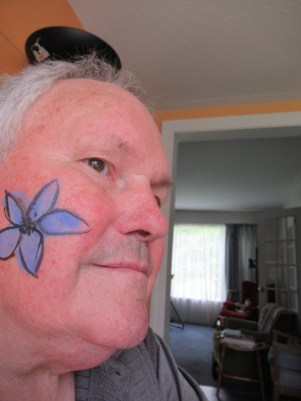
So it’s children’s day at the local supermarket. As I push my shopping cart through the door, I see the face-painter with a young girl sitting before her, getting her face painted. Behind the willing victim, several young children wait, shuffling their feet in expectation. I go out to the car park, unload my cart, and push it back to the supermarket.
As I park my cart, I see that the line-up has disappeared and the face-painter sits alone, cleaning her brushes. I walk up to her table and ask “How much?”
“It’s free,” she tells me. “It’s children’s day.”
“Will you paint my face?” I ask her.
“You’re not a child,” she looks at me in astonishment.
“No, I’m not,” I reply, “but I’m in my second childhood.”
I pull out the chair and sit down.
“I’ve got some photos on my phone, or I can try and paint whatever you would like. Would you like to see some pictures?”
“No, thanks. Just  look at me and paint what you think I would like.”
“What are your favorite colors?” she looks at me and smiles.
“I don’t have any favorite colors, but I always avoid green, yellow, and gold.”
“Oh, well, how about a nice flower?”
“Great!” I say.
One of the trolley boys who return the shopping carts in great convoys walked by.
“You need a mirror,” he says, “so people can see themselves.”
“Great idea, stay here, I’ll go and get one.”
“Don’t worry. I’ve got a mirror in the car. I’ll have a look when I get there. Meanwhile, it’s a surprise. I’ll put a photo up on my blog when I get home.”
“Promise?”
“I promise.”

IMG_0903.JPG

I gave her my blog address and I kept my promise. Unlike many people I know, I usually do.

IMG_0903 (2).JPG

Commentary: with many thanks to Emily, the face-painter, who treated my second-childhood with humor and dignity. As I said to her at the time, ‘why should the young kids have all the fun?”


Dewi Sant


IMG_0899 (2).JPG

Dewi Sant
Cathays

 To be Welsh in Cardiff on St. David’s Day
is to walk the dogs through Blackweir Gardens
and to nod with the daffodils as they step
their stately minuet under the trees.

Wet paths wander through rain‑speckled woods
and the fish are born blind in the gardens’ stream
on account of the coal that drifts its black silt
like fine, powdered night‑time down from Taffs Well.

Under their umbrellas, the fishermen dream
of sewin and perch; the bubbling waters
swirl faster today because of the rain that fell
last night in the Rhondda where a word‑storm

brought closure of pit after pit and each loss
cut colder than a volley of hail as King Coal
tumbled from his mining‑valley throne.

Yet still the daffodils sway, the fish are born blind,
and the Taff’s black waters swirl restlessly on
past unemployed fishermen to Severn and sea.

Dreamer

IMG_0826 (3)

Dreamer
Maindy Road
Cardiff

Dressed in clothes spun from the thinnest of air
I gave my dreams to any who would listen.
“A gift,” they called it, “for words.”

Yet, when the winds blew wrong
my words changed to smoke that stained
or flames that blistered and scarred.

My tongue twisted and forked until lies
lay heavy in my mouth and my words
were weighed down with hooks, and sinkers.

My life became a night-mare ridden full‑tilt
at a windmill with a great wooden sail.
On certain nights, when the sky was sprinkled

with seeds of living gold, I rose upwards
to the moon and my words become stars;
on lesser nights, I lay broken in the gutter.

Swansea

IMG_0898 (2).JPG

Swansea

To be Welsh in Swansea is to know each stop
on the Mumbles Railway: the Slip, the Rec,
Singleton Park, Blackpill, West Cross, Oystermouth,
the Mumbles Pier. It’s to remember where single
lines turn double by Green’s ice‑cream stall.

It’s to know where the trams fall silent, like dinosaurs,
and wait without grunting for one to pass the other.
As you wait you can hear the winter roar of the rugby
crowd or St. Helen’s summer “click” of ball on bat.

Today the tide is out and the nets are golden with starfish
as if a night sky stretched across day’s horizon.
Mudflats rule the bay beyond the sand, and banana boats
ride the distant waves, waiting for the tide to turn.

When it does, the Mumbles Railway has been sold
to a Texas millionaire and the brown and yellow busses
no longer run to Bishopston, Langland, Caswell,
Pyle Corner, Pennard, Three Cliffs, Ilston, Rhossili:
sweet names of sea and sand where my father fished
for salmon bass, his thin line cast defiantly at a rising sea
that would smash the walls of the sandcastles I built to last
forever, unaware that time’s rising tide would breach
their defenses, leaving them in ruins on the summer
beaches where I dreamed my buoyant boyhood away.

Commentary: The Mumbles Pier from Limeslade. This is the first water color painted by my father’s brother, my godfather after whom I received my second name. He took up painting after he retired and became a quite accomplished amateur water colorist. He gave me four of his water colors, I particularly wanted this, his first, and the later ones are excellent, especially the award-winning paintings, of which I have one.

Rhondda Fawr

IMG_0689


Rhondda Fawr

To be Welsh on the coalfield
is to speak the language of steel and coal,
with an accent that grates like anthracite ‑‑
no plum in the mouth for us; no polish,
just spit and phlegm that cut through dust and grit,
pit‑head elocution lessons hacked from the coal‑face.

We sing arias and deep, rolling hymns
that surge from suffering and the eternal longing
for a light that never shines underground
where we live our lives and no owners roam.

Here “gas” and “fall” mean violent death
and the creaking of the pine pit‑prop is a song‑bird
suddenly silent in its cage warning of danger
soon to be upon us…

… words and music stop in our throats
as up above us the sad crowds gather.

Featured Image -- 7454

Sheep

IMG_0126 (2).JPG

Sheep                               

Wales is whales to my daughter
who has only been there once on holiday,
very young, to see her grandparents,
a grim old man and a wrinkled woman
who wrapped her in a red shawl
and squeezed her and hugged her
till she cried herself to sleep
lunging for lack of space and air,
suffocating in a straitjacket
of warm Welsh wool so tightly bound.

So how do I explain the sheep?
They are everywhere, I say.
On lawns, in gardens. I once knew
a man, a friend of my father’s,
whose every prize tulip was devoured
by a sheep, one single sheep
who sneaked into the garden
on market day when they left the gate ajar.

Sheep are everywhere, I say, everywhere.
I remember riding on a passenger train
and seeing sheep leering like tourists
peering from dark coal wagons travelling
God knows where and bleating
fiercely as we passed them by.

In Wales, I say, sheep are magic.
When you travel to Paddington
on the train, just before you leave Wales
at Severn Tunnel Junction,
you must lean from the carriage window
and loudly call “Good morning, Mister Sheep!”
and if the one you greet looks up,
why, provided you’re good and quiet
for the rest of the journey,
your mum and dad will buy you
something nice in London.

My daughter shows disbelief. And “Look
at that poster there:” I say, “a hillside
of white on green, and every sheep
as still as a stone,
and each white stone a roche moutonnée.”

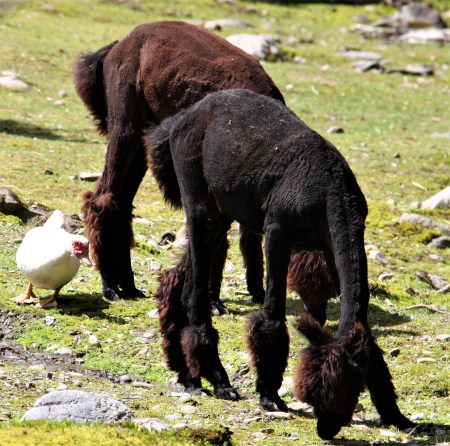
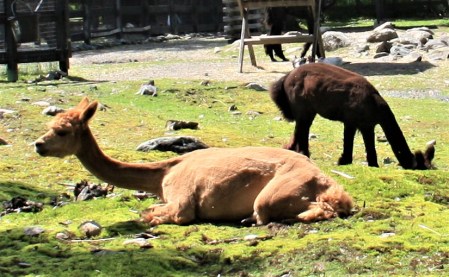
Commentary: I couldn’t find a Welsh sheep in my photo collection, so I used this photo of Pre-Columbian Incan sheep substitutes instead. Llamas is probably a Freudian slip or a typo for lambs. See: there’s reason for everything and a link between all things, even llamas, vicuñas, and alpacas, like this pair from Kingsbrae Garden Barber Shop Shorn Quartet. The other two from the Barber Shop Alpaca Quartet are around somewhere. I’ll go and look. Ah yes, here they are. Listen carefully, and you may hear them sing.

IMG_0119 (2).JPG

Tracks

IMG_0777

Tracks
McAdam Railway Station #12

“Put your fingertips on the rail,
see if you can feel its pulsing beat.

No heart rail rhythm now. No tremble.
Put your ear on cold metal:

nothing but silence. No murmur,
however distant. Black fly whine.

No-see-ums flit. The train track’s
buzz of harmony is lost and gone,

replaced by careless nature. Listen
to the wind whistling in the woods,

hark to spring sounds, so subtle,
grass growing, rust accumulating,

sleepers turning over in their graves,
silent, rotting beneath forgotten rails.”

Comment: Nothing so lonely as an abandoned railway track, rusting beneath snow and rain, the wooden sleepers rotting into oblivion. That said, the Southern New Brunswick Railway still carries freight trains through McAdam, and it is the railway station that suffered, with the loss of passenger traffic, rather than the rails themselves. What a pleasure, incidentally, to hear the hoot of the approaching diesel, to count the wagons as the train came to a halt outside the station. Then came the joy of watching the engine separate wagons from the main train, shunt them into sidings, return, and take the freight train, slow at first, but rapidly gathering speed, out of the station and away into the distance. Such memories. So many ghost trains riding those rails. So many ghosts bewitching the windmills of the child’s mind that still inhabits the ageing brain.

IMG_0780


Duende

img_0826-3.jpg

Duende
Federico García Lorca

It starts in the soles of your feet, moves up
to your stomach, sends butterflies stamping
through your guts. Heart trapped by chattering teeth,
you stand there, silent, wondering … can you? …
will you? … what if you can’t? … then a voice breaks
the silence, but it’s no longer your voice.

The Duende holds you in its grip as you
hold the room, eyes wide, mouths open, possessed,
taken over like you by earth’s dark power,
volcanic within you, spewing forth its
lava of live words. The room is alive
with soul magic, with this dark, glorious
spark that devours the audience, heart
by heart. The magic ends. The maelstrom calms.

Abandoned, you stand empty, a hollow
shell. The Duende has left you. God is dead,
deepening your soul’s black night. Exhausted,
you sink through deepest depths searching for that
one last drop at the wine bottle’s bottom
that will save your soul and permit you peace.

IMG_0810 (2).JPG