B & W

B & W

black words     white page

thoughts

floating in space

airs and graces

the world’s wind

blowing through

freshening     cleansing

cotton clouds     silky sky

that one word

waiting

to be spoken

that one thought

soon to be borne

out from the dark

a new existence

brightens

blinds with its light

Click here for Roger’s reading.


“If you look at a page of poetry, the slim words are couched in the empty whiteness of the page.” John O’Donohue, Anam Cara, p. 69.

Spider Web

Spider Web

for
Ginger and Michael Marcinkowski

I do love long and complicated sentences,
stuffed with clauses and dependent clauses,
 and all strung together like a spider’s web,
an enormous web with silvery threads that glisten
 with dew drops in the early morning sun that
blanches them, turning them white, and look,
there’s a little fly caught in this one, trapped
by his own struggles, and struggling even more
as the spider emerges, advances towards his prey,
soon to be his breakfast, or lunch, if he lets his victim
stew in the poisons soon to be injected, and look,
dew drops are falling as web shakes, and threads
tremble, and the dark and seamier side of life
emerges with its stark, black lines, from beneath
the advertising mask of glorious beauty that distorts
reality, as the spider turns into an assassin and the fly
into his victim, and yes, each of us must choose whether
to be an assassin or a victim, meurtrier ou victime,
as Camus phrases it in one of his books, L’Étranger,
though I read it so long ago, when I was a teenager,
studying French in school, and that was one of the books
I chose to read, but I was never labelled, meurtrier or
victime, just trouble-maker, first class, because I didn’t,
wouldn’t, couldn’t tow the official line and kow-tow
to a rigid authority, that walked set lines, like this spider,
the meurtrier, who turned that fly into his victime, and I,
I who could so easily become either, became neither,
but merely the observer, who stands on the outside,
looking in, and watching as the show goes on and on,
year after year, seculae seculorum, world without end,
and yes, the English Master told me never to mix
metaphors, nor to add foreign languages to my poems,
but what if they are not foreign to me, but a part of my being,
as part of the spider’s being is to be a meurtrier, and as for
that fly, well, he is the victime, in whichever language you use,
and yes, this poem is only one sentence, and I love it, amen.

Click here for Roger’s reading.

The Rover’s Return

The Rover’s Return

The eternal return to The Rover’s Return,
renovated, again and again, but filled
with the ghosts of Ena Sharples and others
who walked this cobbled street before,
and every episode more or less the same,
though décor, characters, accents change
and life becomes ever more complicated
from episode to episode, the street slang
changing slightly, and ageing characters
ageing more and more as time goes by,
and yet the trumpet’s martial sound,
the rhythms of the northern brass bands,
the first of those accents to break the plum
in the mouth snobbery of Oxford English
and the BBC’s domination of the language,
and ‘hey, Mr. Oxford Don, me no graduate,
me immigrate,’ echoing round the abandoned
buildings where the working class once worked,
and the elderly were cared for by their friends
and neighbors, not tossed into care homes,
and abandoned to their fate, as they have been
so often of late, and all things change, in time
with the clocks that tick-tock forward, their clock
work everlasting, and the pigeons still there,
and those crazy chimney pots, and that cat,
slithering down the roof, and the rovers still roving,
then returning, once again to the Rover’s Return.

Click here for Roger’s reading.

Comment: For more than sixty years I have listened to Coronation Street and some things have never changed, the trumpeter from the Brass Band, the rain on the cobbles, the memories and ghosts that linger among brickwork and paint. It takes me back to my childhood, when ITV was the upstart channel that dared to challenge the might of the mighty, one might almost say, the almighty BBC. And now, here in Island View, I turn away from the color and recall the old black and white sets, with their selection of two channels, one of them advert free, and their scheduled times of programs, not the TV blaring twenty four hours a day and two hundred channels available at the touch of a button.

It’s all one sentence, though I had to stop and take a couple of breaths while reading it. My good friend and fellow poet, Jane Tims, has called me ‘the master of the long sentence,” and I do love long sentences, especially when I am in rant mode, like now. But I am also very much aware of other friends that warn me that “your sentences are too long. They are too complicated. I don’t understand them. Write shorter sentences.” OMG, FFS. LMA* – 4 – UAW** – IMHO.

Translation of unusual terms: LMA* = Leave Me Alone. UAW** = You aRe Wrong.

Acknowledgements: My quote from the poem, inaccurate, and from memory, is from John Agard, whose poetry I love. I acknowledge now his poem and its influence upon me. I too am no Oxford don, and I too am an immigrant. His wonderful reading of the full poem can be found here. John Agard, Oxford Don.

Ides of March

Ides of March

Sometimes, as the sun goes down, the shadows close in.
You can sense real people, half-hidden in the mists
rising up from the ground. You shiver in their presence.

They fought a battle here, according to legend.
Legends never lie, though they hide away the facts,
as these mists hide those fallen warriors, brought
back to life, in the half-light, and thirsting for warm blood.

In the distance, blood flows staining the evening sky.
When the hairs on your neck rise up as wraiths, you take
to your heels and run to the place where you left your car.

Westbury White Horse, Badbury Rings, Maiden Castle –
such places are haunted with those whose spirits never left,
never moved on. They stayed here, defending the defenseless,
spirited warriors, never saying die, not even when dead.

Close by, at the hill’s foot, someone has built an altar
crowned by a small, carved cross. Who put those flowers on it?
Who came to bless the peace of those who dream and wait?

The Ides of March have come once more. Now they have gone.
Like all those other Ides before them, like all those years,
those seasons, those warriors. Come and gone. Or not gone,
as you stand there, sensing their spirits, living on and on.

Click here for Roger’s reading.

Comment: The Ides of March – March 15 this year, two days before St. Patrick’s Day. “The Ides of March are come.” “Ay, Caesar. Come but not gone.” William Shakespeare. Julius Caesar. The Ides always seem such a precious time. Sandwiched between St. David (Wales) on March 1 and St. Patrick (Ireland) on March 17, and all so close to the Equinox and the start of spring. It is snowing outside my window as I type. About four inches / ten centimeters down and more to come. But, with the lengthening of the daylight hours and the arrival of spring, we hope the snow won’t last too long.

Light Breaks

Bandits

Two shadows,
at three in the morning,
their faces masked,
shifty in the moonlight,
slip soundless over snow,
as they move towards
the bird feeders.

They huddle together,
forming a darker patch.
I watch the feeders move,
but cannot see the seed
nor hear it as it falls.

The feeders empty,
they move again
towards the back porch,
climb the steps,
and settle once more.

I know that by morning,
all traces of seed will be gone,
devoured by Dyson and Hoover,
scavengers and professional
seed removers.

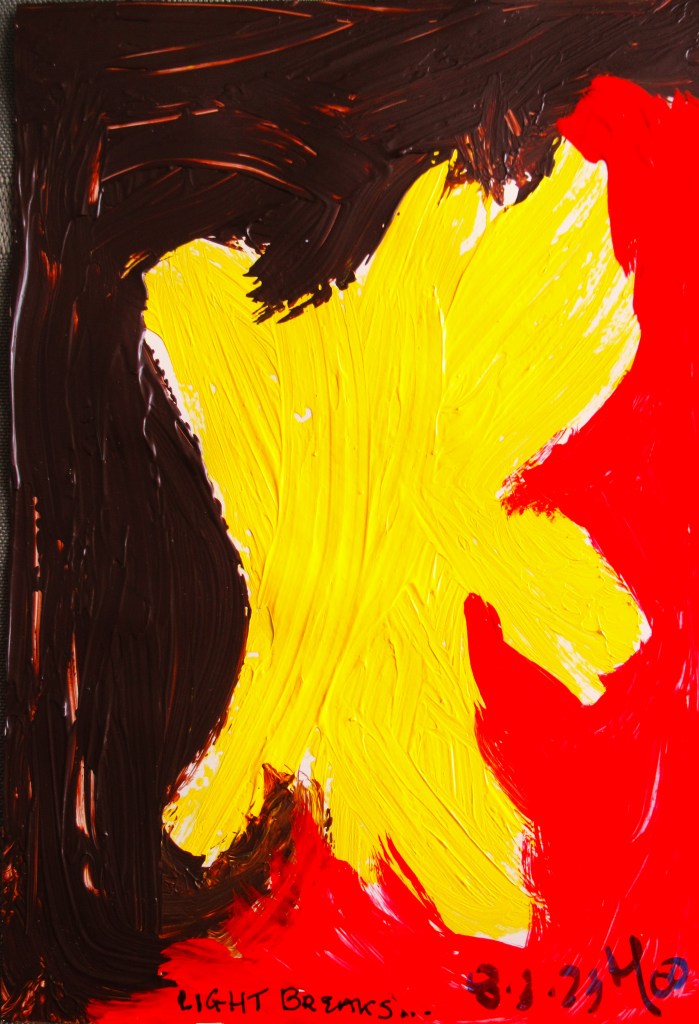
Comment: Light Breaks

“Light breaks where no sun shines…” but sometimes it takes a long time to happen. The name of my blog is rogermoorepoet and it’s main function is to showcase my poetry, above all, to my friends and followers. In my efforts to publish in print form, I have neglected to pay attention to the main function of this blog – poetry. Why? Because when I submit poems I always find the phrase – ‘must be unpublished – including on social media’! So I stopped publishing poetry on my poetry blog and on other social media. Okay, okay. I know. I am an idiot. BUT – light has now broken where no sun shone – Dylan Thomas, of course, another Swansea Boy, and as of today poetry is back. A big thank you to any and all who have been waiting for its return. Give me some encouragement – let me know if you like what I am doing – paintings and poetry!

Click here for Roger’s reading.

Waiting for Godots

Waiting for Godots

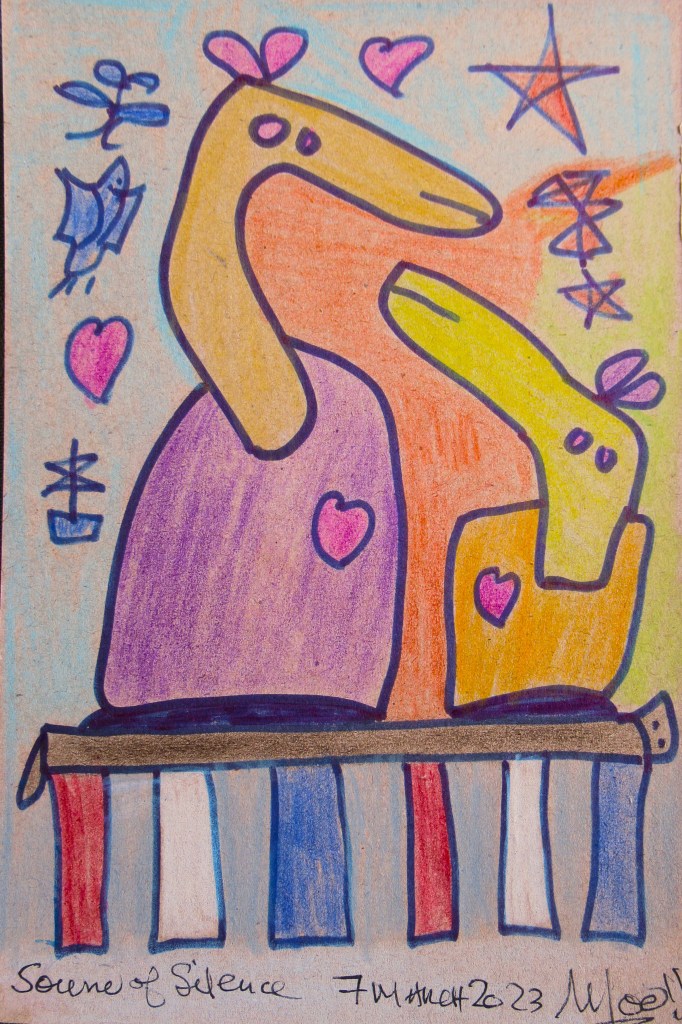
What do authors do when they send manuscripts to agents or presses? They have several choices. For example, they can listen to the sound of silence. Listen carefully to the paining above. What does it say to you? Absolutely nothing. Quite. It doesn’t communicate. It’s the sound of silence.

Another choice, they can read and re-read Beckett’s Waiting for Godot. Alas, in this case there are many Godots out there and all of them are super-busy gazing at their navels – and I don’t mean oranges. Some indulge in the wonderful world of “Mirror, mirror, on the wall…” and we all know what the answer is to that question. And we know what happened to Narcissus when he saw himself in the river water. Or have we forgotten? Our failure to share cultures is also a sound of silence – two solitudes, gazing at each other, neither one having anything in common with the other one, except maybe the weather. And we can’t always agree on that.

A third choice, they can climb into their dustbins, Queen’s English for garbage cans, and stand there waiting for someone to put the lid on so they can go back to sleep. Allusion / elusion – you don’t know what I am talking about? Well, maybe we are living in two separate solitudes. It wouldn’t surprise me in the least.

A fourth choice, they can take up painting, and scribbling, and drawing, and doing all sorts of things. But, if the phone rings and you don’t recognize the number – don’t pick up the phone. It’s probably a fraudulent scam call. And if you don’t know the e-mail address, put it in Spam and then block it. It’s probably some bot from another country trying to trap you into giving them your bank account details and signing your savings away. Whoever it is or they are , I doubt if it’s an agent or an editor!

Tell us about yourself

Tell us about yourself

That is one of the questions I most hate to be asked. What on earth is there to tell? One direction is the Muhamad Ali route – “I am the greatest!” Some people take that route and walk you down the highway of their lives, everything from winning the egg and spoon race (age seven), to coming second in the three-legged race (age 9), to finishing third in the slow bicycle race (age 11). And that’s just the start. A similar route is the 007 route – license to kill – shoot from the lip – a blast from the past – history, herstory, my-story – by me!

No way. My history is a mystery and long may it remain so. There are many magic moments (thank you Perry Como – my mother’s favorite singer) and many tragic moments. Some might be worth mentioning, most I’d rather keep quiet about. I think sometimes of the famous examination question – write down everything you know – except I can’t remember who was examining who, nor why they were being examined. Sounds a bit like the Civil Service to me, before they ask you to swear the Official Secrets Act.

On the other hand, if a person asks me a direct question, I will try to answer it to the best of my limited ability. Who is Lisi? I don’t know. Her identity has baffled the literary critics for close to 400 years and I certainly haven’t been able to solve it. Why did Cervantes write the Quixote? Try asking him yourself – but I guess if he’s been silent since 1616, he will remain silent for a lot longer. Not everyone is – or wants to be – the Memory Man – “We know Easter is a Moveable Feast, when did Easter Sunday last fall on Boxing Day?”

Trick question – Easter Sunday is a race horse, not a holy holiday. Boxing Day, in Britain, used to be the day for point to points and obstacle races for horses. But the Memory Man knew that. He also knew the name of every jockey, every horse, their weights, their odds, the order in which they finished, and the name of the fence which caused Easter Sunday to fall on Boxing Day.

So, tell us about yourself. No. I won’t. I am not the memory man and I will reveal as little as I can. Remember the old song – “Yesterday is history, today is still a mystery, but what a day it’s going to be tomorrow.” Right – now I am ready to tell you about myself. I am not yesterday’s man, I am today’s man, and today is still a mystery. Sorry, I can’t do better than that!

Writing in the Red Room

Writing in the Red Room

Dawn over Kingsbrae, as seen from the writer’s desk in the Red Room in KIRA. “A poet could not but be gay, in such a jocund company.” Wordsworth, thankfully, for how words change their value as language transforms itself and old values and meanings grow wings and flit away.

Gai saber – from Old Provençal: “gay knowledge” or “gay science”, the art of composing love poetry, especially the art of Provençal troubadours as set forth in a 14th-century work called the Leys d’amors. But one doesn’t have to be gay, in any sense of the word, old or new, to write poetry, and it is difficult not to write poetry when the sun creeps over those hills and lights up the room and the bay below.

Warmth and light flood into your heart. The pen fills with words and they splash out over the page, moving the writer as the sun moves, as light moves, as light breaks where no sun shines as yet, but will, soon, so very soon, and here it comes, filling the heart once more with wonderment, the bay with light, and the page overflowing with the joy of light.

To be here is to be honored and privileged beyond words. To be able to share that joy with others is a blessing that many seek and few find, and none possess, for, like fairy gifts, such powers fade away all too swiftly. And, when all is said and done, one can only be humble, rejoice in each moment, and give thanks.

My Teenage Self

My Teenage Self

What advice would you give to your teenage self? In one word – grow up. Useless advice really, because it happens, whether we want it to or not. That said, I have lost so many young rugby players that I coached or played with, to driving accidents and other misfortunes, sometimes self-inflicted via alcohol or drugs, that to say grow up – please! – is so important.

Each morning I read the obituaries in the local newspaper. Afterwards, I look back over the path I have journeyed. If I had perished at the age of the current ‘missing person’ – say, 45 – 50 – 55 – 60 – I think of all that I would have missed in those intervening years. Then I grieve for all that they will have missed in the life that should have lain ahead of them.

“Don’t cry over spilt milk” – Old Welsh Proverb. And no, we mustn’t cry over what is lost. We must celebrate what has been achieved, Dylan Thomas (1914-1953), one of Wales’s greatest Anglo-Welsh poets, dead at 39 – what other glory may have lain ahead of him? Garcilaso de la Vega (1501-1536), one of Spain’s purest and most innovative poets, dead at 35. What more might he have written in an extended lifetime? Federico Garcia Lorca (1898-1936), executed, many say tortured and murdered, at the age of 38. Think of the theatre, the poetry, the Gypsy Ballads, the songs of a dark love – what more did he have, hidden inside him, that was never allowed to spread its wings and fly out into the light of day?

So, I would give to my teenage self, the same advice that I would give to any teenager – grow up – please, grow up, don’t go too soon, – and please grow into that unique and wonderful being that you have the potential to be.