Rage, Rage
54
Terminal and terminus,
they both mean nec plus ultra:
the Pillars of Hercules,
the end of the known world,
and my own world’s end.
I throw my hands skywards
in desperation:
“Is anybody up there?”
There’s no reply,
and I see no ladder
for angels to descend
or ascend.
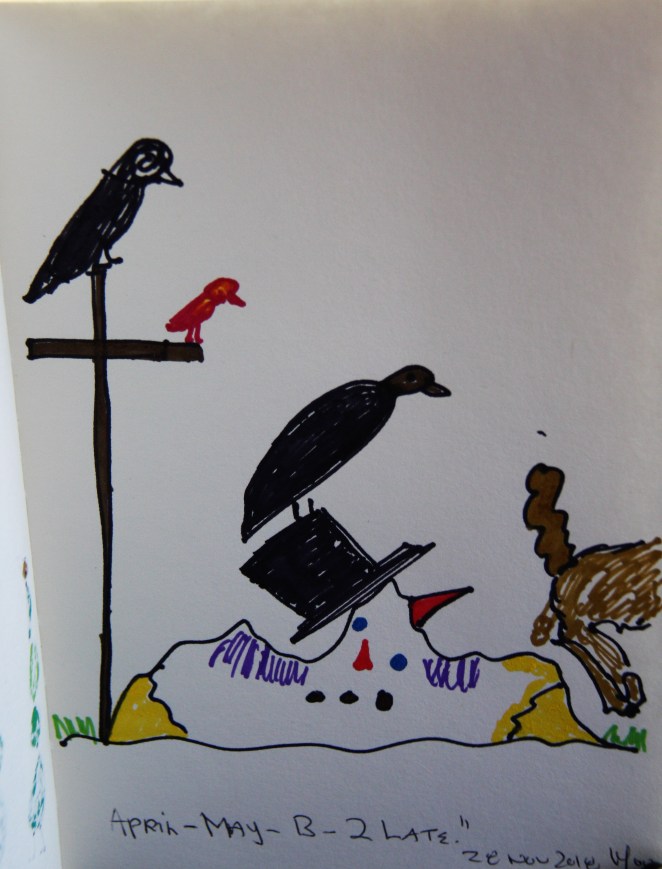
Only the crows,
those black-winged
monarchs
destined to wear
the survivor’s crown,
cry out their anguish
as they wait for the day
when they’ll pick clean
my unburied bones and
rule this sickening world,
an earthly paradise no more.
Comment:
When I said “I am looking for a picture of a crow,” Moo went wild. “Me,” he said. “I’ve got one.” And indeed he had. Here it is – two crows perched like vultures over the body of a fast melting snowman. Our current world in miniature – and don’t forget the yellow snow and the doggy doing a dump. “Moo,” I said, “That’s not nice.” “True to nature, though,” he replied. “You want reality – you got it.”
Reality – what a strange word. Who knows nowadays what is real? The barber’s basin in Don Quixote – is it a barber’s basin or is it Mambrino’s Helmet? Good question. Relativism – it depends on your point of view. U a barber’s basin – turn it upside down Ω and it’s a helmet. So how do we deal with an object that has two functions and can be seen both as one thing and then another?
Good question. Cervantes solves the problem in his own unique fashion – U – bacía / basin and Ω – yelmo / helmet. Put them together and you get the neologism [newly invented word] baciyelmo – a basin that serves as a helmet and a helmet that serves as a basin. Wonderful – if it weren’t for the snout, I’d swear that was the origin of the pig-faced bassinet.
Some days, I try to understand all this – but I throw my hands skywards in desperation: “Is anybody up there?” Another good question. I often ask myself that question but I despair of an answer.
My friend Francisco de Quevedo voiced the same question in a dream that came to me last night.
¡Ah de la vida! ¿Nadie me responde?
Life ahoy! Will nobody reply?
Is anybody up there?
Will someone reply?
Blas de Otero once made a similar utterance –
“I raise my hands in supplication
– you cut them off at the wrist.”
Tell me, if you know, – what is this life if, full of care, we have no time to stand and stare. And look at those crows, standing there, staring, waiting … waiting for their turn to come. Patient, eternally patient. Just standing around. Waiting.




 rogermoorepoet