Painting

untitled


Kingsbrae 10.4
10 June 2017

Painting
for
Geoff Slater

I took a line for a walk.
It was
as disobedient as
an untrained puppy on a leash,
as crazy as a kite
in a wind-filled sky,
as joyful as
a schoolboy when they cancel school,
as easy as
pie when the R is squared.

The dog walks round in circles,
gets my legs caught in his leash.
The kite, all twisted strings,
comes tumbling down a ladder of sky.
The apple pie is a pulled-up sheet,
folded double, and I am a child again,
trapped in my boarding school bed.

“Color me now,” my painting cries
and I fill the spaces between the lines:
blue for happiness, blue for hope;
yellow for the lion mane of the sun;
red for the redbreast;
brown for the worm;
and green for schoolboy freedom
at the end of term.

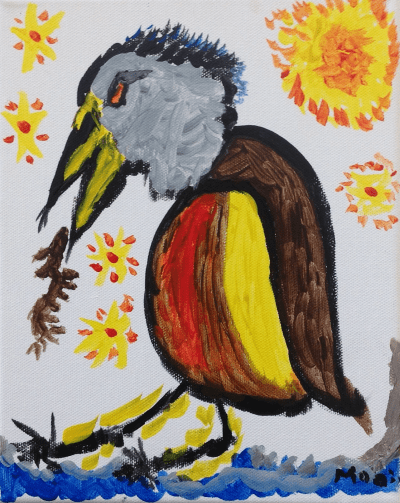
Journal: I had the great pleasure of working with Geoff Slater this afternoon. He sat me down at his painting table, alongside all the children, and gave me a palette, brushes, water, cleaning paper, and a rainbow of paint. Then he placed an easel and a canvas before me and put an apron on me to protect me from the paint. “Go for it,” he said. I looked at a field of white … and I remembered … “Drawing is taking a line for a walk” … so I drew a line, first a beak, and then a head and an eye, then I added wings, and legs … it was wonderful. The children were laughing with me and I was slapping the paint around with great delight. “Let me see, let me see,” they cried. And then, when they saw it: “What is it?” It was even more fun when I started to fill the spaces between the lines. This is, or was, the first time I have ever placed paint upon a canvas. In my old age, I have started to paint. “Is it a worm or a fish?” they asked. “Is the bird going to eat it?” “Is the bird spitting it out?” Such curiosity … and even I didn’t know the answers. “What’s the bird’s name?” asked one little girl. “Eagle-eye,” said the other. “And the worm’s called Squirmy,” added a third. “Are they talking?” another chimed in. “Yes,” I said. “I think they’re friends and they’re having a chat.” What fun. We left the painting out in the sun to dry … and now I don’t know where it’s gone. Let me know if you see it, anyone.

Poetic Process: Thursday Thoughts

img_0186


Kingsbrae 8.3
8 June 2017

Poetic Process: Thursday Thoughts

The end result of the poetic process, however we define it, is the poem. Whether the poem be good, indifferent or bad, depends on a set of critical value judgments of which the poet may or may not be aware at the time of writing. The end product must be allowed to look after itself. But what about the process?

The question is simple, but the answer is more difficult, because the actual nature of the process will vary with each one of us. If the end point is the poem, how do we write the poem, what is its starting point? Is it when we sit down to write? Is it when the pen nib (yes, I still write the old-fashioned way) makes contact with the paper? Is there a pre-writing starting point and if so, where does that begin? Is it in the poet’s head, or the poet’s eyes? Does it reside in touch or scent? Good questions: no answers other than the failsafe … it depends.

One thing that has emerged from this KIRA retreat is that above all we need time to be artists. Art and poetry take time, and artists, whatever their medium, need time to think, time to practice, time to splash paint on canvas, time to sit down and put their head in their hands and meditate … “What is this life,” writes W. H. Davies, the great Welsh poet, “if full of care, we have no time to stand and stare.”

Elise Muller came up with an interesting exercise for developing self-expression. “Write down a question with your dominant hand,” she said. “Then answer it by writing with your less dominant hand.” I tried this. “What do you mean by writing process?” my right hand asked. My right hand held the pen about half an inch from the page and made me stop … and think. I thought about the critical analyses, usually ultra-academic,  that I had written and read over the years. Then I started to organize them into do’s and don’ts. The thoughts of certain serious writers sprang to mind … then I switched my pen to my left hand.

Uncontrolled, uncontrollable thoughts came tumbling out and spilled off the end of the pen on to the empty page that rapidly filled with visual and verbal images: evening falls and the stars grow into flowers in the darkness … three deer enter an empty field and dance on the dandelions … the sky fills with snowflakes that erase, one by one, all the objects in the yard … the tide flows back in and the bay recovers its memories of silver fish beneath the waves … the half -empty / half-full glass becomes meaningless: its essence is to filter the sunshine and to sparkle with light … clouds gather into small, wooly herds and the wind chases them across the sky …

To be filled with poetry and creativity we must first be emptied of the cares of the world. Then, when our heads are empty and free there is space for them to fill with the most beautiful images and ideas. This creative process needs time. Time to download and forget our worries. “Time to stand beneath the boughs and stare as long as sheep and cows” (W. H. Davies again). Time to be ourselves. Time tobe. Time to become one with nature.

To gain this state of freedom, we need to be free of financial cares and woes. We need to escape from domestic duties. We need to be alone (when we need to be alone) and among friends of a like mind (when we need company). “The time to see when woods we pass, where squirrels hide their nuts in grass” (W. H. Davies, yet again). So, in the poetic process, we need that freedom to create, to cut the ties that bind so tightly, to walk and watch and stop and stare. When that old, tired head is empty, the poetry will flow back in. And it will be a poetry not of grinding ideas but of dancing metaphors and sparkling words. “A dull life this, if full of care, we have no time to stand and stare.”

KIRA has gifted me with this time, this quality time. Clare and the WYPOD and my Fictional Friends and the Thursday Grunts and my fellow New Brunswick writers have encouraged me to take advantage of it. The process is in process. Some of the results are already being seen on these pages.

My thanks to all those who made this adventure possible. I would also like to thank all those who now facilitate this process every day.


Kingsbrae 2.1

IMG_0486.jpg

Kingsbrae 2.1
2 June 2017

Pan Pipes
(for Carlos)

Lips form to make sounds
and the pan pipes speak
the international language
of love and lost love,
of a breeze through river reeds,
of fire on the snow high above
on Huascaran, Misti,
and wherever the pan pipes
roam, the piper will be at home,
his magic moving hearts and minds,
entering fingers that tap
and feet that move to the music’s beat,
yet beat is too harsh a word
for music that moves
like a breeze through the reeds
to pierce our souls
with its rhythmic breath
of a life now shared
with its mastery of that sacred art
older by far than other music,
save for the tapping
of stone and stick.

Zampoña andina
(para Carlos)

Los labios se comprimen
para formar sonidos
y habla la zampoña
la lengua internacional
de amor y amores perdidos,
de una brisa entre las cañas,
de fuego en las altas nieves
de Huascaran, Misti,
y dondequiera que viaje la zampoña
estará en casa el zampoñista,
su música penetrando
el corazón del oyente
haciendo bailar sus dedos
y danzar sus pies
al compás de la música,
aunque compás es una palabra
demasiado dura para describir
esta música que mueve y nos mueve
penetrando el alma
con el suspiro rítmico
de una vida ahora compartida
con su dominio de esta arte sagrada
más antigua que toda la música
salvo el batir de bastón contra piedra.

Journal: Last night, I picked Carlos up at the airport and we loaded the car. It was getting late, and between thunderstorms, water on the highway, poor visibility, the spring presence of moose on the highway, the gathering dark, and the hydroplaning that was a part of the storm, we decided to spend the night in Fredericton rather than arrive late and in the dark. My Spanish, very rusty, is improving under Carlos’s guidance. I am helping him with his English as he helps me with my Spanish.

This morning we are up early. Breakfast is ready. I will post this and then we will be on our way.


Metaphor: Wednesday Workshop

img_0177

Metaphor
Wednesday Workshop
26 October 2016
Revised
31 May 2017

Metaphors: What are they? I must be honest: I don’t really know. I don’t understand them. I never have. I probably never will. This morning, I determined to find out what a metaphor really is. So I Googled metaphor and came up with the following definitions.

  1. A metaphor is “a figure of speech in which a term or phrase is applied to something to which it is not literally applicable in order to suggest a resemblance.”
    Well, that is pretty clear, isn’t it?
  2. A metaphor is “something used, or regarded as being used, to represent something else; emblem; symbol.”
    No doubts there.
  3. “Metaphor is a figure of speech which makes an implicit, implied or hidden comparison between two things that are unrelated but share some common characteristics. In other words, a resemblance of two contradictory or different objects is made based on a single or some common characteristics.”
    I know exactly what they mean. Or do I?
  4. “In simple English, when you portray a person, place, thing, or an action as being something else, even though it is not actually that “something else,” you are speaking metaphorically.”
    No misunderstanding here.
  5. “A metaphor is a figure of speech that refers, for rhetorical effect, to one thing by mentioning another thing. It may provide clarity or identify hidden similarities between two ideas. Where a simile compares two items, a metaphor directly equates them, and does not use “like” or “as” as does a simile.”
    Slightly clearer, but not as clear as daylight.

I turn to my blog in search of metaphors that I have created in my poetry and read that “The egg of my skull / shows hairline cracks: / tiny beaks pecking / fine-tuned sparks of song”. “This piece,” Tanya Cliff writes, “offers a unique and beautiful perspective on the theme (of birds).” I think I can do without the dull, dry definitions set out in the definitions above and understand metaphor as “a unique and beautiful perspective”. This functions for me. Thank you, Tanya.

Two more sequences, this time from October Angel: (1) “she gathers her evening gown / and walks among ruined flowers” (Meg Sorick’s choice) and (2) “a snapdragon opens / the frosted forge of its mouth / and sprinkles the sky / with ice-hard shards of fire” (Tanya Cliff’s choice). I can understand the first in terms of “a unique and beautiful perspective” since the picture of the October Angel is clear in my mind. In addition, evening / evening gown / ruined flowers are particularly evocative. The second sequence is much stronger as anyone who has seen the snapdragon flowers braving the ice and frost will testify.

After thinking about these three examples, I think I can now understand metaphor a little bit better. I would now define a metaphor as “a brief verbal sequence that creates a new reality that offers a unique and sometimes beautiful perspective on something that we have long known and accepted but now, thanks to the writer / poet, see in a different light.”

This personal definition allows us to distinguish more easily between dead metaphors and clichés like dead as a door nail or avoid it like the plague while allowing us to enjoy the permutations that spring from the innovation of the true metaphoric sequence. The metaphoric sequence also allows us to distinguish between a two word metaphor and a series of metaphors that are thematically linked.

From my own poetry, ruined flowers would be an example of the first while the longer sequence a snapdragon opens / the frosted forge of its mouth / and sprinkles the sky / with ice-hard shards of fire would be an example of the second. Iterative thematic imagery, a form of sequenced metaphor chains, then links the whole work, be it poem or longer piece, within an associative semantic field of parallel meanings. This also illustrates the idea of differentiating between the inorganic and organic conceit, where the inorganic conceit is the example of a single, independent instance while the organic conceit is woven into the fabric of the oeuvre.

In the WFNB Workshop on Metaphor, held in Saint John on Saturday, 27 May, 2017, we had a two hour, in-depth discussion on this topic. We began the workshop with a meet and greet and ice-breaker. Then we offered a pictorial definition of a metaphor. We generated a series of dead metaphors, to be avoided like the plague, except where we use them to define a character, or make fun of them, or use them in a new fresh light that resurrects them and brings them back to life. This was a great deal of fun. We then indulged in a series of creative writing exercises that focused on the creation of new metaphors. We finished the workshop with a “song of craze” in praise of the joys of metaphors. What a day!

The structure of the workshop was very simple. We had 120 minute (two hours) and broke them into 3 sessions of 20 minutes, a 5 minute break, 2 sessions of 20 minutes, and  a grand finale composed of 3 sessions at 5 minutes each. The twenty minute sessions broke down into 5 minutes writing, 7 minutes small group discussion (4 participants per group), and 8 minutes full room participation. The five minutes writing centered on each person writing to a topic. Each member of the group then shared what they had written with the other group members. This helped develop individual voices (the theme of the conference) and showed how each individual approached a single topic in a multitude of different ways. A representative piece from each group was then chosen and the writer read the creation to those gathered in the full room participation.

As a result, everybody was actively engaged in the thinking, writing, creating, reading, and critiquing process. A considerable number of what I call “writing starts” were made. Hopefully participants will continue to develop these writing starts and develop something from them, long term.

Phoenix

IMG_0158

Phoenix

The wool shop has gone.
It survived the winter storms
that whipped the bay ice
into waves of mashed potatoes
that hardened and crashed
against the quay, splintering
its timbers, tearing it down.

It survived the spring time
freeze and thaw that cracked
the sea wall, split foundations,
and wobbled the shop
as if it were yellow jelly.

It survived the carpenters,
the stonemasons, the police,
the insurers that came
with their cameras and their
oh-so awkward observations.

It survived everything
except the lightning bolt
that lit the fire that reduced
the old shop to dust and ashes
from which, unlike the phoenix,
it would never be born again.

Gift

img_0137

Gift

“I have a gift for you,” I said.
“Why?” I had no answer.
Silence built its barriers
between us. “Look,” I said.
“It’s yours.” I held out the book
and she took it in her hands.
“For me?” she asked. “You wrote
this book for me?” “Yes.” The lie
hung in the air for a moment,
a listless, lifeless kite, floating.
“It’s beautiful,” she said. Her smile
ignited the air, sent sparks across
the space between us. She opened
the book, turned the pages, saw
her name. It was indeed her name,
but she was not the person who bore
that name when I wrote the book.

Rainbow

IMG_0375

Rainbow

I dreamed last night
that angels lofted me
skywards and wrapped me
in cotton-wool clouds.

The nearest rainbow
was a helter-skelter
that returned me to earth
where I landed in a pot
of golden sunlight.

Red, gold, and yellow
were my hands and face.
I stood rooted like
an autumn tree covered
in fall foliage with
no trace of winter’s woe.

“May this moment last
forever,” I murmured,
as the rainbow sparkled
and I rejoiced in
my many-colored coat.

Ticks

img_0177-2

Ticks

Ticks, as a student, are never to be feared.
They are good for you,
mark your rites of passage,
never catch on your skin
or bite into your beard.

Ticks in the woods creep and crawl,
people really don’t like them at all.
They fall and they climb,
bring diseases like Lyme.

Leeches are bad and suck at your blood.
They swell up with your juices
as you well knew they would.
But leeches don’t kill, as tick bites might.
So get out your tweezers and squish ticks on sight.

Comment: Ticks are about. Watch out for them and be very careful with them. Announcement on CBC Radio, 19 May 2017.

Weird

img_0380-2

Weird

Weird these words
dropping in inky
drops from pen end
poised above paper:
a variety of poses.

Not for me the key
-board’s voluminous
vocabulary, nor the tap,
tap, tap, fingers on lap
top to search for a word,
an idea, a distraction
just a tap away.

For me, the slow flow
of thought, the clumping
together of the mind’s
pretty litter of ideas
milked slowly, one by
one from a cornucopia:
happy creativity.

Sandman

IMG_0131

Sandman

The sandman brings
sand to put in my sandwich.

He brings it from
the nearby beach.
It’s as fierce as
fine salt in life’s
dwindling hour glass,
thin-waisted sandpaper
thinning down our ways,
throwing sand in the clockwork
that ticks out our days.

Sand rasps between toes,
sticks fast to our feet,
grows castles on the beach
where no grass grows.

Seven, lucky seven,
those clouds close to heaven,
but beware the sandbox
if you count up to eight.