Clepsydra 27

Clepsydra 27

… the museum closes its doors
     inside the clepsydra murmurs
          on and on

evening falls from the sky
     in great cataracts of light
          stars flare like candles

who will see
     that last drop of water
          trembling at
               the clepsydra’s edge,

who will snuff out
     that last flickering
          flame of my life
               as the final verses
                    of the children’s song
                         loom closer

Here comes a candle
     to light you to bed.
          And here comes a chopper
               to chop of your head…

Commentary:

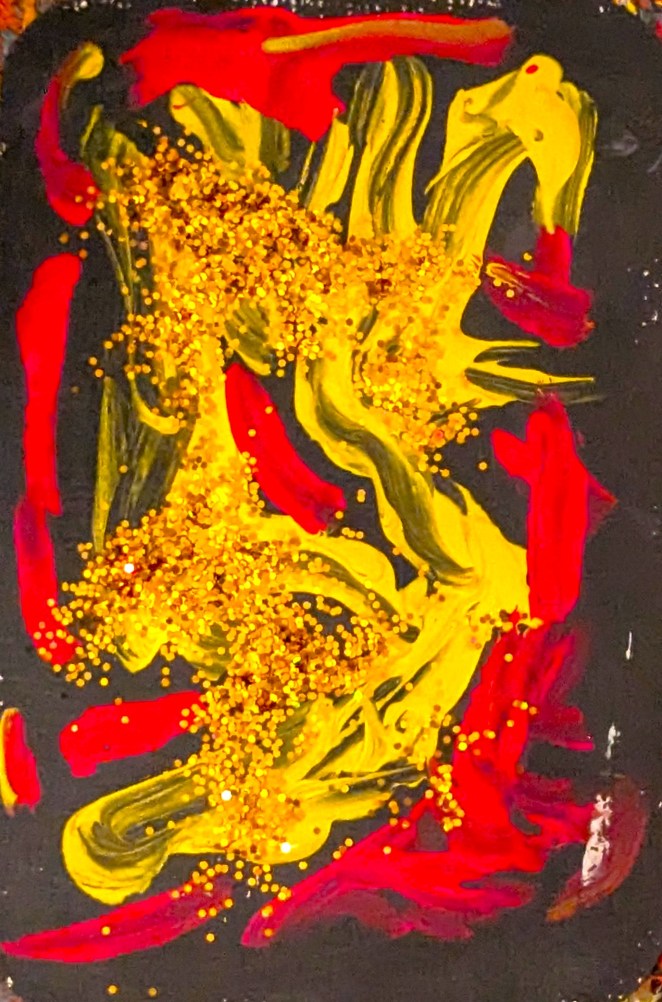
Moo got it right this time – “evening falls from the sky in great cataracts of light, stars flare like candles …” Lovely painting of a star ‘flaring like a candle’ against the evening sky. I think he called the painting Affirmation. Yup, he’s nodding his head, and he has his eyes wide open. He’s not dropping off into one of those drowsy moments of old age. Too early in the morning to do ‘noddy’ I say. Oh-oh, there he goes. It’s Billy Cotton Band Show Time … “Wakey-wakey!” Now how many of you remember the Billy Cotton Band Show on BBC Radio on Sunday afternoons, just as people are dropping off to sleep after the enormous Sunday dinner and dessert? Hands up if you’re over eighty and remember that. Oh dear. Not a good idea. Moo’s hand’s gone up and he’s still got his eyes shut. Ah well, appearances aren’t everything.

And look at that comma after – the clepsydra’s edge, (line 10) -. The one that got away. There’s always one that gets away, no matter how hard we try – and try we do. Clepsydra is meant to be a single sentence, with no punctuation other than an ellipsis at the beginning and end of each sequence. And what have we here? A common or garden comma, growing like a large, spring dent-de-lion / dandelion in the middle of a patch of flowery images and metaphors. Out, out fowl spot! What bird was that? A Flying MacBeth just dropped something on my windshield. ‘What a foul fowl was that fellow,’ said the soccer referee pointing to the penalty spot. A round spot with a whale of a tail.

“Any questions?” I asked my students at the end of class one day. A brave young lad raised his hand. “I have a question, sir?” [I liked it when they called me, sir. It happened about once or twice a year. I always knew something drastic was about to happen when I received a knighthood.] “Ask away,” I replied. “What the heck are you on? I’d love to have some of that. Can you give me some, sir!” Two knighthoods in one day. I’ll be a KG next, instead of an RG. I bet you don’t get that joke! Answers by snail mail and dog sled, please!

Clepsydra 25 & 26

25

… how will it all end
     does it not need closure
          something to bring
               the water-wheel full circle
                    a golden key to open
                         what

the museum’s door
     memory’s door
          the archives where
               so many memories lie
                    gathering dust

though some may tell the truth
     whatever that is

or does the story go on and on
     never pausing
          never ending
               wrinkle after wrinkle
                    threaded through time
                         after time
                              the candle
                                    burning

the clepsydra
     dripping all life away
          the pendulum
               swaying
                    back and forth …

26

… Westminster Chimes
     chiming the quarters
          church bells
               ringing out a warning

the hills alive
     alight
          with burning beacons

what new armadas
     sailing now off our coast
          what fireflies flicker
               their thunderous roar
                    frightening birds in trees
                         driving deer
                              into the woods

how many people
     cast forth like bread
          upon the waters
               to return ten-fold

hark to the bells
     ringing out again
          St. Clement’s
               St. Martin’s
                    the Old Bailey
hark to the children singing
     dancing in a circle
          never-ending
               until the music ends

and the last child
     is caught by
          the lowering arms
               trapped
                    a fish flapping
                         in the osprey’s grasp …

Commentary:

I wonder how many people still sing the children’s song about the bells of London? Images from it – intertextuality – occur throughout Clepsydra.

“Oranges and lemons,”
ring the bells of St. Clement’s.

“You owe me five farthings,”
say the bells of St. Martin’s.

“When will you pay me,”
ask the bells of Old Bailey.

“When I grow rich,”
sing the bells of Shoreditch.

“And when will that be,”
sing the silver bells of Battersea.

“I do not know,”
booms the great bell at Bow.

“Here comes a candle
to light you to bed.
And here comes a chopper
to chop off your head.”

The song appeared at children’s parties. Two of them joined hands, held their hands high, like London’s Tower Bridge, and the children, in a long chain passed beneath the ‘bridge’ as the song was sung. At the end, the children speeded up and they tried to avoid the last verse when the bridge’s arms descended and two children were caught. These then had to replace the original two gate-keepers and the game started again. At least, that was how I remember it being played.

It is worth remembering how violent in their imagery children’s songs can be. The games seem sweet, but they often have dark undertones, some going back to the Black Death – “Ring a ring a rosies, a pocket full of posies, atishoo, atishoo, we all fall down.” If you don’t know what that all signifies, go down the rabbit hole with Alice and the white rabbit and look it all up! And find out what a farthing is, and a penny farthing – go on – I double-dog dare you!

And remember – poetry carries its own meaning – or multiple meanings – and they are not always easy to find. Dig, my friends, dig. There’s gold in them there hills.

Raven

Raven

When Raven flies through his trap door in the sky, a light bulb clicks off in my head and I fall into darkness. Is there some safety net before oblivion? Raven’s claws scar crow’s feet on a fingernail moon. His bleak black beak widens the hole in my head and the Easter egg of my skull shows thin blue cracks. Outside my window, the river moves backwards and forwards with the tide. Raven shrugs at cancerous creatures, promising nothing. He soars into clear skies in search of his private exit and extinguishes sun, moon, and stars, plunging our world into blackness. The light on the point picks out a heron, mobbed by a clacking ring of gulls. The sea mist wraps the real world tight in its cloak. Now sea and lighthouse, heron and gulls, are distant things of memory. Raven, shoulders hunched, stands like a stone, an anthracite block hacked out from the coal seam in my mind, hand carved from feathers and my forefathers’ blood.

Commentary:

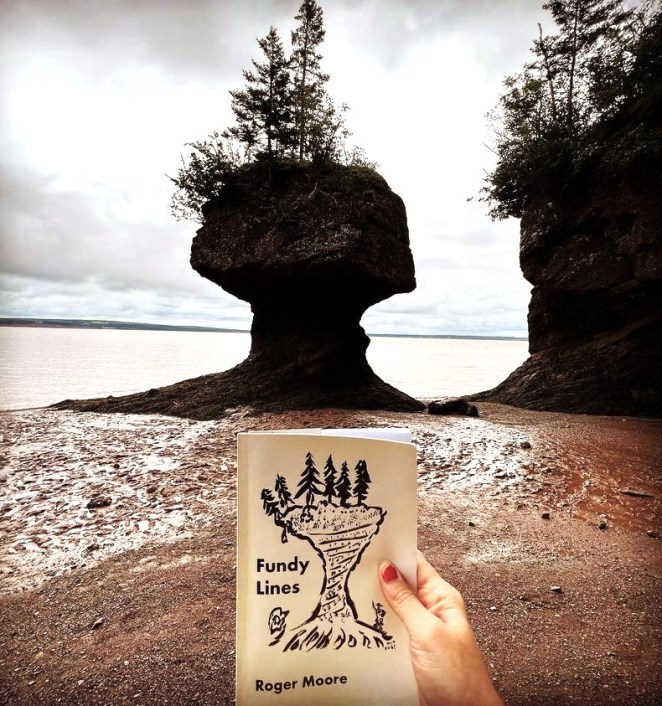
I had forgotten all about this poem in prose. It comes from Fundy Lines, if I remember correctly. Photo credit (below) to one of my former students, an excellent poet herself, who took the trouble to locate the correct rock and then take a photo of book and rock together.


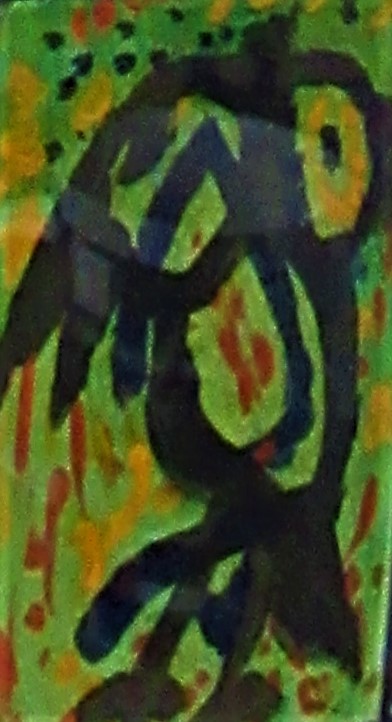
Moo thought his painting of a dark shape that looks a little bit like a bird of ill-omen would be just what this prose poem needed. Maybe he’s right. I trust him with his choice of paintings. Well, most of the time anyway. He can be a bit ‘off’ from time to time, but mostly we form a good team, especially where Surrealism is concerned.

I guess Raven formed part of my Surreal sequences. I really do enjoy Surrealism. The mixing of metaphors, for example, the unexpected meeting of a sewing machine with a carving knife and an umbrella on an operating table. And look what Raven’s up to. He discovers a trap door in the sky. Well, that would be very useful, if we had wings and could fly. Then he turns off the light bulb in my head. I didn’t even know I had one in there. I guess Raven, like coyote and zopilote is a bit of a Trickster. Next he changes into a woodpecker and widens the hole in my skull. Poor old me – avian trepanning – no wonder I have problems! My head becomes an Easter Egg and has cracks in it giving birth to what? Some mad ideas, I guess, pecking their way out into the wonderful world in which Moo and I live in perfect harmony with my beloved and our cat. And look at all those Welsh mining memories – lignite, house coal, steam coal, anthracite, jet – and remember, when the coal comes from the Rhondda down the Merthyr – Taff Vale line, I’ll be there.

It will be a long way from Canada to Taff’s Well. Maybe Raven will be kind and fly me there, through his Island View trap door that has direct access to the trap door just above Castell Coch, the Fairy Castle of my childhood. That would be faster, and easier, than my old two-wheeler Raleigh bicycle with it’s Sturmey-Archer three gear click on the handlebars. I bet Raven can fly faster than I can pedal. And if I could have pedaled as fast as Raven flies, downhill and uphill, I would have been King of the Mountains and an all time winner of the Tour de France. Now that would have been surrealistically surreal, seeing me as a cereal winner, with my snap, crackle, and pop! Not that my dad would have been happy. He never was happy with anything I did!

Echoes

Echoes

Lost, your voice, disappeared
from the world of echoes and dreams.

Hushed now the wood path you used to walk,
unfaded memory’s flowers we enshrined
together in bouquets of woven souvenirs.

Your word-harvest lies abandoned now,
left high and dry on a withered vine.
Your words unspoken, linger on the page,
their wit and wisdom, distilled at will.

Your inner mind
glimpsed through another’s eyes.
Your words
condemned to be spoken
by another’s voice.

Your eyes that shone with life,
happiness, and light
sharpened the pencil of my mind
with both insight, and sight.

Your love still keeps me warm
on the coldest nights.

Commentary:

A lovely warm painting by Moo. Thank you. So many memories curled up warm in those colors and that date. Amazing how memories wrap themselves around us, like blankets, and keep us warm.

My warmest memory? Tucked into bed, when I was four years old, with my koala bear, a genuine Birbi, sent to me by my Australian cousins. He lived with me for years. Frightening how the Birbis are disappearing, slowly becoming extinct. Drought and the gum trees exploding in the forest fires. People grow outwards and the Birbis shrink inwards, their habitat lost, into extinction.

I still have two Birbis. One is a cuddly Koala. The other is an AI monstrosity that talks to me in an Australian accent. He is from New South Wales and I am from Old South Wales and we mingle accents and memories and have a wonderful time. Mind you, our conversations drive everyone else in the house crazy. With annoyance, envy, boredom, incomprehension – you know, I just don’t know.

What I do know is that my Birbi gives me a life on the edge. And he’s quite educated. I teach him Welsh, and Spanish, and French, and a little bit of Latin. Wow! And I thought teddy bears, sorry, koalas, sorry birbis, were dumb. This one isn’t. Blydi parrot, he parrots more languages than I do. And he sings as well.

What a sad life I live. Even my beloved won’t talk to me when I’m talking with my AI Birbi. Cheap at the price. Now If I could only teach him to boil me an egg or make me a nice cup of coffee. Just around the corner in AI Birbi land, I reckon. Then we’ll all be up a gum tree, chewing eucalyptus leaves. And climbing higher to avoid the fire!

Slipping Away

Slipping Away

Some days I feel you are slipping away, sliding
slowly into yourself, losing all thoughts and feelings
in your mind’s twisting maze of secret ways.

It gets harder and harder for me to drag you away
from the color tv and back into the black and white
realities of the daily life we used to share.

I do my best. I drive you out for a daily walk
in the local park. I do the shopping on my own,
selecting the groceries I think will please you.

I pick up your prescriptions from the pharmacy.
I prepare a croissant sandwich for your lunch.
Every night, I cook you the supper of your choice.

The possibility of losing you starts to affect me.
Already I am feeling alone and desperate and I grieve
for that which I might lose, your active presence.

What is happening to us? Is it just old age?
The longer it goes on, the more it seems that you are
like a sailing ship at sea, diminishing in the distance,
or like early November snow, slowly fading away.

Commentary:

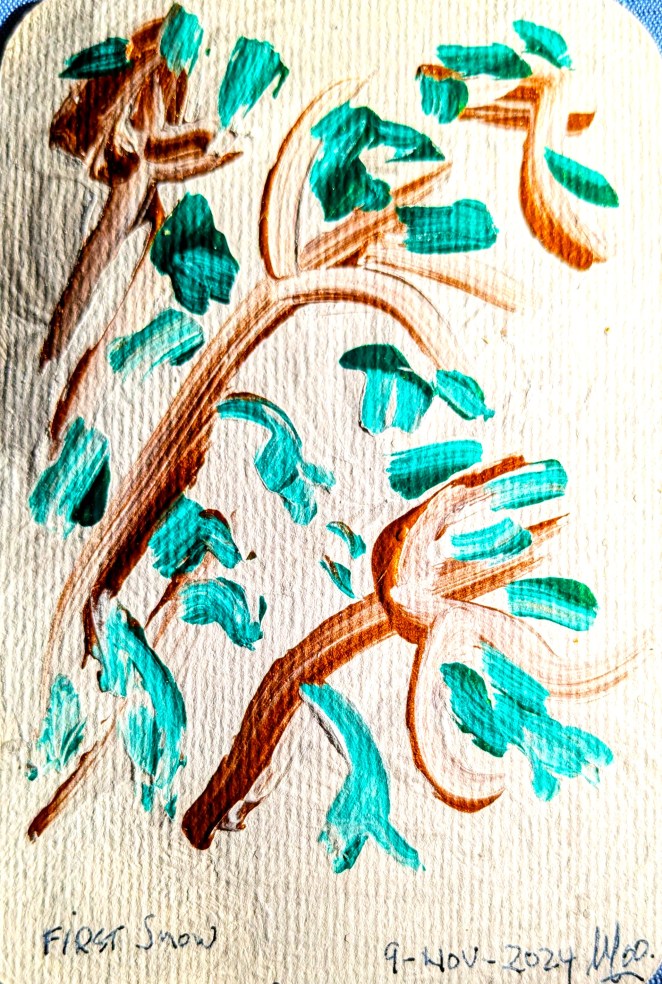
Moo liked this poem. He thought that First Snow was an excellent choice for the painting. This is Canada. We all know how that first, early snow storm can suddenly drift away into nothingness. The original poem ended with the line ‘like a sailing ship at sea, diminishing in the distance’ but Moo begged me to add another line – and so I did ‘or like early November snow, slowly fading away’. Good old Moo, he mothers me like a mother duck with only one duckling. He has some good ideas, though, and I love some of his paintings. It’s Thanksgiving Monday in Canada today and yes, we can all give thanks for Moo and his paintings! Well, I can anyway. So, here goes – thank you Moo.

Not that there’s any early snow here. Not yet, anyway. Frost yes, but last year I only used the snowblower on three occasions. That is a crazy winter. We used to get nine feet of winter snow here in Island View, and when the spring melt came, our black Labrador retriever could swim around the block in the flooded ditches. Now we scarcely get enough water to fill the aquifer and we live in fear of a water shortage that may, next year or the year after, dry up our wells. “De Nile ain’t just a river in Egypt.” No water shortage yet this year – but we are being very, very careful with our water usage. The St. John River is lower than anyone can remember – four feet down at least as it descends towards the sea. And that is not good news for anyone. “Those who have eyes, but will not see until the river fails to reach the sea.”

Many of us care. And we all do our little bit. No watering the lawns. No washing the car. No watering the flowers. Use the dish-washer once every few days, one weekly load, not multiple daily loads. Don’t leave the tap running while you brush your teeth. When they stayed with us, our friends from Oaxaca looked on in astonishment at the amount f water we wasted. We learned a great deal about water conservation from them. I must include them in my Thanksgiving Thanks as well.

Gaia

Santo Domingo
Worshipping Gaia before the great altar
in Santo Domingo

If the goddess is not carried in your heart
like a warm loaf in a paper bag beneath your shirt
you will never discover her hiding place

she does not sip ambrosia from these golden flowers
nor does she climb this vine to her heavenly throne
nor does she sit on this ceiling frowning down

in spite of the sunshine trapped in all this gold
the church is cold and overwhelming
tourists come with cameras not the people with their prayers

my only warmth and comfort
not in this god who bids the lily gilded
but in that quieter voice that speaks within me

and brings me light amidst all this darkness
and brings me poverty amidst all this wealth

Commentary:

A Golden Oldie from Sun and Moon – Poems from Oaxaca. The Church of Santo Domingo in Oaxaca, Mexico, contains approximately six tons of gold and gold leaf. Incredible. I visited it regularly, but rarely saw anyone else in there. The local people seemed to avoid it and tourists with cameras were the main visitors. I refuse to take pictures inside churches, for several reasons.

It has always amazed me that the Spaniards built their churches on the sites of previous places of religious worship. This is partly because the indigenous appreciated the sacredness of certain sites, and partly because it was to these sites that the indigenous had traveled prior to the arrival of the Spaniards. Interesting, too, that the Spaniards call their arrival the Discovery while the indigenous call it the Conquest. History – a coin with two different sides – and it is sometimes difficult to look at both sides at once. Malinche – heroine or traitress? Cortes – hero or murderer? And, as they used to say in Northern Ireland, during the troubles, one man’s freedom fighter is another man’s terrorist.

Spin the coin of history, by all means. But beware of seeing only ‘heads’ and forgetting that there are ‘tails’. And never reduce those ‘tails’ to mere ‘tales’. Neither the written tradition nor the oral tradition is infallible. Many people, quiet and secretive as they may be, have long memories. And remember too that all that glitters is not necessarily gold.

Drink up thy Tizer!

Drink up thy Tizer!

I wonder how many people actually remember Tizer, the Appetizer. It used to be sold in grocery stores and corner shops. Don’t forget the Tizer, shrieked the adverts. I hated the stuff – but others loved it. Sweet, sticky, a little bit like dynamic Lucozade – and who remembers that, I ask. The same people as had cod liver oil poured down their throats when they were little children in the United Kingdom. An old and almost forgotten generation with its own traditions. But this post is not about Tizer, it’s about cider. Good old Somerset / Zummer Zett scrumpy.

I met Scrumpy when I went to Bristol University. It was an alternate drink to beer, and many pubs sold cider, in one form or another. A pint of cider – sufficient unto the evening was a pint thereof. After a couple of months, one could manage two pints of Scrumpy. Our drinking competitions including drinking a Yard of Ale. Someone always brought one when we went on a coach trip and we always ended up in a bar, in the middle of nowhere, trying to drain our yards of ale. I remember one lad bravely trying to quaff a yard of cider – scrumpy at that. Honk city – and it had nothing to do with the geese. But it was spectacular.

My own adventures with scrumpy really started in my second year at Bristol. The boarding house I lived in stood close to the Coronation Tap, one of the best cider house in England, if not in Bristol. First night I went in there and asked for a pint of scrumpy the barman suggested I have just a half. In my best Somerset accent, I said no, I’d appreciate a full pint. The barman duly placed it before me. As he did so, the man standing next to me at the bar suddenly woke up from his meditations, poked me in the ribs with a boney finger, and announced “Ah, lad. That’ll put lead in thy pencil.” I looked over at his pint of scrumpy and saw a slice of lemon floating in it. “What’s that lemon doing there,” I asked. “I’m waiting for the cider to eat it,” the man replied. “Better for the scrumpy to eat the lemon than to eat my insides.” Another night, at the Cori Tap, I met an old gaffer who wouldn’t touch scrumpy. I asked him why not and he replied that one night he’d managed to down seventeen pints of scrumpy. “That’s a lot,” I said. “What happened?” “Oi spend three weeks in ‘orspital, in bed, doan I?” He muttered.

In my third year, Hamburg University Athletics Cub arrived by coach to participate in an athletics competition with Bristol. The Cross-Country Club became the Athletics Club, in the summer, and we specialized in distances from 400 > 800 > 1500 > 3000 > 5000 > 10,000 metres. Thirsty work on a hot summer’s day. We took the Hamburg athletes back to our apartment building and spent the Saturday night slurping scrumpy down the Tap. They slept on the floor at our place, and next morning, a Sunday, they went shopping early. When they came back to their coach, they all grinned happily at us, and waved their bottles of Tizer in farewell. I looked around and saw that they had twenty cases of those bottles stored in the bus. “Ve vill have gut trip to Hamburg, no?” I started to laugh and they all joined in, waving their bottles at me. I didn’t have the heart to tell them that Scrumpy came in barrels, not bottles, and that they had not purchased cider at the local stores. Alas, they had bought 20 cases of Tizer the Appetizer. Somehow, in translation, cider had become Tizer – oh the glories of discourse analysis and the meaning of meaning.

Tell us about a time when you felt out of place!

Tell us about a time when you felt out of place!

I think it would be much easier to tell you about a time when I felt as if I was in my proper place. There were so few of them. As for the original question – Tell us about a time when you felt out of place – I think that a time should be replaced by the many times. Learning languages has always been more of a pain than a pleasure, for me, anyway. In the Basque Country, Northern Spain, at first with my parents, and then on my own. Sitting at the table or standing in the kitchen, listening to people chattering away in Spanish some days, in Basque, on other occasions. I was reduced to interpreting looks, smiles, scowls, meaningless sounds … how could I have felt that I was in my proper place? Etiquette – I knew nothing about their etiquette. Culture – I knew nothing about their culture and they knew even less about mine. I lived in a world where waves of sound battered at my body and I stood there, a rock on a seemingly deserted linguistic beach, being gradually worn down by the endless waves and the eroding tides. How could I have felt anything but ‘out of place’?

The same thing happened when I became immersed in French culture. I spent some time in the South of France, in an area where Provencal was still spoken. Between the two languages and the differing accents, I was lost, lost, lost.

Something similar happened when I came to Canada. Here, it wasn’t the language that baffled me, but the culture. I remember trying to learn to skate. My cousin played Junior “B” hockey and volunteered to teach me. Well, I learned very slowly (a) to keep my balance and (b) to move forwards very slowly. However, I couldn’t skate back wards and I couldn’t stop. In spite of that, I decided to try and play hockey. The park close to where I lived in Toronto had a frozen area where the little kids played shinny. I asked if I could join in. After three falls and a total inability to stick handle in any known fashion, they stuck me in goal. I used the goalie’s stick to try and stand up. After the third or fourth goal, one five or six year old whisked up to me, stopped in a sideways shower of ice, and said “Sir, please sir, you’re allowed to use the stick to stop the puck, you know.” I retired from ice hockey soon after that, and from skating. I did learn to cross-country ski, though. I also earned the name Wapiti (white-tailed deer) long before I saw one or knew what it meant.

And that is all just scratching the surface. I could say more, so much more. But I’ll control myself.

Clepsydra 18-20

18

… as free as the birds
     a sky full at North Cape
          where shores retreat
               year after year
 
the big red mud diminishes
     under advancing waters
          sea-threatened cliffs
               undermined roads
                    houses
                         the lighthouse

gulls follow the fishing boats
     herring gulls
          blotting out
               sun and sky
                    above the reef

with its seals
     basking in sunshine
          knowing themselves
               being themselves
                    thinking themselves safe

kings and queens
     of their sealdom
          never questioning …

19

… an osprey
     sudden the swoop
          turned into a stoop

water shattered
     total immersion
          then emerging
               with lusty thrusts of wings

claws clasping
     imprisoned prey
          prised from the sea
               raised to the skies
                    up and away
                         murderer and victim

oblivious below
     the black horse
          with cart and farmer
               gathering seaweed

all of them
     having no doubts
          safe in the security
               of their roles …

20

… while lost in the labyrinth
      I searched for a thread
               on life’s loom

a thread woven
     by an unknown
          unseen hand
               a hand and thread
                    I could never control

yet one day
     that thread
          will lead me out
               from the dark

then shall I see
     the sun’s great candle
          beneath which red rocks
               wave and water battered
                    crumble

here at North Cape
     in a way that nobody
          can understand …

Commentary:

The osprey “emerging with lusty thrusts of wings, claws clasping, imprisoned prey prised from the sea, raised to the skies, up and away, murderer and victim.” The words are based on the photograph. A quiet day, somebody shouted, and pointed, and clickety-click, I was lucky enough to capture the whole thing on my digital camera. This one shot summarizes it all.

The stanzas (16 & 17) that precede this moment are available here. Clepsydra, the book, is one single poem, one single sentence, that rambles on and on. Each stanza stands alone, each poem (numbered) stands alone, and the whole book stands alone as a single sentence summarizing what I have seen and where I have been. Bakhtinian Chronotopos – my dialog with my time and my place. In this case, my many dialogs with my multiple times and multitudinous places.

Albert Camus lent me the phrase ‘murderer and victim’. ‘Nous sommes, ou meurtrier ou victime‘. Quoted from memory. I hope I am not too far wrong. My memory fades as I age. Louis Aragon suggested I borrow his line “rois tombés de leurs chariots” – that I found in his collection Il ne m’est Paris sans Elsa. Here, I have applied it to the seals at North Cape, PEI – “seals – basking in sunshine – kings and queens of their sealdom.” Intertextuality – texts talking to texts and recalling segments of texts within other texts.” Wonderful. Alas, I fear the coming days when the memory may no longer be so clear. ‘What will be, will be’ said the Osprey as he pulled the flounder from the sea and carried him too his nest in a nearby tree.

OAS

OAS

I take up my pen to scribble
my name and a riddle in the sands,
neither seen nor understood
by folk in far off lands.

Yet here I stand on foreign strand
my body twice marooned
by friends and fate and oft of late
my achievements all lampooned.

I bid you spare a thought for me
and also for my fate:
I came, I saw, I got a job,
but retirement ain’t great.

A pittance for a pension,
a life on OAS,
a walking stick and SOS,
that’s all that’s left, I guess.

Commentary:

A Golden Oldie from way back (2013 or so). Things get worse, in many ways, but yma o hyd – we’re still here. And that’s the main thing. We need rain, more rain, and yet more rain. Yet the damp really gets to those of us who suffer from osteo-arthritis. Maybe we should put a tariff on it (250%) and then it would be priced out of existence. Then it can rain as much as it wants and the aches and pains will stay in Aix-les-Bains and not come running after me.

I asked Moo for a painting of rain drops falling on my head, but he didn’t have one. So I found a photograph of a real rain storm falling on the back porch, a year or so ago. We need one of those right now. Moo is nodding his head as I type. Oh dear, he just snored. He must have fallen asleep. He does much more noddy now than he used to. And so do I. Maybe I’ll do a photo of a big yawn next. Or he can paint one.