Wednesday Workshop: Reading

IMG_0167

Wednesday Workshop
11 April 2018
Reading for Writers

Miguel de Cervantes once wrote that he was so fond of reading he would pick up even the scraps of paper he found in the street to read them if anything was written on them. This is well-known. What is less known is that Don Quixote, his immortal novel (DQI, 1605, DQII, 1615) is a masterpiece, not only of writing, but also of reading.

From the initial sortie, a prose transcription of an earlier short play, to the Scrutiny of the Library, Cervantes demonstrates right from the start his awareness of current trends in poetry, theatre and prose. In addition, he shows (especially DQI, chapter 47) his acquaintance with contemporary literary theory, as E. C. Riley has so ably established in Cervantes’s Theory of the Novel.

Cervantes begins with the traditional Renaissance novel (DQI, 1605) in which he experiments with plays and poetry turned into prose, oral and written histories, pseudo-autobiographical episodes, the picaresque novel, the pastoral novel, the Italianate Novel, the picaresque novel (briefly), his own versions of the realistic Spanish short story, and then, after a ten year gap during which he receives all kinds of reader feedback, he invents (DQII, 1615), the self-referring modern novel. DQII refers back to DQI as if it were true history. Don Quixote on his ravels meets with people who recognize him, for they have read his story and know all about him. The fictitious character establishes himself as an almost flesh-and-blood living person.

What can we, as writers, learn from this? Above all, we must learn to read copiously, not just once in a while, but all the time. Not only must we read, but we must learn how to read. Yes, we can read for knowledge and information; yes, we can read for pleasure and enjoyment; yes, we can read to lose ourselves and wash away the cares of the world. However, as writers we must learn to read in a different fashion. We must read in search of the narrative structures that inspire other good writers. We must read in search of the iterative thematic imagery that binds a text with meaningful, repeated images. We must read in search of the poetry that sates the soul’s constant thirst for beauty. We must read in search of the dialog that cuts to the bone and reveals the hidden character of the protagonists. We must read in search of the layering that allows us to give extra meaning at all levels of the narrative. We must read in search of the secret that allows us to trim all unnecessary material in order that our stories may be spare and sparse with not an extra word or thought.

Reading: I have just finished taking an eight-week online course with the School of Creative Writing at the University of Toronto. In the course of those eight weeks, I read the following books.

  1. 3 short stories a week, recommended by the instructor, the wonderful novelist Kerry Lee Powell, to illustrate each week’s lesson. [24 stories]
  2. 14 first drafts, one from each of the magnificent students in the course (I had the honor of being the fifteenth student). [38 stories]
  3. 14 revised stories. [52 stories]
  4. 14 first drafts of a second story. The course asked for two stories to be written by each participant over the duration of the course. [66 stories]
  5. 14 revised drafts of this second story. [80 stories]
  6. My own voluntary reading included Raymond Carver’s What we talk about when we talk about love (17 stories), Cathedral (12 stories), and my own short story collection, Bistro (35 very short stories). Recognizing the errors, weaknesses, and inaccuracies in my own collection reduced me to tears. [144 stories]

I have spent eight wonderful weeks exploring creativity and the art of short story writing.  Am I a better writer for all that work? Undoubtedly. I can see and think much more clearly and I am beginning to gain a better understanding of how short narratives work. I am a better writer, but I am not yet a good one. There is still a long way to go.

I am retired. A long, cold, icy New Brunswick winter has kept me in the house, close to the fire. I have been gifted the time and mental energy to make the most of this course I have taken. I attended the University of Toronto, as a graduate student, back in the sixties. I was amazed at the quantity of work handed out by the professors in the School of Graduate Studies. My first decision, made very early on in my graduate career, was to take a speed reading course. Accelerating my reading speed and capacity for understanding was the only way I would be able to compete. I am still a fast reader, though not as fast as I was. This speed reading has left me time for long thought and slow writing.

Over the last eight weeks, in addition to the reading, as described above, I have written five new short stories, including two for the course. I have also revised and re-written a series of short stories for my next collection. As a good friend keeps telling me, we are not writers, we are re-writers. After eight very intense weeks, the acts of re-writing, re-reading, re-vising, and re-editing have become much, much easier.

Carpe diem, seize the day: pick up a book and start reading. Pick up your pen and start writing. No excuses. Participaction: don’t think about it, do it.

Wednesday Workshop: Attending a Reading

weir 2

Wednesday Workhop
Wednesday, 04 April 2018
Attending a Reading

            Number one piece of advice: don’t arrive late. I thought last night’s reading at the Oromocto Public Library began at 7:00 pm. I used Google maps to locate the library and I left plenty of time to get to there early. The Oromocto Public Library is just off the main road, tucked sideways on, so you are driving past it before you see it. I didn’t see it.

            I drove to the first roundabout, went straight through that, looked again: no library where the library ought to be. So I drove to the second roundabout. Still no library, and now I was running out of road space and the highway beckoned. So, I went right around the second roundabout, scanning both sides of  the road for the library as I drove. Still no library. I returned to the first roundabout, went right around it, drove back to the second roundabout … I was becoming fixated on driving in circles … then back to the first again.

            Just past the first roundabout, I spotted a gas station. I pulled over to ask the way to the library and there it was, just in front of me, right beside the gas station, facing the new Japanese restaurant, and sideways on to the road. There was one parking spot left and I took it.

            When I got inside, the library was very silent. I asked directions to the reading room and was directed to the back of the building. The reader stood before the audience, with the podium at his back, and was already talking. It was 6:50 pm. “Wow,” I thought. “He must have started early.”

            I have known Chuck Bowie, the invited reader, for several years and we share the same writer’s group, a group which he organized. He invited me to join it and we meet regularly (there are seven of us), once a week, on Tuesdays. Regularly: this is Canada … regularly, when it isn’t snowing, when there’s no icy rain, when the temperature is above -30C, when the wind doesn’t threaten to blow the car off the road … regularly, you know what I mean. There are usually three or four of us at each meeting.

            “There’s Roger,” Chuck announced my presence as soon as he saw me.  The audience turned round and several people whom I knew gave me a smile and a wave. There were no vacant chairs. A lady at the back gave me hers and went to fetch another one for herself. I found out later that she was the organizer and I thanked her profusely for her generosity.

            Chuck, as I found out later, had started at 6:30 and was well into his stride. He mixed anecdotes from his stories with advice about writing. As I was settling, he was explaining how much research he had done into wine and wine growing for the winery scenes in his four Donovan novels (the series is called Donovan: Thief for Hire). I love wine and I have visited several excellent vineyards in Rueda and La Seca (Spain). Chuck’s deep knowledge of the vines impressed me. “Roots,” he told us, “sometimes going down twenty-one to twenty-four feet.”

            I thought of the Spanish wines with their denominations of Old Vines, Reserva, Gran Reserva as Chuck dragged me from the outside world to the inside world of the winery laboratory where the crime had taken place. Then he read an excerpt from his novel, four or five pages that illustrated the use to which he had put his knowledge of the vines (Book Four of the series, Body on the Underwater Road).

            Chuck then talked about writing from memory (Rumania) and emphasized that memory alone was not enough. Memory gives atmosphere but accurate details come from many places, including the ubiquitous, omnipresent, and virtually omniscient Google search. Thus, as he explained, cum grano salis, the churches in Rumania are circular, constructed that way “so the devil may not corner you.”

            From memory and Rumania, he moved to Manchester Gangs in the 1980’s (Book Three: Steal It All), a simple anecdote about how the neighborhood protection racket protected the local families who in turn protected the criminals, while all crime was committed outside the area. Chuck’s ability to turn a table-top conversation into the idea for a story, or in this case, a full novel, is exemplary. How many creative seeds are scattered on stony ground, never to come to full fruition?

            Violence can play a meaningful role in the crime thriller but it has to be meaningful, and it must be accurate. Chuck spent some time explaining how he had researched guns and armaments so that the right weapons would always be carried by the right people and used in correct fashion at the right time. He talked a little about entry and exit wounds and I had visions of Rumpole, in the Penge Bungalow Murders, stabbing a ketchup filled sponge in the kitchen of his suburban home on The Gloucester Road, to see how the stains spattered, much to the disgust of She-who-must-be-obeyed.

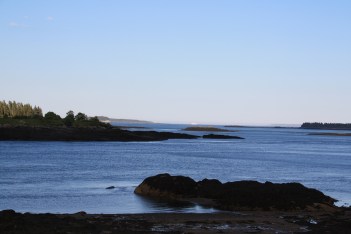
            Chuck’s next book, the fourth in the Donovan series, Donovan: Thief for Hire, is called Body on the Underwater Road. Much of this story takes place in St. Andrews, New Brunswick, and Chuck explained how he had scouted out the local area and, in particular, the ‘underwater road’ from the mainland to Minister’s Island. The Fundy Tides, the highest in the world, cause the roadway to disappear at high tide, thus making the island inaccessible for long stretches of time. It also makes the underwater road a natural fishing weir for dead bodies. This research work involved live interviews with the local RCMP and others on the movement of bodies in the Fundy Tides, where would they end up if they were inserted into the water at place A, B, or C. That sort of thing.

            Chuck ended with a request for questions and the audience announced their own engagement by asking questions on how to develop characters, how to name characters, how to thread narrative arcs, and on how much rewriting is necessary if an arc goes wrong. The answer: “Lots. Sometimes you need to abandon the arc completely; other times, you must rewrite it from top to tail. But cave scriptor / writer beware: if you make a change on page 272, make sure that it checks out all he way backwards, page by page, back to the book’s beginning on page 1.”

            The use of humor within a thriller series serves to illustrate the layers of complexity that the characters manifest. The insertion of this element serves notice that genre writers who are serious about their craft write with the intention of elevating words, their sense, and their impact on the discerning reader. It also serves to layer the novel with additional meaning. Such layers of complexity spark joy in the writer.

            An interesting evening, then. With some old friendships renewed and some words of wisdom cast before an appreciative audience by the Atlantic Provinces Director of The Writers’ Union of Canada and local Fredericton author, Chuck Bowie.  I attach his web page. Do some research: check it out.  http://www.chuckbowie.ca

Painting credit: Roger Moore. Fundy Weir Poles (acrylic), St. Andrews, NB.

My Body

IMG_5811_2

My body

My body has so many rooms and you,
my love, possess me in them, wander
through them, and I see you, here, there,
everywhere, your presence a shadow
glimpsed in a mirror, or your warm touch
a breath upon forehead or cheek. Where
have you gone? Why did you leave me
here on my own to languish in your absence?
I walk from room to room, but when I knock
you open no doors, and though I seek,
I fail to find. I know you are somewhere near.
I hear your footstep on the stair, your voice
in the silence that surrounds me. My name,
a syllable or two, whispered in the way
I so clearly remember. How can it be true,
my love, that you have gone, that you have
left me here and forged ahead into another
time and space? I count the hours and days.
Will you prepare me a place? Will your face
be there to greet me? Alone, I clutch at straws,
embracing dust motes, counting the angels that
dance on the rainbows on the head of a pin.

Rain

15-may-2002-pre-rimouski-224

Rain

Insane, the rain
washing down
my window.

Insanity of raindrops
mixing, matching,
their Van Gogh
rainbow colors,
no artist’s eye
to select them,
just a false ear,
tin drum
to their sound.

They blur blossoms,
twist tree and bush,
water censers now
those branch ends
bending beneath
water’s weight.

Unseen, the island now,
nor visible the bay
beneath cloud blankets
wrapping them away.


Sun Worship

IMG_0018

Sun Worship

Worship the sun
as it rises over the hills
from whence cometh
its golden glory.

Trees and their forest,
forces older by far
than this Christian god,
walk in darkness
until touched by the sun.

Worship the sun ropes
that tie you to your daily work,
rejoice in your bondage,
for no man kills
to glorify the sun.

Sun, my father and my mother,
sunshine that floods my spirit
and enlightens my world,
here, before sunrise,
I raise my voice in a song
praising you, and your strength,
the life you give, the death
you will one day bring.


Mysterious Mist

DSC02058

Mysterious Mist

Mysterious mist,
how I have missed you
wrapping and unwrapping
your gifts of seashore and sand.

So delicate, your will o’the wisp touch,
your fingers dampening my curls,
a delicacy of delight your butterfly kiss
laid upon forehead and cheek.

A distorting mirror in a circus
or a sideshow at the fair,
you twist things round your little fingers,
complicating our simple lives,
shape-changing them with dreams
and visions conjured from thin air.

Now you are here again, in my garden.
I welcome your presence among the trees,
your spirit enveloping the bees’ balm,
your crowning gift, soft-toned cone-flowers
where Monarch butterflies drift and reign.

Mont Blanc

IMG_0026 (3)

Mont Blanc
(for Chuck Bowie)

“But what is that stick-like thing
between notebooks and mouse?”

“That stick-thing by my mouse,
as you so elegantly phrase it,
is my Mont Blanc fountain pen.

It’s also a metaphor app.
You stick the blunt end in your ear
to wind up your brain,
then you carefully clean
the tip on a piece of paper.

If it leaves suitable marks,
you read them like Runes
and use them to create metaphors.

You can also use it to conduct music
or to take a thin, blue line for a walk.
It’s very useful for poets who don’t like
staring at computer screens, and with one
they rarely suffer from writer’s block.”

Moon

IMG_0261 (2)

Moon

when the glue of the universe
sticks to your fingers
the turtle’s snap
is a red-tailed kite
sky blue across the marsh

where now the will o’ the wisp
that ragged wanderer
in his tinker’s coat
all hash-tags and patches

frost crisps the leaves
dry cactus in a tilted rain stick
they patter and fall
three deer watch from the ditch
twitching their ears

gibbous this rabbit moon
night hung from the sky
who will gnaw next at the rind
of its round yellow cheese

Heart

IMG_0040 (2)

Heart
(sonnet for Hanna and Cherry)

club-foot the pigeon feet
burned off by frost and lime
cracked this egg shell in its cup
the world’s heart overflowing

this silver spoon carved from milk
-tops pecked by morning birds
who placed it in my mouth

song of the blackbird
sung from the corrugated iron roof
where he whistles his virtuosity

playing cards placed face down
who holds the jolly joker
with his floppy cap and jingling bells
who holds the red ace key to my heart