Wednesday Workshop: Recycling

IMG0075_1

Wednesday Workshop
09 May 2018

Recycling 1

“You never know when you might need it,” my

grandfather said, finger-nails cracking red-
waxed parcel string. Bright sealing wax rained down
on the tablecloth, covering it with hard,
scarlet chips, wax cracked, tight knots emerging.
One by one, my grandfather first loosened
them, then sought the string’s free end, following
it along its snaking way from knot to
knot. Like Theseus following his twine
through the labyrinth below the palace, my
grandfather mused, hesitated, followed
the clues given him by the knotter’s mind.
Set free from its parceled knots and lashings,
he looped the string around his fingers and
tied the twine into a tight bow that he
stowed away for future use. Reef knots, slip
knots, sheep-shanks, bowlines, bowlines-on-the-bight,
he showed me how to tie them all. He taught
me too how to never tie granny knots.
“Never cut string with a knife: untie knots,”
strict his advice and followed still today.

Recycling 2

finger-nails
cracking red-waxed
parcel string

sealing wax rained down
staining snow white tablecloth
wax cracked
hard scarlet flakes
tight knots emerging
loosened

now seek the string’s
free end
then follow it
the way it snakes
linking knot to knot

muse
hesitate
unknot
the mind of she who tied

set free these
parceled knots and lashings
loop string around fingers
tie tight the twine

a child’s bow
to be stored
for future use

Recycling
Haiku 1
[7/11/7]

string yields blood-bright scarlet wax
a thread to lead through the parcel’s labyrinth
open now the magic box

Recycling
Haiku 2
[5/7/5]

blood-bright scarlet wax
a thread through the labyrinth
open now the box

Commentary:
There are many ways to recycle. All are valid. Some are more valid than others.

Inundation

DSC01055

Inundation

Seven flashes of light, then raindrops start
falling, one, two, followed by a curtain
dragging its damp dishcloth wetness over
windows, walls. It pocks the river’s troubled
face. Rising waters surpass all levels
from former floods. Water pours into homes,
floods basements, climbs stairs. Drowned branches scratch at
second floor windows as they float by.  Old
people evacuate their houses, are
boated to higher ground, beloved pets
upon their laps, boxed and caged. Men wonder
when this will end while older people shake
their heads, saying that they have never seen
anything like it. Overhead the storm
gathers strength. Rain tumbles, bubbling in
brooks that slide downhill filling the river.
Grand Lake now extends from Freddy to Saint
John. Why has it come to this? What can we
do to appease the mindless river gods,
fall on our knees and pray, if so, for what?
Last year we suffered drought, forest fires,
wells running dry, wild life dying of thirst.
This year it is death by inundation.
Rain continues. Thunder rolls. The wind gets
up and drives waves high against house windows.
Lightning carves fresh scars across dark clouds.
We shuffle our feet, accepting our fate
with grimaces, hugs, kisses, and sad smiles.

Friday Fiction: Crave More

IMG_0125

Friday Fiction
04 May 2018
Crave More

Crave More: I hate those words. I always choose
a cart with the shop’s name on the handle.
I can handle that. I can’t stand a cart
that screams Crave More at me every time I
bend to place an item in the wire grid.
If stores were honest they would write Think More
and Crave Less
 on their shopping carts. I bet
that would cut into profits. Anyway,
there I was, in LaLaLand, leaning on
my cart, half asleep, when this ghost drifted
towards me. “Help me,” it said. “I’m hungry.
I need money for food.” I woke up from
my dream, looked at the ghost, tall, skeletal
thin, cavernous eyes and cheekbones sticking
out, gaps in the teeth, grey face drawn with shame.
“Sorry,” came automatically. Then I
too felt shame. I looked at him again. “I
only carry plastic.” The excuse limped
heavily across the air between us.
I saw something in his eyes, I knew not
what, and turned away. As I walked away,
I added one hundred pound of muscle
to the scarecrow frame. Took forty years off
his age. Filled his body with joy and pride,
not shame, and remembered how he played, hard
and fast, but true. I ran the card index
of former players that I had coached through
my mind. I knew their moves, and attributes,
the way they played the game, strengths, weaknesses …
I remembered him holding up the Cup.
But I couldn’t remember his name. I
pushed the cart all over the store in a
frantic search for him. At the ATM
I withdrew cash. I could hand it to him.
I could tell him he had dropped it. I went
through a thousand scenes. I could invite him
to the snack bar. I could tell him to buy
what he needed and follow me. Check out
time, I would add his purchases to my
bill. I looked everywhere. He was nowhere
to be seen. One opportunity. One
chance. That’s all we get. Miss it, and we blow
the game. Grasp it and we medal with gold.

Commentary:
I have been experimenting with iambic pentameter, counting words and syllables on my fingers, tapping rhythms on the table, driving Clare crazy, and disturbing the cat. I have also disturbed my usual way of writing, for better or for worse I am not yet sure. Yesterday’s entertainment was to rewrite my brief story, Crave More, as a poem in pseudo-iambic pentameter. The measures seem to function and the rhythm and word count move both within the line and in the melodic, rhythmic phrasings that move between lines in a constant enjambement.

So, by all means let me know what you think of this experiment.  Here’s the link to the short story, also called Crave More. I would love to receive your opinions on narrative pseudo-iambic pentameter.

Revised Version:

Encounter

I was in the Superstore, leaning on
my cart, half asleep, when this ghost drifted
towards me. “Help me,” it said. “I’m hungry.
I need money for food.” I woke up from
my dream, looked at the ghost, tall, skeletal
thin, cavernous eyes and cheekbones sticking
out, gaps in the teeth, grey face drawn with shame.
“Sorry,” came automatically. Then I
too felt shame. I looked at him again. “I
only carry plastic.” The excuse limped
heavily across the air between us.
I saw something in his eyes, I knew not
what, and turned away. As I walked away,
I added one hundred pound of muscle
to the scarecrow frame. Took forty years off
his age. Filled his body with joy and pride,
not shame, and remembered how he played, hard
and fast, but true. I ran the card index
of former players that I had coached through
my mind. I knew their moves, and attributes,
the way they played the game, strengths, weaknesses …
I remembered him holding up the Cup.
But I couldn’t remember his name. I
pushed the cart all over the store in a
frantic search for him. At the ATM
I withdrew cash. I could hand it to him.
I could tell him he had dropped it. I went
through a thousand scenes. I could invite him
to the snack bar. I could tell him to buy
what he needed and follow me. Check out
time, I would add his purchases to my
bill. I looked everywhere. He was nowhere
to be seen. One opportunity. One
chance. That’s all we get. Miss it, and we blow
the game. Grasp it and we medal with gold.

Comment to the Revision:

The first eight lines of the original poem set the scene. While I tried to use them to accentuate commercial exploitation of the customer’s potential for greed, Crave More, they are not essential to the story of the encounter. Meg noticed this and following her interaction I have revised the poem, eliminating those first eight lines.

This is an interesting and inter-active way to work. Thank you Meg!

Revisions

IMG_0261 (2)

Revisions

This carving may be gently touched

Original Version
(Pseudo-Jackpine-sonnet with a fifteenth line)

It doesn’t act like a bear. It has a
Spaniel’s stop. Its jaws are wedged in a
grin. Its tongue hangs still. No saliva drops
from its chin. Motionless eyes. This carving’s
tame. Children sit safely on its back, may
stroke the mighty muscles. It’s safe. Woodworm,
like moth, have left holes in its back. More:
many a crack ensures its tameness. Its shoulders
hunch. Sixteen claws probe at the concrete museum
floor. It’s nearer ear is chipped like my grandmother’s
tea-set. There’s lots of room for slips between cups
and this bear’s lips. Yet I can sense death’s closeness.
Suddenly, I know you’re in there, Bear, alive, alert,
angry, hungry. I feel you move: cold sweat covers
my false, carved skin.

Revised version:
(Meaning within each line rewrite)

It doesn’t act like a bear.
Its head bears a Cocker Spaniel’s short, sharp stop.
Its jaws are wedged in a grin.
Its tongue hangs still.
No saliva drops from its chin.
Motionless eyes.
This carving’s tame.
Children may sit safely on its back,
may stroke the mighty muscles.
It’s perfectly safe.
Woodworm, like moth, have left holes in its back.
More: many a crack ensures its tameness.
Its shoulders hunch.
Sixteen wooden claws chisel the concrete museum floor.
It’s nearer ear is chipped like my grandmother’s tea-cup.
There’s lots of room for slips between cups and this bear’s lips.
I can sense death’s closeness.
Suddenly, I know you’re in there, Bear,
alive, alert, angry, hungry.
I feel you move:
cold sweat covers my false, carved skin.

Comment:

Be careful how you revise your earlier work. The ‘revision’ often loses the impact of the original. By extension, don’t destroy you  original, ever: you may want to restore it one day. My horoscope said: ‘You will dither all day and never get anywhere. Take a firm grip. Drink less coffee.’

Violet

IMG_0004 (2)

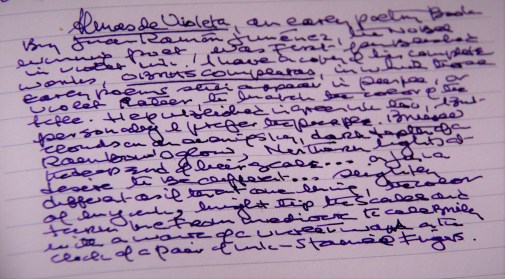
Almas de violeta, an early poetry book by Juan Ramón Jiménez, the Nobel winning poet, was first published in violet ink. I have a copy of his complete works, Obras completas, in which those early poems still appear in purple, or violet, rather, to match the color of the title. He published poems in green ink, too, but personally I prefer purple. Bruised clouds in an evening sky, dark depths of a rainbow’s glow, Northern Lights at the deep end of their descending scale … or is it just a desire to be different … slightly different, as if that one thing, the color of my ink, might tip the scales and turn me from mediocre to celebrity with a wave of a violet wand or the click of a pair of ink-stained fingers.

What else is there to do, other than meditate and walk your fingers across the keyboard, when rain mingles with snow and grey and white streaks fall at faster, slower rates to trace a network across window, trees, and garden? JRJ, Juan Ramón Jiménez, forgotten now by all but the scholars who read and teach him to the few ardent graduate students who clutter the ivy covered halls of academia and blow away the dry dust that settles on unused books when they languish on library shelves. Is that what will become of us, we poor poets of today? Are we to be reduced to the polvo seco de tesis doctoral / the dry dust of a doctoral thesis, as my good friend José María Valverde once wrote?

I guess the dry dust of a doctoral thesis is better than the silence of unturned pages, the empty sands of the voiceless desert, the dunes of forgetfulness shifting here and there along a sea-shore swept by shiftless winds. Forgetfulness: we must first be read … only then can we discarded and forgotten. And who will read us? Who will emerge from their twitter and their tweets to open a book and lift the written word from the page and carry it into their hearts so it can be placed on the soul’s altar and surrounded by incense and flowers?

Purple ink on a purple page, the violence of violet, life with it’s doldrums and purple patches, the cat curled up in its basket, one paw out to test the weather on this rainy, snowy day, when coffee appears at my elbow, as if by magic, and words seek sanctuary in a ritual flow of  song.

Wednesday Workshop: Vis Brevis


IMG_0068 (2)

Wednesday Workshop
18 April 2018
Vis Brevis

Rain. Persistent rain. Cornish mizzle that chills and wets. Basque chirrimirri penetrating flesh and bone. Low cloud blankets buildings, wraps itself round the windshield. Clings with the tenacity of Saran wrap. Visibility variable, now clear, now a muffler round the car’s headlights. Darkness gathered, still gathering. Lights moving, cars moving, the road moving, blending first with the lights then with the shadows, shape-shifting.

Down the hill now, out of the city lights, into the countryside. The road changing, patches and potholes, lights flickering in and out, darkness and light. Small animals of light, the potholes, shimmering, bumping by. Another pothole, moving, turning from side to side, a pothole with a ringed tail and two tiny eyes. A baby pothole, misses the front wheels, not the back. One dull, dry thump.

What were you doing there, in the middle of the road? Why alone? Why no mother, no brothers? Why so small? I didn’t mean to … I didn’t want to … Why me? Why now? If only …

Light breaks through the darkness clouding my mind. Memories: the driver on the road to Kincardine, chasing a jackrabbit, trapped in the headlights, a Belgian Hare, dodging down the middle of the country road. Laughing, the driver, with the joy of his hunt. Then: one dry thump. The car stopped, the hare, still twitching, held by its long ears, shown as a trophy at the car window, then thrown in the trunk. Memories: two lads in a half-ton, on a back road by Grand Lake. A sunny Sunday. Spotting the ground hog at the roadside. Driving at it with the truck. Swerving to hit it. The joy and laughter in their faces, looking back. One dry thump. The ground hog, front half viable, spine fractured, back legs paralyzed, dragging itself with its forearms to the roadside, dropping into the ditch.

Legend tells of the man who met Death in Cairo. Death looked surprised to see him. “What are you doing here?” he asked. Fear filled the man. He ran, packed his bags, left Cairo with its vision of Death. Travelled to Bagdad. Met there with Death, who welcomed him. “Why were you surprised to see me in Cairo?” the man asked. “Because we had a meeting here in Bagdad, tonight,” Death replied. “And I didn’t know if you’d show up.”

“Every morning, at day break,
oh Lord, this little prayer I make,
that thou wilt keep thy watchful eye,
on all poor creatures born to die.”

Dylan Thomas wrote those words in his poetry play for radio, Under Milkwood. All poor creatures born to die. That’s us. That’s you and me. We don’t know how, or why, or where, or when. And it doesn’t matter. That’s the whole point: it doesn’t matter. Our death is born with us, walks with us, lives inside us, and one day will take us, each of us, we poor creatures born to die. What matters is that we live while we can, rejoice while we can, thrive while we can, think while we can, write while we can …

Enlightenment came last night, at the darkest, wettest of times. It followed me home and crept with me into my bed. I thought of all the creatures found each spring morning, their lives cut short at night along the sides of our New Brunswick roads: deer, porcupine, squirrels, groundhogs, foxes, domestic and feral cats, dogs, skunks, and yes, one, very special, baby raccoon, a tiny raccoon, so small as to be almost invisible in chirimirri, mizzle, and mist.

His spirit came to me in the under-blanket dark, wrapped itself warm around me, and brought me comfort. “You too,” he whispered. “You too. But not just yet. My work is done. I can go now. But you still have lots of work to do. Remember: Vis brevis, ars longa,”  his raccoon spirit nuzzled me and I reached out and patted him. Then both of us settled down to dream our different dreams of a life and death that is surely nothing but a game of touch and go.


Wednesday Workshop: Reading

IMG_0167

Wednesday Workshop
11 April 2018
Reading for Writers

Miguel de Cervantes once wrote that he was so fond of reading he would pick up even the scraps of paper he found in the street to read them if anything was written on them. This is well-known. What is less known is that Don Quixote, his immortal novel (DQI, 1605, DQII, 1615) is a masterpiece, not only of writing, but also of reading.

From the initial sortie, a prose transcription of an earlier short play, to the Scrutiny of the Library, Cervantes demonstrates right from the start his awareness of current trends in poetry, theatre and prose. In addition, he shows (especially DQI, chapter 47) his acquaintance with contemporary literary theory, as E. C. Riley has so ably established in Cervantes’s Theory of the Novel.

Cervantes begins with the traditional Renaissance novel (DQI, 1605) in which he experiments with plays and poetry turned into prose, oral and written histories, pseudo-autobiographical episodes, the picaresque novel, the pastoral novel, the Italianate Novel, the picaresque novel (briefly), his own versions of the realistic Spanish short story, and then, after a ten year gap during which he receives all kinds of reader feedback, he invents (DQII, 1615), the self-referring modern novel. DQII refers back to DQI as if it were true history. Don Quixote on his ravels meets with people who recognize him, for they have read his story and know all about him. The fictitious character establishes himself as an almost flesh-and-blood living person.

What can we, as writers, learn from this? Above all, we must learn to read copiously, not just once in a while, but all the time. Not only must we read, but we must learn how to read. Yes, we can read for knowledge and information; yes, we can read for pleasure and enjoyment; yes, we can read to lose ourselves and wash away the cares of the world. However, as writers we must learn to read in a different fashion. We must read in search of the narrative structures that inspire other good writers. We must read in search of the iterative thematic imagery that binds a text with meaningful, repeated images. We must read in search of the poetry that sates the soul’s constant thirst for beauty. We must read in search of the dialog that cuts to the bone and reveals the hidden character of the protagonists. We must read in search of the layering that allows us to give extra meaning at all levels of the narrative. We must read in search of the secret that allows us to trim all unnecessary material in order that our stories may be spare and sparse with not an extra word or thought.

Reading: I have just finished taking an eight-week online course with the School of Creative Writing at the University of Toronto. In the course of those eight weeks, I read the following books.

  1. 3 short stories a week, recommended by the instructor, the wonderful novelist Kerry Lee Powell, to illustrate each week’s lesson. [24 stories]
  2. 14 first drafts, one from each of the magnificent students in the course (I had the honor of being the fifteenth student). [38 stories]
  3. 14 revised stories. [52 stories]
  4. 14 first drafts of a second story. The course asked for two stories to be written by each participant over the duration of the course. [66 stories]
  5. 14 revised drafts of this second story. [80 stories]
  6. My own voluntary reading included Raymond Carver’s What we talk about when we talk about love (17 stories), Cathedral (12 stories), and my own short story collection, Bistro (35 very short stories). Recognizing the errors, weaknesses, and inaccuracies in my own collection reduced me to tears. [144 stories]

I have spent eight wonderful weeks exploring creativity and the art of short story writing.  Am I a better writer for all that work? Undoubtedly. I can see and think much more clearly and I am beginning to gain a better understanding of how short narratives work. I am a better writer, but I am not yet a good one. There is still a long way to go.

I am retired. A long, cold, icy New Brunswick winter has kept me in the house, close to the fire. I have been gifted the time and mental energy to make the most of this course I have taken. I attended the University of Toronto, as a graduate student, back in the sixties. I was amazed at the quantity of work handed out by the professors in the School of Graduate Studies. My first decision, made very early on in my graduate career, was to take a speed reading course. Accelerating my reading speed and capacity for understanding was the only way I would be able to compete. I am still a fast reader, though not as fast as I was. This speed reading has left me time for long thought and slow writing.

Over the last eight weeks, in addition to the reading, as described above, I have written five new short stories, including two for the course. I have also revised and re-written a series of short stories for my next collection. As a good friend keeps telling me, we are not writers, we are re-writers. After eight very intense weeks, the acts of re-writing, re-reading, re-vising, and re-editing have become much, much easier.

Carpe diem, seize the day: pick up a book and start reading. Pick up your pen and start writing. No excuses. Participaction: don’t think about it, do it.

Wednesday Workshop: Attending a Reading

weir 2

Wednesday Workhop
Wednesday, 04 April 2018
Attending a Reading

            Number one piece of advice: don’t arrive late. I thought last night’s reading at the Oromocto Public Library began at 7:00 pm. I used Google maps to locate the library and I left plenty of time to get to there early. The Oromocto Public Library is just off the main road, tucked sideways on, so you are driving past it before you see it. I didn’t see it.

            I drove to the first roundabout, went straight through that, looked again: no library where the library ought to be. So I drove to the second roundabout. Still no library, and now I was running out of road space and the highway beckoned. So, I went right around the second roundabout, scanning both sides of  the road for the library as I drove. Still no library. I returned to the first roundabout, went right around it, drove back to the second roundabout … I was becoming fixated on driving in circles … then back to the first again.

            Just past the first roundabout, I spotted a gas station. I pulled over to ask the way to the library and there it was, just in front of me, right beside the gas station, facing the new Japanese restaurant, and sideways on to the road. There was one parking spot left and I took it.

            When I got inside, the library was very silent. I asked directions to the reading room and was directed to the back of the building. The reader stood before the audience, with the podium at his back, and was already talking. It was 6:50 pm. “Wow,” I thought. “He must have started early.”

            I have known Chuck Bowie, the invited reader, for several years and we share the same writer’s group, a group which he organized. He invited me to join it and we meet regularly (there are seven of us), once a week, on Tuesdays. Regularly: this is Canada … regularly, when it isn’t snowing, when there’s no icy rain, when the temperature is above -30C, when the wind doesn’t threaten to blow the car off the road … regularly, you know what I mean. There are usually three or four of us at each meeting.

            “There’s Roger,” Chuck announced my presence as soon as he saw me.  The audience turned round and several people whom I knew gave me a smile and a wave. There were no vacant chairs. A lady at the back gave me hers and went to fetch another one for herself. I found out later that she was the organizer and I thanked her profusely for her generosity.

            Chuck, as I found out later, had started at 6:30 and was well into his stride. He mixed anecdotes from his stories with advice about writing. As I was settling, he was explaining how much research he had done into wine and wine growing for the winery scenes in his four Donovan novels (the series is called Donovan: Thief for Hire). I love wine and I have visited several excellent vineyards in Rueda and La Seca (Spain). Chuck’s deep knowledge of the vines impressed me. “Roots,” he told us, “sometimes going down twenty-one to twenty-four feet.”

            I thought of the Spanish wines with their denominations of Old Vines, Reserva, Gran Reserva as Chuck dragged me from the outside world to the inside world of the winery laboratory where the crime had taken place. Then he read an excerpt from his novel, four or five pages that illustrated the use to which he had put his knowledge of the vines (Book Four of the series, Body on the Underwater Road).

            Chuck then talked about writing from memory (Rumania) and emphasized that memory alone was not enough. Memory gives atmosphere but accurate details come from many places, including the ubiquitous, omnipresent, and virtually omniscient Google search. Thus, as he explained, cum grano salis, the churches in Rumania are circular, constructed that way “so the devil may not corner you.”

            From memory and Rumania, he moved to Manchester Gangs in the 1980’s (Book Three: Steal It All), a simple anecdote about how the neighborhood protection racket protected the local families who in turn protected the criminals, while all crime was committed outside the area. Chuck’s ability to turn a table-top conversation into the idea for a story, or in this case, a full novel, is exemplary. How many creative seeds are scattered on stony ground, never to come to full fruition?

            Violence can play a meaningful role in the crime thriller but it has to be meaningful, and it must be accurate. Chuck spent some time explaining how he had researched guns and armaments so that the right weapons would always be carried by the right people and used in correct fashion at the right time. He talked a little about entry and exit wounds and I had visions of Rumpole, in the Penge Bungalow Murders, stabbing a ketchup filled sponge in the kitchen of his suburban home on The Gloucester Road, to see how the stains spattered, much to the disgust of She-who-must-be-obeyed.

            Chuck’s next book, the fourth in the Donovan series, Donovan: Thief for Hire, is called Body on the Underwater Road. Much of this story takes place in St. Andrews, New Brunswick, and Chuck explained how he had scouted out the local area and, in particular, the ‘underwater road’ from the mainland to Minister’s Island. The Fundy Tides, the highest in the world, cause the roadway to disappear at high tide, thus making the island inaccessible for long stretches of time. It also makes the underwater road a natural fishing weir for dead bodies. This research work involved live interviews with the local RCMP and others on the movement of bodies in the Fundy Tides, where would they end up if they were inserted into the water at place A, B, or C. That sort of thing.

            Chuck ended with a request for questions and the audience announced their own engagement by asking questions on how to develop characters, how to name characters, how to thread narrative arcs, and on how much rewriting is necessary if an arc goes wrong. The answer: “Lots. Sometimes you need to abandon the arc completely; other times, you must rewrite it from top to tail. But cave scriptor / writer beware: if you make a change on page 272, make sure that it checks out all he way backwards, page by page, back to the book’s beginning on page 1.”

            The use of humor within a thriller series serves to illustrate the layers of complexity that the characters manifest. The insertion of this element serves notice that genre writers who are serious about their craft write with the intention of elevating words, their sense, and their impact on the discerning reader. It also serves to layer the novel with additional meaning. Such layers of complexity spark joy in the writer.

            An interesting evening, then. With some old friendships renewed and some words of wisdom cast before an appreciative audience by the Atlantic Provinces Director of The Writers’ Union of Canada and local Fredericton author, Chuck Bowie.  I attach his web page. Do some research: check it out.  http://www.chuckbowie.ca

Painting credit: Roger Moore. Fundy Weir Poles (acrylic), St. Andrews, NB.
My Body

IMG_5811_2

My body

My body has so many rooms and you,
my love, possess me in them, wander
through them, and I see you, here, there,
everywhere, your presence a shadow
glimpsed in a mirror, or your warm touch
a breath upon forehead or cheek. Where
have you gone? Why did you leave me
here on my own to languish in your absence?
I walk from room to room, but when I knock
you open no doors, and though I seek,
I fail to find. I know you are somewhere near.
I hear your footstep on the stair, your voice
in the silence that surrounds me. My name,
a syllable or two, whispered in the way
I so clearly remember. How can it be true,
my love, that you have gone, that you have
left me here and forged ahead into another
time and space? I count the hours and days.
Will you prepare me a place? Will your face
be there to greet me? Alone, I clutch at straws,
embracing dust motes, counting the angels that
dance on the rainbows on the head of a pin.

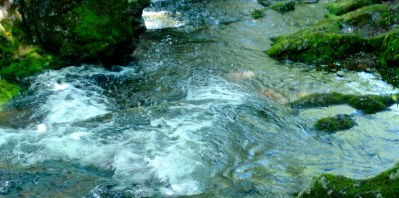
Rain

15-may-2002-pre-rimouski-224

Rain

Insane, the rain
washing down
my window.

Insanity of raindrops
mixing, matching,
their Van Gogh
rainbow colors,
no artist’s eye
to select them,
just a false ear,
tin drum
to their sound.

They blur blossoms,
twist tree and bush,
water censers now
those branch ends
bending beneath
water’s weight.

Unseen, the island now,
nor visible the bay
beneath cloud blankets
wrapping them away.