Summer in Wales

Summer in Wales
aka
Cricket, lovely cricket!              

Summer in Wales is always as I remember it: glorious days of sun and sand and blue skies and warm winds … and especially the sun on the beaches with the water sparkling and little boys and little girls playing cricket on the dry wrinkled sand packed hard when the tide goes out and leaves the land stranded … and uncles and aunties bowl under arm, not over arm, so the little ones could manage to score lots and lots of runs … and I remember us, standing breathless between the wickets, or at the wicket, if there was only one set of stumps, or a picnic basket stood on its side, or three pieces of driftwood, with sea-weed for bails, and what are bails, you ask?

              Well, bails are the sea-weed that is draped over the driftwood that stands as stumps. And we guard our stumps with the cricket bat that somebody has brought and we bowl with wet tennis balls, because nobody will risk a red, leather ball on the sands, with the wet tide standing there, waiting for the ball to be hit at it, or into it, and it’s cold, but not that cold, and when uncle hits the ball, right out so sea, someone has to run after it, then dive, and then swim after it, and if it’s real runs you want, then uncle runs two or three quite quickly; then the aunties tell him to stop running so fast or he’ll have a heart  … so he slows down and trots four or five; then he walks six and seven; and when you throw the ball back, he’s walking eight or nine; and then the dog intercepts the ball, catches it in his teeth, and starts running around with it in his mouth and everyone is trying to catch the dog except my uncle who is now limping very, very slowly between the wickets, but he’s already up to eleven or twelve; and then the little ones start crying because “It’s not fair!” Loud sniff! Then uncle stops in the middle of the wicket and sits there, waiting for somebody to run him out; except everyone is tired, except the dog, who is tireless and completely energized, and now the centre of attention; and nobody is going to catch him;  and finally uncle walks to the wicket and he lifts the piece of seaweed with his bat and everybody appeals, then he’s finally “OUT!” because officially he’s hit his own wicket and that’s illegal and now the game can go on once more, with everyone happy and God’s in his heaven and all’s right with the world …

And the dog has dropped the ball right at the edge of the waves and is barking furiously at the incoming waves as time and tide march up the beach and sweep us and our memories all away.

After the Lecture

After the Lecture

After I delivered the lecture at London University, as it was back then, I caught the tube and descended at Paddington station. While waiting for the train back to Cardiff, I sat in the station bar and ordered a pint of beer and a Cornish pasty. An older man wearing a sweater and jeans asked if he could join me. I didn’t say ‘yes’ but he sat down anyway and straight away began to talk.
            I paid no attention to him until he rolled up his sleeve and showed me the collection of scars that ran crisscross, hard and welted, over his left wrist.
            “Failed attempts,” he said. “But I’ll get it right next time. “I wouldn’t want you to make the same mistakes I did. If you want to kill yourself, you must do it this way,” he reached across the table and picked up the knife I had used to cut my pasty. He pulled out a dirty hanky and wiped the knife in it. Then he laid the blade not cross-wise but parallel to the artery in his wrist. “And you must dig deep, first time, and at a slight angle.”
            “I’ve got to go,” I told him as a tinny voice came over the Tannoy. “That’s my train.” I stood up, leaving the remains of my pint and my pasty on the table.
            I got to the door of the station bar and looked back. Then I watched as my table companion finished my pasty and reached across the table to claim the remains of my beer.
            “Quite the lecture,” I thought. “Good job I didn’t spit in the glass.” Then I realized that both my day’s lectures had been effective, in one way or another.

To be Welsh on Sunday

To be Welsh on Sunday
in a dry area of Wales

              To be Welsh on Sunday in a dry area of Wales is to wish, for the only time in your life,  that you were English and civilized,  and that you had a car or a bike and could drive or pedal to your heart’s desire, the county next door, wet on Sundays, where the pubs never shut  and the bar is a paradise of elbows in your ribs and the dark liquids flow, not warm, not cold, just right, and family and friends are there beside you  shoulder to shoulder, with the old ones sitting  indoors by the fire in winter or outdoors in summer,  at a picnic table under the trees or beneath an umbrella that says Seven Up and Pepsi (though nobody drinks them) and the umbrella is a sunshade on an evening like this when the sun is still high  and the children tumble on the grass playing  soccer and cricket and it’s “Watch your beer, Da!” as the gymnasts vault over the family dog till it hides beneath the table and snores and twitches until “Time,  Gentlemen, please!” and the nightmare is upon us as the old school bell, ship’s bell, rings out its brass warning and people leave the Travellers’ Rest, the Ffynnon Wen,  The Ty Coch, The Antelope, The Butcher’s, The Deri, The White Rose, The Con Club, the Plough and Harrow,  The Flora, The Woodville, The Pant Mawr, The Cow and Snuffers — God bless them all, I knew them in my prime.

Comment: When I lived in Wales, a long time ago, there were twelve counties and each one of them voted whether or not to allow open pubs and hence drinking on Sundays. The ‘dry’ areas did not permit drinking, but the wet areas did. Hence there was mass migration from dry to wet every Sunday, especially after Sunday morning chapel. I dedicate this piece to every dedicated Welsh boy who fled his dry county to quench his thirst in a wet one! NB This piece should be read out loud, fast, in a Welsh accent and also in a single breath! Mind you, I find that hard to do nowadays.

Kite

Kite Flying

So light, the kite,
a butterfly in flight.

Breeze battered,
sky-blue shattered.

Children stare
seeing the wing-shape
fluttering there
rising on flimsy air.

Diving, dipping,
nylon cord slipping,
finger-flesh ripping.

Here come others,
children and mothers.

Butterflies, bright,
ready for flight,
fighting wind-might:
a child’s delight.

I didn’t have photos of a kite.
I offer some humming birds instead.
Listen closely:
you can hear them hum.

Rats

Rats

Black clouds build over the Bristol Channel, threatening to cross the Severn from Ilfracombe to Brandy Cove and climb inland to rattle our windows and bounce rain off our corrugated roof.
            We run out to the lane, looking for the dog, calling his name. Hoping to get him in before he gets soaked. The rubbish dump outside the gate sits on a concrete stand and dominates the lane. Tall and stinky, the red-brick structure rustles with scavenging, skirmishing rats. Pinned to the dump, a hand-written notice: “Please do not light this dump.” We smile as we read it. Our neighbours will put a match to this dump, one dry night, on the way back from the pub.
            Kim, Nana’s Wire-haired Fox Terrier, spends his days at the dump in an effort to achieve his life’s desire: the elimination of every worrying, scurrying rat that ever inhabited the planet. When he tires of killing rats, he will bring their bodies home to the bungalow. Sometimes he lays them in rows outside the backdoor: rats, mice, field mice, voles. Sometimes he brings them inside and places them on the concrete base beneath the old cast-iron stove. Every day Kim sacrifices to my grandmother, his Gower Goddess, and lays the victims out on her altar.
            The rain is close. We run back down the lane to avoid the storm that is now upon us. Violent and short-lived, like so many summer storms in Wales, raindrops will thump against windows and roof. Lightning will flash, thunder roll its celestial drums, and the wind will whip its lash round the chimney. We sit at the table and sip hot cocoa. No sign of the dog.
            Later, when the storm has passed, we wander up to the lane, avoiding the deeper runnels of muddy water, and stepping from high point to stony high point. We scurry hurriedly past the dump and listen to the rats. They will survive for another night. Nobody will be able to light the dump after rain like that. Back in the field, we fill up the water can, take a handle each, and carry the precious liquid back to Gran.
            We walk to the back door. Our neighbor is standing there, crying.
            “I didn’t see him,” she stammers. “He ran out from the dump as I drove round the corner,” she points to Kim, laid out on the back step, his broken body wet and bloody, the last rat he would ever catch still clasped tightly in his jaws.

Forget-me-not

Forget-me-not

sitting in the kitchen
crouching by the coal fire
hands quite warm
back quite cold
checking the windows
peeling back the curtains
blackout curtains
frayed and old
looking at raindrops
sliding down the windows
chill greasy raindrops
grey and cold

wondering who wants me
wondering who loves me
wanting my teddy bear
longing for my pussy cat
wanting my little dog
longing for his tail wag
so much missing
my nose so cold

now I am seventy
everything has changed
changed town and country
changed clime and weather
everything is different
nothing is the same
longing for my childhood
longing for my home land
watching the ocean
that comes rolling in

ocean of waters
ocean of memories
ocean of people
now long departed

Comment: Rhythm is everything here. I have just re-read The Sing-song of Old Man Kangaroo from Just So Stories (Rudyard Kipling). My mum and dad gave me copy when I was seven years old. Did they really think I could read it and understand it at that age? Whatever! The rhythms have stayed with me all my life and today I tried to reproduce them. My soul and my fingers danced as I thought of old man kangaroo and how he lost so much to gain so much. And what of the Elephant’s Child with his insatiable curiosity? I lost so much when I came here to Canada but I gained so much from this wonderful country. I tore my world apart then put it back together. How to explain it? It may not be explicable.

Dream

Fall Foliage

Dream

I dreamed last night
that angels lofted me
skywards and wrapped me
in cotton-wool clouds.

The nearest rainbow
was a helter-skelter
that returned me to earth
where I landed in
a pot of golden sunlight.

Red and yellow
were
my hands and face.
I stood rooted like
an autumn tree covered
in fall foliage with
no trace of winter’s woe.

“May this moment last
forever,” I murmured,
as the rainbow sparkled
and I rejoiced in
my many-colored coat.

Comment: I have noticed on several occasions that when I am reading a text, I change the wording on the page to a new wording that seems more in keeping with the rhythm of the moment. I see that I have done this here, more by accident than by plan. I have noticed this too when listening to Dylan Thomas’s recordings of his own verse. Each reading then becomes a new variant on the poem. In this case, I rather prefer the second variation, but I am not sure that I approve of the first one, nor nor do I approve of leaving words out. Naughty! I am afraid that I still haven’t developed the skill of reciting instead of reading my poems. I guess it will happen soon enough. In the meantime, I’ll just have to put up with these little flaws.

Dream … A poetry reading from One Small Corner
Fall Foliage in Island View

My Grandfather’s Chair

18581930_1306791786107970_4016640231053970709_n

My Grandfather’s Chair
For Margie Goldsmith

“Write about that chair,” Margie said,
and I wondered what was in her head.
How can I write about that chair
when those who sat in it are not there.

Before the coal fire my grandfather sat,
snoring away, on his lap slept the cat.
At three years old, I climbed that chair,
and blew on the bald spot in his hair.

So many things we no longer know:
my grandpa did the same thing, years ago,
and years before that, his own grandad
did just the same to make his old man mad.

Now I, in my turn, when I drink deep,
like to sit in that chair for a little sleep,
and my grand daughter, there’s no grandson,
climbs up that chair, as others have done,

and sees the bald spot in my hair
and blows and blows as I snooze there.
The years roll back and I see the smiles
of generations woken by a young child’s wiles.

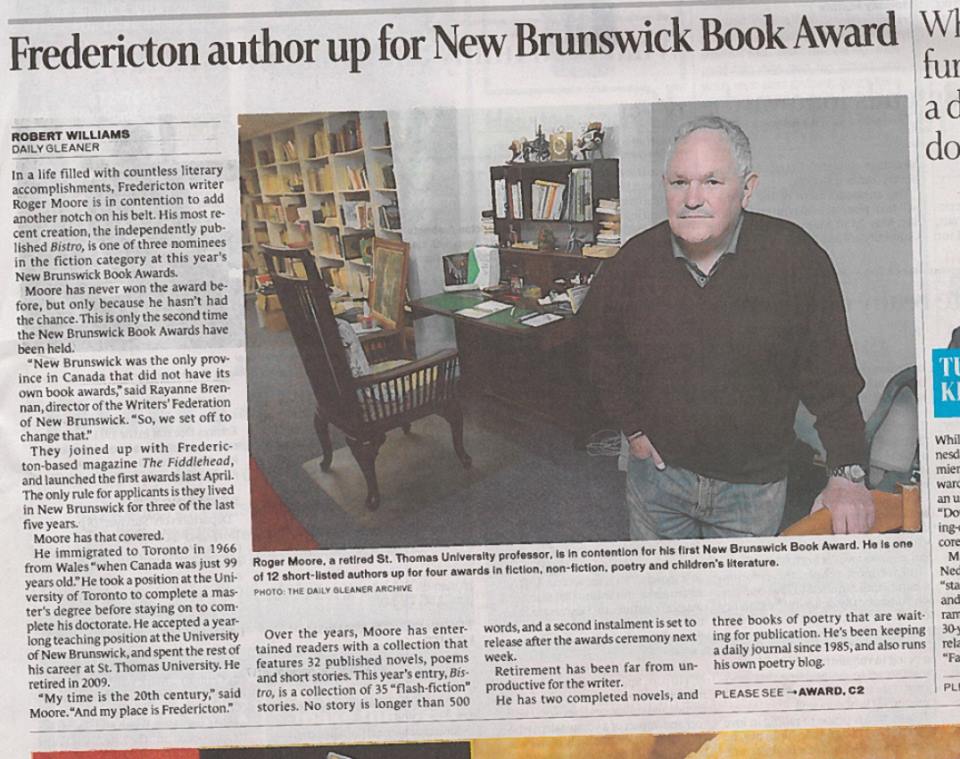
Comment: Talking the other day, I mentioned my grandfather’s chair, the only piece of furniture rescued from my parents’ house, and Margie said I had to write a poem about it. So, last night I did. The result is something very different from what I normally write. This is what in Spanish is called an occasional poem and it celebrates a specific occasion, a specific set of circumstances. Thus, it is written under different rules, rhyme, rhythm, stanzas. It is always an adventure to write something suggested by someone else. Poems like this cross the boundary between poetry of play (which this is) and occasionally enter the realm of poetry that expresses the authenticity of being which, to a certain extent is present in this poem too. The above photo, from our local newspaper, The Daily Gleaner, is the only one I have of the chair which resides in the basement where I keep my books. The article is an old one (2017), but the photo is nice!

Keeping Score

Avila 2007a 035 (2)

The Score

It’s the old conundrum:
you place one grain of wheat
on the chessboard’s first square,
two on the second,
four on the third.

And so on and so forth,
eight on the fourth,
sixteen on the fifth.
Now close your eyes
and make a wish:
“Let all these pandemic victims go.”

Alas, no.
You must sit and watch them grow:
32, 64, 128,
and that’s the first rank done.
Seven more marching ranks to go.

256, 512, 1014,
Lord above: how many more?
2028, 4056, 8112,
what on earth can people do?
Wash your hands, stay inside,
and hope your best friends
haven’t died.

Doubled again
that’s even more:
16 thousand 224.
Upon this rank
just one more square
sees 32 thousand
lying there.

How many more,
how many more,
and each death ringed
by family and friends.
This week it seems
death’s dance will never end.

Comment: La Calle de la Cruz / Street of the Cross, shown in the above photo, runs past the cathedral of Avila. It is also known locally as La Calle de la Vida y de la Muerte / the Street of Life and Death as it seems duels were sometimes fought there. It seemed an appropriate photo to accompany this poem which speaks of the seeming lottery, with its winning and losing tickets, in which we are all currently involved. The lower photo, incidentally, captures a stone mason’s mark carved into the face of the cathedral in Avila.

When writing the poem, I repeated the numbers naming them with their single digits, thus: 256, 512, 1014 becomes two five six, five one two, one oh one four (line 14). This allowed me to manage rhythm and rhyme. In my mind I always associate  rhyme with reason, but in this current pandemic, I can see very little reason. I guess, as I wrote in one of my earlier poems, ‘there are so many ways to die’. I just hope Corona Virus isn’t one of them. No, I don’t want to live forever, but hell no, I don’t want to die just yet! Keep safe, keep well!

Avila 2007a 039

Fire and Flame

IMG_1571 (2)

Fire and Flame

1

The world is on fire.
Someone, somewhere
lit a match.
The world exploded.

A match in the lungs.
the whole world burning.

Someone, somewhere
sneezed into their sleeve.
the world collapsed
in a fit of coughing.

“It isn’t the cough
that carries you off,
it’s the coffin
they carry you off in,”
said the talking head,
scientific boffin.

2

Intelligence, give me
the exact name of things:
corona virus, vaccine,
air that’s pure,
drinkable water,
a new, fresh world
for my daughter
and her daughter.

I wish I could spare them
from all this slaughter.

Comment: The echoes in here are obvious to me, but to how many others? Octavio Paz strolls through the first stanza while Juan Ramón Jiménez patrols the second one. How many people read their poems now? Polvo seco de tesis doctoral / dry dust of a doctoral thesis, as my friend José María Valverde once wrote. He, too, passed and will all too soon be forgotten like the rest. And time: what is it? How does it function? Is it linear or circular and repetitive? It twists and turns, like we did last summer, but not like we’ll do this one. My old arthritic bones will allow me to twist no more. Vingt-et-un, quatre-vingt- et-un: twist and bust. Yet time flows by, like water under Le Pont Mirabeau and days blend into days. 79 days of lock down now, all voluntary, or is it 80? El tiempo aquí no tiene sentido / time is meaningless in here, as my friend and mentor, José Hierro wrote, so long ago. And yes, these memories linger on, as time lingers on, as life lies heavy around us, and time limps by with its lame, old feet, yet looking back, it has raced passed like a spring river in spate. And the leaves are back, and the flowers are coming up, and the spring birds and bees and butterflies are arriving … and, in spite of everything, perhaps even because of it, life is as lovely as it ever was. Keep safe, keep well!

IMG_1264