Mannequins


IMG_0836

Mannequins
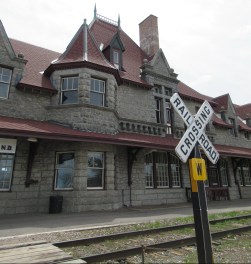
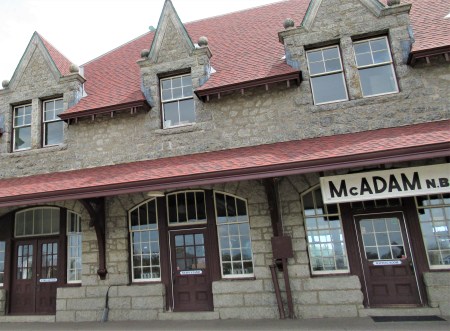
McAdam Railway Station #12

“He startles the unaware, that man by
the door, in uniform, with his youthful
looks and old-fashioned peaked cap,

fingers poised by his silver watch chain
ready to pull out his Waltham pocket watch
and check the time against the master-clock.

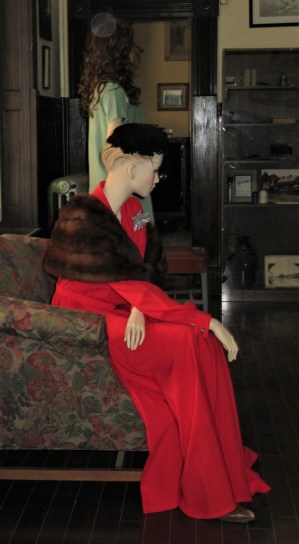
Two ladies wait in the waiting room.
One wears winter robes of red and black
while the other wears velvety green. Both

are motionless, one seated, one standing. Yet
if you watch them from a corner of one eye,
you will see shadowy gestures as their lips move.

Overnight they have changed into summer
clothes, gauzy, almost see-through, flowery
patterns, light-weight wedding boots, laced,

restful, cool, thin-soled. ‘Are you for real?’
I ask the standing one, for a joke. When she
nods and winks, a chill settles over the room.”
IMG_0676 (2).JPG


Tracks

IMG_0777

Tracks
McAdam Railway Station #12

“Put your fingertips on the rail,
see if you can feel its pulsing beat.

No heart rail rhythm now. No tremble.
Put your ear on cold metal:

nothing but silence. No murmur,
however distant. Black fly whine.

No-see-ums flit. The train track’s
buzz of harmony is lost and gone,

replaced by careless nature. Listen
to the wind whistling in the woods,

hark to spring sounds, so subtle,
grass growing, rust accumulating,

sleepers turning over in their graves,
silent, rotting beneath forgotten rails.”

Comment: Nothing so lonely as an abandoned railway track, rusting beneath snow and rain, the wooden sleepers rotting into oblivion. That said, the Southern New Brunswick Railway still carries freight trains through McAdam, and it is the railway station that suffered, with the loss of passenger traffic, rather than the rails themselves. What a pleasure, incidentally, to hear the hoot of the approaching diesel, to count the wagons as the train came to a halt outside the station. Then came the joy of watching the engine separate wagons from the main train, shunt them into sidings, return, and take the freight train, slow at first, but rapidly gathering speed, out of the station and away into the distance. Such memories. So many ghost trains riding those rails. So many ghosts bewitching the windmills of the child’s mind that still inhabits the ageing brain.

IMG_0780


Elevator Pitch

IMG_0627 (2)


Elevator Pitch
Jean Chrétien

His enormous presence filled that tiny
space. His corkscrew smile, well-known tic,
semi-frozen face, that trick of wild speech

butchering language, misunderstood in
both English and French. “Bonjour,” he said. “Good
day.” I nodded, didn’t know what to say,

just shuffled my feet. I remember he
talked on the radio about our land,
how, in winter, with car stuck in snow,

we spin our wheels, forward and back, a bit
at a time until we emerge, content,
victorious. Time and the floors slipped by.

I thought of the elevator pitches
I had written for my films. Should I pitch
him about my latest film or should I

just keep quiet. The elevator stopped.
Jean Chrétien got out. “You’ll be back,” I
said. “Damn right,” he grinned, lop-sided.

Renaissance Hotel. Toronto. Nine-teen
eighty-five. Tongue-tied I had stood there.
Later I thought of all I might have said.

Duende

img_0826-3.jpg

Duende
Federico García Lorca

It starts in the soles of your feet, moves up
to your stomach, sends butterflies stamping
through your guts. Heart trapped by chattering teeth,
you stand there, silent, wondering … can you?
will you?what if you can’t? … then a voice breaks
the silence, but it’s no longer your voice.

The Duende holds you in its grip as you
hold the room, eyes wide, mouths open, possessed,
taken over like you by earth’s dark power,
volcanic within you, spewing forth its
lava of live words. The room is alive
with soul magic, with this dark, glorious
spark that devours the audience, heart
by heart. The magic ends. The maelstrom calms.

Abandoned, you stand empty, a hollow
shell. The Duende has left you. God is dead,
deepening your soul’s black night. Exhausted,
you sink through deepest depths searching for that
one last drop at the wine bottle’s bottom
that will save your soul and permit you peace.

IMG_0810 (2).JPG

Vision

61958745_10157302398440522_1367573584830005248_n.jpg

Vision

Vision
appears from nowhere
holds you in its hands
molds you like putty
play dough or plasticine
till you bend to its will

62074164_10157302392400522_2936552509885382656_n.jpg

is it a conundrum
like chicken or egg
the final product
laid out in all its details
or is it a process
step by step along the way
sometimes even the artist
cannot really say
yet shaping happens

61873858_10157302392335522_4315892376666112000_n.jpg

maybe it happens each day
in a different way
a power descending
an angel entering
a vacant mind as if it were
an empty room
Lorca’s duende
alive and well
and living in St. Andrews

62071670_10157302392320522_4450451399947321344_n.jpg

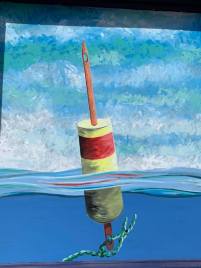
Comment: The above verses express, in part, a conversation on the origins of inspiration and vision held around the dinner table at the KIRA residence in St. Andrews on 9 June 2019. Those who participated in the dinner discussion … de sobremesa, as they say in Spain, over the table top … included (clockwise round the table) Chuck, Masha, Heather, Susan, Geoff, Andrea, Roger, Evelyn, Perri, Faye, and Mel. If I have forgotten anyone, or placed them in the wrong seating order, please forgive me. I am growing old and my memory is not what it was. However, the arrival of inspiration, how we greet the artistic vision, what it means to each of us, whether it arrives in totality or in fragments, glimpses or a full vision, this varies for each one of us. More on this tomorrow when I write about Lorca’s duende, the dark earth power that takes over performance artists when they perform, filling them with fire and fury, then leaving them empty, drained of all essence, ripe for the old rag-and-bone man and his cart. The paintings, incidentally, are by my line-painting friend, Geoff Slater, who is also a muralist, indoor and out, and the photos are courtesy of Mary Jones, the much-beloved former Executive Secretary at KIRA.

Murals

IMG_0692.JPG

IMG_0659 (2).JPG

Murals
McAdam Railway Station #11

Painting a mural,
inside, interior
wall, knowing it will
stand time’s test.

Viaduct broken,
a tumbled engine,
Canadian workers,
railwaymen all,

some from Macadam,
pebbled the floor,
handrail, radiator
camouflaged for war,

part of the painting.
Depart from the station.
Turn right. Straight ahead,
flaked peeling paint.

So sad, this outside
mural, exposed to winter’s
snow, frost, winds, and ice.
So vulnerable

and so ephemeral.
Such a short-lived
summer, over in a day.
Butterfly on a rock.

IMG_0691 (2).JPG

image1 (2) - Copy.JPG

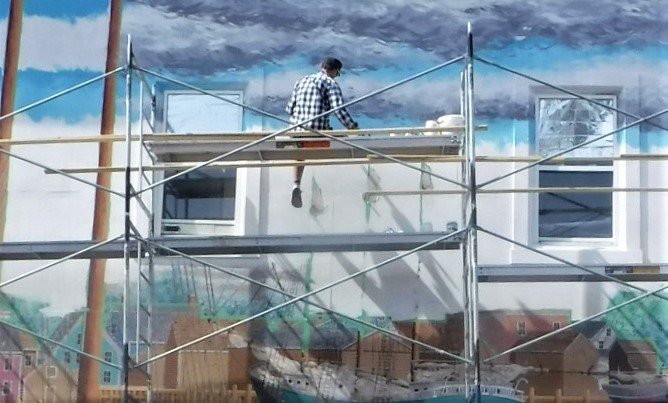
Comment: This sequence comes from the indoor and outdoor work (murals) of my friend Geoff Slater. Geoff told me how ephemeral were the outdoor murals with a life-span of about ten years before they needed redoing. After that, the paint starts to fade, then crack, then dry and peel away. Our Canadian winters with their icy cold and the ensuing springs with their frost and thaw do not help. The protection, no ice, no snow, no sun, no rain, afforded to the interior murals means that they will last so much longer. Our outdoor art, unless cast in the firmest stone, is ephemeral. Like a butterfly, it will not last much longer than a brief summer day. Hence the final metaphor.

Faces

IMG_0258.JPG

Faces
McAdam Railway Station #10

“White at windows
when trains pass through
in June on their way
to summer and sand.

Wind-tousled, tanned
at summer’s end
returning home to
Boston and Montreal.

I remember them
waving their hands,
flickering white hankies
as they went by.

This station is a ghost train
that travels through time
instead of space. Stand
still as silent stone. Wait.

Look: there’s someone,
waving at us now
from that window
on the second floor.”


IMG_0782 (2).JPG


Hospital

IMG_0811 (2).JPG

Hospital
McAdam Railway Station #9

“I was here the day they
took the hospital away.
I gave some writing workshops.
Teachers upset, students in tears,

everywhere, fear and despair.
‘I was born in that hospital.’
‘My grandfather died there.’
‘Where will my child be born?’

I helped them write down
their memories and fears,
their hopes and dreams.
My lesson plans vanished.

How could they survive
when life’s rising tide
broke all bulwarks,
flooded open hearts.

A wounded community,
diminished by its loss,
they took me into their hearts.
Their loneliness wrapped me.

They wrote down memories.
Tears stained every page.”

Comment: This is one of my memories of being in McAdam. I was invited to run a series of writing workshops there, under the Writers’ Federation of New Brunswick  (WFNB) WiSP (Writers in Schools Program). I arrived there the week the announcement was made that the local hospital would close. I remember all too well the effect that this announcement had on the local community and I have tried to express that anger, sorrow, despair, fear, resentment in the above poem. More than anything, I felt the sorrow and despair of students and teachers. It is so easy to make an executive decision, at a distance, to rip the beating heart out of a living community on financial grounds. It is so difficult to revive the patient after the act of removal. What amazes me about McAdam is the effort hat volunteers are making to rebuild their town. Their words and deeds are truly impressive: as impressive as their magnificent railway station, now declared a national heritage site.

S.O.S

IMG_0678 (2).JPG


S. O .S.
McAdam Railway Station #8

“Dozing in the cab, I was.
Smelt a different smoke.
It wasn’t my engine’s.

Looked around.
Saw flames. One, two,
three houses on fire.

Steam was up. Yessir.
Three short hoots I gave.
Three long. Three short.

S.O.S. Mayday. Mayday.
S.O.S. S.O.S. Kept going
till house lights came on.

People running. Leaving homes.
Jumped out of the cab.
Ran out to help them.

They thanked me.
Said I had saved their lives.
What else could I have done?”

Comment: This is a third hand poem. It came to me from Geoff who heard the story from the hardware store owner who witnessed the fire. The narrator is the anonymous engine driver who raised the alarm. Of course I don’t know exactly what he did, said, or thought. Our knowledge of history can be divided into two great moments: the momentous events, recorded by expert historians via diligent research, and intra-historia, as Miguel de Unamuno, that great Spanish philosopher and rector of Salamanca University called it, referring to those small, individual moments when history is made by anonymous human beings who did what they had to do and then faded into the anonymity of a distant past, now wrapped in silence, as is the store-keeper and the driver of the train.

IMG_0678 (2).JPG