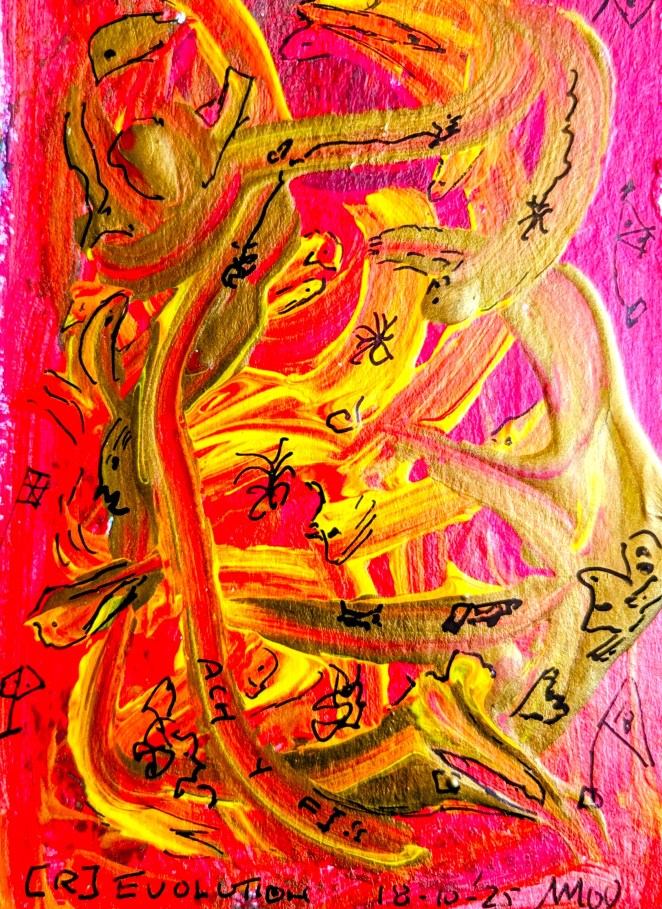
Rage, Rage 18

Rage, Rage
18


I nod off again and dream
of a summer beach,
burning sand, tide way out,
sparkling waves, clouds moving,
inaudible, as they drift by.

I dream of my beginning
and find a forlorn formlessness
that sought the solace of sound
only to discover waves and wind
as I drifted on an amniotic sea.

The wind of change has blown.
I awake and pick up my book.

Voltaire –
“Si jeunesse savait,
si vieillesse pouvait.”

“If youth knew,
if age were able to.”

Comment:

The wind of change has blown and, by all accounts, it is still blowing. A Nor’ Easter here, swinging down from the Arctic and bringing us cold weather, ice, and more snow. Driving isn’t too bad, for the roads are cleared regularly, especially when schools are in. Most enterprises have cleaned, salted, and sanded their premises. Some haven’t. Yesterday, it took two people to move my shopping cart from the shop to the car, a matter of about thirty yards. The wind was so strong. It tussled and tugged, drove me where I didn’t want to go, and two people stepped in to help me. Then I discovered an undug doorway. I parked my car at a sharp upward angle, on the snow. A man offered me his arm. I said no, but he stood beside me, hands held out to help, just in case. Leaving that same shop, I was accompanied by a young lady who insisted on carrying my bags, taking my arm, and leading me to my car. The dangers of falling on down hill ice were even greater than going uphill.

I dream of my beginning, more and more often nowadays and now-a-nights. I know, spell check underlined that word. A neologism, not a proper word. But I like it, for though I dream by day, nodding suddenly into a shallow sleep, it is by night that I really do my dreaming.

At night, I find I can roam a world that has become hostile in the light of day. I can, and do, dream of my childhood on the Gower Peninsula. The fields are still there. My grandmother walks among the bluebells, and together we tell the time by the old dandelion clock. The larks still rise on Bishopston Common and Bluebells, Cowslips, and Primroses still hide beneath the trees. The sands at Brandy Cove are still clean. There is no pollution in my dreams and no oilers clear their tanks in the pristine waters of the Severn Estuary. There is no industrial haze and, on a clear day, I can still see, from the steps of the bungalow, Ilfracombe, across the bay.

And the people – my family and friends are still there. My uncles and aunts, my cousins, all young still, my parents and my grandparents … and all my dogs return, one by one, from their canine adventures. At night the cows can be heard crunching grass, and wheezing in my dreams. I met one, once, on a night trip to the outhouse – we had no indoor plumbing. And, on one memorable night, I stepped into a wet, warm cow patty, left like an anti-personal landmine, just outside the back door. I still shiver as I think of that warmth creeping up between my toes. No amount of wiping has ever really removed it. It haunts like the ghosts of summers past that drift at midnight round my room. waiting to be plucked from the air.
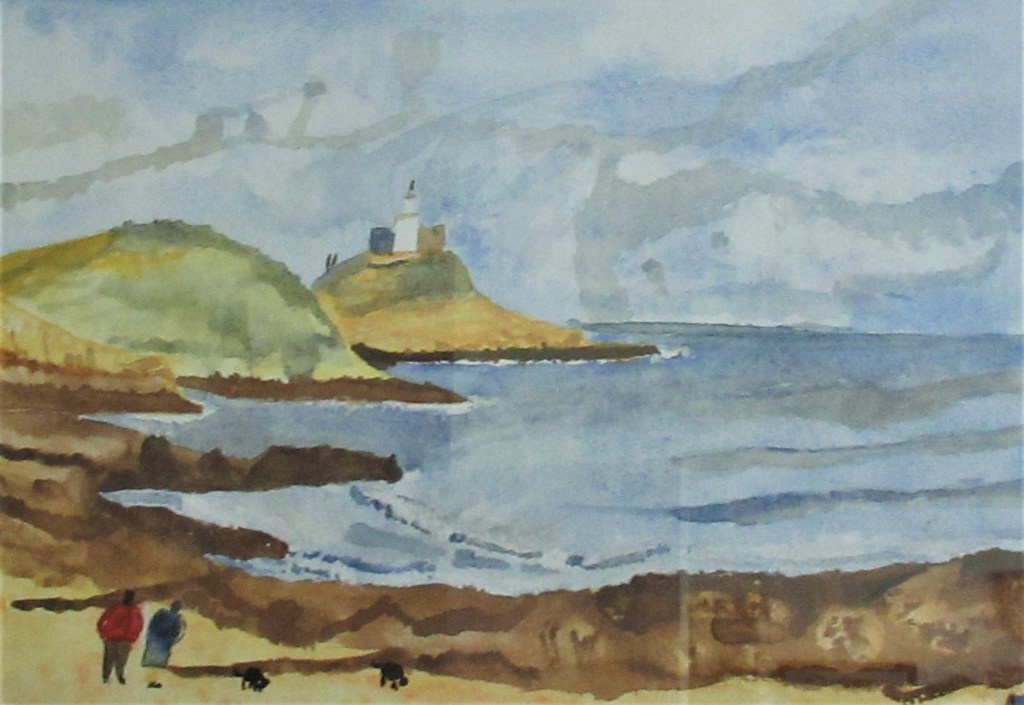
Summer in Swansea

My Uncle Frank’s first water color:
the Mumbles Lighthouse from Limeslade

              … but it’s watch out for the dog, for the dog gets everywhere because he’s on holiday too and everybody’s on holiday in this little sea side town and the cousins have come down from London with their cockney accents, born within the sound of Bow Bells, though they’re half Welsh by blood, though you wouldn’t believe it with those incredible accents which nobody can understand … and they’ve never seen the sea, though their mother was born here, beside my mother, beside this self-same sea which has never left and which still flows in and out, even now, and it still flows through my bones and “Look at all the water!” my youngest cousin cries and then he really cries because London, the capital of England, is concrete and tarmac and all petrol smell and smog and fumes and busses and he’s never ever seen the sea, the sea’s open spaces, the wide open arms of the bay held out to embrace you with Swansea Docks on the left, a working area of ships and shipyards where my grandfather labours and takes me on workdays, even in summer, and shows me the ships and his friends and everyone is happy and laughing because it’s summer and it’s hot and there’s lots of employment and the banana boats are lining up in the bay, at low tide, waiting for high tide, when they can enter harbour and be unloaded and this happens all year round, but it’s really in summer, when the sun is as yellow as the bananas, that the banana boats become significant and we show them to my cousin who has never seen the sea nor the banana boats, though he knows what a banana is and where to buy them and what they cost, but he never knew they came in on these boats, these great white summer boats, from Africa and the Caribbean,  with their funnels all yellow and their bright stripe of blue, Elder and Fyffe, and the boats all lined up in the bay and look: to the right there’s the Mumbles and the Mumbles has a pier and a playground and you can go out and walk on the pier and at the end there’s the life boat and the life boat has a slipway for the life-boat to run down into the sea to rescue people who are shipwrecked, but only in winter because in summer the sea is calm and shiny and it runs in and out twice a day, like an obedient dog, and why is the beach wet? Because the sea weed … and the pier is a world full of wonders, with its peep shows and its games and the old men fishing off the end, chatting and gossiping, and not ever worrying about whether or not they catch the fish which many of them throw back anyway, so they can catch them again tomorrow  …

Kingsbrae 2.2

img_0165

Kingsbrae 2.2
2 June 2017

The Red Room

Carlos makes music on his flute.
He lives in the Green Room,
an open door opposite mine.

He creates the highest note of all
and it floats before me in the air,
a trapeze artist caught in a sunbeam,
suspended between the hands
that fling and those that catch.

His musical rhythms are different.
I try to follow his fingering.

In the space between notes,
hummingbirds flash their ruby
throats as they flit between flowers.

With a whirring of wings, all music
stops, save for the robin’s song
refreshing the early summer
with the sound of his eternal joy.

Journal: As I unpack my bags and start to settle in and arrange the room to my own liking, Carlos who will stay in the room opposite mine, starts to play his flute. I listen to the notes and, as I am listening, a robin joins in the song. I rest for a moment and sit at the small writing desk by one of the windows. From here I can see white clouds floating their ice-berg shapes across a sea-blue sky. Beneath them, Passamaquoddy Bay sparkles and crackles with filtered sunshine.

My mind goes back to another, more desperate time, two years ago, when I sat by the hospice window in Moncton and looked out at the car park. My car sat out there, abandoned, lonely, waiting to take me home for the welcome respite of a weekend free from radiation and treatments. Now, looking out of the window towards Minister Island, I feel as if I belong, as if this place had been waiting a long time for me to arrive and bear witness to it. I feel deep inside me the joy I feel when I walk in the door and enter the warmth of my own family and home.