On being Welsh in a land ruled by the English Dydd Dewi Sant Hapus
I am the all-seeing eyes at the tip of Worm’s Head. I am the teeth of the rocks at Rhossili. I am the blackness in Pwll Ddu pool when the sea-swells suck the stranger in and out, sanding his bones.
Song pulled taut from a dark Welsh lung, I am the memories of Silure and beast mingled in a Gower Cave.
Tamer of aurox, hunter of deer, caretaker of coracle, fisher of salmon on the Abertawe tide, I am the weaver of rhinoceros wool.
I am the minority, persecuted for my faith, for my language, for my sex, for the coal-dark of my thoughts.
I am the bard whose harp, strung like a bow, will sing your death with music of arrows unleashed from the wet Welsh woods.
I am the barb that sticks in your throat from the dark worded ambush of my song.
Striving onwards to the light I don’t need a ladder nor an Aladdin’s Lamp to transport me upwards, not to stardom but to the sun and stars that wait, day and night, outside my window.
Prince of Mirth, soon to be Lord of Light, I will wear my hibiscus crown for a short time, but with joy and pleasure, a treasure I will treasure until the natural end when stars, sun, and crown come tumbling down, leaving me alone, naked, yet clothed in, and surrounded by, light.
so easy to forget the troubled times when the lines of life did not align with what we thought we wanted even if we didn’t really want it and it wasn’t any good for us anyway but we did it in spite of knowing all the time the harm it would do short term long term and the results of that one false step walk with us still and we wish we could wash away the stains on our hearts souls minds memories underwear but the strings are knotted and tied and we can forget them knot
On days like these, the center must hold, but not just hold, it must writhe and strive to live longer, be stronger, to hold together so that the periphery understands that it too is at the center of an extended web of life that contains us all, you and me, past and future generations, in a great chain of being alive and knowing that yes, we are here, we are, at heart, really only one, and totally unique, is spite of the sameness that sometimes surrounds us as time’s spider-web unravels, oh so fast, so slow, and yet still we are here, and still the center holds.
On a sunny morning, the sun lights up my bedroom wall. Each day he arrives earlier and earlier, a minute a day. Now days grow longer, a sure sign that spring is on its way.
As I lie awake, waiting for the sun, I sing my morning sunshine song. It keeps me warm and comforts me. I also count the birds that fly across the garden in search of sunshine and food.
Crows come first. They perch atop the highest trees and watch and wait. Mourning Doves come next and their dawn song is a mourning chorus, “Who-who-who’s next? called from branch to branch. With the sun come Chickadees, Pine Siskins, lazy Blue Jays, Juncos. These are all regulars.
Irregular are my neighbor’s Cardinals, orange and red, American Goldfinches, two small woodpeckers, a Downie and a Hairy, a Nuthatch.
Gone now are the Gray Jays, Gorbies, Whisky Jacks, those ghosts of the woods. Lost too are the Greater Pileated, the flocks of Grosbeaks, Evening, Pine, and Rose-Breasted.
They may come back, but somehow, I doubt it. For now, the Blueness of Jays, the Blackness of Crows, and an unsubtle dawn chorus of Caw-Caw-Caw-Caw-Caw.
“A moment in your life,” she said, “a moment that changed you forever.”
A bad boy, banned from representing the school, condemned to acting as a servant to the chosen few, those who were good enough to go.
They gathered early in the refectory. I served them tea. But first I salted the tea pot with Epsom Salts, or something similar. The tea pot frothed and foamed , then settled.
Later, the house master called me. “Can you dance? he asked. “Yes,” I replied. “Show me,” he said. He handed me a chair and put a record on his gramophone. I danced, six legs, to his satisfaction.
“Put on your Sunday suit,” he said. “Be on your best behavior. It appears we have suffered a bout of gastro-enteritis.”
That’s where I met her. Age seventeen. At a school dance. The one. My one. The only one. Sixty years later, we’re still together. Writing this, I see us as we were back then. My chest goes tight. My eyes overflow with tears.
Paintings: doors you can walk through, windows that open onto visions of another, more beautiful life. Deeper than the paint, the thoughts and words that formed them, brushed them into life, an ephemeral life, so brief that butterflies seem to last longer and flowers live for all eternity.
Transience and insubstantiality. Change is all around us, we are surrounded by change. But the deepest changes, the ones that affect us most are internal, set deep within us, death’s eggs hatching slowly since the day we were born.
Life is indeed short, and art endures. Carved five thousand years ago, in stone, this magnificent henge, first Wood-henge, then Stonehenge, majestic at the dawn of time, with its sarsen stones, pillars, post-holes, and labyrinths, circling within circles, a frail spider-web of sunlit brilliance.
Lost now, the message, as my own message is lost, covered by paint, though words emerge in the strangest places, allowing us to peer in through windows as long-lost words and worlds whirl out through carved and painted windows and everlasting doors.
Doors First version
Paintings are doors you can walk through, windows that open onto visions of another, sometimes better, life. Deeper than the paint are the thoughts and words that formed them, brushed them into life, an ephemeral life, so brief that butterflies last longer and flowers live for all eternity, or so it seems.
Transience and insubstantiality. Change is all around us, we are surrounded by change. But the deepest changes, the ones that affect us most are internal, set deep within us, death’s eggs hatching slowly since the day we were born.
Life is indeed short, and art endures. Carved five thousand years ago, in stone, this Towie ball with its labyrinths and circles. Lost now, the message, as my own message is lost, covered by paint, though words emerge in the strangest places, allowing us to peer in through windows as long lost words and worlds walk out through carved and painted doors.
The spider plant spins out web after web, all knotted together, then ejected from the central nest.
One landed on my floor the other afternoon with an enormous clunk. A huge new set of offspring and roots ejected and sent on a voyage of discovery to find a new home.
Mala madre / bad mother. Oaxacans have a curious way of naming their plants. I lived in an apartment above a courtyard filled with malas madres.
A Bird of Paradise nested in the same tree, while in the garden a banana plant, in flower, a huge hibiscus, and such a variety of prize poinsettias that I could never get the varieties straight: red, white, cream, single, clotted, and double-crowned.
In the powder room, downstairs, our hibiscus is about to break into winter blooms.
Sider mites crawl all over it. Every day, I hunt them down, squishing them whenever I can.
My daughter calls me cruel and a padre malo.
I say ‘no: it’s them or the hibiscus. You can’t have both.’
Stumps, yes. Firmly planted. Newly arrived at the wicket, I can now take my guard. Last man in with everything to play for.
“Middle and off. Please.” I hold the bat steady, upright, and the man in white nods his head, counts the coins, or stones, he has in his pocket and wonders when he can leave his post and go to tea.
I stand, there, right-handed, and the field adjusts. Then I change hands, keep the same guard, now middle and leg, and stare at the square leg, now a short leg who glares back fiercely.
The man in the white coat tut-tuts in despair. I know he knows this isn’t done. It’s just not cricket. But then, he’s not the one batting on a cloth untrue, with a twisted cue, while the bowlers bowl with elliptical balls.
The field changes over to a left-handed stance. I think about changing over again, but I’m sure there’d be an appeal: wasting time, a nasty crime at this stage of the game, though many do it.
First ball, a long-hop, and I clobber it for four. Three runs to win, four balls to bowl. I block the next ball. The one after is short. I cut it away past gully and call for two. I make it home safe but my partner is run out at the bowler’s end.
We lose by one run. “Serve you right,” says the man in the white coat, racing towards the pavilion for a pee before tea. “That just wasn’t cricket.”
I walk slowly back, stiff upper lip, ramrod straight bat, and no time at all for this sticky dog wicket.
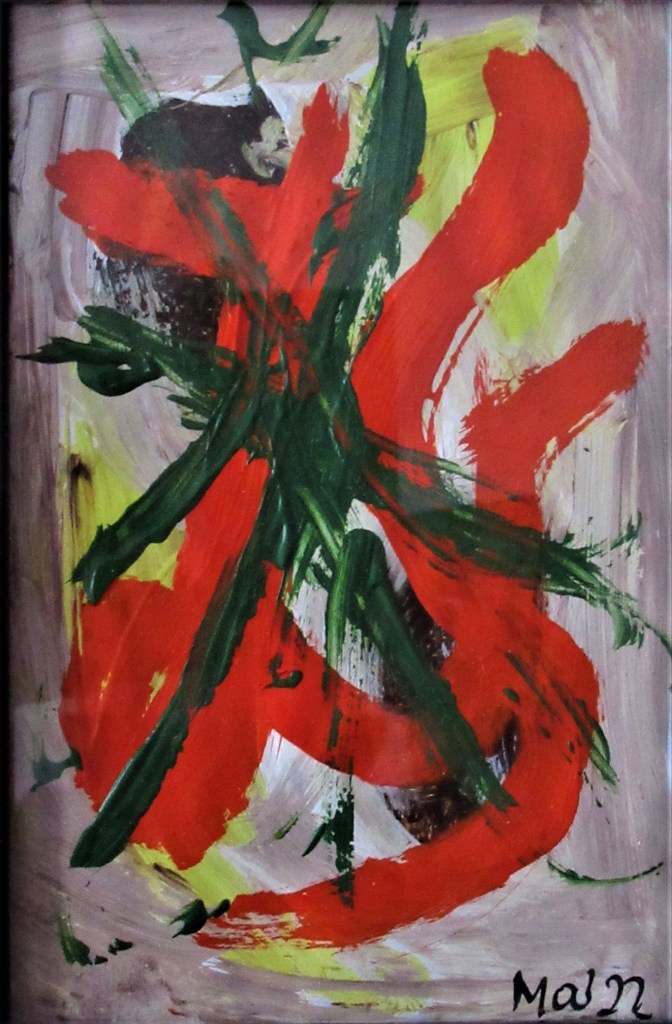
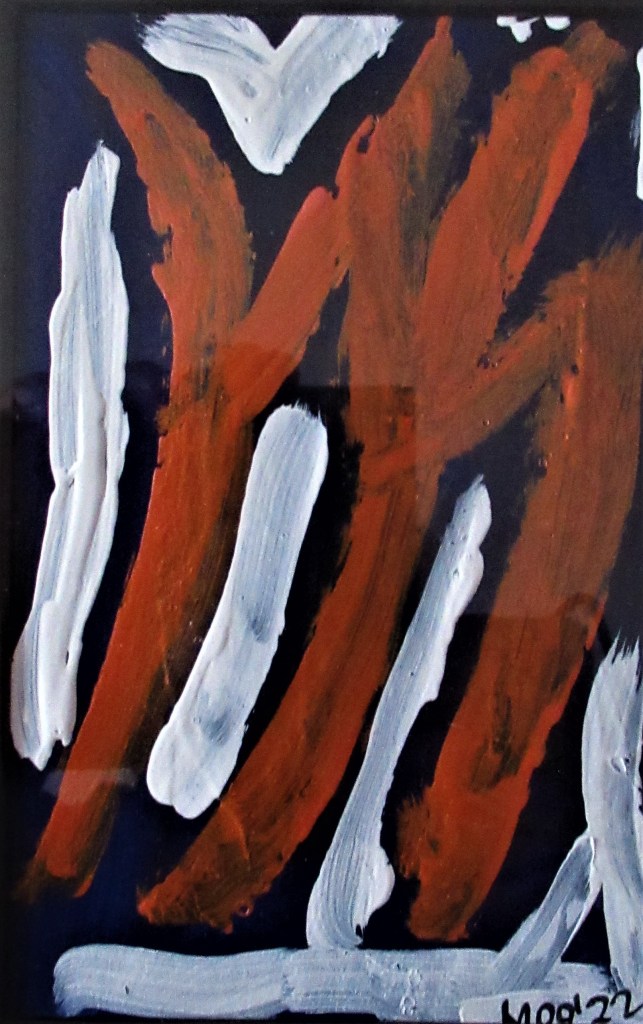
Comment: I wonder how many of my followers will have understood a word of what I have written. Never mind. You can always enjoy the painting. Oh the mysteries of what used to be England’s national game and a wonderful source of metaphor and image. A double-header on the weekend. England vs the West Indies. I wonder if it will be that close?




 rogermoorepoet