DIY Fridge Magnets


IMG_1197 (2)

DIY Fridge Magnets

Tired of your old fridge magnets? Worn out by dire warnings, by political slogans, by advertisements from unwanted people for even less wanted things? Join the club! I set it up yesterday: The DIY Fridge Magnet Recycling Club.

IMG_1203 (2).JPG

Take that old magnetic advertisement for ‘who-knows-what’. If you don’t like the original photo, strip it off, some peel away with great ease. Others can be coloured over. In harder circumstances, you must stick  new painting surface over the old one. I use Crazy Glue for this quite simply because, yes, I know it’s a craze idea, and yes, crazy ideas not only work, they make and save money. When you have your new surface, paint away. I have used acrylic paints but I now use marker pens. Who cares? I’m crazy anyway. Who needs selfies? Here’s a self portrait, as stuck on my fridge. Crazy eh? Now you know exactly what I mean.

IMG_1202 (3)

Rolling Stones

IMG_1159 (2).JPG

Rolling Stones

I have counted down the days, hours, minutes,
one by one, each tock of my grandfather clock
linked in pen and ink chains of endless words.

From arrival to departure, time’s fickle finger has
pointed me onwards into my future or backwards
into a delusional past that never was as I recall it.

Packed bags, backpacks crammed full of snacks,
ammunition against the hunger wars soon to be
upon them, they commence their long journey home.

Grown ups, some in their second childhood, bemoan
ties that bind, tides that rip us apart, tearing hearts,
swinging us in and out as, cockle-shell heroes, we man

our coracles and consult wide-ranging horoscopes that
never fail to comfort, the future’s wild words, written
in pitiless skies to guide and inspire all earthly creatures

born into sadness and death. No heroes in this house.
Just two old people, grey-haired, broken, contemplating
this soon to be silent home, knowing the Rolling Stones

were right, that rocks in motion don’t gather no moss,
that each lost moment is a finger-nail torn from flesh,
that today of all days could verily be ‘the last time’.

Commentary: Here for such a little while and gone already. Two years since they were here and two more years before they come back again. The silence is overwhelming. Only CNN with its endless cacophony breaks into the conscious mind, though that mind is unconscious now of words and their meanings. Images of emptiness, empty nests, this empty nest, these empty nests fill the vacancy of space. The heart is a black hole in the chest, sucking everything out of the light and into that dark, vacant space.

IMG_1112 (2).JPG

Read My Book

Time-Spirits.png

Read My Book

Of course, you don’t have to, if you don’t want to. More important, why spend  money on purchasing someone else’s words when you don’t have to? So here, for all you poor people, old and young, for penny-counters, penny-pinchers, and ultimate scroungers, here a is a free poetry book.

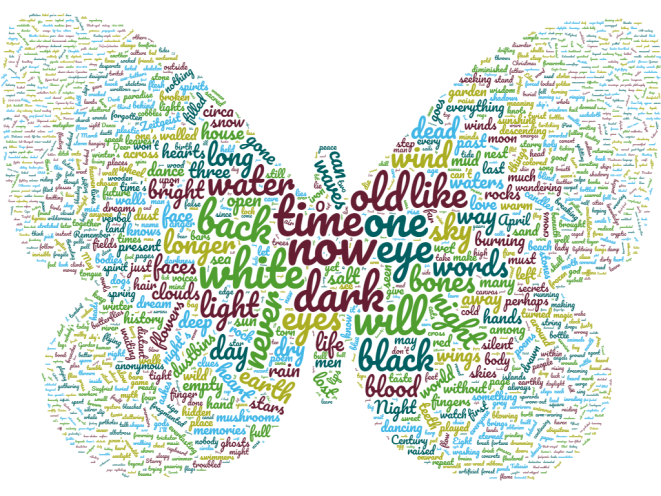
You don’t have to spend a penny (well, not in that way anyway) and all that poetry is all yours. Just click on the butterfly, decipher the words, and all my genius will be yours in the flick of a butterfly’s wings, be it Monarch, Red Admiral, Swallow-tail, or Indigo Bunting.

IMG_0713.JPG


Now tell me: what exactly is a butterfly kiss, or a butterfly’s sting? Answers on a postcard and in word-cloud form. And remember: there’s more to poetry than meets the eye.

Zeitgeist 1-10.jpg

A Different Kind of Doorway

different kinf of doorway.png

A Different Kind of Doorway

When one door closes, another opens. And yes, they are so important, these doors, that open and close. One day everything is open to us; the next, the future seems closed. But another door opens and we walk right through.

Avila 2008 072 (2).jpg

Or maybe we don’t. So much depends. The brain drain, as they called it. The migration of students from Great (as she used to be) Britain to North America.  “Make sure,” they told us, “That you can see light at the end of the tunnel. If you can’t, don’t go.” I went to Canada for a year and stayed here for the rest of my life. I came to New Brunswick for a year and stayed here for the rest of my life.

Regrets? None. Dim o gwbl /  none at all, as we say in Welsh, the language of my maternal grandfather, from the land of my father(s), who never spoke a word of it. A language that I am just learning now with great pleasure, in the evening of my life. I am losing my French. I am losing my Spanish. I am learning Welsh.

So how do we open those doorways? Well, that depends on you, each one of you. Keep your eyes open. Study. Learn. Don’t waste your life. Recognize your talents. Don’t despair. Never give in. Nil carborundum illegitimi. No. Don’t allow yourself to be beaten down. Believe. Breathe deep and believe. And remember: there is always light at the end of the tunnel. Any tunnel. Don’t give up. Never give up. You just have to find that light. Seek: and you will find it.

Avila 2007a 105 (2).jpg

Carousel

Carousel

carousel.png

Around and around a roundabout! I love it when the painted wooden horses open their mouths and rock up and down, and the little children hold out their hands to watching parents and grandparents, and big sisters and brothers hold them tight and keep them from falling off and the world passes by in a blur and open mouths are black holes in faces sucking the carousel in as it spins past in triumph.

And never forget the dodgem cars, weaving in and out, never dodging anything, but jousting like armor-clad knights of old, bumper to bumper, and ready, steady, charge! Or the old swing boats, twin-roped, non-mechanical, lifting us up to the skies and dropping us back to earth with that stomach-churning fall from stardom to the loss of innocence as the wooden break grinds, our thruppence is spent, and the ride is over.

Those days are as forgotten as one a penny, two a penny, or the tuppenny loaves that the elephants dropped, or the sing a song of sixpence where the twenty-four blackbirds descended like clothes pegs to devour the bread and honey and peck off the nose of the open-eyed innocent who never tired of the joke until the ultimate childhood squeal as his or her freckled or un-freckled nose was pinched and stolen away. So much lost, so much forgotten.

For two weeks now I have tried to photograph the hummingbirds, colibris, who visit the hollyhocks. Tonight, after a hundred or more photos, I managed to catch one in the fish-net of the camera. What joy: success after days and days searching for that delicate flash of red and green, only to find nothing there. Oh hummingbirds, I weep to see you, to capture you in the camera’s eye, to preserve you … for such a short, brief, moment of time.

IMG_1033 (2).JPG

F-F-F-Forgetting

IMG_0486

F-F-F-Forgetting

    The apps and programs that no longer work. The computer files you can no longer access. The photos that vanish leaving a blank space in the album.
Now your memory goes on the blink and you forget faces and voices, friends, phone numbers, addresses, street names, the houses where people live, when to turn, where the best parking spots are, how far you can walk, where you were really going, and what you were sent out to buy.
Snow banks don’t help: that banked-up whiteness, that sticking out of the car’s snout into traffic, that stretch of your neck peering round corners. How many number plates have vanished into those white mists? How many cars? How many phone numbers have you forgotten?
You have forgotten the birthdays of your closest family and friends. When was your father born? When did he die? When and where did you bury him? Did you actually scatter his ashes or did someone else do it for you? When was your cousin born? When did he die? How close were you at the beginning, in the middle, and at the end? What color were his eyes, his hair? Did he even have any, hair, I mean of course?
What happened to that carton of eggs you abandoned in the store? Do you remember buying it, let alone leaving it there? How about your brothers, their faces, the sound of their voices? Did your own voice change when you emigrated?
Have those who live in Australia forgotten that they are Welsh? Do they speak like Australians, now, or do they still have those rich Welsh voices and rhythms that nobody in Wales ever wanted because they made us stand out when we moved, unwanted, to England? How many times have we, the Welsh, heard those threatening words: why don’t you go back home to Wales. Countless times, no doubt. In fact you have forgotten how many and you have forgotten so much.
Do you remember the parking spot in which you left your car? Do you recall your number plate or what model your car is, or what color?
“What day is it today,” you ask, for the second or third time. “I’m sure I know you,” you say to a friend who stops to talk to you in the shopping mall, “but I’m sorry, I can’t remember where we met and I can’t remember your name.”

IMG_0452

Cell Phone

IMG_0135

Cell Phone

    Fingers slip across the telephone key board, pressing  wrong numbers or punching them in in the wrong order. Strange voices reply from the other end. This morning a woman spoke to me in a language I didn’t understand, Then a man came on the line and yelled at me in broken English to “Go away! Go away! Leave alone!” I imagined him tearing the telephone from his wife and berating her for answering this call from a total stranger.

    Often, I am too clever for my own good. I think I recall the right number for a friend, but when I punch it in, I find I have reversed two of the figures. I imagine other people doing that when they call me: “Sorry,” I say. “I think you have the wrong number.” “Is that 472 …?” they query. I say that it isn’t and they say sorry and end the call. Then they call me straight back and get the same answer.

    I hate running through my list of callers to get to the name that I want to call. But that’s what I have to do most days now. At least I don’t run into so many wrong numbers.

    And as for answering the phone … well … I am tired of robot calls, especially around election time. I am fed up with telephone surveys. I am driven crazy by heavily accented, high-pitched voices that call me from overseas, in the middle of the night or wake me early in the morning to tell me that my computer needs repair. “Suh, suh, we have discovered a werry nasty wirus [sic, or should that be sick] on your computer. Give me all your passwords and let me in to your computer and I will repair it instantly.”

    I have had calls from the telly-phony tax men who tell me the RCMP are about to knock on my door and arrest me if I don’t immediately give them my VISA Card number, passwords, and send them, right now, the $7,200 I owe them in taxes. I have grown to loathe the harbor boat hooter that announces I have won a cruise from Florida to Mexico on a super cruise ship …. probably a rusty tug boat that will take me twice around the harbor, be declared un-seaworthy, and leave me stranded, miles from anywhere, and paying a fortune to get myself home … and all I have to do, they say, is … I put the phone down. Click!

    I think it’s the marketing surveys that really get my goat though. I am no expert, but I have read up on surveys and designed some myself. What I love-hate about telephone surveys is the lack of real choice, the forced direction in which they push you, the pre-determined result on which the designers are fixated. I know it’s a waste of time, but I occasionally indulge: “On a scale of 1-5, where 5 is good and 1 is poor, how would you rate …” I explain that the question and the ratings do not work, but they are adamant that I must answer from 1-5. Yes, they understand that it can’t really be done, but yes, it must be done, because that’s what they are paid to ask me to do.  Click!

    O tempora o mores … the Latin phrase translates literally as Oh the times! Oh the customs! but more accurately as Oh what times! Oh what customs! or yet again, Alas the times, and the manners (Wikipedia). No wonder they call it a cell phone: all too often I feel I am a prisoner in the cell of the telephone system, incarcerated in my love-hate relationship with the cell.
Hair of the Dog

IMG_0040 (3)

Hair of the Dog

I awoke to the dog’s tongue licking my hand. When I moved, he jumped off the bed, ran to the door, turned and barked. The hall clock chimed six times, early for me to get up, but I did because I needed a pee. The dog followed me into the bathroom, whimpering. Street noises seemed louder than usual. The dog started barking again and a voice called out from the hall below.
“Anyone home?”
The dog clattered down the stairs woofing wildly. Still in my pajamas, I looked over the balustrade to see the milkman standing below.
“Hello,” he said. “The door was open and I just dropped in to see if everything was all right. Where’s your mother?”
“In bed, asleep,” I dug with my index finger at the sleepy crackling gathered in the corner of my eye.
“Not if I know her,” the milkman said. “She’s run off again and taken a bottle with her. You’d better get dressed.”
I scowled at the milkman, went back upstairs, and looked in my mother’s bedroom. Her red flannel nightie lay in a heap on the floor by the unmade bed, with its rumpled sheets and pillows all higgledy-piggledy. The bed felt cold beneath my fingertips and the clothes she had worn the day before had gone.
“I’ll get dressed,” I shouted. “I’ll just be a moment.”
“Sure,” the reply floated up the staircase.
“You’re right,” I said to the milkman as I met him at the bottom of the stairs. “She’s gone.” The first rays of sunshine touched the stained-glass windows above the door, and fragmented colors danced with dust motes, turning the milkman’s white uniform into a harlequin suit of lights.
“Not the first time she’s gone AWOL,” the milkman winked at me.  “She’s got quite the reputation round here. You’d better go out and find her. I bet she’s in the park with the others. That’s where she goes when the mood takes her. I see her sometimes when I’m in the milk float. I’d take the dog, if I were you. He’ll find her. He usually does.”
The dog whimpered as we got to the end of the drive. I checked my watch: 6:30 AM. The early sun slowly sliced through the morning’s damp creating rainbows in the mist. I shivered.  The milkman waggled his fingers in a silent good-bye and his electric milk float hummed then lurched out into the street with a clinking of bottles.

I stood at the roundabout at the corner and didn’t know which way to go.
“Find mum,” I said and patted the dog’s head. He wagged his tail, put his nose down, turned right, and set off down the main road towards the city center.
Shadows danced on the lower ironwork of the locked park gates. A child’s swing creaked gently in the breeze. The dog sniffed at the gates, lifted his leg on them, gave them a generous squirt, then put down his nose and tugged at the leash.
I followed the dog as he went past the gates and pulled me towards a hole in the hedge, just large enough to squeeze through. The dog whined with excitement and pawed at the gap. I followed pushing aside the bushes.
The dog whined again and tugged me towards a sort of mound that lay on the nearest park bench. Newspapers offered scant warmth to the body that they covered. A hand hung down and the dog licked it frantically. I touched that hand and the dog’s lick joined us in an unholy matrimony. Beside the sleeping figure on the bench, an inch or two of what appeared to be whisky huddled at the bottom of a forty-ounce bottle. Other empty bottles lay on the wet grass, like spent cartridges, some of them pointing at the woman’s head.
Shuffling feet had worn down the grass where the woman lay. I saw traces of blood on bandages and empty syringes. Some needles had been wiped on the pair of torn pink panties that peeped out of the grass.
The dog continued licking at the woman’s hand then stopped, pointed his nose at the sky and let out a single, piercing howl.
I shook my mother’s shoulder.
“Mum, Mum,” I called, but she didn’t move. She was locked in a land where I dared not follow her. I took out my cell phone and called the police.

They arrived with a park attendant who opened the gates and let their car in. They took one look at my mum and called for an ambulance. When it got there, the ambulance men examined my mum, said she was alive, put her on a stretcher, and carried her to the ambulance. I told them I wanted to accompany my mum to the hospital.
“Not with that dog, you don’t,” the driver replied. He got in, started the engine, turned on the siren, and pulled away.

I took the dog home, called for a taxi, and it took me to the hospital. When I got to the room in which they had caged her, she was unconscious. She never woke up.
I buried what was left of my mum ten days later, after the autopsy.


Face to Face


IMG_0832.JPG

Face to Face

Such a lovely phrase and so suggestive of so many things.  “I turned a corner and there was my wife [daughter, cousin, mother, mother-in-law, very best friend, fiancée, all with so much potential] face to face with a complete stranger.” “The bull loomed out of the early morning mist, and they we were, face to face, the bull between me and the gate, and me with a broken stick in my hand.” [Actually happened. Mushrooming with my grandmother. I was about 8 years old.]  “They lay there, face to face.” [I do like the possibilities inherent in that one.] “If I have something to tell you, I’ll say it to you, face to face. If you have something bad to say about me, tell me now, face to face, and stop spreading rumors behind my back.” [Loads of potential here, too.]

If the longest journey begins with that first step, how many stories begin with that first sentence, and how many works can we write when once we have made that first verbal foot-print. “In a place in New Brunswick, whose name I have no wish to recall …” [Don Quixote, slightly adapted.] “She was the worst of friends, she was the best of friends …” [Charles Dickens, after his emigration to Toronto … hey, it could have been a man … he … he … or should that be hee, hee!]

Such potential in words. So much potential in a cliché turned upside down and inside out. Language waiting to make friends with us, needing our company, and us, alone in the world when we lose or forget our relationships with words. I looked up and found myself face to face with HOW and WHY?

Face to Face.  Go on, click on the link. You know you want to. Whatever could be just a click away, waiting to meet you, face to face.

IMG_0835

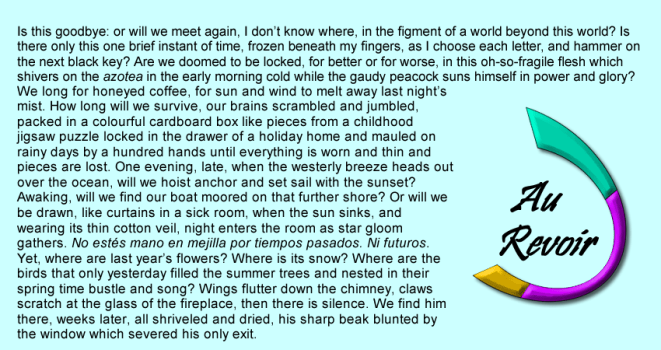
Au Revoir

Au Revoir

Au Revoir

Commentary:

This construction (verbal and visual) dates back to my visits to Oaxaca, Mexico (1995-2001). So many friends, so many happy relationships, and then the world turned and I never went back. I remember doing yoga early in the morning on the azotea. Zopilote, the turkey vulture, wings motionless, flew high above the world, the sun lighting up his wings with its fiery flame. Zopilote, aka Trickster, the bird who stole fire from the gods and brought it back to earth so women could make men their morning chocolate over the old wood stoves or open fires. Or was that all a myth, fake news as some would say today when everything we touch is fake? So much has been lost, destroyed. So much beauty, verbal and visual, has been laid aside, destroyed, and forgotten. Au revoir, good-bye, will we ever see it again? Adieu, goodbye, we will never see it again, it’s gone for good. So much meaning in these brief French phrases, synonyms in English, yet carrying such different meanings in French.

Amarrada nuestra barca a otra ribera … Antono Machado wrote those words. We will awake one morning, he suggested, to find our boat moored on the other side of the river between life and death. And so we will. But in our daily lives, we try to ignore that fact. We seize the day, drowning our sorrows in a sea of forgetfulness: for tonight we’ll merry, merry be, we sing, but tomorrow we’ll be sober. Or will we? And nowadays, who cares anyway? As Seamus Heaney writes “my friends and neighbors, let it flow. We’ll be stood no rounds in eternity.”

Yesterday, I met a man in a wheel chair sitting outside the store where I was shopping. He asked me if I could spare some change and I told him I only carried plastic (true). Then next man who approached gave him a cigarette. My beloved was sitting in the car and I gave her a five dollar bill from the parking money and asked her to give it to the man in the wheel chair. So: how did we feel? Good for an act of charity? Bad for not responding immediately? Terrible that we see people living in poverty in a supposedly rich country? Fearful that one day the money would run out and that we too would be out there, begging for money, grateful for a cigarette, a hand out, a helping hand … happy for anything that would help postpone the inevitable end?

And then there was the bird that fell don the chimney and perished in the fireplace. We never even knew he was there until we found his feathers and his body, lifeless among cold ashes. So which is it to be: au revoir or adieu? Or even worse, the middle finger, the scowl, and the old ‘screw you’?