Treason

IMG_1203 (2)

Treason

The cans betray their contents.
Bulmer’s Strongbow cider,
used to be from Herefordshire,
pale and dry,
now made in Amsterdam
from apples that have never seen
Hereford nor heard of the Malverns.

Somerset cider,
not made in Zummer Zet,
apples never falling
from zyder apple trees,
but born in Denmark
with value added sucrose

and an extra sweet taste
that would never be allowed
in a Wurzel song
about schoolboys and satchels.

No self-respecting
Zummer Zet head master
would allow such muck
in his school when local Scrumpy
was available at twice the taste
and half the price.

I can see the school note now:
“Next time send proper zyder,
Zummer Zet
made.
This growing boy of yours
needs real apple juice
and lots of Vitamin C
to keep his young cheeks
red and rosy.”

Dozy basturds these furriners,
stuffing their cans with false fruit
and sucrose, taking in vain
those sacred names:
Strongbow, Hereford, and Zummer Zet.

Pax amorque

img_1092-2.jpg

Pax amorque

“Nowhere did she find peace and love
save in the dregs at the bottle’s bottom.
She solved life’s dilemmas with her whisky
aides: Johhny Walker, Glenfiddich, Bell’s.

Doctors told her that she must stop drinking,
not stoop to conquer yet another bottle.
The remedies they suggested didn’t suit her.
Family and friends lectured her in vain.

She knew she would not live forever,
no matter what the religious told her.
She opened bottle after bottle of Bell’s
Scotch whisky and hid them everywhere,

all over the house and garden so she could
always have one more before the road.
She drank until darkness overcame her.
Conquered by Shadows, she never emerged.”

Comment:
A found poem, overheard.
Pax amorque is the Latin for peace and love.

Words Overheard

IMG_0198

Words Overheard while Waiting

“Just one of those things,” an old woman whispers,
“my husband gone and me alone with all the grand
kids.” “Was it four years ago?” her friend says.

I remember his name, but I forget his face.”
“I’ll cope somehow, and the fourteen-year old,
with her belly 
starting to swell.” Silence wraps
a warning scarf around their flapping mouths.

Lives and worlds end and begin. Back turned
to their words, I listen to them talk. They chatter
about friends, family, acquaintances, giving
intimate details of childlessness from cancers
and sudden sicknesses, all laid out before me,
willy-nilly, to root and grow in my listening mind.

Never will I put a face to the girls with breast cancer,
the overweight women with diabetes, the old men
with their heart attacks, strokes, and damaged brains.

Fine dust dances in a sun ray.  Floating motes,
my lost loves, buried before their proper time.

Autumnal


IMG_1258 (2).JPG

Autumnal

Skeletal rattle of autumn trees their crisp,
leaves fallen beneath barren branches.
Rat-a-tat rap of dead bone music dries out
flowers, shakes seed pods. Summer’s end
yammers its ruby-sweet, rose-tinted world
where petalled hope and October carnival,
with its ghoulish goulash, mish-mash mix
far-fetched mismatched face. Gruesome
uniforms, fairy-faced, gauze-winged, facile.

Cadaverous danse macabre of death mask
clowns posing distorted in a hall of mirrors
for selfies. The drowned moon needs a kiss
of life. Last night, she peeped through my
window and nuzzled me. This morning my
head is full of mystery, poetry, and dreams.
I analyse them. None of them make sense.

Old Pal

IMG_1002 (2).JPG

Old Pal
It’s as easy as ‘Bob’s your uncle,’ as we say in Wales. Yet Bob is my uncle and life with him is never easy. On Saturdays I drive him to the local supermarket so he can purchase his groceries. He also buys cans of Old Pal dog food for Paddy, his ageing and eccentric Cocker Spaniel.
Bob always strips the labels off the cans he brings home. He trades them in for stamps so he can buy cigarettes and things. However, this stripping reduces the cans to bright, shiny aluminum canisters that sit together on the pantry shelf. He claims he knows in which order he stacks them, but I think he’s playing Russian Roulette, because he can’t tell the difference between soup, rice pudding, and dog food. They’re all locked in look-alike cans. Bob doesn’t care. His diet is a lottery anyway. He shoves the can’s contents into one end and as long as they come out the other, he’s happy.
“That’s what life is all about,” he tells me. “Munchies in and munchies out.”
            Bob’s quite happy with mushroom soup for lunch, or eating rice pudding. If he opens a mystery can and finds dog food in it, he just adds a spoonful of curry powder and heats it up on the stove. He stressed out about eating the meat in dog food when Mad Cow Disease hit Wales and consumers avoided beef, but his family doctor told him not to worry.
            “You’ll never get Mad Cow Disease from dog food,” the doctor told him.
“Why not?” Bob asked.
“Because dog food’s made from horse meat.  You can’t get Mad Cow Disease from a horse.
Bob loves dogs, but he hates Welsh Corgis. One day, he asked me to take him out for a drive. He put Paddy in the back seat, on an old blanket then patted him on the head before closing the car door.
I was already in the driving seat. I had taken the precaution of placing a plastic garbage bag over the passenger seat, in case Bob had an old man’s accident, but he told me not to worry.
“I’ll be all right. “I’ve got my Old Pal with me,” he pointed to the canvas bag at his feet. It rattled when he kicked it.
“Where do you want to go?” I asked Bob.
“Down the road,” he replied. “Let’s visit the Corgis.”
Down the road we went, driving happily, until Bob’s face came alive with joy.
“Turn right,” he cried. “There’s a Corgi down that street. Drive slowly now.”
I slowed down while Bob counted the houses.
“Stop,” he told me. “Now. Stop now.”
I stopped and Bob turned around and started slapping Paddy until the dog began to howl. Then Bob rolled down the window, pulled an empty can of Old Pal dog food from the canvas bag, unzipped his fly, stuck his old man’s magic screwdriver into it, and peed.
“The Corgi’s coming. He’s nearly here,” I could hear Bob’s chest wheezing.
“There he is,” Bob screeched with delight as a black-and-tan Corgi appeared at the gateway to the house. Bob whistled at the Corgi and, as the dog looked up, he threw the contents of the can … whoosh! … all over the dog. The Corgi jumped back, blinked, shook himself, and growled and snarled as the can drenched him in a sticky, smelly, golden shower.
“Take that, you dirty dog,” Bob cried. “Quick, drive away, now, before anyone sees us.”
I put the car into gear and accelerated away.
“This is so much fun. I’m so excited. I’m so excited I want to pee again,” Bob pulled a second empty can from the canvas bag. “Turn left. Third house up. Get ready, Paddy. There’s another Corgi on the way.”

Bilingualism

IMG_1092 (2).JPG

Bilingualism

I went on a French immersion course last week. The instructor asked each one of us to address the class for ten minutes in French. When my turn came, I stood up and announced that I didn’t know what to say.

The instructor then suggested I tell the class about my dreams. What do you dream of? I said that I didn’t have any dreams, I just had nightmares, not rêves but cauchemars, you know, nightmares. She asked me to describe my nightmares and I said I couldn’t. So, she repeated, describe your dreams. I don’t have any. Do you dream about your mother? Yes, I said, but I don’t call them rêves / dreams I call them night-mères / cauche-mères, sometimes couche-mères. Couche-mères, the instructor repeated the word.

The look she gave me: finger-nails scraping down a chalkboard. She turned her headlights on me and I sat there, frozen in the twin beams emanating from her eyes. Yes, night-mères, I repeated, because I set myself goals, not just dreams, achievable goals, and then I have night-mères, inspired by my mother, who says I will never achieve any of my dreams, because they are not her dreams, the ones she has for me, and they are the only ones that count.

You are here to speak in French, the instructor said, and you must speak French for another five minutes. So I told the class about the seals in the Parc du Bic in Quebec. The seals are like a plague, I said, like mosquitoes, only bigger and nastier, quite vicious, in fact. So the people who made Off to keep the mosquitoes away designed a new chemical spray that would keep the seals away. Now the French for seals is phoques, and since this is mainly a problem in Quebec, at the Parc du Bic, and not elsewhere, they called their product, you guessed it, Phoque–Off.

It’s quite simple to use, I said. It’s a spray, not an ointment, and you point the spray in the general direction of the seals. Then you squeeze the button and loudly say “Phoque–Off” at which point all the seals slide off their rocks with a little splash and vanish into the sea, leaving you alone on the beach.  I have tried it myself, I tell them, and I know it works so I highly recommend it to anyone who is plagued by seals.

I still don’t know why she threw me out of the class.

On Learning Welsh

IMG_1238 (2).JPG

On Learning Welsh
            Here I sit, an old man now, in front of my computer, learning at last my mother tongue, Welsh. English is the language of the invaders, the mine-owners, the men who own the steel works and foundries, and who rule this land with a fist of coal inside an iron glove. Welsh is the tongue of farmers and fishermen, of the villagers who live on the hills and tend the sheep and plant potatoes in tiny small holdings where only the fittest children survive.
My mother’s father was the last of us to speak Welsh. It was banned in our house because it was bad for the kids. In a working-class household, Welsh, be it language or accent, was a barrier to success. And success came from imitating your English betters, and climbing upwards, like a vine, or Jack on his beanstalk, until you achieved the impossible and talked and looked and dressed like them.
Sitting here, I have discovered the beauty of simple words, not so much their meaning as their sound, the way they flow, the poetry of remembered rhythms:
Cwmrhydyceirw, the Valley of the Leaping Stag, though legend has it that ceirw was really cwrw, and cwrw is beer, and its real name was the Valley of the Brown Stream Frothing like Beer.
Words have their own music, even if you cannot pronounce them properly: Mae hi’n bwrw glaw nawr yn Abertawe / it’s raining now in Swansea. Mae’r tywydd yn waeth heddiw / the weather’s worse today. Bydd hi’n dwym ddydd Llun / it will be warm on Monday. Why, oh why, in Wales, do we always talk about the weather?
Place names also have their own magic: Llantrisant, Llandaff, Dinas Powis, Gelligaer, Abertawe, Cas Newydd, Pen-y-bont … Meaning changes when you switch from one language to another:  gwyraig ty / a housewife, gwr ty / a househusband, a concept of equality that has ruled Welsh lives since Julius Caesar invaded Albion, coming from Gaul with his legions in 55 BC.
            Un deg chwech, dau deg saith, tri deg wyth, naw deg naw … The photographer asks me to speak in English, then in French, then in Spanish, then in Latin, and lastly in Welsh. He checks the memory card in his camera and looks puzzled.
“You put on a new face each time you speak a different language,” he tells me. “Look, this is when you spoke French.” He shows me the photo and yes, I look happy.
“And this is when you spoke Latin.” He holds out the camera and I see myself on the screen. I look ever so grim. English, French, Spanish, Latin, Spanish, and Welsh: all different and each language is a new a map carved into my face.  Am I a clown, then, a comedian, a chameleon to wear so many masks and to slip so easily from one to another? Which, then, is my language and where is the Old Red Sandstone from Wales into which I can carve my memories and my dreams? More important, which of those many tongues will shape my story as I sculpt each letter of my tale?

Hummingbirds

IMG_1237 (2).JPG

Breaking News:

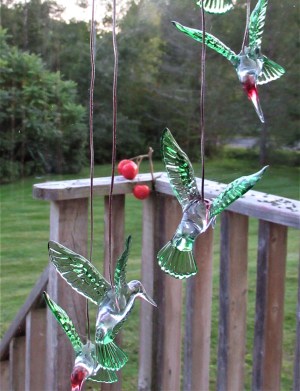
A swarm of hummingbirds is attacking ripening tomatoes in Island View. They were first spotted by Princess Squiffy, our attack cat. Unfortunately, they were outside and she was inside, so she couldn’t get at them. and scare them away.

Further Development:

IMG_1243.JPG

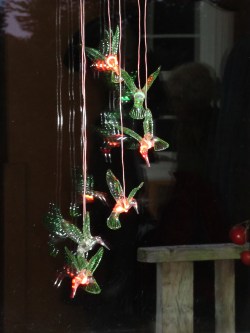
Those hummingbirds must have been high on something: they were glowing and humming in the dark. Radio active tomatoes, perhaps? Or could this be a trick of the light or a joker’s hoax? Please post your answers in the comments section.

Conclusion:

Whatever: Princess Squiffy is not perturbed. David Suzuki, when consulted, said he had no opinion on the matter. Is that really David Suzuki? It looks like Foo Man Chew, to me.

IMG_1063 (2).JPG

Dolphins

Dolphins.png

Dolphins

Another life, another world, another dream …  dream of freedom perhaps. A great white shark, fifteen feet long, has broken into the peace of Passamaquoddy Bay. Yesterday, or was it the day before, he snagged a seal and devoured it before the eyes of tourists on a tourist boat. You can see the video on YouTube, but I won’t watch it. There’s too much violence in the world around me. Too much hate, illness, sickness, death, too many predators.

We have fallen in love with violence. Ketchup Violence I call it, because the victims get up after the shootings and appear next day on another eppy-sode, another video, another film. Except in real life, they really don’t. The shootings are real. The victims are really dead. And no, they don’t recover. Red blood is red blood and when we shed enough of it, and when the shock is violent enough, or the hit brutal enough, no, we don’t recover. Human blood is not ketchup spread on the french fries of old bones and recirculated later. It is ours, it is vital, and when it flows out, it does not flow back in.

Contrasts: the gentleness of the beginning, versus the harshness of the end. The hatred and tension that drives us on and on. Perhaps we should all join the army, for a year or two. “There’s no life like it.” We live in a bilingual country, at least, I do. “Pour ceux qui aiment la vie.” Or, as Socrates once said: “The unlived life is not worth examining.” So, join he armed forces: there’s no life like it. Pour ceux qui aiment la vie. Vietnam, Afghanistan, Iraq, Iran, Ukraine, Crimea, Yemen, Syria … where next, where ever next?

As Pink Floyd once said: Is there anybody out there?

Think about it!

Dog days.png

Commentary:

Climate change, is it real or is it a hoax? Do we believe the scientific facts or do we follow the propagandistic myth makers? Your choice. The issue has become so clouded by the religious and the anti-religious who stress belief above fact. It reminds me of the religious wars of the sixteenth century: believers, true believers, non-believers, un-believers disbelievers, all summed up in atheists, agnostics, gnostics, and true believers. But believers in what, and in which, and in where, and in why, and in whom?

I am not a scientist: I am a linguist, an analyzer of language. I do not know the rights and wrongs of maths and science. But I do know the difference between Stork and Butter, or Talk and Mutter, as David Frost (the original) once said in TWTWTW (That was The Week That Was — remember that? If you do, you are as old, or older than I am! And you probably didn’t live in this geographical region). I have never played poker. But I have studied languages, more than most people have and I know from body language when the speaker is bluffing, throwing up Aunt Sallies (remember them? Rhetoric 100), Straw Men, or Pestilential Pancakes.

Bluster and Bluff. Emotion not argument. Lies not truth. Think about it. Listen carefully. Make up your own mind. But please: move beyond twits, twitter, and tweets. Move beyond bewitching personae. Move beyond the casual joke, the witty epigram and read beyond the grade nine press and the flagrant advertisements. If you can’t, and if you are trapped in the comic art of the rhetoritician’s net, please consider upgrading your knowledge, your studies, and your education.

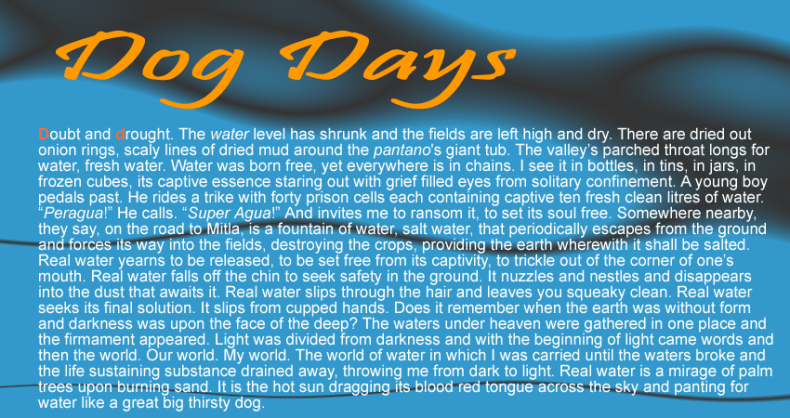
Our well ran dry a summer ago. Think about it. I did. Deeply. Our neighbors wells have also run dry. Think about it. I have lived here for thirty years. Never before have we seen a water shortage. Think about it. I thought about it. Luckily, in our case, it was a problem with the pump. $200 for a new control panel and a couple of adjustments, not $12,000 for a new well and an even deeper dip into the diminishing aquifer.

Lucky, lucky, lucky: but for how much longer?
Think about it!