Carved In Stone

Carved in Stone

Brief Introduction

“Poetry explains itself. If it doesn’t, it’s inexplicable.” Pedro Salinas.

I entered this collection of poems for the Alfred G. Bailey Awad (poetry manuscript), WFNB, 2025. Alas, it did not win an award, but the judge, Kathy Mac, made some excellent suggestions as to how I might improve the manuscript. I have followed her advice to the best of my ability.

Carved in Stone is the second dialog (Chronotopos II) in my Bakhtinian Dialogs with my time and my place. Clepsydra, Chronotopos I, won third place in the Bailey Award (2025) and has already been published. I have one, possibly two, more Dialogs planned.

Reception Theory – I write, you read. Any meaning that you extract from my poetry will depend on your own culture and background. Tolle, Lege – Take and read. Read slowly, and with care.

I am a poet, a dreamer, if you will. These are my dreams. When you enter my world, you mingle your dreams with mine. The result, I hope, will be an interesting intellectual blend of new creativity. Pax amorque.

1

Behold me here,
filled with a sort of shallow,
hollowed-out wisdom
accumulated over decades
while listening with my eyes
to the words and thoughts
of writers, long-dead.

Imprisoned in book pages,
do they bang their heads
against walls that bind,
or hammer with their fists
at the barred lines
of their printed cages?

These spirits long to break free,
but they choke on library dust
and pollen from verbal flowers
that bloom unseen.

Those old ones avoided
the traps of temporal power,
or, once trapped,
gnawed off a precious limb
to limp into freedom.

Comment:
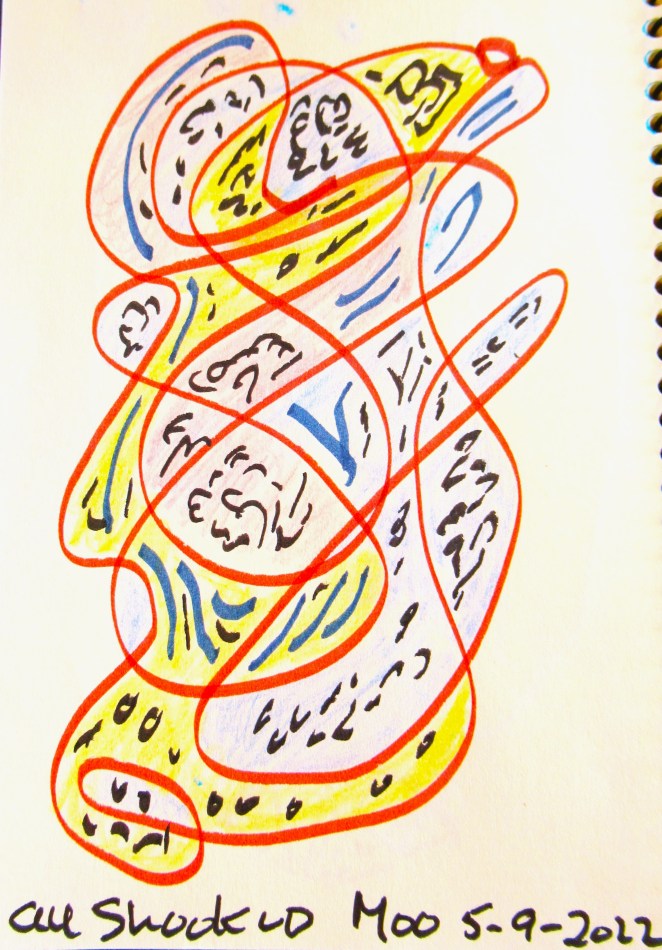
The cover painting, painted for me by my friend Moo when he read the manuscript of this book, is called Coal Face. It refers to the young Welsh boys in the Rhondda coal fields, aged 8-12 years old, who went down the mines to work at the coal face. This happened when the coal seams grew thin and only small children had the ability to work at the coal face and carve and mine the coal. Here are the relevant verses (44 – 45).

44

The old man, withered,
last house on the left,
leaning on his garden wall,
coughing, spitting up
coal dust and blood.

He’s not old, when you get close,
just grown old, underground,
where emphysema
and pneumoconiosis
devour men and boys.

He spits on the side walk.
Mining souvenirs,
Max Boyce calls them,
and they appear
every time the young man,
turned suddenly old,
starts to cough.

He can’t walk far,
wearing carpet slippers,
soft and furry,
just leans on the wall.

He fell, or was pushed,
into the trap at an early age,
when the coal seams
had grown so thin,
that only a small boy
could kneel at the coal face
before the black altar
of the underground god.

There, with a pick and shovel
he learned to carve and shape
those seams.

45

No candles burned at that altar.
A single match, let alone
a candle flame,
would spell the end,
if gas leaked from the seam.

Only the canaries,
confined in their cages,
sang songs.

Doomed,
like the blind pit ponies,
never to see the light of day,
they lived out their lives
down there.

So many died underground,
unable to get out,
buried alive,
before they were even dead.

Clepsydra

Clepsydra

WFNB 2025 BAILEY PRIZE: 3rd Place
Citation

Clepsydra relates a process of identity loss, as time’s passing removes the people closest to the eroding narrator. Its consistent form – the manuscript is one long poem made up of 48 sections of varying length, each of which begins and ends with an ellipsis – provides a framework in which the narrator strives to describe how their sense of self drains away, drop by drop, the way the liquid in a clepsydra (a water clock) marks the passing of time. Amazingly, the poems convey existential dread through remarkably vivid and grounded images of things like “seals basking in sunshine, / knowing themselves, being themselves, / thinking themselves safe, / kings and queens of their seal-dom, / never questioning” (19) and “…an osprey, sudden, the swoop, / turned into a stoop, water shattered, total immersion, then emerging, / lusty thrust of wings, claws clasping, / prey imprisoned” (20). Sense slides in and around the sounds of the words as well as in their dictionary meanings. In Clepsydra the author rigorously plumbs a difficult subject: the loss of subjectivity.

Exhortation

Thank you for the privilege of reading your poetry manuscript, Clepsydra. I was quite taken with all of its virtues: a meaningful concept, carried out in an impressive form which is followed both rigorously and nimbly in each section.

Introduction

     The National Museum of Wales, in Cardiff, had a working Clepsydra that fascinated me. School children could enter free, and every week day, during the school holidays, I would visit the museum and also the Clepsydra.

     I have built the structure of the Clepsydra into the verses of this book. The words flow down, from left to right, just like the waters of the Clepsydra. Sometimes they overflow the line, and sometimes they hold back, just a little. This visual construction fortifies the idea of the ebb and flow of time, water, and memories.

     I first met the poetic image of the Clepsydra in the poetry of Antonio Machado – No temas. Tú no verás caer la última gota que en la clepsidra tiembla. / Never fear. You will not see the fall of the last waterdrop that trembles in the clepsydra. I have, for better or for worse, repeated this theme throughout the poetic dialog.

     I would like to thank the judge, the poet Kathy Mac, for her comments and her excellent suggestions. I have followed most of them in this revision of the original manuscript. My thanks go to all who have read Clepsydra at one time or another.

Clepsydra

1

… time, and my own place
     not this dry museum
          filled with dust

its ghosts, running rampant,
     raging silent
          over ancient artefacts

the clepsydra dreaming
     time like its liquid
          slipping
               through clay fingers
 
runnels of water
     ebbing flowing
          continually running down

earthen-throated
     its hour glass structure
         
each terracotta bowl
     lower than the one before
   
a mini-cataract
      a constant waterfall
            second by second
                    time dwindling away…

Dark Angel

Dark Angel

He will come to me, the dark angel,
and will meet me face to face.

He will take all that I own,
for my wealth is only temporary:
health, wealth, possessions are all on loan.

My house, my wife, my car,
my daughter, my grand-child,
 my garden, my trees, my flowers,
my poetry, my works of art.
I use the possessive adjective
knowing full well that these things
are only on loan. I will never be able
to preserve and possess them.

I even rent this aching heart,
these ageing, migrant bones,
this death that has walked beside me,
step by step, every day
since the day that I was born.

My death alone is mine.
It belongs to nobody else.
It will be my sole possession.
It will soon be the only thing
I have ever really owned.

Comment:

Dark Angel is the third poem in the first sequence (Crystal Liturgy) of my poetry book Septets for the End of Time. The painting, by my friend Moo, expresses his impressions of how he reacts, in paint, to my poem, in words.

“Well,” I said to Moo, “you’ve gone and done it this time. Do you think that painting really represents my poem? I see no darkness in it and certainly no angel.”

Moo gave me a long, strange look. I felt like I was looking in the mirror and seeing parts of my own soul fragmenting and falling away, like scales from my eyes.

“It’s not what the poem says,” he replied. “It’s what I think you feel as you’re writing that poem. I see the tension, the cry from the heart, the struggle to accept, and the realization that, in the end, everything is inevitable and must turn out as it will. That said, more than anything, it is the cry, de profundis, from the depth of your self that I feel. My painting depicts that cry and your suffering.”

“What if it’s not my suffering? What if it’s the suffering of Messiaen and his musicians as they play the soul music that keeps them alive?”

“But surely,” Moo replied, “that’s the whole point. Orde Amoris, according to the recent Pope who has just passed away, is love felt for the person suffering, no matter who he or she is. Pope Francis spoke in praise of the parable of the Good Samaritan. When you see someone suffering at the wayside, you stop and help that person. You don’t just walk on by. Your suffering is my suffering. When I paint your suffering I also paint my own suffering and when you grieve, then I grieve with you.”

“And when that happens, when we all grieve together, we do not grieve alone and in vain.”

“Exactly.”

The End of Time

The End of Time

A thin violin crying
its cat-gut heart out
in tears of sound, falling,
rhythmic raindrops,
down a grey-streaked face
tight with stress and taut with pain.

Such concentration,
such soulfulness packed
into each mindful note.

An audience of one,
I sit, head bowed, meditating
on the meaning of meaning
and the nothingness
of a being condemned
to oblivion, yet oblivious
of the how and when.

Each note a hammer-blow,
then, the piano pounding nail
after nail into this living coffin,
this body I drag through the motions
of extracting meaning
from this meaningless life.

Comment:

The End of Time is the second poem in the first sequence (Crystal Liturgy) of Septets for the End of Time. The painting, by my friend Moo, expresses his impressions of the nature of the end – but he doesn’t tell me the end of what. Certainly not of our friendship, I hope.

I am always worried by those last two lines: extracting meaning from this meaningless life as I don’t think that life is meaningless. However, there are times when it certainly feels that way. Those are the times when we need our beliefs in truth and the purity of art to survive. But how do you define them, you ask me. In all honesty, I don’t. I can’t. Art changes. What we consider to be true changes. Relativism? Yes, to a certain extent. I know what I believe. I don’t know what you believe. But I would never try to inflict or enforce my beliefs on to you. That is not how I work.

As for Moo, I don’t know how his mind works. I think he just sees things in color and shape and in the creation of movement within the stillness of a two dimensional illusion. I also think he thinks like a child. Maybe, like me, he has entered his second childhood, though I don’t really remember ever having had a first one. Oh dear – the meaning of meaning – one of the great enigmas of this wonderful world in which we live.

Empty Nest

Empty Nest

Who are they, these ghosts who flit into my life
and leave me foundering in treacherous waters
as I search for enlightenment and meaning?
Why do they return, revenants, to disturb
my peace and quiet, and to trouble my sleep?

I watch them wandering through the coal mines
of my mind, while yellow canaries twitter rage
from their cages. Oh, praise the blind pit ponies
whose blinkered eyes will never see the light.

They are so lonely, so distant, so lost in deep-down
galleries that I no longer know them.
Memory’s fish-hook cannot snag them,
cannot haul them back into daylight reality
far from night’s net of silvery dreams.

A place… a time…the sudden scent not of presence,
but of absence. The absence of movement,
noise, of that other body that once walked the rooms,
floors, opening and shutting doors, windows, a robin’s
whistle, a thrush’s trilled song… gone now, gone, all gone.

We drift through silent sadness, avoid each other’s eyes,
sit with our heads in our hands or knit our fingers together
in desperate gestures that express our emptiness,
the emptiness of an empty nest…

Comment:
So many people, leaving, drifting on, out, and away, so many empty nests left behind. Why do I grieve, when I know that this is the natural path of life? And for whom do I grieve, for myself, or for them? I do not know. I only know that when that last visitor leaves the party and the door finally closes, the walls close in and I am left alone in this emptiest of nests.

To sleep, perchance to dream. And that is when they return, those broken ghosts who visit me at night and fill my empty head with memories, some happy, some beautiful, some ugly, and some of them sad. They fly, tiny silent birds, when the first rays of the sun, hit my window and awaken me. But they endow my day with memories – each morning marked by the rawness of a nightmare, or the sweetness of a midsummer night’s dream.

Where did my mojo go-go?

Where did my mojo go-go?

Wow! My first post since January 8, 2025. What on earth has happened to me? Good question – I just don’t know.

Today’s painting, from the last day of 2024, is taken from The Idylls of the King, Tennyson. “The olde order changeth lest one good custom should corrupt the world.”

This quote is used in my Old Boys magazine at the end of each school year when the students leave the college and go out into the real world. This happened to me in 1962 – 63 years ago. Certainly I changed, and for the better, without the college. Whether the college changed or not, in my absence, I really don’t know. I suppose it did. It became co-educational, quite the thing for a boys’ boarding school. It expanded into larger grounds. It tore down at least two of the old houses, including the one in which I boarded for four years. I read about these things, but I have only been back on one or two occasions, so I don’t really know. And living in Canada, I rarely see any old boys from the school. They don’t cross the pond to visit me.

I receive the old school magazine regularly, by e-mail. However, I no longer recognize faces or places, unless the places are totally unchanged since I was there. And not many of them are. The most important page for me has become the obituaries, and I study with care those who have passed on before me and those who remain. I grieve when I see the names of old friends. But I grieve even more when I see the names of people so much younger than me falling by the wayside.

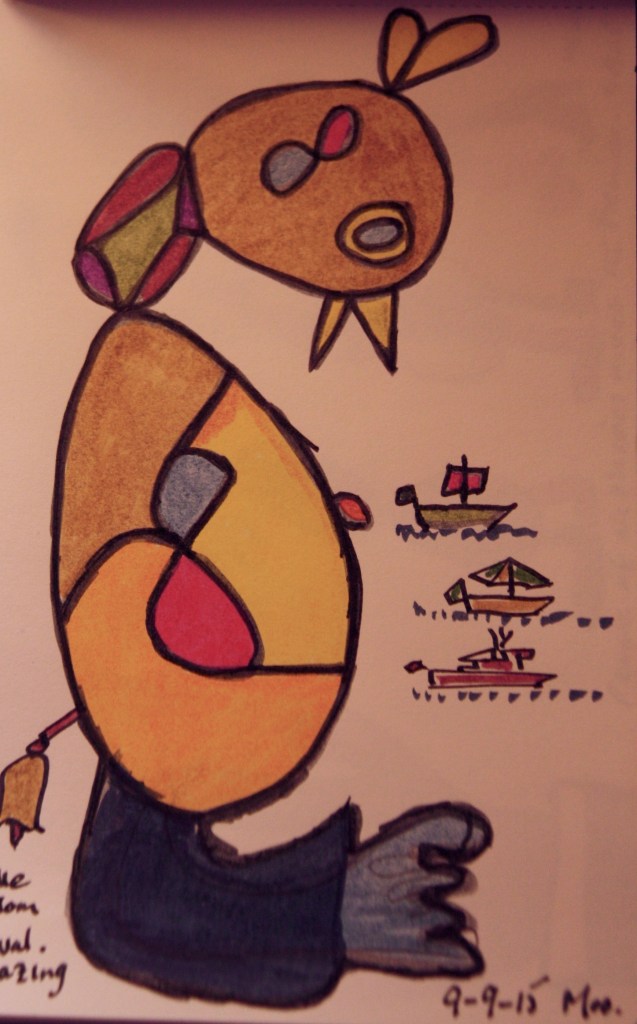
As for that mojo of mine, well, I guess that writing on a regular basis has become more and more difficult. “Don’t sit with your head in your hands thinking of time past,” says the Spanish poet. Yet time past seems preferable, in many ways, to time future. I am beginning to feel a bit like a pin-cushion, on account of all the needles now being stuck into me. Perhaps that’s where all my mojo went? Still, for anyone interested, I am still here. Still happy. I am working on my latest novel and I have two books of poetry waiting to be published. So maybe my mojo hasn’t done a bunk, just my blog mojo! I shall have to kick start it. Or maybe I’ll get that little yellow duck who wears blue gumboots to stand on a brick and give me a hearty booted boost. Yup! That should do the trick.

And so, in the words of Dylan Thomas, “I’ll take a bow, and say ‘good-bye’ but just for now.

What is your mission?

Daily writing prompt
What is your mission?

What is your mission?

Let us begin, as usual, by asking, what do we mean by ‘mission’? Here are some examples of the meaning of mission. (a) an important assignment carried out for political, religious, or commercial purposes, typically involving travel. (b) the vocation or calling of a religious organization, especially a Christian one, to go out into the world and spread its faith. (c) any important task or duty that is assigned, allotted, or self-imposed. (d) an important goal or purpose that is accompanied by strong conviction; a calling or vocation.

I can happily dismiss (a) and (b) from the start. I do not consider an assignment to be a mission, not in my case anyway. I am not one to wander the world, good book in hand, heart on sleeve, convincing people to believe what I believe. That said, I can work with (c) and (d) because, as a life-long teacher, who was offered, at various time, an array of other jobs, I am happy to say that I was a teacher by vocation, by calling. Teaching was my mission. My mission was accomplished.

I taught, in Canada, from 1966 to 2009. Then I reached retirement age. On June 30, 2009, I was a teacher. On July 1, 2009, I was nothing. The shock was enormous. It took me a long time to recover and discover that no, my life was not over, and yes, I had many other things to do. Thankfully they all involved teaching, in one way or another. I used my teaching / research experience to sit on the editorial boards of various learned journals. I even edited a couple of them. I also translated, usually from Spanish to English, and worked with the translations of other people. I also wrote articles on teaching and on creativity.

Creativity gradually took me over. I offered workshops on prose and poetry, wrote and edited books, penned introductions for other writers, and even published some books by other people, usually my family or close friends.

There was never much money in teaching or in creative writing. I always did it for love – love of the subject, love of learning, love of the students, love of watching them grow and develop. When I work one-on-one with another writer, or with a small group of writers, that love is still there. Alas, as I grow older (much older!), I feel the ability to motivate slipping away. The will, the vocation if you like, is still there, but body and mind are growing weak, and that, my friends, is the saddest thing of all.

Dark Angel

He will come to me, the dark angel,
and will meet me face to face.

He will take all that I own,
for my wealth is only temporary:
health, wealth, possessions are all on loan.

My house, my wife, my car,
my daughter, my grand-child,
 my garden, my trees, my flowers,
my poetry, my works of art.
I use the possessive adjective
knowing full well that these things
are only on loan. I will never be able
to preserve and possess them.

I even rent this aching heart,
these ageing, migrant bones,
this death that has walked beside me,
step by step, every day
since the day that I was born.

My death alone is mine.
It belongs to nobody else.
It will be my sole possession.
It will soon be the only thing
I have ever really owned.

Comment:

Dark Angel is from my poetry book – Septets for the End of Time / Poems for the end of Time. The lead painting in today’s blog is by my friend, Moo, and he calls it Storm-Me.

Do you play in your daily life? What does ‘playtime say to you?

Daily writing prompt
Do you play in your daily life? What says “playtime” to you?

Do you play in your daily life? What does ‘playtime say to you?

Poesía de juego y poesía que expresa la autenticidad del ser / poetry as play and poetry that expresses the authenticity of being. For me, poetry is play. However, it is far more than just ‘play‘ – because it is a play that expresses the authenticity of my being.

I write in my journal on a daily basis. As I write, I sometimes spot little gems, thoughts or word clusters that can be turned into poems. For me, playtime is when I start to elaborate the words (signifiers) and turn them into thoughts (signified). The meaning may be the message, but the words that carry the message are the building bricks of the poetry of play which sometimes, with a happy Midas touch, turns into the poetry of gold that expresses the authenticity of who and what I am.

But play is also what I do when I paint. And sometimes I sit beside my mirror image friend, Moo, and paint with him. While Moo is great with colours, he is sometimes at a loss for words. Then I help him by playing with words, shuffling them around, until he finds the title that he wishes for his poems. Sometimes I consult, on Moo’s behalf, with other friends, and they are the ones who join in the game, and settle the dispute by agreeing upon the name that Moo will finally choose for his painting.

But, speaking of painting, there is no play better than the game of making meaning out of color [does it really matter how you spell it? ] and shape while taking a line for a walk and turning it into something playful yet meaningful. Mix and match, and stitch and patch, and then add the lines and title that ease the metamorphosis of color into shape and meaning.

There are other games I play to help fill in the daily gaps that have entered my post-retirement life. Online games of patience, crosswords, chess games with their intricate patterns of red and white or light and dark. Then their [now it does matter how you spell there!!!] are mining games when I dig deep into other people’s poetry and search among the gems of Octavio Paz, Antonio Machado, Dylan Thomas, John O’Donohue, Milton Acorn, Valverde, Quevedo, St. Teresa of Avila, Gongora, Sor Juana, Cervantes, or many other friends, their voices now silences, with whom I speak with my eyes, in order to find something that inspires me to play yet another game – hunt the symbol.

Re-reading Rudyard Kipling is a game too. “Do you like Kipling?” “No, I never Kipple.”And in books like Kim, the great game of life goes on and on, and Kipling’s signifiers (words) turn into a signified (meaning) that is warped by my creative mind and changed into my ideas of a new game in which hunt the symbol turns into the game of Brillig where the slithey troves of new words, fresh words, are reborn into my game-world and emerge from their game-whirled into my own word-play conversation with my own thyme and plaice [or should that be time and place?] And long may Moo and I play that game!

What are your thoughts on the concept of living a very long life?

Daily writing prompt
What are your thoughts on the concept of living a very long life?

What are your thoughts on the concept of living a very long life?

A simplistic question in so many ways as so many definitions are needed. How long is long? 100 years? 200 years? Back to 1066 to watch the Battle of Hastings? 1588 to see the Spanish Armada sailing up the channel? 1815 to see the Battle of Waterloo and talk with Wellington and Napoleon – why not? I am Anglo-Welsh and New Brunswick is bilingual, French and English, so why shouldn’t I – or anyone else who wants to live such a long life – have a talk with both of them?

And does living a very long life include the concept of being healthy, and happy, and wise, and not living in squalor or poverty or in a permanent war zone? How about being kept in an incubator, or an iron lung, or on permanent life support? How long is long under those (or similar) conditions. And what about friends and family? In the Celtic myths, men who visit the fairies in Ireland and live and eat with them, come back to reality [now define that word in this day and age] only to find their friends and families long dead and gone. So what would the conditions of the ‘return’ be like if a long life meant watching the passing of everyone and everything you know or returning to a world you no longer recognized?

And change is so rapid nowadays. AI is developing so quickly, how can anyone keep up? I know that as I slow down (mentally and physically) I understand less and less about the machines I use, including my Nexus Rollator. Does a ‘very long life’ include sipping from the Fountain of Youth? Or does it consist of an enlarged old age – post molestam senectutem, nos habebit humus after a troubled old age, the earth will have us. I am sure we all recognize Gaudeamus igitur, in Latin, and its theme of Ubi sunt qui ante nos in mundo fuerewhere now are those lived in this world before us, and if we don’t, then how swiftly we have forgotten the power of Latin is with its memorable phrases and omnipresent seeds of memento mori .

For me the question is a clear one – do you wish for quantity (a very long life) or quality (a very happy and successful one, even if it is a bit shorter)?

A close friend of mine, one of the most honest and courageous people that I have known, suffering in a horrific way from terminal cancer, asked for, and received, MAID (Medical Assistance In Dying). It was a long legal and medical process to get MAID, involving famiy members, lawyers, doctors, and many other things. As the Romans used to say mors omnia solvit death resolves everything. My friend and his family preferred to shorten life – on their own terms – rather than prolong it under such prolonged suffering and torment. My friend, I salute you and your family and commend you for your bravery.

So, define the terms within which that very long life would be lived – and then ask yourself the question once more. Because as it stands right now, with no further understanding, the answer should only be “depends”. And remember, lives are like swimming pools – they have shallow ends and deep ends. All too often when you talk about life and the end of life, so much depends.

Comment:

I must thank my friend, Moo, for his depiction of the fireworks from New Year’s Eve. Sky Flowers, he calls it. The fireworks have gone already – but – vis breve, ars longa – his painting still survives.

Nightmares

Nightmares

The jaws that bite,
the claws that snatch,
the hands grasping you
through the railings
as you scuttle upstairs.

Those same hands descending,
beating, shaking you,
back and forth, a rag doll,
then thrusting you into
that cold, dark cupboard
beneath the stairs, no story,
your childhood reality.

And now, those dreams come back
and you lie awake watching
as the grey revenants return
and the nightmares repeat
themselves, again and again.

And return they will, until
that final curtain call,
when the stage turns black,
and you’ll never be taunted,
haunted, and hunted ever again.

Comment:
On Thursday night we discussed the difference between poetry of play and poetry that expresses the authenticity of being. Into which category does this poem fall. Intertextuality – the idea of texts talking to texts. How many different texts can you count, talking to each other in this poem that may even be a Jackpine Sonnet?