I always hated Queen Pawn openings 1. P-Q-4 – P-Q4. 2. P-QB4… the poisoned pawn.
Queen’s Gambit the poisoned pawn
Openings are so important. They should be magnets drawing you in, but sometimes they’re whirl-pools dragging you down.
You try to hold your breath, but you must breathe and let go, you must go with the flow and sink to whatever awaits you in the deep.
Down there, it’s a different world. Light breaks its alternate shadow, and you are the light in the darkness, down there, where no sun shines.
You are the glow-worm, glowing where no stars glow. You are the line, the sinker, the hook, the bait, the temptation that encourages your opponents to sacrifice their own peace, to join you, to swim, or to drown.
Comment: To take or not to take, that is the question. It’s a long time since I read Hamlet or played competitive chess. I have forgotten many of the ins and the outs, the traps and the snares, the devils that hide in the details of ‘yes’ or ‘no’. Sometimes we must just take a chance and play by the seat of our pants. Sometimes we must try to recall all the nuances and shades of meaning. And we all know how one step leads to another and how a misstep leads to one disaster after another. Not to win or lose, but to play up, play up, and play the game. Says who? I don’t find those words in my favorite chess book: Chess for Money and Chess for Blood. The poisoned pawn, indeed: and a throw of the dice never eliminates chance / un coup de dès n’abolira jamais le hasard. Go on, take the pawn, throw the dice, I dare you.
Couldn’t find a picture of a cross-bill, so I found some genuine humming birds instead. Listen carefully: you can hear them hum.
Crosswords
I wander a vacant, black and white wonderland of empty, accusing, crossword puzzle squares. Most mornings, I sit at the kitchen table, head in hands, puzzled by the news and the crossword puzzle’s clues.
Outside my window, crossbills squat on the feeder, squabbling, heads turned sideways, blinking,
and winking sly eyes. A yellow-bellied sapsucker hops over syrup-sticky squares. His hand-carved chess board
glistens as feasting flies swarm beneath the sun.
My own thoughts are rooted in a stark, new reality. They walk wordless through threatening spaces where unmasked people wander grey, concrete streets or walk in shops, in the opposite direction to arrows, painted on the floor to guide them.
Cross-words, cross-purposes: why do some people obey the current laws while others ignore them and risk their health as well as the health of others by doing what they damn well please, in spite of the scientists who beg them to do otherwise? Like the puzzle’s clues: I just don’t know.
Comment: Well, last year was a year like no other that I can remember. It is so easy to dismiss it as an aberration, but we shouldn’t do that. Hopefully next year will be better. But it might get worse. Let’s look on the bright side and hum along with the song the humming birds are humming: “Yesterday is history, today is still a mystery, but what a day it’s going to be tomorrow.” I still can’t workout how or why some shoppers just head up the shopping aisles, walking or pushing their carts in the wrong direction. Nor how they can stand for five minutes at a time choosing a breakfast cereal, one hand on the handle of their angled carts, another poking at the cereal boxes, and the aisle totally blocked. I also love the people who still handle every apple in the box before choosing just one of them. For apple you may substitute grapes, pears, avocadoes, tomatoes. Oh the joys of ageing in an age of skepticism and pandemic. Mind you: if life is, as Albert Camus always insisted, absurd, or if it is, as Calderon told us, nothing but a dream, I guess none of it matters anyway. Il faut imaginer Sisyphe heureux / we must believe that Sisyphus is happy!
Married 54 years ago today. What a way to celebrate with 3 poems to Clare on QBF. My thanks to Brian Henry and Quick Brown Fox.
Yours
Yours are the hands that raise me up, that rescue me from dark depression, that haul me from life’s whirlpool, that clench around the jaws that bite, that save me from the claws that snatch.
Yours are the hands that move the pieces on the chess board of my days and nights, that break my breakfast eggs and bread, that bake my birthday cake and count the candles that you place and light.
You are the icing on that cake, and yours is the beauty that strips the scales from my eyes, then blinds me with light.
Comment: what excellent timing: thank you for publishing three of my poems to Clare and on our 54th wedding anniversary too (24 December 2020). An incredible gift and Clare and I both thank you for it, Brian. How to make a memorable day even more memorable. Tonight, when we open the champagne, we will have a glass for you on the table. Much as we would appreciate your presence, the two week quarantine on entering New Brunswick places a blanket over so many invitations and celebrations. That’s why every little helps, and this is so much more than a ‘little’, it is a lot, a very thoughtful lot. So, for Brian, his family, and all my family and friends: tonight we will be alone in our home. But we will raise a glass to absent friends, and we will be together in our hearts. “To absent friends”!!! Here’s the link to Brian’s page.
Silence in the garden. A hawk perched nearby. There are so many ways to die.
Death by Devilry
Silence in the garden. A hawk perched nearby. There are so many ways to die.
A cerebral bleed, minor, but enough to send him to hospital and keep him there.
Cured, ready for release, he would need extra care and added attention.
The devil lived in the small print. Too much attention needed now: his care home wouldn’t care for him.
Back to the old folks ward he went. There he lay, waiting for a vacancy in a home that would really care.
One day, Covid came a-visiting, stalked the ward that night, choosing its victims: you, you, and her, and him.
What killed him? A cerebral bleed, a minor stroke? Or a major stroke from the devil’s pen?
Bold words, bare words, a barren ward, another vacant place around a Christmas table.
Comment: Sitting at the breakfast table, with an empty space before me, I penned these words. So tragic, so avoidable. Yet how many families have gone through something similar in the past twelve months? How many empty spaces are there, vacancies that will never again be filled? I look at today’s figures from the USA: 18,466,231 infected and 326,232 already perished, an increase of 227,998 and 3,338 since yesterday. I am reminded of the words of Pink Floyd: “Is there anybody out there?” Blas de Otero also echoes through my mind: “levanto las manos: tu me las cercenas” / I hold up my hands: you cut them off. And yet it is Christmas Eve and there is still the Christmas promise of joy, and hope, and a new year entering. Let us raise our hands in prayer: and let us pray they are not hacked off.
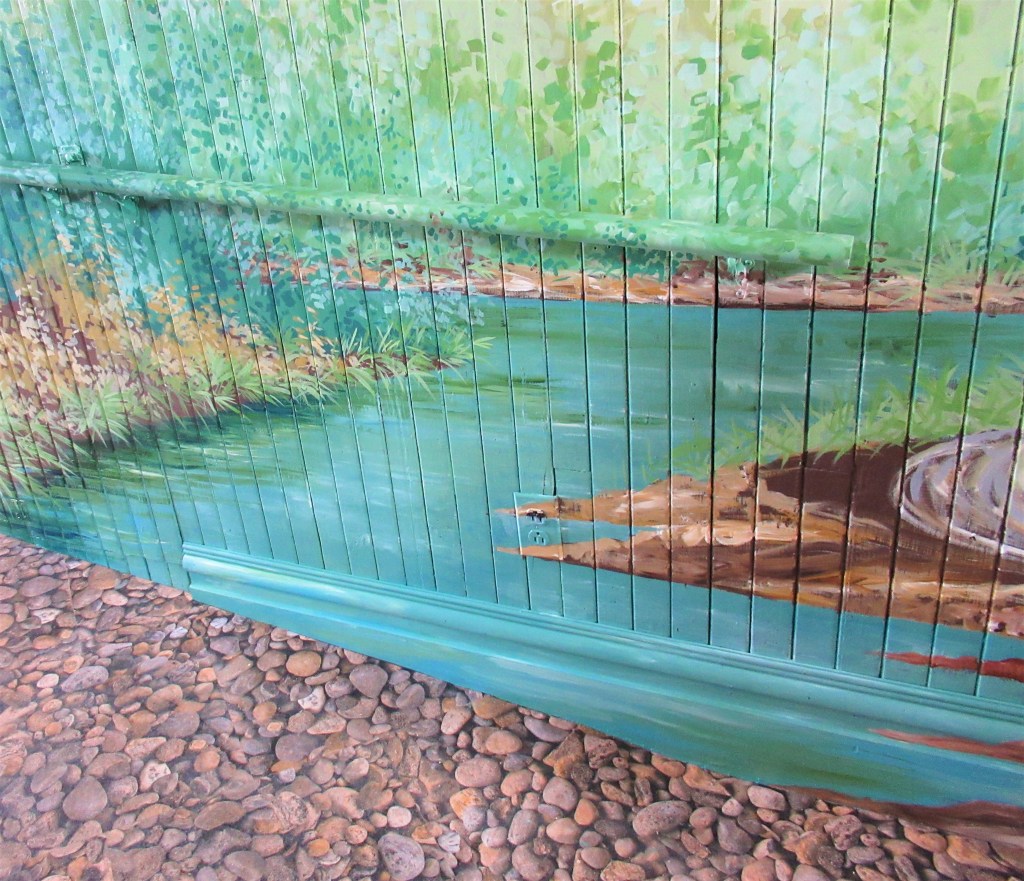
Geoff Slater’s mural at McAdam Railway Station. ‘You cannot step in the same river twice.’ Heraclitus.
Heraclitus
Nothing will ever be as it was before.
Time, like water, like these people marching, constantly flows, trickling through my fingers, uncatchable, unstoppable, sand filtering through the hour glass’ waist.
Water flows, currents shift, rocks wear down, banks slide and fall.
“You cannot walk in the same river twice nor ever attend the same demonstration.”
Nor can you recapture that first, fine, careless rapture, the touch of that first drop of river water.
Kneeling by the river bank, like St. Kevin and his Blackbird, I cannot recall the river’s name.
Comment: I love the reality of the river, its impressionist style of flowing water, impossible without the enormous presence of Claude Monet and his portraits of the Seine. However, what makes the mural, for me, is the brutal reality that breaks into the painting’s unreality. The boards covering the interior wall, the hand rail blended into the painting, the skirting board, the electric socket. I also like the intertextuality: art speaking to poetry, poetry replying to art, the links to Heraclitus, poetry speaking to poetry, the anonymity of the river, and the further poetic links to Robert Browning and Seamus Heaney. I often wonder if readers and viewers pick these things up. Or do they just speed-read, link to their own experiences, and move on with no further thought? You tell me. But what I will tell you is that artists reaches out to art, poets extend their hands to poetry, and our world is an inter-connected maze of thoughts and ideas, linking and unlinking, occurring and re-occurring, lapping like an incoming tide at the fingers and toes we immerse in those amniotic waters, often so long-forgotten, in which our creativity is berthed and from which it is born.
Searching for le mot juste, the exact word that sums it all up, catches the essence of the thing and holds it in the mind forever.
Think flowers. Think scent. Think of the limited ways we describe how daffodils lift and clematis clings.
I look across the breakfast table and see my wife of fifty years, a teenager reborn, walking into that café where we had our first date.
I search my memory and my mind for the words to describe that beauty, that surge of excitement, I still feel when she enters the room:
but find I cannot find le mot juste.
Comment: I shortened this poem from its earlier version. You can click on this link to compare the two versions. I am always puzzled by the dilemma of lengthening or shortening. My thoughts center on the longer and shorter versions of some Raymond Carver stories. Follow the editor’s advice and cut all material down to its essential bones or fill out the skeleton with flesh and blood and expand the creative process further. I also think of the exhortation to ‘stay in the moment’. Anything that takes the reader away from the central experience is superfluous. Experienced writers are aware of that moment and its importance. Writers at my stage are often baffled by it and need to be told yes, this is the moment or no, that is not the moment. I guess the more we write, the more we understand the process. Understand: do we work this out consciously or does it develop in unconscious fashion? Are some people just born with those skills or we must work hard to develop them? Sunt rerum lachrimae: tears are in all things and I guess hard work is all part of the process. As I was told a long time ago: genius is 99% perspiration and 1% inspiration. You have to put in the hard work for that little light bulb to go ‘pop’!
An acolyte in a charcoal suit runs by. He neither stops nor speaks but slips on slippery words dripping from another monkey’s tongue.
This other monkey has eyes of asphalt, a patented pewter soul, ice water flowing in his veins. “Hear no evil! See no evil! Speak no evil!”
The hatch of his mind is battened tightly down. Nothing gets out nor in. The acolyte’s fingers grasp at a khaki folder, his manifesto for success.
Senior monkey stalks to his office and turns on the radio. His favorite music: the clink of mounting money.
Disturb him at your peril: this monkey is very important, and very, very busy. He’s also clever: a real smarty.
First, he empties all the chocolate candies from the box then he sorts them into little piles: green with green, brown with brown, blue with blue, red with red.
Then, like the Good Shepherd checking His flock, he counts them again and again, to ensure that none have been stolen and not one has gone astray.
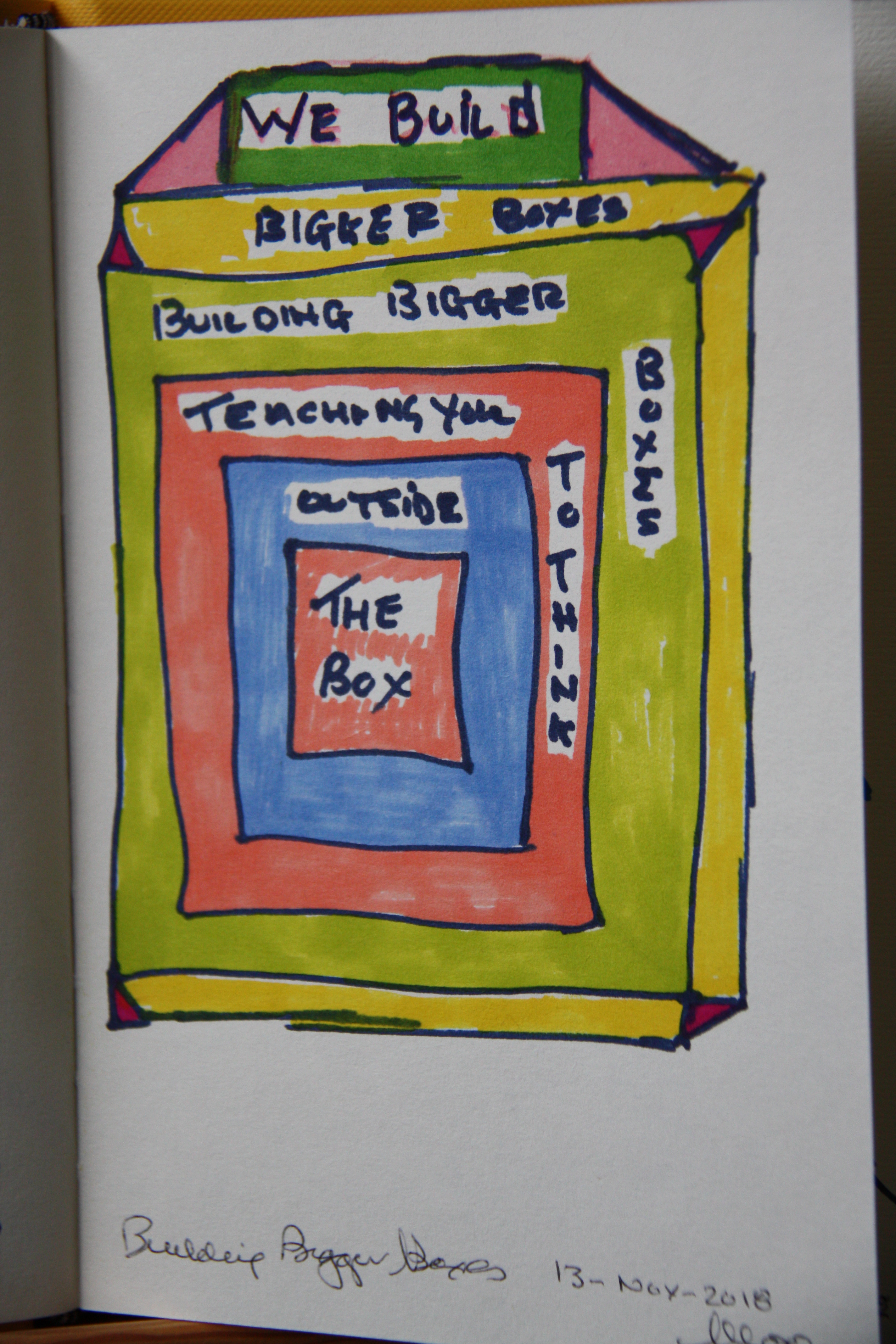
Comment: Another Golden Oldie, this time from Monkey Temple. I have updated it slightly so it won’t be exactly the same as it is in the printed text. Senior Monkey has, of course, built a bigger box into which he can place all his chocolate candies and tuck them away for ever and ever. I guess if he were a bull and not a monkey, he would have tucked them away for heifer and heifer. Such is the sad state of reality in the Monkey Temple. But if monkey were a bull, he would be living in the cow shed, not the Monkey Temple. Oh dear, oh dear: and oh what a tangled web we weave when first we practice to deceive with fiction, flash fiction, creative non-fiction, and all the other sugar and spice which goes into the spinning of spider-webs and fairy tales. Speaking of which, did I ever tell you the story of the… well, maybe next time. So tune in again tomorrow. Same thyme, same plaice, and I’ll sing you a song of the fish in the sea… and a fishy tail that will be.
I saw my father yesterday evening. I walked through the zócalo, opened the main cathedral doors and walked in. The doors closed behind me. I looked towards the main altar and there my father stood, motionless. The evening light shone through the engraved glass panels and illuminated him as if he were some long passed saint come back to visit me. We stared at each other, but I couldn’t open my mouth to speak. The hairs on my neck stood on end and my hands shook. When I forced my mouth open, words stuck in my throat. He wore his best grey suit over a light blue shirt and a dark blue, hand woven tie: the outfit in which I had buried him.
Three old women, dressed in black, broke the spell. One stood in front of me and wouldn’t let me approach my father. She held a large bag of knitting in her hands and the wool spilled everywhere as she pushed me away. The second threatened me with a pair of scissors that she held in her left hand and thrust towards my face. The third smacked a tailor’s measuring rod against my father’s head. He nodded, smiled sadly, and they all turned their backs on me and hurried away out of the cathedral and into the square.
Just for a moment, I stood there in silence. Then I pulled the doors open and ran in pursuit of my father. The setting sun filled the square with shadows that whispered and moved this way and that, as if a whole village had come down from the hills to walk beneath the trees and dance in the rays of the dying sun. I stood on the cathedral steps and called out my father’s name, but I could see no sign of him among the cut and thrust of the shadowy crowd.
I ran out into that crowd and pushed at insubstantial people who stood firm one moment and then melted away the next like clouds or thick mist. I came to a side street and saw real people, flesh and blood beings, a group of villagers gathered behind their band. I stopped and as I did the village elder put a live match to the taper of the rocket that he clutched between his thumb and forefinger. The taper caught on fire and the rocket soared upwards with a searing whoosh. The village band marched forward and started to play a traditional dance as the rocket clawed its way into the sky to explode with a loud knock on the door of the gods.
Tired of grasping at shadows and afraid of this living phalanx of men that marched towards me I went back to the cathedral and knelt at the altar of La Virgen de la Soledad, the patron saint of Oaxaca. Real wax candles stood before her altar, not tiny electric lights, and I inserted five pesos in the slot, took a taper, and lit a fresh candle from an ageing one that had started to sputter. I knelt and, for the first time in years, I prayed. I prayed for the soul I had saved from extinction by lighting my candle from another’s flame. I prayed for my father and my mother and, above all, I prayed for myself.
On the way home to my second-floor apartment where I live alone, I bought two litres of mescal, one to send me to sleep, and the other so I would survive the next morning.
Comment: A Golden Oldie that I had forgotten about. I found it among the drafts of earlier work. Monte Alban is also known as Dani Ba in the indigenous language of the region. Click on the link for more on Monte Alban. And click on this link for another piece on my father and Oaxaca. It’s a funny thing about Golden Oldies: sometimes they stick with us and are ‘unforgettable’, but sometimes they were better off left in the pile that gathers dust, like a forgotten book on a forgotten shelf. Speaking of which, have I told you about the time when …
I did the memory test today. It’s hard to believe that tomorrow I may not know where I am nor what is the day. Others have passed this way, none to my knowledge in my family. Sorrow gnaws the red bone of my heart. The lady at the doctor’s counter says she is seventy. Her bed-ridden mother, for whom she seeks medicinal solace is ninety-eight. Her mind, she says, is as sharp as a needle or a knife, or a blade of grass. What dreams, I wonder, flit through her head at night? Does she recall her child hood with its pigtails, the first young man she kissed, church on Sundays, the genders carefully segregated, driving there in the family horse and cart? Thunder rolls and shakes my world’s foundations; a storm watch, followed by storm warnings, walks across my tv screen. Lightning flashes. Aurora Borealis daubs the night sky north of Island View with its paint-box palette of light. Memories, according to the song, are they made of this. But what is this? Is it these shape-shifting, heart-stopping curtains of shimmering grace? Or is it those darker shadows cast by firelight on the smoky walls of a pre-historic Gower cave where my ancestors gnawed the half-cooked bones of the aurox and never ever dreamed of Jung’s racial memories as they communicate information from the unconscious to the conscious mind.






 rogermoorepoet