Limbo

Limbo

I live with my head in the clouds.
What clouds you ask – Alto-Stratus,
Nimbus, Cumuli-Nimbus?

No, I reply, none of those.
At one level I build cloud castles,
in Spain, as they say in French.

But, at another level,
I find myself lost in the medieval
cloud of unknowing, this mental limbo.

Here, grey mists weave spider-webs
of doubt that glisten with dew, and sparkle
with the two-edged sword of thought.

Here, I feel my life-web tremble
and I realize that I alone can walk
this way and try to understand

how frail threads catch small flies,
how words tell stories, but not the story
of all I know, nor where my world will go.

Comment:
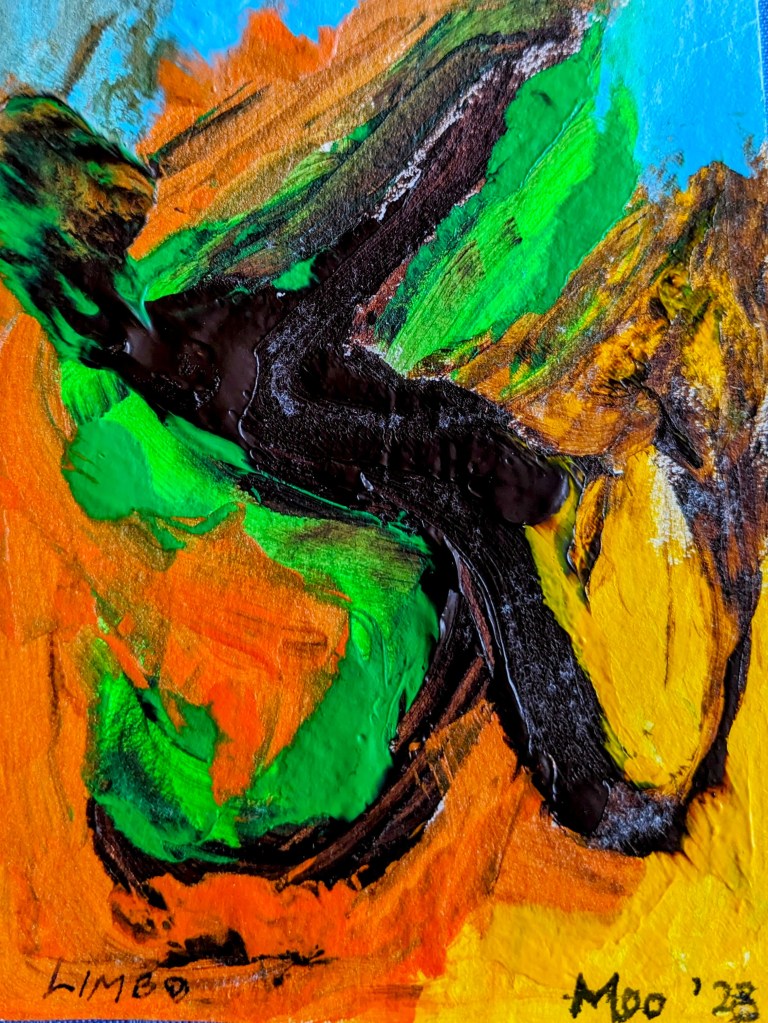
Once more I have linked verbal and visual images. Moo’s painting above – thank you, Moo, – called Limbo, depicts a limbo dancer while my poem expresses the reality of that internal space in which creative spirits sometimes find themselves. It is a sort of Limbo of the mind, in which thoughts appear, dance along the frail threads of the mind’s web, yet never really materialize into formal verse or poetic patterns. This is also the lost world of the dreamer. But remember, the dreamers of the day are dangerous people, because sometimes they make their dreams come true.

Joy of Words

Joy of Words

If the words won’t come, don’t worry.
Sooner or later, they will arrive, driving
down in flurries. Think wind-driven leaves
or the soft white whisper of snaking snow.

There is a moment when all sounds cease
and you can be at one with your inner self,
there, where summer sunshine twinkles
and soft rains bring forth clarity and joy.

What are words anyway, but soap bubbles
emerging from an iron ring to rise in
child-hood’s skies, soaring, dying, around
the cloudy thrones of sun-kissed clouds.

We, their so-called creators, are left below,
building cotton-wool castles spun from air.

Comment:

The painting, animales de fondo, comes from a book by Juan Ramon Jimenez in which he describes human beings as ‘animals living at the bottom of an ocean of air’. I have tried to capture the concept both verbally and visually.

Who is the most famous or infamous person you have ever met?

Daily writing prompt
Who is the most famous or infamous person you have ever met?

Who is the most famous or infamous person you have ever met?

First, some definitions. What exactly does ‘met’ mean? I met you yesterday, for example. How long was the meeting? A nod and a passing of ships in the night? A stop and a handshake and a brief conversation? Or a genuine meeting of minds when people know each other reasonably well and can be considered ‘friends’? Infamous – that is relatively simple. Meanings, in my quick check, include – well known for some bad quality or deed, eg an infamous war criminal. Well, I have certainly never met any of those, not that I am aware of anyway. What does famous mean? Here’s one definition – famous implies little more than the fact of being, sometimes briefly, widely and popularly known. How wide is widely? How popular is popularly? Never mind. Let’s give it a go.

Brief encounters – I met several famous people briefly. Gento, from Santander, the Real Madrid soccer player and possibly the best winger of his time. John Charles, the Welsh soccer player, born in Swansea, and a good friend of my father. I met him once, briefly, in a Cardiff Street and my father presented me to him. Federico Bahamontes, the first Spanish cyclist to win the Tour de France. I met him, very briefly indeed, outside his bicycle shop in Toledo.

Longer encounters – these include the Spanish poet, Jose Hierro, who taught me Spanish, over three summers, in Santander at the UIMP. I also met Jose Manuel Blecua at that university and he introduced me to the poetry of Francisco de Quevedo. At the University of Toronto I had the good fortune to take courses from Erich von Richthofen, Geoffrey Stagg, Keith Ellis, J. H. Parker, and Diego Marin, each of them famous in their own way, with excellent academic reputations and publications. At Bristol University, I briefly met Jorge Luis Borges, whom I met again at the U. of T. a couple of years later. Academia and literature formed a happy blend in which to meet people who were famous within their own fields.

The same is true of the sporting life. While enjoying Cross-country running at Bristol University and while running for Bristol Athletic Club, I met Martin Hyman, Basil Heatley, Eddie Strong, John Boulter, and several other athletes of international renown. The same thing with rugby. Names that I can drop include Don Rutherford, Full Back for England and the British Lions, with whom I took a coaching course at Bisham Abbey. Welsh rugby personalities that spring to mind include Ray Williams, Billy Hullin, ‘Buck Rogers’, and several other luminaries of whom Alun Priday, Dai Watkins, and Elwyn Williams spring to mind.

But does any of this matter? I remember going to a poetry reading in Avila, Spain. This is what happened after the reading.

After the Reading

Many names were dropped and lay scattered on the floor.
Some of them broke. Others bounced back to their feet
and walked around stiffly, smiling unhappily.

Sugar and saccharine, unnamable sweetness, honeydew melon,
all lay on the ground, with empty shells, hollow metaphors,
accumulated clichés, vague imagery, the blanched bones of poets
that once wore life’s armour of grammar and blood.

When the cleaner came, she summoned a broom
and it swept away the remains:
dust without love, cigarettes butts and smoke,
nothing and nothingness, emptiness, empty nests, shadows of dreams,
living words, dead, now lying in a common grave.

The meaning of meaning – meeting and knowing, famous and infamous, names pulled from a hat like a rabbit and then dropped to the ground where they prick up their ears and scamper away. Yes, I have (briefly) met several famous people. But I know only a few really well. Sometimes, I wonder if I ever really met them, or knew them, and then I ask myself, did any of them know me, or remember me at all? Maybe that should be the larger question!
On Writing Poetry

On Writing Poetry

I sit here writing poetry
and, head in hands, I cry
at all the things I’ve left unsaid,
and then I wonder why
I wasted so much time on things
that perished before my eye.

Outside the night is dark and cold
and shadows flit and filter by.
I know that I am growing old,
that soon my story will be told,
and when it ends, I’ll die.

I know that death is not the end,
yet I do not want to die.
I want to paint the autumn trees,
the clouds that float on high,
with evening lights that stain the sky.

But rhyming is not all I do.
I’ often write in prose, with words
that wound and sow dark seeds
that root and flourish, grow like weeds,
and nourish other people’s needs.

Alas, I know not what I do,
nor yet what I have done,
nor when, nor where, the seeds
were sown, nor if they aided anyone
to turn away from the dark inside
and walk in the light of the sun.

Candles

Candles

Candle-light

Three candles burn at my table.
Outside,
the night wind howls like a dog
and scratches its pelt on my roof.

The wind has torn
branches from the trees
and polished the evening frost
until it sparkles
like eighteenth century silver.

A moth circles and sizzles
in a sacrifice of flame.

I keep my vigil at night’s altar
and place a wrinkled palm
into the candle’s liquid flame.

Put out a candle, put out a child.
Who would put out a dog
on a night like this?

Outside,
playing tag between dark trees,
the wind runs wild.

Rites of Passage

Rites of Passage

Summer slid silently away. Autumn’s
harvest is upon us. Slowly the mountain ash
is stripped of its fruit, from top to bottom.

Robins flit from branch to branch until
the whole tree shakes with bouncing birds
pouncing on the few remaining berries.

Berries gone now. Leaves will soon follow.
The Farmer’s Almanac forecasts a long, cold
winter, filled with wind, ice, and snow.

All too soon, the deer will appear, ghosting
their silent steps at wood’s edge. They’ll arrive
at dusk and wander all night, just to keep warm.

At dawn, they’ll leave, having exercised their
ancient rites of passage, the routes engraved
in their racial memory since the dawn of time.

When my time is up, I too shall follow them
into the lonely silence of that long, wintry night.
Restless, or at peace, I’ll hope for dawn’s light.

Grand Manan

Grand Manan

Cruel, the baited fish-hook, the bait
swallowed by an eager gull,
then reeled in by the young boy,
hauling him down, hooked from the sky.

Such things bewilder me. Words
control me, I don’t control the words
that appear in my mind. I cannot bait them,
nor hook them, nor reel them in.

Seagulls come and go, floating on the wind,
hovering, soaring, descending, poised
to snatch any morsel held before them.

The blue sky, so beautiful. The azure sea
a mirror image of the universe above.
White caps, floating, drifting, poised
for a moment, then crashing down.

The lonely sea and the sky. And me
a tourist, marveling at a wonderland
so far from my inland Island View home,
by a river, over which no seagulls fly.

¡Qué será, será!

¡Qué será, será!

“Those who the gods would destroy,
            they first make happy.”

Twenty-four hours
            after our power came back,
it had been gone for 52 hours,
            we lost it again.

And happy we were,
            cleaning out the freezer,
            draining the water from the bath,
            packing up the pots and pans.

We sat down for happy hour,
            a drink before supper,
            and zap – the power went.

Promises, they made,
            estimates of when the power
            would return – 4:30 pm –
            5:30 pm – 6:30 pm –

Now we don’t know
            when it will return.
            The power site says
            “No estimate available.”

I write these words by candlelight.
            The battery on the radio
            just failed and now our cell phones
            are rapidly draining.

“¿Quién sabe?” Some are saying.
            “¡Qué será, será!” say I.
            Whatever will be, will be.

Bird

Bird

The bird came to me
   on the wings of Hurricane Lee.

Carried along by stronger wings
   he perched in my tree.

A new species, he was unknown to me.
   Our own power lost, the usual ways
               of searching were denied me.

He moved from the tree
   to the window feeder and gazed at me,
               eye to eye, as the hurricane’s eye
                           passed overhead.

Free. To come and go at his will,
   but there is little free will
               when the hurricane blows.

A sudden, strong gust
   whisked him away.

Unknown, and a stranger still,
   he soon was lost to me.

Comment:

All my good will and new resolutions went down the proverbial plughole when Hurricane Lee swept in, washed away one of the roads near to me, and left us without power for 52 hours. We lit candles, as much for warmth as for light, and, when dark descended outside, gathered in their flickering glow. The time has come, the Walrus said, to indulge in simpler things. Water saved in the bath upstairs and in an assortment of pots, pans, and buckets, served for the washing of hands, the flushing of toilets, washing the dishes. Food was served cold – but we indulged ourselves with perishables that needed to be finished quickly. The morning face wash and shave, in cold water, no shower, was a throwback to old times. The experience brought us closer together. Neighbors with generators dropped round with hot food and drinks, and all went well. After two days of picnics, we got a bit bored. I managed to write lots of poems though. The creativity of that experience will live on in words.

Poems for KIRA 2023 # 1

1

when we two came together
 we closed an ancient circle
becoming one with the standing stones
that measure seasons and time

now we harvest the summers
 lilies lupins fox gloves blue bells
a surfeit of wild flowers plucked
from the maze of our days

we wait and watch the slow snow
settling white on sarsen stone
as time weaves crow’s feet
into the corners of our eyes

2

i listen with my eyes
to the words and thoughts
of long-dead writers.

age-old and wise they walked
alone along the hidden ways
to set themselves free

they fled the royal courts
where power and jealousy
plotted twisted ways

cruel means
justified by brutal ends.
mindless quarrels bitter strife

i also ran away
and slowing down i found
an enviable life

enriched i live
harvesting a wealth
of goodness

days lived far from fear
 envy resentment distrust
in wooded seclusion

Comment: I was invited to attend KIRA as writer in residence this month. However, a weakened immune system and a series of setbacks over the late summer made this impossible. That said, KIRA and the early morning light seen from the Red Room live on in my heart and I will try to complete my planned project, here in Island View, over the next month or so. Wish me luck.