Alebrijes

Alebrijes

alebrije2
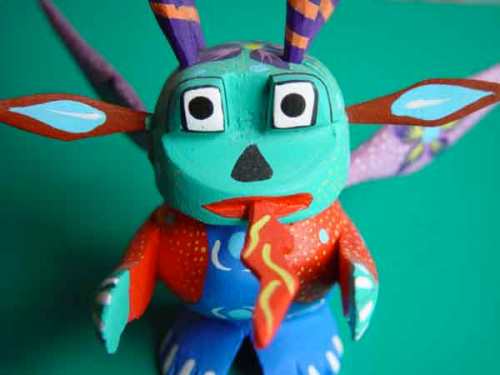
This is one of the first alebrijes I bought in the zocalo (main square) in Oaxaca. He has lost his ears and probably his tongue. They started falling out so we wrapped them up carefully and now we can’t find them. He’s still a happy chappy, hough, and has been in this house for a quarter of a century. Happy Birthday Alebrije!

     Alebrijes step out from dried wood and stand in the shower of paint that falls from the brush’s tip. Yellow flash of lightning, pointillistic rain, garish colors that mirror those of the códices. The carvings take the form of fantasy figures, anthropomorphic animals, and mythological creatures.
Sometimes one individual selects the wood, carves it, then covers it in paint. Occasionally an entire family takes part in the work of making the alebrije. One person collects the wood and prepares it for carving. Another carves and sands it. A third works on the undercoat, and a fourth applies the final patterns of paint.
The great debate: does the form in the wood reveal itself to the carver or do the carvers impose their own visions on the wood? In the case of the team, do the family members debate and come to a joint conclusion?
These thoughts, exchanged with wood-carvers in Oaxaca, have led to a series of interesting conversations. What exactly is creativity? Where does it come from? Do we, as artists, impose it upon our creations? Or do we merely observe and watch as new ideas float to the surface of our minds? How does the creative mind really function? And, by extension, how much of the sub-conscious creative sequence can be placed into words?

Alebrijes

 Are they half-grasped dreams
that wake, wide eyed, to a new day’s sun?

Or are they alive and thriving
when they fall from the tree?

Does the carver fish their color and shape
from his own interior sea,
or does he watch and wait for the spirit
to emerge from its wooden cocoon
to be reborn in a fiery block of color?

Daybreak:
in a secluded corner of my waking mind,
my neighbor’s dog greets the dawn with sparks
of bright colors born from his bark.

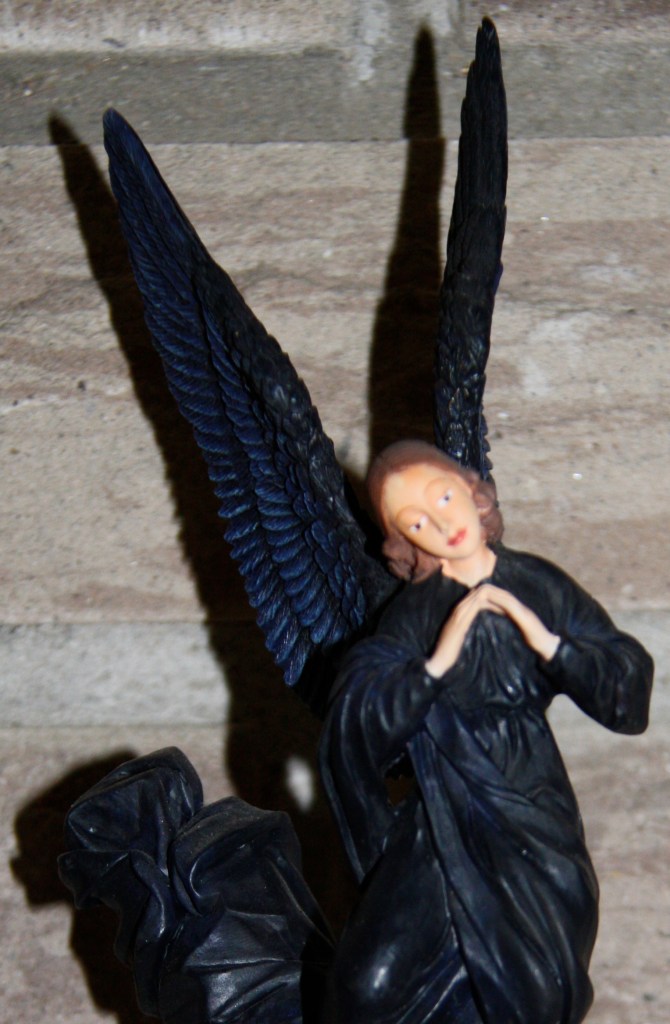
My waking dream: dark angels with butterfly bodies,
their inverted wings spread over my head to keep me warm.
In the town square, the local artist plucks dreams
from my head and paints them on carved wood.

IMG_0299
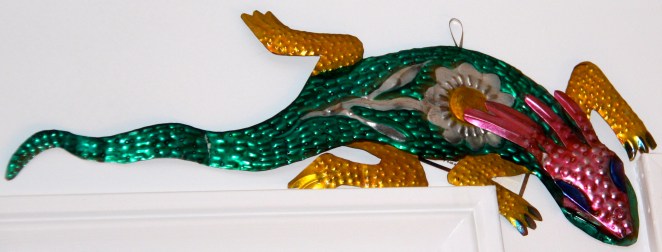
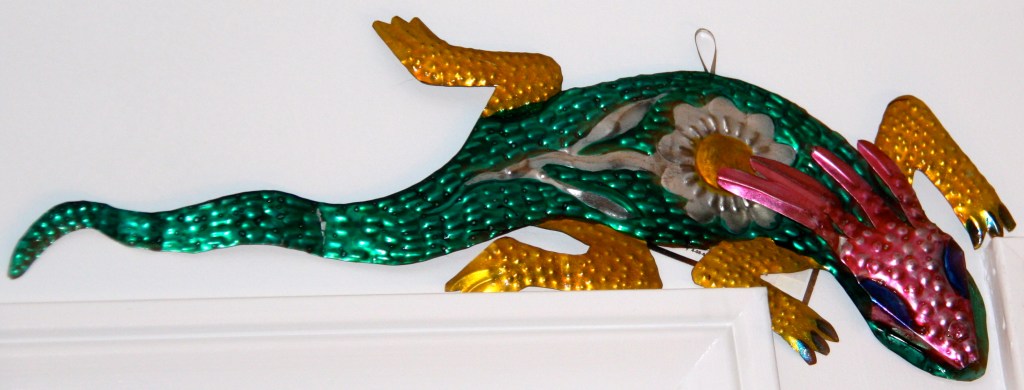
Our house iguana: he is not an alebrije, but is made out of painted metal foil, carved first, and then decorated. He’s the one who guards the front door and falls upon unwanted intruders when they least expect it. Never stay home alone without one, or two, or more. But watch out if you have too many and they get hungry.

Sympathetic Magic

Nunca llueve en los bares: it never rains in the bars.

Sympathetic Magic

“Rain, we need rain.”
The bruja whirls her rain stick.
Rain drops patter one by one,
then fall faster and faster
until her bamboo sky fills
with the sound of rushing water.

An autumnal whirl of sun-dried cactus
beats against its wooden prison walls.
Heavenwards, zopilotes float
beneath gathering clouds.
Rain falls in a wisdom of pearls
cast now before us.

Scales fall from my eyes.
They land on the marimbas,
dry beneath bar arches
where wild music sounds,
half-tame rhythms,
sympathetic music
like this rainstorm released
by the bruja‘s magic hand.

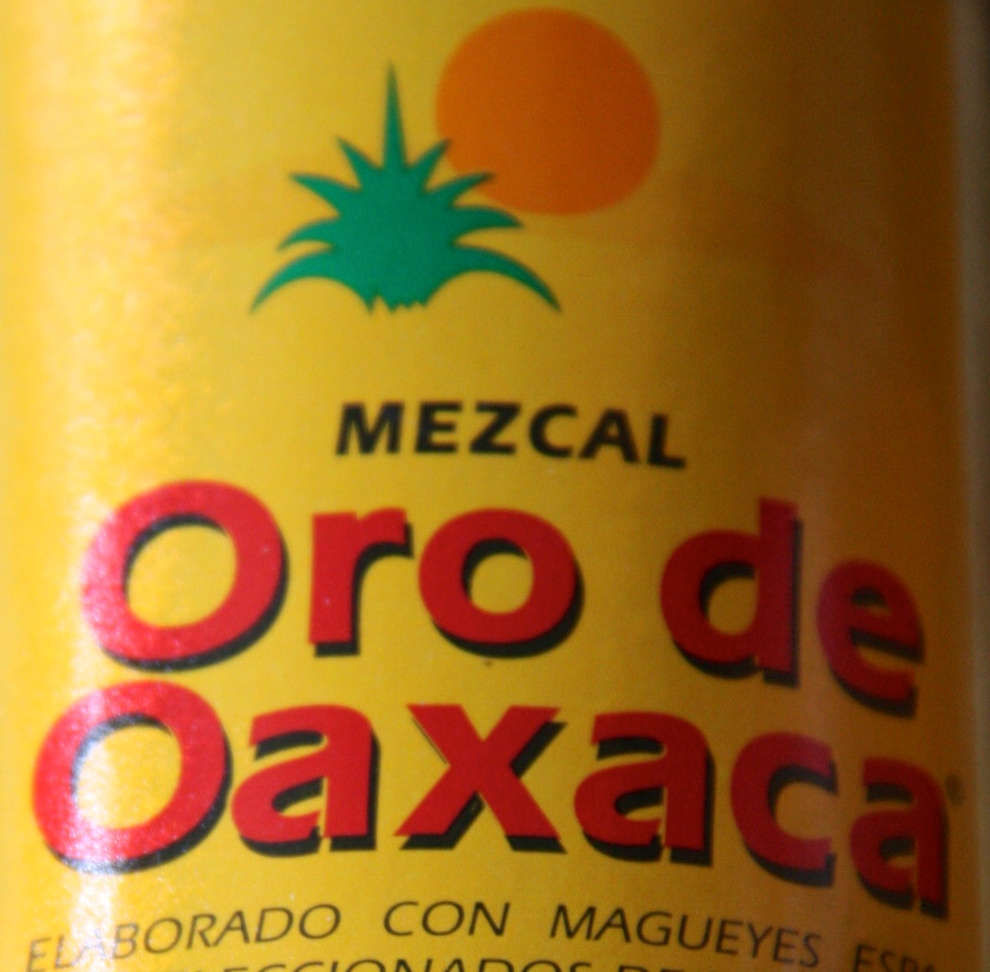
Comment: Bruja: witch, witch doctor; Oro de Oaxaca: mescal, the good stuff; Zopilote: Trickster, the turkey vulture who steals fire from the gods, omnipresent in Oaxaca; Marimbas: a tuned set of bamboo instruments. But you knew all that!

Water

Not Oaxaca, but Avila, with una tromba, a meseta rainstorm, about to descend upon us. And when it descends, there is water, water, everywhere, as you can imagine from the clouds. In Oaxaca, water is precious. Tap water is to be avoided. Bottled water is to be preferred. We used to wash our vegetables in water that was specially chlorinated, also the pots and pans!

Water
Peragua
Water seeks its final solution as it slips from cupped hands.
Does it remember when the earth was without form
and darkness was upon the face of the deep?
The waters under heaven were gathered into one place
and the firmament appeared.

Light was divided from darkness
and with the beginning of light came The Word,
and words, and the world …
… the world of water in which I was carried
until the waters broke
and the life sustaining substance drained away
throwing me from dark to light.

The valley’s parched throat longs for water,
born free, yet everywhere imprisoned:
in chains, in bottles, in tins, in jars, in frozen cubes,
its captive essence staring out with grief filled eyes.

A young boy on a tricycle bears a dozen prison cells,
each with forty captives: forty fresh clean litres of water.
¡Agua!¡Peragua!” he calls. “¡Super Agua!”

He holds out his hand for money
and invites me to pay a ransom,
to set these prisoners free.

Real water yearns to be released,
to be set free from its captivity,
to trickle out of the corner of your mouth,
to drip from your chin,
to seek sanctuary in the ground.

Real water slips through your hair
and leaves you squeaky clean.
It is a mirage of palm trees upon burning sand.

It is the hot sun dragging its blood red tongue across the sky
and panting for water like a great big thirsty dog.

https://rogermoorepoet.com/2016/04/28/water/

Comment: More and more competitions, publishers, and magazines are asking for ‘original material, not previously published, or self-published, even on your own blog.’ So what is a poet to do? Put up fresh material, and it is illegible for entry elsewhere. Recycle and revise old material? Now that might work. Click on the link above for the original version of this post! And yes, it has been previously published on these ages!

Queen’s Gambit

I always hated Queen Pawn openings 1. P-Q-4 – P-Q4. 2. P-QB4… the poisoned pawn.

Queen’s Gambit
the poisoned pawn

Openings are so important.
They should be magnets
drawing you in,
but sometimes they’re whirl-pools
dragging you down.

You try to hold your breath,
but you must breathe and let go,
you must go with the flow and sink
to whatever awaits you in the deep.

Down there, it’s a different world.
Light breaks its alternate shadow,
and you are the light in the darkness,
down there, where no sun shines.

You are the glow-worm,
glowing where no stars glow.
You are the line, the sinker, the hook,
the bait, the temptation that encourages
your opponents to sacrifice their own peace,
 to join you, to swim, or to drown.

Comment: To take or not to take, that is the question. It’s a long time since I read Hamlet or played competitive chess. I have forgotten many of the ins and the outs, the traps and the snares, the devils that hide in the details of ‘yes’ or ‘no’. Sometimes we must just take a chance and play by the seat of our pants. Sometimes we must try to recall all the nuances and shades of meaning. And we all know how one step leads to another and how a misstep leads to one disaster after another. Not to win or lose, but to play up, play up, and play the game. Says who? I don’t find those words in my favorite chess book: Chess for Money and Chess for Blood. The poisoned pawn, indeed: and a throw of the dice never eliminates chance / un coup de dès n’abolira jamais le hasard. Go on, take the pawn, throw the dice, I dare you.

Dreamer

Dreamer

A once-upon-a-time god struts past the table where I drowse.
Once I stole his nose, breaking it from a sacred statue.
Now I watch it cross the square: a proud beak nailed to a face.

Casting shadows on the cobbles, zopilote flies over the square.
I caught him once, dozing on a local bus filled with love-birds:
he begged me to fold his wings and let him sleep forever.

The balloon lady sits in the square selling tins of liquid soap.
Released from school, the children charm my days
blowing colored bubbles that seek freedom in the skies.

Eight Deer, eight years old, sets out on his conquests.
Nine Wind gives birth to his people, releasing them
from their underworld prison by carving a door in a tree .

Faces crowd the trees above me, as long-dead friends
come back to life, chattering like sparrows in the branches.
Roosting time and their voices slip slowly into silence.

Sometimes, at midnight, they scratch at the window
in my head and tumble through my half-awake mind.
They need me, these dreams, for I bring them to life.
Without me, the dreamer, they would surely fade and die.

Worshipping Gaia before the Great Altar — Santo Domingo

worshipping Gaia before the great altar
Santo Domingo

​if the goddess is not carried in your heart
like a warm loaf in a shopping bag
you will never discover her hiding place

she does not sip ambrosia from these golden flowers
nor does she mount this vine to her heavenly throne
nor does she sit on this ceiling frowning down

in spite of the sunshine trapped in all this gold
the church is cold and overwhelming
tourists come with cameras not the faithful with their prayers

my only warmth and comfort
not in this god who bids the lily gilded
but in that quieter voice which speaks within me

and brings me light amidst all this darkness
and brings me poverty amidst all this wealth

Comment: I was surprised to find this article on my poem Gaia while doing an online search for something else last night. It is an interesting interpretation of the poem. I would like to thank the writers and editors who put it together for their careful work and attention to detail. Sun and Moon is available on Amazon.

Striations

There are striations in my heart, so deep, a lizard could lie there, unseen, and wait for tomorrow’s sun. Timeless, the worm at the apple’s core waiting for its world to end. Seculae seculorum: the centuries rushing headlong. Matins: wide-eyed this owl hooting in the face of day. Somewhere, I remember a table spread for two. Breakfast. An open door. “Where are you going, dear?” Something bright has fled the world. The sun unfurls shadows. The blood whirls stars around the body. “It has gone.” she said. “The magic. I no longer tremble at your touch.” The silver birch wades at dawn’s bright edge. Somewhere, tight lips, a blaze of anger, a challenge spat in the wind’s taut face. High-pitched the rabbit’s grief in its silver snare. The midnight moon deep in a trance. If only I could kick away this death’s head, this sow’s bladder, this full moon drifting high in a cloudless sky.

Comment: This is the prose version, from Fundy Lines (2002). The prose version was based on an extract from a longer poem that first appeared in Though Lovers Be Lost (2000). Though Lovers Be Lost is also available on Amazon and Kindle.

Pilgrim

Pilgrim
Oaxaca, Mexico

Outside the church,
a boy pierces his lips
with a cactus thorn.

The witch doctor
catches the warm blood
in a shining bowl.

He blesses the  girl
who kneels before him.

On her head she carries
a basket filled with flowers
and heavy stones.
He sprinkles it
with her brother’s blood.

All day she will walk with
this basket on her head
until evening’s shadows
finally weigh her down.

Cobbles clatter beneath her clogs.

When the stones grow tongues,
will they speak the languages
in which she dreams?

Comment: Revisiting and revising some earlier poems. The early version can be found here. The original poem comes from the collection Obsidian’s Edge, which can be found on Amazon.

Impressions

Impressions
Early Morning Mass

A single sunbeam:
sharp blade of a heliocentric sword,
it shatters the chapel’s dark.

Fragmented light
speckles white-washed walls.

The priest’s face:
a pallid lily truncated
in the dawn’s pearly light.

A wanderer kneels and prays.
A halo of sunshine
runs a ring around her head.

Her flesh now clutches
a statue’s marble hand.

Her pilgrim palm
presses into granite
forcing warm fingers
into cold stone.

Her veins
weave a warm spell
over frosted rock.

Comment: Revisiting and revising some earlier poems. The early version can be found here. The original poem comes from the collection Obsidian’s Edge, which can be found on Amazon.

The Medallion

img_0265.jpg

The Medallion (Solace 7, 8, & 9)

7

St. James, Santiago, the patron saint of Spain and of the Conquistadores. Pale, egg shell blue walls, darkness ruling inside the church. It will do so until the sun peeps in the stained- glass windows and awakens all the sleeping colours. I bow my head, then my knee, and kneel at the back. Ahead of me, I recognize some of my neighbours who concentrate on the gestures of the priest as he mumbles to himself before the altar.

The early morning shadows creep across the walls until a single beam of sunshine descends and shatters the altar into a thousand tiny chips of fragmented light. My hands are pallid butterflies fluttering in the sun’s rays and a rainbow halo adorns my head. I shift away from the sunbeam and move to the side-chapel dedicated to the statue of St. James.

… St. James the Moor-Slayer … Santiago Matamoros … he stands on the severed heads of the Moors he has killed … behind him hands tied behind their backs dusky skinned warriors march away into slavery … my eyes are level with those severed heads and I stare eyeball to eyeball at a decapitated Moor … beside the statue stands a photo of the Gate of Glory, la Puerta de la Gloria, in the Cathedral of Santiago de Compostela in Spain … … generations of pilgrims have laid hands upon the Tree of Jesse, imprinting their fingers into the stone … human hands clasping rough granite in a search for comfort and warmth …

8

When I leave St. James, I find the witchdoctor squatting, in a trance. His fire burns low and a strong scent of copal rises from the coals, hangs heavy on the air, then slowly dissipates. I stop for a second to study El Brujo and the witch doctor speaks without opening his eyes.

“I spoke to your mother yesterday.”

“That’s nonsense,” I replied. “My mother’s dead.”

“What ails you, my son?”

“I’m not your son.”

“It’s a wise man knows his own father,” El Brujo opens his eyes. “One night, many years ago, Jaguar crept between your ribs and took your heart into his mouth. When he closed his jaws, your heart was as heavy as stone and Jaguar broke his tooth upon it. He cursed you and your heart remained a rock within your chest. At night, when you sleep, you dream of dust and ashes.”

“You speak in riddles,” I try to remain calm yet the words fan a sorrow within me that I thought had died a long time ago.

“Perhaps, but my words speak true.”

            … curses, stone, dust, ashes, broken heart, rock, heart in mouth … a marigold path, zopilote, high in the morning air, fire-red his wing-tips, and then an old stone bridge, a river below it with the snow floating down to be carried away by the current, three crones dancing on the steps of an orphanage, three beautiful ladies dancing on the temple steps, an old man, dead, then alive and walking in his burial clothes … hummingbirds dancing round the sun … red slashes of blood … tulips against a white-washed wall … an old man vanishing into a tomb … death’s face simmering in the moon’s dwindling pool …

“You must make a sacrifice, my friend.”

“I don’t do sacrifice, not like that boy this morning.”

“No, not like that,” El Brujo shakes his head. “You must sacrifice your beliefs and allow me to bless you.”

“I have no beliefs.”

“Even that is a belief.”

“Then I am sacrificing nothing.”

“If that is what you believe, it is so. Here: take this. It’s yours by right,” El Brujo offers me a medallion on a braided leather thong. “This is your mother’s gift to you.”

“You’re crazy. I told you: my mother’s dead. She didn’t leave me this.”

“I tell you that she did.”

“Did you know her?”

“I did.”

“I don’t believe you.”

“You may believe what you want. But tell me, does the medallion call you?”

“I like it, yes. I can’t say it calls. How much?” I put my hand in my pocket.

9

“You do not have enough money to buy it, and if you did, you wouldn’t be the man I think you are. And in that case, I wouldn’t sell it to you,” his eyes took on a faraway look. “However, it comes from your mother and I promised your mother I’d give you this.”

            El Brujo’s eyes hold a power that disconcerts me. I lower my head to his fire and the copal makes my eyes water. I cough and my vision blurs. My lungs fill with perfume and El Brujo pushes me closer to the incense. I inhale deeply and break out in a sweat.

“You must wear this always. It will protect you,” El Brujo places the medallion round my neck. I place my hand upon it, feel its rough edges, and see through my tears that it is incomplete, for it has been broken in half. What remains shows half a cross with some broken roses where the crucified Christ would normally appear.

“But it’s broken.”

“Not broken, but divided. You must find the missing half.”

“Did my mother tell you that?”

“Your mother is dead.”

El Brujo lapses into silence and stares me down. Then he breaks into a weird, wailing chant, using a language that I do not know. As he sings, he leans forward and brushes my eyes with an eagle feather that he draws from his pocket.

“Now, you will be able to see.”

… an old woman dressed in black, pushes at a young man … colored threads hang out from her basket … they flap like flags in the single ray of sunshine that breaks into a million tiny sparks of fire … hummingbirds, tiny warriors, wing their dance around a sun that bears a man’s  face … a pair of scissors snips at the string that ties a child’s balloon to the earth and it floats away up into the air high above the cathedral tower … fire catches its wings and it flares like zopilote, the trickster, in the dawn’s early light … the cathedral spire is a notched measuring stick conducting the clouds as they dance and weave their patterns … within the prison of the sky … trenchant shadows, twisted dancers, old warrior kings bend themselves in and out of shape as they struggle to escape … an old man  wrings his hands, then vanishes …  a soap bubble floats away on the wind … a young girl stands on a bridge in winter … snow swirls and  draws a curtain around her body as she falls into the waters below … an old crone wrapped in rags carries a bundle of clothes to a set of steps and leaves it there …

            “The medallion vibrates, it’s heavy and warm.”

“It knows you.”

“What do you mean, ‘it knows me’?”

“Did you feel nothing? Did you see nothing?”

“I saw nothing,” I cough and clear my throat. “I saw nothing at all.”

El Brujo looks at me long and hard. He opens his mouth to speak, then shrugs his shoulders.

“Come, you have accepted the medallion your mother left you. Now accept my blessing.”

“Why?”

“Because I ask you to. Are you such a coward that you cannot accept a blessing from an old man? Here, kneel beside me,” El Brujo taps the ground at his side and, wondering what on earth I think I am doing, I kneel beside him.