Clepsydra 37 & 38

37


… now I am absent from myself
     but can an absence
          be a presence

 I guess it can
     like when I lose a tooth
          I lament the loss of its presence
               and run my tongue
                    around the tender gum

a space where my tooth once stood
     where the candle flame
          once flickered and flared
               before it disappeared …

38

… I grieve for my mother
     standing in the garden
          her magnolia bleeding
               ivory petals
                    as soft as spring snow

some settled on her head
     crowning her
          with youthful beauty
               as she walked towards me
                    eyes shining arms held out

yet when I try
     to recapture that scene
          I only see a winter garden
               with withered blossoms
                    on a leafless tree …

Commentary:

“Can an absence be a presence?” Good question I asked Moo that and he showed me several paintings of trees in winter and vacant faces that he had knowingly filled with sorrow. But I preferred the image of “I only see a winter garden with withered blossoms on a leafless tree.” So I chose my own photo. Moo was very upset and asked me to put in one of his winter paintings anyway, so here it is.
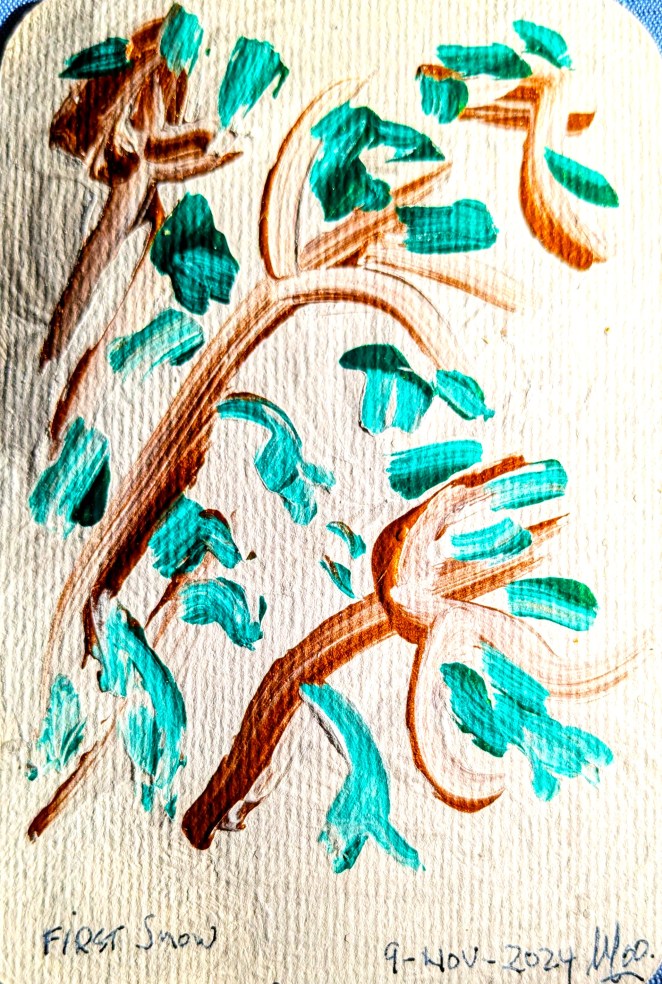
Now Moo is very happy, and he needs to be, because he has had a bad day. I am so glad I am not Moo when he has a bad day. His cardiologist wanted Moo to wear a Holter. Moo didn’t want to wear one. But he listened to his specialist, and obeyed. He was very stressed when he went into the hospital. The acquisition of the Halter was meant to take 15 minutes, maximum. Moo sent 75 minutes sitting in a cold room with no shirt on, terminals attached, and no Holter available. “Can an absence be a presence?” Indeed it can. And Moo is still very upset and very stressed. Nobody’s fault. Things happen. “The candle flame once flickered and flared before it disappeared.” Now you see it, now you don’t. And Moo laments the absence of what should have been a presence and then became a delayed presence. Oh fickle life and times!

I still grieve for my mother, standing in the garden, her magnolia bleeding ivory petals as soft as spring snow. I remember that some settled on her head crowning her with youthful beauty as she walked towards me, eyes shining arms held out. Yet when I try to recapture that scene I only see a winter garden with withered blossoms on a leafless tree. Maybe Moo, with all his stressed out Moo-ds saw that scene more clearly than I did. So, Moo boosts me, and I boost Moo, and that’s what best friends always do. So you go out and boost your best friend too. Blessings and blossoms. And may you all help each other to fare well.

Clepsydra 31 & 32

31

… I become more aware
     of the world
          outside my mother’s womb

I listen to the house’s heartbeat
     the occasional creak
          intruding rarely
               the house inhaling
                    exhaling

 I pay attention
     to my own bodily sounds
          my heart rate slowing
               increasing

now I can hear
     the faint tick-tock
          of a distant clock

a sunray illuminates
     a dust mote
          that dances before my eyes

light without sound
     silent butterfly wings
          seeking celestial light …

32

… did I write
          these words for me
               or did I write them
                    for someone else

does it matter
     when the only thing that counts
          is the beauty released,
               when the butterfly breaks free
                    and takes flight …

Commentary:

“The only thing that counts is the beauty released when the butterfly takes flight.” Sounds beautiful, doesn’t it? Just like the old poetic adage “beauty is truth and truth beauty.” But is it true? There are some very ugly truths and it is very hard to beautify them, even though we do our best to do so. I have always hated simplicities like “lipstick on a pig” or “silk purse out of sow’s ear”. And then there’s ‘a rose by any other name would smell as sweet.’ Probably true. Yet an ugly truth is still an ugly truth however much the spin doctors try to spin it.

And for whom does a poet (he in this case, the poet being me) write his poetry? Did I write those words for me, or for someone else? Good question. I certainly wrote them in the hopes that someone, somewhere, perhaps you, whoever you are, might read them. But I don’t know you, can’t know you, how could I know you? But if I don’t know you, how could I write for you? Did Cervantes write the Quixote for himself, or for his readers? And who were his readers, did he know them? He certainly didn’t know me, because he passed away on April 23, 1616, same date as William Shakespeare and the Inca Garcilasso de la Vega. The same date, you notice, but not the same day! Puzzle that one out, if you will. Meanwhile, he died 328 years, give or take a month or two, before I was born, so I don’t think he had me in mind as he penned his words, much as I didn’t have you (specifically) in mind, as I penned mine.

Carpe diem – seize the day. Don’t wase it on such idle philosophical speculations. Speculation / peculation – go buy yourself a lottery ticket – you may even win the jackpot. Of course, if you wish, you can be like me. I never buy lottery tickets and that would put money in my pocket every week (think of it as winnings!) except I never take it out. And remember – “Keep your water weak and your cider strong, keep your hands in your pockets and you won’t go wrong.”

Clepsydra 30

30

… but before all that
     did I emerge slowly
          from the grain
               of a granite heart
                    as a sculpture
                         emerges from stone

I broke out of a silent world
     left the flesh-and-blood house
          where my mother lodged me
               abandoned that amniotic silence
                    broken only
                         by my mother’s heartbeat

my own heart
     responded to that rhythm
          until I materialized
               and slipped into
                    this waiting world

only to be held at the hips
     trapped
          a climber in a cave
               half out
                    yet not able to break
                         completely free

and me
     visited all my life
          by the nightmare
               of that pincer grip
                    until the doctor
                         forceps in hand
                              pincered me
                                   and drew me forth
white meat
     from a reluctant lobster’s claw
          silent
               dangling upside down
                    a special lobster
                         blue at the bottom
                              red at the top
                                   breathless
                                        motionless

until that first slap
     broke the silence
          and wailing
                I came into
                     that waiting world …

Commentary:

Nice painting, Moo. I like that. Its original title is Walking on Air, and I guess that’s what it might have felt like, dangling up side down, held by my feet, trying to walk on my hands, and look at all those suggestive colours. Colors / colours – English or Canadian? Does it matter? Red is still red and a rose by any other name would smell as sweet.

“Vanity of vanities, all is vanity.” Ecclesiastes, if I am not mistaken. “Great knowledge brings great grief; for in much wisdom is much grief, and he who increases knowledge increases sorrow.” So, we live and we learn, but what do we learn? Only the wisdom of all the wise people who walked this way before us. “In my beginning is my end …” – T. S. Eliot – “and in my end is my beginning.” In blood we begin our days, and in blood will we end them, just as the day begins with the spilling of the sun’s blood and ends in an evening of glory. Except when it’s cloudy, and then, of course, we have to guess what’s happening.

Guess-work – we guess how it began and we guess how it will end. And there’s the Clepsydra for you – drop after drop of water and people gathering knowledge, only to know how little they know, for, as Erich von Richthofen said, in the Medieval Course at the University of Toronto, a long time ago, in the 60’sixties of the last century which was also in the last millennium – “The more I know, the more I realize how much I don’t know.”