Moon

IMG_0261 (2)

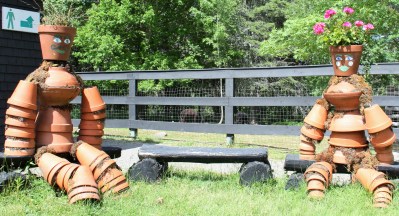
Moon

when the glue of the universe
sticks to your fingers
the turtle’s snap
is a red-tailed kite
sky blue across the marsh

where now the will o’ the wisp
that ragged wanderer
in his tinker’s coat
all hash-tags and patches

frost crisps the leaves
dry cactus in a tilted rain stick
they patter and fall
three deer watch from the ditch
twitching their ears

gibbous this rabbit moon
night hung from the sky
who will gnaw next at the rind
of its round yellow cheese

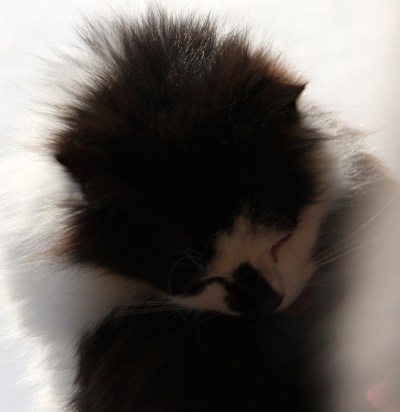
Heart

IMG_0040 (2)

Heart
(sonnet for Hanna and Cherry)

club-foot the pigeon feet
burned off by frost and lime
cracked this egg shell in its cup
the world’s heart overflowing

this silver spoon carved from milk
-tops pecked by morning birds
who placed it in my mouth

song of the blackbird
sung from the corrugated iron roof
where he whistles his virtuosity

playing cards placed face down
who holds the jolly joker
with his floppy cap and jingling bells
who holds the red ace key to my heart


Words

IMG_0127

Words

Waxing gibbous:
gibberish to most, or jabberwocky.
How now the moonraker
dragging the village pond for gold,
or the witch on her ducking-stool
accepted by God if she drowns,
but burned alive if she survives
and the Omnipotent rejects her?

Words rise and fall like trout to flies.
In words, out words, taboo words,
code words, the ebb and flow words
that see conversational tides
rising and falling, waning gibbous
beneath a failing lexicon, sacrificed
at the altar of barbaric speech to appease
the new gods and falsify the old:
nuance, shades of meaning, language,
meta-language, para-language,
raised, a supercilious eyebrow,
that lip curled in the snort of a sneer.

Losing Weight

IMG_0094

Losing Weight

First, you must study Nature.
It will make you aware that trees
lose weight by shedding in the fall
their useless leaves. Do they ever
grieve you wonder, when winter
winds strip twig and branch?

That dog who owns your heart,
he sheds his coat and shakes
away both water and fleas.
Dogs can lose weight
whenever they please.

Don’t bother to diet.
Step fully clothed
on the bathroom scales
and weight yourself.
Step off, and shed your clothes,
leaves, twigs, branch, and fleas.
Then naked to the world
step on the scales and weigh again.

I bet you’ve lose a pound or two.
Believe me … and try it.

True Love

IMG_0027.JPG

True Love

Her voice in the night
drags me from my dreams.
But it is not her voice:
she has gone back home
leaving Clare and I alone.

Our sleeping rhythms have changed
and we wake each other up
when we unexpectedly touch
or startle at the voices in our dreams.

True love is so much more
than an exchange of rings
or a holding of hands,
especially when our lives
are no longer ruled by hormones,
and they’re taken over
by rebellious glands.

Feathered Kangaroo

IMG_0125.JPG

This is a photo of a Feathered Kangaroo
water hopping on PEI, Canada.

Feathered Kangaroo!

A long time ago, still wrapped in the stifling chrysalis of academia, a friend of mine tried to flutter her immanent butterfly wings by making a joke at a very serious conference. She was delivering a paper on one of my favorite Spanish poets, in which she examined the sundry variants of a sonnet that the poet first wrote in 1603, then re-wrote in 1613, revised again in 1627-28, and revised a couple more times before its final revision in 1643, about two years before his death (1645).

At the end of her paper, she was caught off-balance when faced by an apparently serious question from the audience “Did the poet make any more revisions after 1645?” In an effort at humor, she replied, “Well, actually, no. But when they were carrying his body to the church for the funeral, he popped his head out of the coffin and proclaimed in a loud voice ‘Hell, no, I won’t go. I haven’t finished revising the poem yet.’”

This off-hand academic pseudo-joke was greeted with a babble of excited voices and an elderly fellow scholar clapped his hands, exclaimed “Wonderful!” and, in the ensuing silence, asked her what documentary evidence she had for this astonishing revelation, hitherto unknown to the academic world. If she was off-balance before, she was clearly reeling at this stage: a punch-drunk amateur academic swaying before the hypnotic fists of Dr. Muhamad Ali. She smiled sweetly, said she would produce the proper evidence at the appropriate time, and left the podium.

Later, sharing drinky-poos with some fellow scholars, I listened to her as she made excuses for her strange sense of humor and I smiled as explained the situation to them. They were not amused. “You, madam, are an acknowledged expert in your field,” one of them told her. “Your fellow academics trust you and believe you when you make such statements. You must be very careful about what you say.”

Feahered Kangaroo, indeed, water-hopping on PEI!

Now I must make an apology on my own behalf. Alas, if you read the blog item I posted recently, you might be puzzled by the Gazunda tree. I am forced to admit there is no such thing, to the best of my knowledge, as a Gazunda tree, not in the main square in Oaxaca, nor anywhere else in the world. Of course, when it rains people have been known to go under certain trees to use them as an umbrella and thus to take shelter from the rain, but this is the full extent of the origin of the name: the tourist or the golfer or the walker or whatever goes under (say it fast — Gazunda) the tree when it rains. There is nothing more to the Gazunda tree than that little joke.

And this brings us to a really serious series of questions: how do we know things are true? How do we establish the truth of a statement? Why do we believe some people and not others, some facts and not others? How do we choose between a series of alternate truths all of them presented as factual realities when, in actual fact, not all of them are true? This leads us on to the basic foundations on which our knowledge is built: how do we distinguish between scientifically established facts, and hearsay, and gossip if we are ignorant of basic scientific knowledge and principles?

To this we must add the triple increases that threaten us. These are (1) the increase in the availability of real scientific knowledge that bombards us every day with fresh facts and new information; (2) the increase in sources of information and the easy access to those sources; (3) the fact that many of these sources, far too many in my opinion, present us with a fictional or heavily biased version of a pseudo- or alternate truth. And yes, in light of telling the truth, the whole truth, and nothing but the truth, we are indeed entitled to question the existence and indeed the very meaning of these words: alternate truths.

These considerations seem modern and up to date, but of course they are not. They can be found in Miguel de Cervantes’s novel, Don Quixote (Part One, 1605, and Part Two 1615). They are present throughout the meta-theater created by playwrights like Pedro Calderón de la Barca (1600-1681), who set similar dilemmas of truth and fiction in, for example, his play La Vida es Sueño (Life is a Dream) as well as in the twelve plays he wrote based on Cervantes’s masterpiece. They are also present in the writings of some of the philosophers of the day. This is exemplified in the following passage that comes, I think, from René Descartes:

“There is no earth, no heaven, no extended body, no magnitude, no place and that nonetheless I perceive these things and they seem good to me. And this is the most harrowing possibility of all, that our world is commanded by a deity who deceives humanity and we cannot avoid being misled for there may be systematic deception and then all is lost. And even the most reliable information is dubious, for we may be faced with an evil genius who is deceiving us and then there can be no reassurance in the foundations of our knowledge.”

“There can be no reassurance in the foundations of our knowledge.” These are chilling words and present us with the unfortunate fact that unless we ourselves, each one of us, to the best of our abilities search out the absolute truth about all we hear, say, and do, we are indeed lost and we must wander in the dark with no light to guide us. ‘A sad life this, when beneath the axe, we have no time to check our facts.’ So: hie thee to Wikipedia, or Google the infamous Feathered Kangaroo. Or you can take my photo and the words accompanying it for the truth, the whole truth, and nothing but the truth. The choice, my friends, is yours.

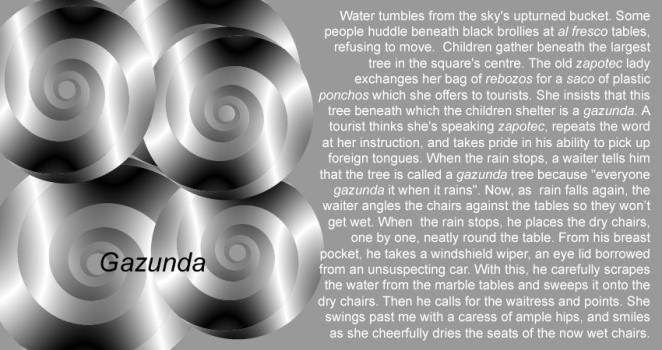
Gazunda

Gazunda

Gazunda
for John Sutherland

John and I were talking about the rare Gazunda tree the other afternoon. I had forgotten that I had indeed written abut the Gazunda trees that flourish in the zócalo in Oaxaca, Mexico. Oaxaca is a magic place, full of mystery and myth and the myth of the Gazunda tree is not well known outside the confines of the city. I was so pleased to discover this account, written many years ago, when I first became associated with the Escuela de Idiomas attached to the Unversidad Autónoma Benito Juárez de Oaxaca (UABJO).

Much remains to be written about my experiences in Oaxaca and I hope to have a collection of prose poems completed fairly soon. They are golden oldies, but like many golden oldies, they are also golden goodies. The Gazunda trees are very welcome when it rains, but they should be avoided, for obvious reasons, during thunder and lightning storms. Then, nobody Gazunda them. By the way, if you do visit the zócalo in Oaxaca, or anywhere else in Mexico, after heavy (or light) rain, be sure to test the seat of your chair before you sit in it. If you don’t, you will soon find out why all the waiters and waitresses have that open, friendly smile the tourists love so much.

Night Thoughts

15-may-2002-pre-rimouski-224

Night Thoughts
(for Tanya Cliff)

The weight of the weather
with its dark clouds pushing
down on my shoulders
bends me to its omnipotent will.

I know my back doesn’t have
the power to lift up my heart
and soar above such heavy clouds.

I need a chariot of fire …
yet the clouds are so strong,
and the light is so weak
it won’t break through,
except in sudden flashes.

I hear the creak of sodden wheels.
Clouds blinker the lightning
as thunder crashes through my brain.

I listen to the pouring down of rain
and pull the bed sheets over my head.

Really? Wednesday Workshop

IMG0061_1

Really?
Wednesday Workshop
19 July 2017

“Steevie K says adverbs are out. You shouldn’t use anything ending in -ly.”
“Really?”
“No. -ly words are banned. They’re as bad as Anglo-Saxon four letter words.”
“That’s folly, surely?”
“No. It’s an absolute from the best of all writers. You do agree, don’t you?”
“Oh, absolutely, in a sort of writerly fashion. I’ll leave all my -ly words on the trolley.”
“Are you being facetious?”
“Absolutely not. Clearly, Steevie K obviously has a point. Totally too many -ly words in use. Well, usually, anyway.”
“What’s more he says that people in general and writers in particular should avoid adverbs.”
“Funnily enough, I actually feel the same way, relatively speaking, particularly nowadays.”
“But you use them all the time.”
“Only in July, when there are comparatively few alternatives.”
“You know, Steevie K counts the number of times people use the -ly word.”
“Surely not? But then, he must truly be thoroughly committed to the extermination of …”
“… words ending in -ly. Of course he is.”
“I bet he lovingly caresses his dictionary as he peruses the -ly section while scratching his belly.”
“There is no -ly section.”
“You are lying, surely?”
“No. Anyway, that’s ly-, not -ly, and ly- is not a letter , it’s a combination of letters. Do you understand?”
“Truly I do. I get on swimmingly with this. All of it, actually.”
“All of it?”
“Totally. I always wondered why they said ‘jello’ not ‘jelly’.”
“Who?”
“Those with the smelly yellow-belly, of course.”
“I’ll report you to the Steevie K thought-police.”
“Surely you wouldn’t do that, not really, that’s not particularly nice?
“Really and truly.”
“Verily, I say unto you: ‘Oh shut up, you falsely bloated, heavily spotted yellow-bellied sapsucker’ …”


Yesterday

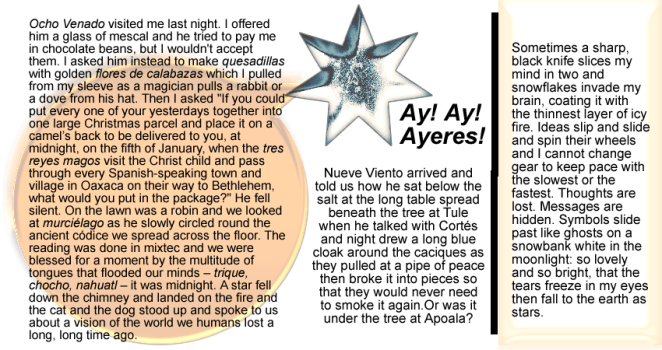
Ay Ay Ayeres

Digging around in the photo files that I transferred from my old computer to my Google drive, I discovered this golden oldie composed of my words and Clare’s images. What a revelation: I had completely forgotten that this group of work existed. I’ll dig them out ne by one and post them from time to time. Ayer is the Spanish for yesterday, hier in French. The title “Ay! Ay! Ayeres!” with its multiple plays All our yesterdays and its reference to the old song “Ay, ay, ay, canta no llores” draws together a series of memories, some in the past and some in the future. ‘How can we have a memory in the future?’ you ask. By recognizing a present moment, or one that lies just ahead in a future that ill become soon enough a present, as one that has already occurred in the past, thus confirming the circularity of our lives and the idea that all time is time present, one of T. S. Eliot’s recurring themes.

Ocho Venado: Eight Deer is a central figure (war leader) in the Zouche-Nuttal, a pre-Columbian Mixtec Codex. He is the war leader in the Conquests recorded in the codex (circa 1050-1100).
Quesadillas: Oaxacan tortillas filled with cheese and flores de Calabaza, gourd flowers.
Reyes Magos: the three wise men or kings who visited the Christ Child on January 6, the traditional Spanish Christmas.
Murcielago: the bat and a symbol of death in Oaxacan mythology.
Nueve Viento: Nine Wind descends from heaven to separate the sky from earth and its waters. Nine Wind at Tule meeting with Cortes is mythical not historical, though the meeting of Cortes with the Mixtec chiefs (caciques) did happen.
Apoala: The Mixtec nation was born form a cave (sometimes a tree) in Apoala, Oaxaca.
Spinning the wheels in the snow: a reference to Jean Chretien and one of his famous images.

The piece is written in a surrealist style that mixes historical fact with creative writing. The distant past is recalled (1050-1100), then the middle past (1525-1530), and finally the present appears. This mixing of time and place (Mexico and Canada) is also related to the surrealist movement. Surrealism creates a dream world in which images float and change shape within a time-space conundrum where dream is more real than reality and creates its own new meanings that are individual to each reader.

Any comments on this rediscovered piece will be warmly welcomed.