Boxing Day

IMG_0010Boxing Day

23 December: my mother and I travel to my mother’s mother’s house, leaving my father to follow, if he wants to. No instructions as to where we’ve gone, or how, or when. But he’ll know and follow eventually, like the good dog he is, when the Pavlovian Parties are droolingly over.

24 December: Christmas Eve. Everyone is very secretive, wink, wink, nudge, nudge, and the ‘boy’ is sent from the room while the grown-ups discuss whatever secrets grown-ups discuss when the little one is not present. I never ask questions any more. Why should I? Little boys should be seen and not heard is the only answer I ever get.

25 December:  Christmas is here. Late last night, my grandfather, on hands and knees, shoved a box under the double-bed in the front room where my grandmother sleeps using his walking stick like a billiard cue. I could see him clearly from my bed on the floor on the far side of the room, beyond my grandmother’s sleeping place. I had a feeling it would be him. It’s been a long time since I believed in Santa Claus, let alone the spirit of Christmas. The Christmas spirits, yes, I believe in them. My grandmother keeps them locked up in a little bottle beside her bed labelled Hennessy Cognac. I have sampled the Christmas Spirits. They are nice. I believe in them. My grandmother has already risen. I’ll get up soon. I guess my father will be downstairs and the Christmas Spirits will be here in plenty. My guess is they have already begun. Joy to the world, peace at Christmas, and a truce and a laying down of arms throughout the joyous day. Perhaps I’ll get a soccer ball and we’ll play soccer in the no-man’s-land that lies between the barbed-wire tongues that simulate the trenches.

26 December: Boxing Day. By the time I get up, the gloves are off and the sparring has already begun. I hear voices, walk into the kitchen, and a hush falls on the room. Knife-edge glances slash the thick atmosphere. It’s Boxing Day. On my left, in the blue corner, my mother, smoking what is probably her tenth cigarette of the day. A thin haze of grey smoke escapes from bruised lips. Whether they are beaten or bitten, I will never know. On my right, in the red corner, my father. White-faced, hungover yet again, truly into the spirits of Christmas. He is breathing heavily, like a Boxer Dog in mid-summer heat, snoring and snorting at the leash. In the middle, my grandfather. He is keeping the combatants apart, creating his breathing space so the true Spirit of Christmas can disentangle itself from the Christmas Spirits and bring peace to earth again for at least sixty seconds between each round. I look around the heaving, threshing silence of the room. My father breaks that silence, pointing at me: “It’s all your fault!” he says, his red-dimmed eyes blazing with a sudden and renewed anger. He starts to rise, but my grandfather steps between my father and me. “Go and see granny. She’s in the kitchenette, by the stove,” he says. “Go now.” I run a gauntlet of staring eyes and go to my gran. As I shut the door behind me, voices rise higher in the room I have just left. Boxing Day, indeed. The gloves are off. The battle has begun again.


Xmas Birthdays

IMG_0013

Xmas Birthdays

They come in all shapes and sizes. The ones closest to Christmas, are they the best? Good question. Are the later ones any better? Who knows? In my case, January born, all I remember are the broken promises.

“I’m not buying you a Christmas present this year. I’m saving up to buy you something special for your birthday. What do you say to that?”

“Thank you, Auntie Gladys. You are so kind. I’ll look forward to my birthday.”

I next meet Auntie Gladys two weeks after my birthday. “Oh,” she says. “Was that your birthday just went by? I forgot all about it. Sorry.”

That’s just one example, but I remember many broken promises. I had to be older, sadder, and very much wiser before I realized that perhaps my Auntie Gladys didn’t have enough money to buy me one present, let alone two.

Then there was my mother’s mother’s birthday. It took place on December 23rd every year. During November, my mother never mentioned it. At the beginning of December, silence reigned. When my father’s office parties for Christmas drew closer, around the 15th or 16th of December, my mother’s mother’s birthday grew in stature and importance.

“Where’s your father?”

“I don’t know.”

“It’s late. He should be home. Did he tell you what he’d be doing tonight?”

“No.”

9 pm, 10 pm, 11 pm … then a key in the lock, I’d run to the door and heave at it with enthusiasm, and my father, pushing against a door I was now pulling open, would fall face first onto the mat, writhing and giggling.

Two or three nights like this and, on the evening of the 22nd or the morning of the 23rd, my mother would announce to me in a loud voice and in my father’s absence: “It’s my mother’s birthday. Pack your bag. We’re going to see her.”

“Aren’t you going to wait for dad?”

“No.”

“Aren’t we going to tell him where we’re going?”

“No.”

She’d call a taxi that would drive us to the train station or the bus station. She’d buy us tickets to her mother’s hometown, 40 miles down the road, and off we’d go.

I was often too tired to note the anxious tones of my grandparents’ questions. The mumbled conversations behind my back. The little errands that I was asked to run while the ‘grown-us’ discussed the nature of the current situational crisis.

“What do you want for Christmas?” my mother’s family would ask.

“I want my dad,” I’d reply.

Then, On Christmas Eve, still fatherless, but full of hope and the promises of presents and joy, I would go to bed and fall asleep, too tired to wait up and spy on dear old Santa.

Next morning, my father, hung over, rather smelly having slept in his shirt, unshaven, and looking sleepily sheepish, would appear and offer me whatever special gift he had been looking for during the past three days.

“Just for you,” my father would say, handing me his wrist watch (one year) or his fountain pen (another). “I went up to the North Pole specially to get it,” his smile lit up the room.

“Liar,” my mother would say and her family would roll their own sheep eyes and look at the ceiling or at their shoes.

“Well, maybe not the North Pole,” my father, now a little moth or butterfly, would wriggle on the pin my mother was sticking into him. “I went to London, actually.”

“Liar, liar.”

“But it was the office club’s official party trip. We saved a shilling a week to hire a coach and drive up to London to see Swansea playing Tottenham Hotspur.”

“Liar, liar, liar.”

“Well,” my mother’s father would mediate, “Swansea were playing Tottenham yesterday.”

“Told you so,” said my dad.

It was Christmas. Mistletoe would appear, kisses would be exchanged, peace would be bought, my watch wouldn’t work, and next time my father saw me he was wearing a brand new wrist watch that actually went tick-tock.

23 December … it’s my mother’s mother’s birthday again. I welcome the day with open arms, yet I always fear what might happen, and I always wait for the worst to come when the first of those Christmas birthday ghosts arrives to sit on the end of my bed and taunt me as I lie there, eyes wide open, haunted, sleepless remembering …


Twits, Tweets, and Twitter

img_0281


Twits, Tweets, and Twitter
aka
Bits and Bytes

After a very cold and snowy December, with low temperatures, way below average and dropping at times to -24C, with snow on the ground almost all month, and all this in the fall, aka autumn, since winter didn’t officially begin until 6 pm yesterday, December 21, it was a real shock and surprise to listen to the rain fall and high winds batter the windows all night as the overnight temperature rose to +14C and we received 40 mms of rain. As a result, we awoke to warnings of flash floods from melting snow and an influx of rain as winter has begun with a more of a whimper and a watery splash rather than with a flash freeze and a bang as your bottom hits the ice. I wonder what the deer think as they paddle through the puddles on their way to and fro from the water-logged feeders. I know what I’m thinking: ‘thank heavens we don’t have to shovel it’, but it will be a totally different story when it all freezes over, the road are like bottles, and we descend the hill in first gear with an ever-present fear of a much too welcoming ditch.

I have just read an interesting article on how, accustomed as we are to Twits and Tweets, many of us are no longer capable of unravelling a long interesting sentence that rambles on and on and refuses to make an immediate Twitter Point, usually underlined by the use of CAPITAL letters for KEY WORDS and all of this for a sound byte audience that is becoming less and less literate as social media proliferates and news is telescoped into tiny jam jars of meaning that are spread around with an illiterate spoon and many exclamation marks. There: you have just read a 96 word sentence. I wonder how you did with it? Did you persevere? Did you give up half way through?

In my former life, when I encouraged young people to read Miguel de Cervantes’s Don Quixote from cover to cover (and they did), I was surprised to discover the difficulties they had with his long sentences, some so long that they continued for a whole paragraph or a full page. I was also surprised to discover that many Spanish speaking people are now incapable of reading Don Quixote in the original Spanish as it is too complicated for them and too difficult in meaning and structure. I have cartoon versions of Cervantes’s master-piece, but have always found them to be simplistic and undignified. I have read the original, in Spanish, twenty-seven times, usually in the Martin de Riquer edition, and have never found the language to be a problem. Indeed, it is refreshing to enter the labyrinth of a long sentence and to struggle for a little while with the exact meaning of a complicated structure that offers so many multiple readings that no single meaning can easily be extricated, if at all, and so the mind wanders on and on in the Cervantine maze spun by a spider-web pen and a brilliant mind, now no longer accessible to the multitudes: a paradise now closed to so many, a garden open to a only a select few / Paraíso cerrado para muchos, jardines abiertos para pocos.

The spirit of Cervantes, the creator, appeared to me last night in a dream. ‘Rogelio,’ the master said. ‘Spare me and spare my creation.’ ‘Don Miguel,’ I mumbled sleepily, ‘here sit beside me on my bed. Welcome to my humble home.’ ‘I am not don Miguel,’ Cervantes replied. ‘I never was a don and I never will be one. I am humble Miguel, writer, poet, and son of a vagabond surgeon who, like father, like son, often entered the debtor’s prison’. ‘That same debtor’s prison where the history of your hero was engendered,’ I replied. ‘So they say, but I am not here for that. I have come for you to save me.’ ‘How, my Lord, how can I save you?’ ‘Rogelio, I am not a Lord, but a rumor has reached me in my after-life, that they have modernized my knight, given him a car, not a horse, set the Civil Guard against him, ridiculed him with condoms that he blows up like balloons, sent him to Salamanca, and Galicia, where he never went, continued his adventures, reborn, in a foreign language that I loathed …’ ‘That is bad, my Lord, I mean don Miguel, I mean Miguel …’ ‘Worse is to come.’ ‘Worse? How can it get worse?’ ‘Indeed, it arrived at my ears, you might say a little bird told me, that they are releasing my book in a series of 240 word tweets on a thing called Twitter that speaks like a Jesuit with false flickering words.’ ‘But you were brought up by the Jesuits …’ ‘That’s how I know of what I speak. This cannot be, the history of my knight reduced to episodes of 240 words, the whole 124 chapters, 1000 pus pages of finely scrawled ink, reduced to tweets on twitter by some poor twit … you must stop this nonsense. I and my knight depend upon you.’ ‘How can I stop it, don Miguel?’ ‘Charge the windmills of Twitter. Attack the falsehoods of Tweets. Stand up for the long, soulful sentence that will withstand the winds of time …’ ‘As your book has withstood, until now, the literary storm that is about to engulf it in an Alfred Hitchcock swarm of wild birds that is poised to twitter and tweet you to your doom?’

The ghost of Miguel de Cervantes vanished with a howl, only to be replaced by that of Pierre Menard, Borgian author of the renewed Quixotic page. ‘To tweet,” the ghost whispered in a thin, shrill voice, ‘or not to tweet, that is the question, and therein lies the Cervantine rub.’

Xmas Trees

tree.png


This year we have abandoned real, once living trees in favor of plastic trees with LED lights. The house doesn’t smell the same, nor did cool air fill the space beneath the tree. No more watering the tree. No more collecting dry pine needles. No more worrying about the cat climbing the tree or the dog pulling the tree down as it chases the cat or tugs and worries at a string of lights. Nor do we have to worry that the puppy might chew its way through the electric cord and electrocute itself. And no more electric eels in the fish tank, even though they are the current thing.

That doesn’t mean to say we are in for a bleak mid-winter, not at all. We have strings of lights, music on the stereo, and even  peces en el rio que ven a Dios nacer, as they sing in Oaxaca (the fishes in the river who come to see God born). And who could not be merry at Christmas time with a fire in the fireplace, a Charlie Brown Christmas on the stereo, and guelaguetza music from Oaxaca waiting to be played and warm the party up. Nobody, but nobody, not even the meanest Scrooge or the most insistent Grinch, can resist the Oaxacan pineapple dance, played at full volume by the state orchestra or a local village band, at midnight, in the zócalo, when the rockets climb skywards to knock on the front door of the gods and the Virgen de la Soledad parades in all her mystery and glory through the candle-lit city streets.

Add to all of this a small miracle: the reappearance this year of the Christmas tree Clare’s auntie used to place every Christmas upon the counter in her shop in Cheap Street, Frome: one of the most famous and eligible streets in Merrie Olde England. We have placed auntie’s Christmas tree on the table in the hall by the front door and surrounded it with lights. What joy: the old and the new, hand in hand, in this new found land that is itself, so very, very old and where we now live together with our memories of a distant past.

And for those who still wish to decorate their very own Christmas tree, you can do so online, adding toys and lights, and an angel on the top, whenever you wish. And remember: where there’s a will there’s always a way.

An old song …

img_0448


An old song … 

            … words wrapping themselves around your neck, the tune a loose scarf, brilliant in the sunshine, and so warm, flapping as you walk the street … people see frayed ends … wave back at you … the sun picking out gold spots in your hair … all’s well with the world … a marching song … the world walks over the hills … and far away … you march to work or play … every day is a new day … blood stirring with this call to arms … to alarms … everything up for grabs … tunes in your head … words wrapped around you  … warming you …

            … a sad song … rain drops falling … mist or mizzle … you walk through damp, low clouds … you are sad … but comforted … wrapped warm in a verbal comforter … the sun breaks through … throws its arms around you … hugs you …. until raindrops radiate … gathering on eye-lash … at leaf’s end … twinkling on an abundance of radiant flowers …

            … a Nor’easter … snow in the air … on the trees … on the ground … a steady accumulation … you know how it is, East Coast Canada … down by the Fundy …  a fire in the fireplace … warm heart … warm hearth … no travel today … books and computer beckon … a time to read … to write … to remember the old ways … the old days … those memories … a warm scarf wrapped around the neck … and the comforter … so comforting … so much to wrap around you … so much to wrap your head around …

Cricket

IMG_0236


Cricket

            Street cricket. Played on ancient, cracked tarmac. The wicket: three sticks whitewashed on to the high stone wall of the cul-de-sac where my grandmother lived. It backed onto the wall that cut us off from the railway yards that led into High Street Station. That wall was the boundary, as were the neighbor’s front yards. Six and out if you hooked the cricket ball and hit it behind the wicket and over the railway wall. And you had to retrieve that ball. Lost ball stopped play and play stopped until you went across the bombed buildings at square leg, for a right-handed batsman, climbed the railway wall at its lowest spot, looked down at the rail yards forty feet below, and shouted until someone emerged from a workman’s hut to find the ball and threw it back.

            No worker … no ball … no game. Then you had to run out of your street, down the main road, up the hill for two streets, beg permission at the locked railyard iron gates: “Please, mister, can I get my ball?” Then run all the way back to where the waiting cricketers hung over your own street wall, by those bombed buildings, shouting and cheering. Search for the ball among shiny rails, shunting rails, rusty rails, dandelions, thistles, and nettles. Avoid the occasional shunting engine, with the driver leaning out of the cab and screaming warnings as the steam hisses out from the engine, brakes squeal, and wheels slowly clack on crossing tracks. Find the ball. Try unsuccessfully to throw it back over the wall. Try again. No good. Wall too high. Carry ball back to iron gates. Thank gateman politely so you can come back next time. Return ball to game. Game continues, rain or shine. Unless it’s real rain. The pissing down type. If so, run for nearest house and shelter by fire in kitchen.

            Other rules. Six and out over the railway wall. Two runs and fetch the ball yourself if you hit it into the bomb buildings at square leg, next to that railway wall. No fielders there. Too many loose bricks and too much scattered debris. Fragile walls still wobble or crumble warning you of cellars that might open up. Low walls that might collapse. You score four and out if you hit the ball into neighbor’s front yard. Some neighbors are nice and don’t mind. But watch out for the old witch whose fenced off garden is guarded by a gate.  If you hit her window, even with a tennis ball, she’ll be out quick as a flash, and steal your ball or stick a knitting needle in it, old spoil-sport. Otherwise, it’s single batsmen. You run your runs and walk back from singles. One hand one bounce, and tip and run once you’ve scored twenty. Much more difficult to stay in and everyone gets a chance to bat. One hand off the wall if you don’t clear it for a six and out. Dog stops play if your fox terrier gets the ball and runs around in circles, chasing its tail, with the ball getting soggy in his mouth. Damned dog. Damn difficult to catch. Lost ball stops match if dog runs back into the house and gives the ball you stole in secret back to your gran who was saving it for tennis.

            Cricket, in those days, was civilization. It had survived the bombing raids that missed the railway yards and bombed the bomb buildings. It had survived the machine-gun fire from the fighter-bombers that had strafed the street leaving bullet-holes, still unrepaired, in walls and shattering now-mended windows. It gave us a sense of rule and law, for the rules were strict and nobody broke them and stealing runs, touch and go, in tip and run was a skill and never a crime.

            Cricket: a small, bright window on the back-street where I lived, a window filled with happiness and light, even when it’s over the wall and six and out, or the dog runs away with the tennis ball, or the ball vanishes down a mysterious rabbit-hole in the bomb buildings and slides down to someone’s ruined cellar.

            Game’s over. The real Test Match is on, England versus Australia, though we live in Wales. The one primitive, tiny black-and-white tv screen in the street lights up with flickering figures and we sit around on the floor watching real men playing the real game on a sunny field in another world, the world, the world of black and white that many of us, us backstreet children from a ruined neighborhood, will never be allowed to know or see.

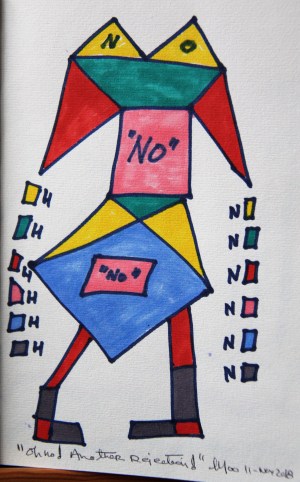
Rejection

IMG_0023.JPG


“Oh no, another rejection!”

“And rejection equals dejection, or doesn’t it?”

“Only if you let it get you down. I wait until I am in a foul mood and ready to tear things to pieces because my mean streak is surfacing. Then I go to my rejections pile, re-read the rejection letters, then read again the pieces that have been rejected.”

“Why on earth would you do that?”

“Above all to work out why the work was rejected. What did the editors see that I didn’t? When I write, I wear rose-tinted glasses and all my little babies are the prettiest, the strongest, the fairest in the land, especially when I give them the ‘mirror, mirror on the wall’ test.”

“I’ve never heard of that.”

“It’s simple: you look in the mirror and ask ‘Who’s the fairest writer of all?’ and the mirror answers ‘Why, you are, of course.’ If you believe that, and as writers, we often do, then rejection becomes a hard realistic rock, shattering both Ego and Id. The immediate response is to deny the editor’s taste and judgement. It is amazing how many stupid, dumb, and uncultured editors there are out there. They hate us and don’t understand us.”

“That’s true.”

“No it isn’t. The fault, dear Brutus, lies in ourselves, not in our editors, that we are not great writers. Understand that, and you have a chance to succeed and to improve. Re-reading allows me to try and understand what went wrong, why the mirror lied, how the rose-tinted glasses distorted the actuality of the written page. Understand the other and how the other perceives what and how you write and maybe, just maybe, you can condition yourself to improve. Many budding writers are dropped on stony ground and fall by the wayside. Others land in the desert and their things of beauty bloom where nobody sees them. Some fall on seemingly fertile ground and earn an immediate immortality that fades in a season when the fad wears off. A few writers, an occasional few, go back to the drawing board and water their flowers with the sweat of their brow. Eventually, if they are lucky, their work may be accepted.”

“You always preach the bus story, Julius.”

“Of course I do. Get off the bus early, and you’ll never finish your journey. Remember Sir Walter Raleigh: ‘it’s not the beginning, but the continuing of the same until it be thoroughly finished that yieldeth the true glory.’ He didn’t sail the Golden Hind around the word by setting up house in Cadiz and living in luxury on a beach in the south of Spain. He continued on and on, always forward, until he arrived back in his home port.”

“So we must just keep going, then?”

“Of course. But never blindly. Take criticism to heart, remembering that it comes from another’s heart. Learn from your mistakes. Correct them when you find them. Never give up.”

“You’re always happy, Julius. I bet you never get rejected.”

“Oh I do, Brutus, I do. And each rejection is a dagger to the heart. But I keep going. For example, last week I received my fifteenth consecutive rejection. So much work, so much genius, and all denied.”

“But you’re still smiling.”

“Indeed I am. I have just received my second acceptance in two days. I no longer feel betrayed by my editors.”

“I’ll never betray you, Julius.”

“You will, Brutus, you will. Never fear, et tu, Brute.”

Anniversary

Empress 048


Anniversary

Kicked him out, she did, just like that. Told him to sleep in the spare bedroom. She couldn’t take it any more. She couldn’t sleep. He had to go.  It was the diuretic that did it, mind, the diuretic.

After the radiation treatment, they gave him hormone injections, told him he’d put on ten to fifteen per cent of his current body weight, but not to worry. It was quite natural. It was the hormones, see?

He stood on the bathroom scales without a care in his heart. Watched his weight rise, five per cent, ten per cent, fifteen per cent. When he reached twenty per cent, he started to worry. Swollen ankles. Swollen knees.

At twenty-five per cent, he was really worried. Socks no longer fitted. Couldn’t put on his shoes. Couldn’t bend to tie his laces. Had to wear sandals and slip-ons.

At thirty per cent, he started to cry. He was ugly, so ugly. He was down to one pair of shoes and one pair of sandals that fitted. He went to the pharmacy. The pharmacist took one look at his feet and gave him a long list of Latin names. Told him he’d need a perscription, from his doctor, to get pressure socks, and medical shoes that would help him walk.

“It’s the feet, see, the feet. Once they start to swell, you’re in big trouble. There’s nothing we can do. Go see your doctor.”

“I’ve seen the doctor.”

“Go see him again.”

So he did. Broke down crying when he entered the surgery.

“I’m down to one pair of shoes. You’ve got to do something, doc.”

So the doctor wrote him out a perscription for pressure socks, medical shoes, appointment with a psycho-something, attendance at a clinic, everything he wanted. Then, just as he was about to leave, the doc stopped him.

“Hang on a sec,” he said. Sat at the desk. Checked the computer. Wrote out another perscription. “New tablets,” he said. “Take these yellow ones. Stop taking those brown ones.”

He went away happy. Stopped at the pharmacy. Got the new pills. Went home. Took them. And straight away started to pee. He peed all day and he peed all night. Every 15 minutes. That’s when his missus kicked him out of bed.

“Go,” she said. “Every fifteen minutes. I can’t stand it.”

So he went. Grabbed his faithful Teddy Bear and went to the spare room with its cold, lonely bed. Except he had his Ted.

Lost four pound that first night. Twelve pound the first week. Twenty pound the first month. God, he felt good.  Tried to get back to his own bed. Missus wouldn’t let him in.

“Go sleep with your Teddy,” she said. So he did.

He’s looking pretty good now. Back down to ten per cent body weight up. Says he can live with that. Likes sleeping with his Teddy. Says it doesn’t snore. Or kick. Or punch him. Unlike his missus. It’s the first anniversary next week. He says he and his Teddy are doing fine. They’re going to have a Teddy Bears Picnic to celebrate.

No, sorry, I don’t know what his missus thinks about that.

Name Game

IMG_0129.JPG

Quacker-quack-quack: I suppose there are better names for a sort of quacking duck cartoon. But then, what’s in a name? A rose by any other name would smell as sweet. But would it? What if we called it a dead rat or a mushroom riot fungal infection, would it then smell as sweet? Good question.

With names, we are looking for le mot juste, the single word or short phrase that sums up the moment and seizes it, framing it forever. As the Welshman once said, when Wales beat the South African Springboks rugby team: “Now I can die happy.” And that’s what he was called ever afterwards: Dai Appy. Then there’s Dai Arrears, who could never pay his bills on time, and Dai Lemmer, who never knew what to do, and Dai Alysis, who had a kidney problem, and Dai A’Beckett, who ate too much sugar and chocolate, and Dai Ear-Kneed, who always held his hand out for a little extra financial help, and Dai Lingual, who couldn’t speak any Welsh (you’ll have to think about that one), and Dai Ap Bolockal, who had a devilish sense of humor and always played practical jokes on his siblings, and Dai Urnal, who slept all night and only woke up in the day time, and Dai Heederal, who threw stones at sea-gulls, and Dai Nasty, who lived in a shoe with so many children that he didn’t know what to do, and Dai Rection, who always knew the way home no matter how much he had had to drink, and Dai Late, who never arrived early and thought he would live for ever, not to forget Dai Anthus, the florist, with a personality so split he was also known as Bill and Ben the Flower Pot Man,  and there’s Dai Yallog, who always mumbling to himself, born in the Mumbles, mind, and mumbled so much his wife called him Mono, and there’s Dai Verse, a rotten poet, couldn’t ever make his poems rhyme in either unofficial language, and Dai Vulge, the village gossip, who could never keep a secret, and … and … One day, I will write a book about all my Welsh friends called Dai, and indeed, there are a great many of them. What adventures they would have. Enough to turn Under Milkwood sour with jealousy, probably.

Meanwhile, back at the duck farm, Quacker-quack-quack is looking for a nice, friendly duck name. Please let me know if you have any suggestions. And stop throwing sand in the Winky Bird’s eye: he’s got enough problems as it is.


Coat of Arms

coatofarms.png


I’ve never yearned for a coat of arms. All those advertisements for this and that, DNA tests to prove your ancestry, where your family name comes from, how many famous people were in your past, how many convicts … and the convicts were often poorer family members, wallowing in poverty and forced into theft, money, a loaf of bread,  a chicken, a lamb, some eggs, something to feed the children, to pay the bills … the possibility of blue bloods and royalty outweighed by the probability of some dark skeletons swinging on gallows somewhere in the distant past.

Yet when I got my online advent calendar this year, there was the coat of arms game … make your own coat of arms. So I did. The choices were very limited, not too original, and came with a ‘clan history’ that has absolutely nothing to do with me. A bear and a dog … I can live with those, especially as the bear is apparently my Canadian spirit animal. A Welsh dragon draped round the top of the frame … wrong color and definitely not Y Ddraig Coch, the blood Red Dragon of Wales, but still a symbol I can happily live with. Down below, we have Sun and Moon, the symbol of Oaxaca and title of the first book in the Oaxacan Trilogy (first published in 2000). Unfortunately, I have reversed the symbols to give us Moon and Sun. Oh dear. Such things happen.

Then we have a snowman and a beer tankard. Sounds good to me. I have now lived in Canada for more than fifty years in Canada and I know all about snowmen, and the taste of beer, sometimes mulled, to take away the cold. I am not so sure about ‘my clan’ as I don’t really think that I have one. I feel it is a very foreign term  like Hi there, gang. I can take Robin Hood and his Merry Men, but Roger and his Merry Gang, no thank you, that’s not for me. Sorry. As for ‘throughout the land’, I wonder which land they are referring to: Wales, England, France, Spain, Mexico, Canada … I don’t really feel that any of these stand up as my ‘land’ … except possibly for Canada, and as for Canada, well, this land is enormous. I have certainly visited some of it, but by no means all, and there is so much more to see and hear.

‘In Battle’, well, I have never been in a battle. I dislike violence and fighting, and I cannot imagine how a phrase like that got in there. ‘Fierceness’ same thing, I am as mild as milk and very easy-going. ‘Loyalty’, yes: that’s what the bear and the dog are famed for. ‘Us bears never forget’, or words like it, from the Chronicles of Narnia. Oh dear, there I go … I can hear mother bear now … ‘Stop sucking your paw’.

Seize the day is good … Carpe Diem … but never in battle … in poetry, maybe, or else in gathering old age where every moment of every day seems more and more precious. I wold have preferred Horas non numero nisi serenas, but they didn’t have that one, even though, nowadays particularly, it is the happy hours that I count, and not all of them spent in a local bar, or home alone, with my own beer mug.