How would you describe yourself to someone who can’t see you?

Daily writing prompt
How would you describe yourself to someone who can’t see you?

How would you describe yourself to someone who can’t see you?

Well, that would depend on why they couldn’t see me. “Those who have eyes, but cannot see.” Many have stood beside or before me, looked into my eyes, as I looked into theirs, and never saw me. “The most difficult role in the play is that of the fool,” said Don Quixote, “for he who would play the fool must never be one. So many people saw me deliberately playing the role of the fool and forgot the above quote. They also forgot what Antonio Machado wrote: “The eye you see is not an eye because you see it, it is an eye because it sees you.” And there you have it: why would I bother describing myself to people of that ilk, so stupid and blind with their own limited wisdom, that they couldn’t see me anyway.

Keenan’s Well, by Seamus Heaney, is a wonderful poem. It tells us about Rosie Keenan, his blind from birth neighbor, who played the piano and sang all day. She let them touch her books, like books of wallpaper, and feel the letters of braille by means of which she was able to read. They allowed her to touch their faces with her oh-so-sensitive fingers, and she said she saw them, as well as knowing them by their voices. When he read her a poem about Keenan’s well, she told him that she, blind from birth, ‘could see the sun shining at the bottom of it now.”

How would you describe yourself to someone who can’t see you? I wouldn’t waste my time and energy trying to do so.

What traditions have you not kept that your parents had?

Daily writing prompt
What traditions have you not kept that your parents had?

What traditions have you not kept that your parents had?

What traditions have you not kept that your parents had?

To the best of my knowledge, my parents only had three traditions. I have not kept any of them.

Tradition 1: They took two weeks holiday every year in August. Both were hard-working, and that holiday was always a precious break from work. Being employed in academia and a life-long inhabitant of the Ivory Tower, I have not had holidays forced upon me by a 9 to 5 work schedule. Research and creativity do not function according to a 9 to 5 clock. I realize how fortunate I am, and I give thanks every day for my intellectual and creative freedom.

Tradition 2: They fought like cats and dogs at every opportunity. It was so bad that, at one stage, in my innocence, I thought that cats were females and that dogs were males, and that was why they opened instant hostilities whenever they saw each other. Luckily, I have no siblings to challenge this view of events, and my parents are long gone, so they won’t be worried either.

Tradition 3: My maternal grandmother’s birthday was just before Christmas. On her birthday, every year when I was a child, my mother would come home early from work, but my father wouldn’t. He often didn’t come home at all. Office parties. My mother would hang around the house for a while, consoling herself. Then she would get angry, tell me to pack a bag, pack one herself, and call a taxi. This would take us to the railway station or the bus station, and off we would go to grandma’s house to celebrate her birthday. My father, looking sheepish and hang-dog, would arrive late Christmas Eve, or early Christmas morning. On Boxing Day, the gloves came off, and they were at it again. That’s why it’s called Boxing Day. Well, that’s what I thought anyway.

So there you have it. Three traditions that my parents had and that I have never kept.

Was today typical?

Daily writing prompt
Was today typical?

Was today typical?

So, I Googled the meaning of typical and here are some of the synonyms that appeared. Standard, normal, stock, representative, usual, conventional, characteristic, regular, orthodox. Following the meanings offered, yes, today was typical. Dark at midnight, dawn breaking about 5:30 AM, full sun by 7:30 AM, noon – dead on 12 o’clock, as usual. And so it goes on. The weather may change, but the basic structure of the days, although also cyclical, growing longer then shorter, in terms of daylight hours, does not change much. Therefore, yes, by this definition, it was a typical day. But was it?

For creative people, each day is different and each moment, minute, hour of each day is different. Creatives listen, observe, feel, touch, delve beneath the surfaces of things, and see things in a lateral multiplicity that means everything is evolving, changing, growing, decaying. Creative people look and listen (with or without mother). They imitate, and from that imitation they create and re-create. And creativity moves way beyond the standard, normal, stock, representative, usual, conventional, characteristic, regular, and orthodox. If it doesn’t, it’s not creative, it’s just standard, normal, stock, representative, usual, conventional, characteristic, regular, orthodox.

Was today typical? Well, it’s not over yet. But up until now, it has only been typical in terms of its intimate creative typicality. The light has changed with the changing sky and clouds. Rain fell, and changed the tones of the colors around. The light changed, but so did the scents that arose from the warm earth with its carpet of grass and the tarmac and concrete, its heat suddenly cooled. The ground glistened, spider-webs sparkled, birds sang when the sun returned, flowers tossed their heads, in slightly different ways from yesterday, when the wind was warm. Now, damp and shining, their dance-steps and rhythms also changed. Now the world is wet. The trees are waving their fans and have caused a slight wind to arise and rustle their leaves. This day is full of creative magic – but only for those who have ears to hear and eyes to see. For too many people, alas, yes, this is, after all, just another typical, humdrum, boring old day. As W. H. Davies wrote: “What is this life if, full of care, we have no time to stand and stare?” Creatives make that time – and they live among the blessed.

How would you describe yourself to someone?

Daily writing prompt
How would you describe yourself to someone?

How would you describe yourself to someone?

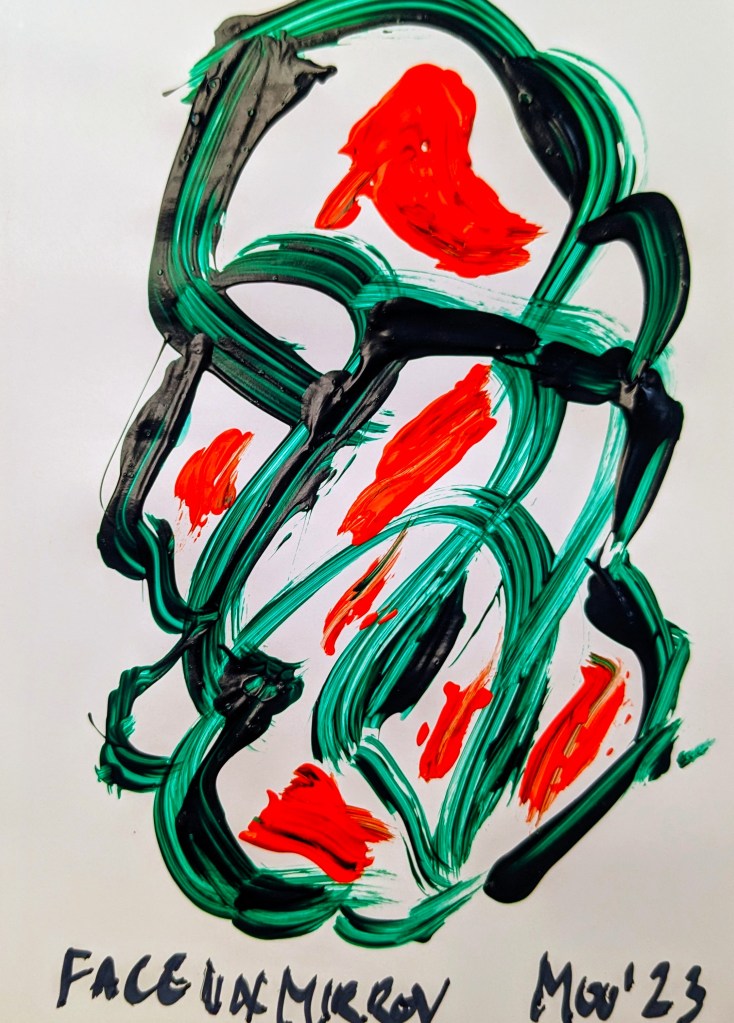
I wouldn’t. Why should I? I might give them a self-portrait, or a painting of me, by my friend Moo. Or I might give them a poem or a book of poems or short stories. That way they could see me for themselves or read about me and make a decision about me that way.

“Ah, would some power the giftie gie us, to see our selves as others see us.” Robbie Burns, if I remember correctly. For those who don’t follow the Scottish accent – the giftie gie us = give us the gift. I don’t have that gift. What I see in the mirror when I shave is not the same as what people see when they look at me with their own eyes or, with their own ears and minds when they read my words or hear me read.

Meanwhile – I invite you to read this. There’s a little bit of me in there somewhere. If you can find it before it floats away down the plug-hole.

Self-Portrait

I smell. I whiff. I gloriously stink.
My arms, my feet, my crotch, reek with beauty.
This is me. I am still alive. I’m rank.
The time has come, the Walrus said, to take
a shower. I strip. I weigh. I obey.

Hot water streams. Bathroom steams up. I draw
faces on grey glass, smiling, glum. Soft soap
works its miracle turning Japanese
nylon into a rough body cloth that
rubs and cajoles all putrid dirt away.

Butterfly from its chrysalis, I step
from the shower, sniff with caution, and stench
no more. I am clean. I no longer pong. 
My body has been taken over by
perfumes no longer mine. Who am I now?

I am no more myself. I am no more
my own gorgeous underarm muscular
ripeness. I have left my odor circling
in the soap suds and drifting down the drain. 
What a pain. It will take me a week or 
more to start smelling like myself again.

If you could bring back one dinosaur, which one would it be?

Daily writing prompt
If you could bring back one dinosaur, which one would it be?

If you could bring back one dinosaur, which one would it be?

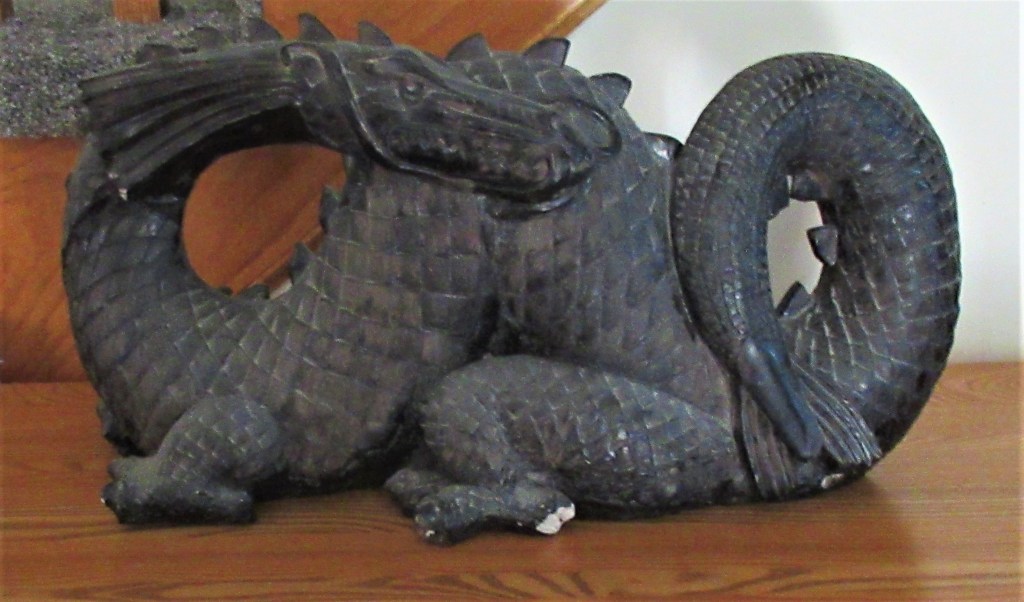
Probably my maternal grandfather. He was always a bit of a fossil, ostrich-like, with his head buried in the past. A great-story teller, he spun a web of intrigue about things that happened in his youth, like when he ran away to sea, age 12, Swansea in the old days, and his time in the trenches during WWI. I would climb up the back of his chair while he was sleeping, and blow on the bald spot at the back of his head to wake him up. Then I would climb onto his lap and say, “Grandpa, tell me a story.” And he would.

My friend Moo painted a picture of the two of us together when I was younger. That’s him, on the left. I am the smaller one on the right. He would walk with me all over Swansea Sands, telling me stories as we walked. “This is where the medicine man would pitch his stall,” he’d say. Then he would tell me about the fraudulent way the doctor sold his bottles of cough mix. A miner, with no voice would approach from the crowd. One sip of the magic potion and he’d be singing hymns and arias, voice fully restored. “Bribed, of course,” Grandpa would tell me.

Next to the snake medicine stall, a travelling dentist would pitch a stage with a small brass band and his chair. Patients would handover their three penny coins, the band would start to play, the patient would open his mouth, the dentist would wield his pliers, and out would come the tooth. Then doctor and patient would dance to the band music until the patient stopped screaming. “No anesthetic back then, see,” Grandpa would chuckle.

Oh yes, that’s the dinosaur I’d bring back. And I’d record his voice, and write down, in full detail, every story, each tall, or short, tale he told me.

If you won two free plane tickets, where would you go?

Daily writing prompt
If you won two free plane tickets, where would you go?

If you won two free plane tickets, where would you go?

Wrong question – because I wouldn’t go anywhere. Now, I’ll ask the right question: If I won two free plane tickets, what would I do with them? That I can answer.

I am no longer a willing traveler. Even a trip into town to go shopping is too much some days. So, I wouldn’t use them, but I would look for someone who could. But before that, a question – are these single tickets – you go there and have to stay there or else pay your own way home? Or are they return tickets, there and back and again, or as they say in Spain, ida y vuelta? If they are the former, I have a couple of people in mind that I would bundle off to the other end of the planet and leave them there, stranded. If they were return tickets, then other options are family.

My Canadian family: a free trip home during these difficult financial times would be excellent. I guess that would be my first choice. But I have family in faraway place, with strange sounding names, and maybe my Australian family would enjoy a trip to Canada to visit me. Or else a trip back home to Wales where there’s always a welcome for the prodigals that return. And what if the family weren’t interested?

Then I would advertise the tickets for a local family that needed free travel for health purposes or family visits. If nobody came forward, I would raffle them or auction them, and give the proceeds to one of my favorite charities, the women’s shelter or the local food bank.

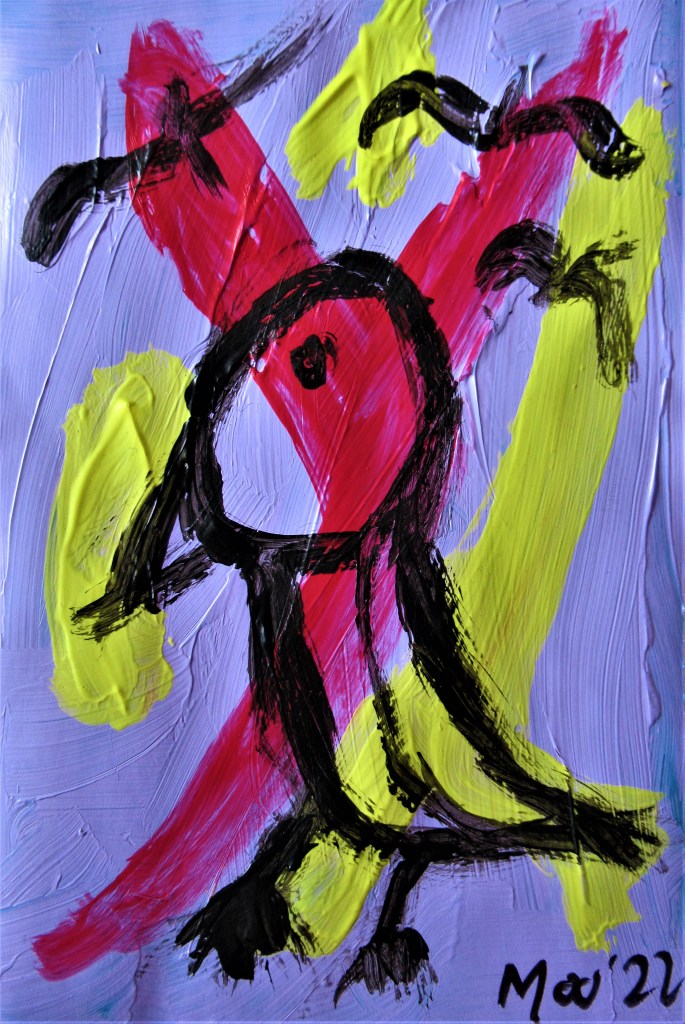
And there you have it. Meanwhile, courtesy of Moo, my favorite artist, the little green man goes sailing through the air in the painting above, flying into the sunset, and enjoying every minute of it.

What’s the story behind your nickname?

Daily writing prompt
What’s the story behind your nickname?

What’s the story behind your nickname?

A long time ago, while Franco was still alive, we lived in Spain, where I was researching my doctoral thesis. Our two bedroom apartment did not have washing facilities for dirty clothes other than a hand wash in the basin and a pegging out on a clothes line outside the bathroom window, that gave on to an inner courtyard. A very good friend suggested we take our dirty washing to her local laundry. The custom in Spain, at that time, was to print in black ink as much of the name of the customer on each item of clothing as was necessary for the clothes to be recognized.

We handed our dirty washing over early one morning and the receptionist told us it would be ready later that afternoon. When we returned, a neatly wrapped parcel of brownish-pink paper, all tied up with colored string, awaited us. We paid our laundry bill, picked up the parcel, and carried it home.

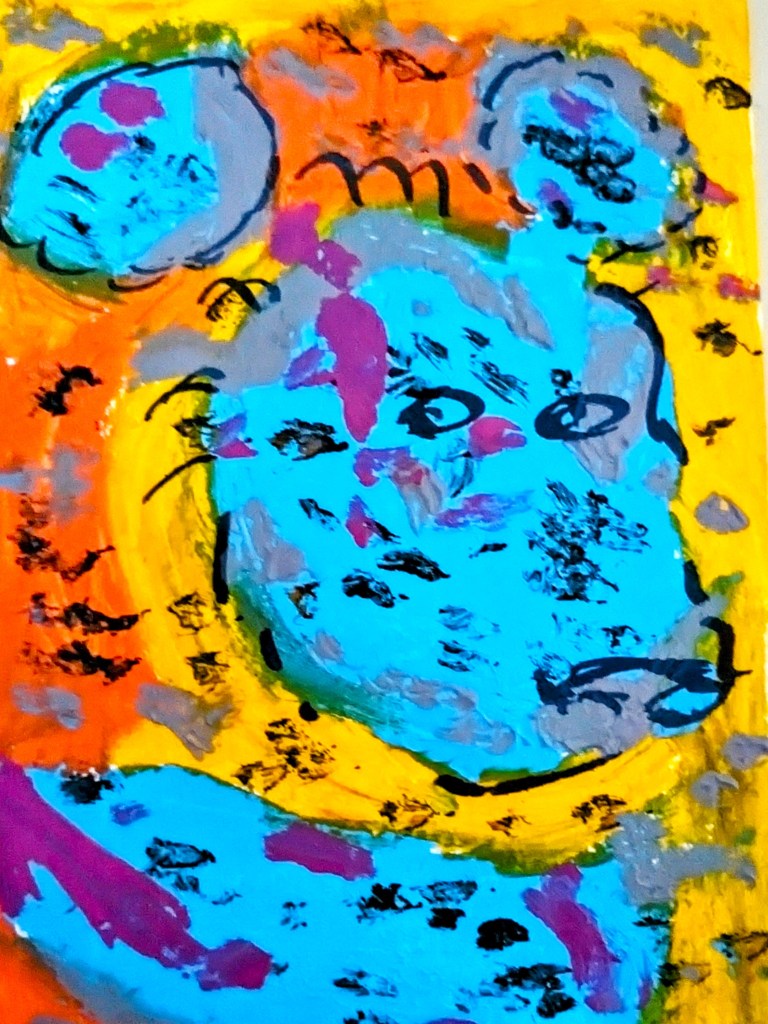
When we got there Clare opened the parcel. Everything smelt clean and the clothes, hers and mine, positively glowed. They were all very carefully folded. Clare picked up the top item, a pair of my Y-front underpants, held it up, and started to laugh. When I asked her why she was laughing, she pointed to the three black letters that distinguished our clothing from anybody else’s in that city – MOO. “Oh Moo,!” she said. And I have been called Moo ever since. And that s why my paintings bear that name – Moo. Oh yes, the above painting is a self-portrait of Moo. Look closely and you may just be able to see him in there. Clare, by the way, is now known, within our family, as Mrs. Moo.

PS – Please don’t tell this story to anyone else. We wouldn’t want everyone to know about it.

Listen!

Listen

When I cannot write,
I take a paint brush,
and start to paint.

When I paint, I listen
to the brush as it moves
itself over the canvas.
I listen to the colors
as they demand attention
and tell me where to place them.

I listen to the paint as it says
‘just here, not too thick,
not too thin, a swirl please,
gently now.”

I also listen to flowers, trees,
the wind in the willows,
the songs of falling leaves,
and the voices of birds
that mourn their empty nests,
abandoned on the branches.

Comment:

This poem also came from yesterday’s prompt – what do you listen to? The act of ranting, based on a prompt, usually generates imagery and ideas that can then be used in either poetry or prose. For me, the secret is to cut away the dross and to search for the gems that are often hidden within verbal outpour. This leads, in my opinion, to enhanced creativity.

Voices

Voices

I forced my characters
into the roles that I chose for them.
Sometimes they complained
and refused to obey me.

Late one night, they came
and knocked on the window
that opens in my head when I dream.

They started to complain
about how I was treating them
and demanded that I change my ways.

I listened as they yapped, and yammered,
and strewed their growing pains
on the counterpane before me.

When I woke up, I remembered
what they had told me and I wrote
down their stories in their words, not mine.
Then they came to life and spoke through me.

Comment:
This poem and the next one both came from yesterday’s prompt – what do you listen to? The act of ranting, based on a prompt, often generates imagery that can then be used in either poetry or prose. The secret is to cut away the dross and find the gems that are often hidden within the rant. This leads, in my opinion, to enhanced creativity.

What do you listen to while you work?

Daily writing prompt
What do you listen to while you work?

What do you listen to while you work?

While I was actually working, although I never called it work, because I thought of it as a vocation, I listened to the complaints of the administration (often about my way of work). I also listened to my students (all too often their complaints about the system and the way they were being taught and treated). And then I listened to the problems that were daily laid before me in my office by these same students. These, problems and students, were many and varied. One day, I designed a label for my door that announced: Office of Creative Solutions. And yes, I provided many innovative and creative solutions to problems that, to young people, especially my students, seemed almost impossible to resolve.

Then I retired. At least, like an ageing horse, or an unwanted donkey, I was put out to grass. And in that clover-filled meadow, I grazed at leisure and worked no more. But I did have time to write and so I became a creative writer. At first, when I started creative writing, I forced my characters into the roles that I had chosen for them. Sometimes they complained. Then, one day, or maybe it was one night when I was dreaming, a host of my characters, minor and major, came knocking on my door. They carried a big arrow that had, written upon it, Office of Creative Solutions. They pointed it at me and began to complain about how I was treating them. I remembered the poem I had memorized as a child – The owl, he was a wise old bird, the more he spoke, the less he heard. The less he spoke, the more he heard. There never was such a wise old bird.

I remembered how I had listened to my students and how, by listening, I managed to find creative solutions to their problems. So, I listened to those characters as they yammered away. One by one, they told me their woes, and their problems. Then, the following day, I rewrote everything I had written previously and wrote the stories down in their own words, instead of mine. When I listened to them, I allowed my characters to tell their own stories, and to speak for me and through me.

Sometimes, when I run out of voices that come in the night and tell me what to say, I cannot write. Then I take a paint brush, and I start to paint. What do I listen to when I paint? I listen to the brush as it moves itself over the canvas. I listen to the colors as they demand attention and tell me where to place them. I listen to the paint as it says ‘just here, not too thick, not too thin, a swirl please, gently now.”

Now, when I am not working, I listen to flowers, trees, the wind in the willows, the songs of the falling leaves, and the voices of birds.